
U.S. Import Duties: How to Calculate Your Landed Cost
U.S. import duties are taxes assessed on goods entering the United States, determined by the item’s 10-digit Harmonized Tariff Schedule (HTS) code, country of origin, and the full stack of applicable tariff authorities — base MFN rate, Section 301 China lists, Section 232 national security duties, and mandatory fees like the Merchandise Processing Fee (MPF) and Harbor Maintenance Fee (HMF). The number on your commercial invoice is not your landed cost. It is the starting point.
Three things to do right now:
- Identify your 10-digit HTS code using the USITC HTS database — the official source for base duty rates on all U.S. imports.
- Run a tariff simulator to estimate your full duty stack, including Section 301 and Section 232 layers, MPF, HMF, and broker fees.
- Contact a licensed customs broker if your product’s classification is ambiguous, your supplier is in China, or your shipment value exceeds $2,500.
When to handle entry yourself versus calling a broker:
- DIY informal entry works for shipments under $2,500 with a clear HTS code, a single country of origin, and no Section 301 or AD/CVD exposure.
- Call a broker when the shipment exceeds $2,500 (formal entry required), involves goods from China or other high-tariff origins, has a disputed or complex HTS classification, or carries forced-labor risk flags.
- Call a broker immediately if CBP issues an exam notice, a detain-and-inspect order, or a Withhold Release Order (WRO) applies to your product category.
Pro Tip: When your product’s classification is genuinely ambiguous — two HTS codes seem plausible, or a small material difference might shift the rate — request a Binding Ruling from CBP before the shipment departs. A Binding Ruling locks in the classification and protects you from post-entry reassessment.
Key Takeaways
Accurate U.S. import duty calculation requires the correct 10-digit HTS code, full customs value including freight and insurance, and every applicable tariff layer — base MFN, Section 301, Section 232, MPF, and HMF — before you can arrive at a reliable landed cost.
| Point | Details |
|---|---|
| Classify first | Identify the 10-digit HTS code at hts.usitc.gov before placing a purchase order. |
| Calculate full landed cost | Add MPF, HMF, and broker fees to your duty figure. |
| Check all tariff layers | Section 301, Section 232, and IEEPA duties stack on top of the MFN base rate — verify each for your HTS code and origin. |
| Evaluate exemptions | USMCA, duty drawback, and bonded warehousing can reduce or defer duty for qualifying importers. |
| Maintain records by SKU | Keep classification rationale, supplier declarations, and entry documents for five years per CBP requirements. |
| Usiship | Usiship provides licensed customs brokerage, HTS classification support, and landed-cost estimates to manage duty exposure end to end. |
Table of Contents
- What are the different types of U.S. import duties?
- How does HTS classification determine what you owe?
- How to calculate import duties: a worked example
- What fees come on top of the duty itself?
- How does the customs entry process work?
- What programs can legally reduce or defer your duties?
- Where can you look up current duty rates and run estimates?
- What are the compliance risks and penalties for getting it wrong?
- What does the 2026 tariff environment actually look like?
- A logistics provider’s perspective on import duties
- What importers consistently get wrong about duties
- Usiship handles customs clearance so you can focus on your business
- Sources
What are the different types of U.S. import duties?
U.S. import duties are not a single rate. They are a legal stack, and multiple layers can apply to the same shipment simultaneously. Understanding which authorities are in play for your product is the first step toward an accurate landed-cost estimate.
The base HTS (MFN) duty
Every product imported into the United States carries a base duty rate under the Most Favored Nation (MFN) column of the HTS. This is the default rate applied to goods from countries that have normal trade relations with the U.S. MFN rates range from 0% on many industrial inputs to 37.5% on certain footwear categories. For most products from most countries, this is the floor — not the ceiling.
Section 232 (national security)
Section 232 of the Trade Expansion Act of 1962 authorizes the president to impose tariffs when imports threaten national security. Steel and aluminum are the most prominent examples. Tariff Overview](https://www.cbp.gov/sites/default/files/2026-02/U.S. Tariff Overview February 2026_0.pdf). Section 232 duties on steel and aluminum have been extended and modified multiple times, with effective rates on those categories reaching approximately 40.9% when stacked with other applicable duties.
Section 301 (China-origin goods)
Section 301 of the Trade Act of 1974 allows USTR to respond to unfair trade practices. The China-specific lists — Lists 1 through 4B — impose additional duties of 7.5% to 25% (and in some cases higher) on thousands of HTS codes for goods manufactured in China. These stack on top of the MFN base rate. If your supplier is in China, assume Section 301 applies until you verify otherwise.
IEEPA and reciprocal tariffs
The International Emergency Economic Powers Act (IEEPA) has been used to impose across-the-board reciprocal tariffs on imports from multiple countries. Executive and USTR notices — including recent White House actions on specific product categories — can add new layers or grant exemptions with limited notice. These are the most volatile part of the tariff stack in 2026.
Antidumping and countervailing duties (AD/CVD)
AD/CVD orders are product- and country-specific and can be substantial — sometimes exceeding 200% of the customs value. They are administered by the Department of Commerce and enforced by CBP. Most tariff simulators do not model AD/CVD, so you must check the CBP AD/CVD portal separately.
Forced-labor restrictions
CBP enforces Section 307 of the Tariff Act of 1930, which prohibits importing goods made with forced labor. Withhold Release Orders (WROs) and findings apply to specific companies and regions — most notably Xinjiang, China. Goods caught under a WRO face detention or exclusion regardless of duty payment.
Excise taxes
Certain product categories — alcohol, tobacco, gasoline, and some chemicals — carry federal excise taxes collected at entry in addition to customs duties. These are separate from HTS-based duties and calculated differently.
| Tariff authority | Legal basis | Typical rate range | Common product targets |
|---|---|---|---|
| MFN base duty | HTS / Trade Act | 0%–37.5% | All goods |
| Section 232 | Trade Expansion Act §232 | 25% (steel); 10%–25% (aluminum) | Steel, aluminum, autos |
| Section 301 | Trade Act §301 | 7.5%–25%+ | China-origin manufactured goods |
| IEEPA / reciprocal | IEEPA | Varies by country | Broad country-specific lists |
| AD/CVD | Tariff Act | Varies widely (can exceed 200%) | Dumped or subsidized goods |
| Forced-labor (§307) | Tariff Act §307 | Exclusion/detention | Xinjiang-linked goods |
| Excise tax | Internal Revenue Code | Product-specific | Alcohol, tobacco, fuel |
The key takeaway from this stack: a single shipment of steel pipe fittings from China could face MFN duty, Section 232, Section 301 List 3, and MPF — all at once. Knowing which layers apply before you place a purchase order is not optional.
How does HTS classification determine what you owe?
The 10-digit HTS code is the single most consequential number in your import transaction. Get it wrong and you either overpay or face post-entry penalties. CBP makes the final classification determination, but you — or your broker — declare the code on entry.
Finding your HTS code step by step
- Start at hts.usitc.gov. Use the search bar with a plain-English product description. Try multiple terms: “cotton t-shirt,” “knit shirt,” “men’s woven top” can all return different results.
- Navigate the chapter structure. The HTS is organized into 99 chapters. Chapter 61 covers knitted apparel; Chapter 62 covers woven. Knowing which chapter applies narrows your search quickly.
- Drill to the 10-digit level. The first six digits are the international HS code. Digits 7–8 are the U.S. statistical suffix. Digits 9–10 are the U.S.-specific tariff line. The duty rate appears at the 10-digit level.
- Check the General Notes. Notes at the chapter and section level can modify rates, exclude certain materials, or apply special rules. Skipping them is a common source of misclassification.
- Verify the rate column. The HTS shows “General” (MFN), “Special” (preferential/FTA), and “Column 2” (non-MFN countries). Confirm which column applies to your country of origin.
When classification gets complicated
Small product details change duty rates more than most importers expect. A backpack made of textile fabric falls under a different HTS code than one made of leather — and the duty rates differ substantially. A power tool with a motor above a certain wattage threshold shifts chapters entirely.
Pro Tip: Keep your supplier’s specification sheet — materials composition, construction method, end use, and technical specifications — in your import file. CBP can request it during examination, and it is the primary evidence supporting your declared classification.
When you cannot resolve classification confidently, two paths exist. First, a licensed customs broker with category expertise can give you a defensible opinion. Second, CBP’s Binding Ruling program lets you submit a product description and receive a written ruling that CBP is bound to honor at entry. Rulings take time — typically 30 days — but they eliminate post-clearance reclassification risk on repeat imports of the same product.
- Binding Rulings are public and searchable in CBP’s CROSS database, so you can often find a prior ruling on a similar product before filing your own request.
- A ruling applies to the specific product and importer described — it does not automatically extend to a modified product or a different supplier’s version.
- If a ruling is issued and CBP later changes its position, they must give notice before applying the new classification prospectively.
How to calculate import duties: a worked example
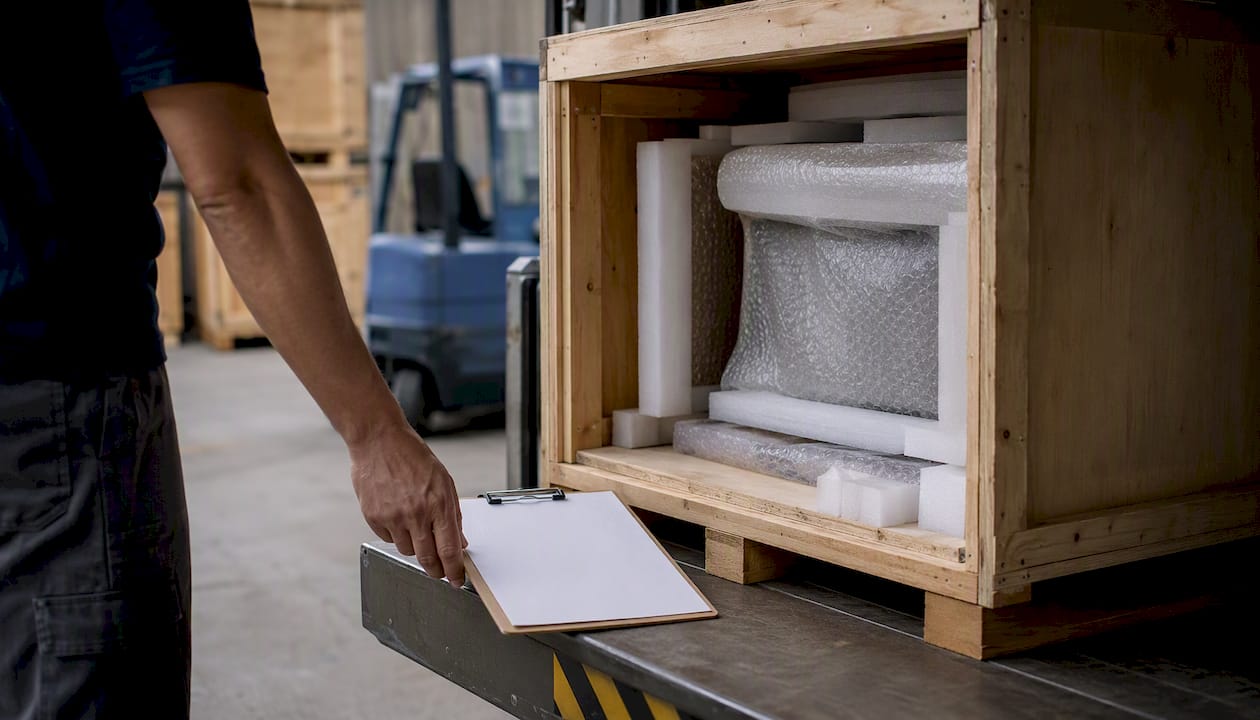
Customs value is the foundation of every duty calculation. The U.S. uses transaction value as the primary method — the price actually paid or payable for the goods when sold for export to the United States. Freight and insurance are added to arrive at the CIF (Cost, Insurance, Freight) value, which is the customs value basis CBP uses.
Ad valorem vs. specific duties
Most HTS duties are ad valorem: a percentage of the customs value. Some categories use specific duties: a fixed amount per unit of measure (e.g., $0.20 per kilogram). A few use a combination of both. The HTS entry tells you which applies.
Worked example: electronics from China
Assume you are importing 500 units of a USB hub (HTS 8473.30.51) from a Chinese manufacturer.
The duty alone is $4,068.75 — but the true addition to your cost is $4,320.46 once you include MPF, HMF, and broker fees.
This is the gap Trade flags directly: duty is only one component of landed cost, and importers who plan around the HTS rate alone routinely underestimate their total cost of goods.
Supplier data checklist before you calculate
- Commercial invoice (price, currency, Incoterms, seller/buyer details)
- Country of origin (not country of shipment — these differ for transshipped goods)
- Bill of materials or product specification sheet
- Freight quote (ocean, air, or land) and insurance cost
- Any applicable FTA certificates or preferential origin documentation
- Supplier’s confirmation of no forced-labor exposure for Xinjiang-linked inputs
What fees come on top of the duty itself?
Duty gets the attention, but the fees that accompany it are mandatory and non-negotiable. Budget for all of them.
For informal entries (under $2,500), a flat fee applies. MPF is assessed per entry, not per shipment — consolidating multiple purchase orders into one entry can reduce MPF exposure.
Air and land shipments are exempt. HMF has no cap.
Customs bond: Formal entries require a customs bond. A single-entry bond is purchased per shipment; a continuous bond (typically around $500–$600 per year) covers all entries and is cost-effective for importers with more than a handful of shipments annually.
Broker fees: A licensed customs broker charges an entry fee (typically $75–$200 per entry for standard shipments) plus ancillary fees for document handling, ISF filing, and exam coordination. These are not government fees — they vary by broker and shipment complexity.
Excise taxes: Collected at entry for alcohol, tobacco, and certain other goods. Calculated separately from HTS duties and paid to CBP on behalf of the IRS.
State and local sales/use tax: Not collected at the federal border. States assess use tax on imported goods separately, and the rules vary by state. CBP does not collect state taxes.
Pro Tip: Freight carriers and forwarders often quote “brokerage estimates” that reflect their own fee schedules, not the actual MPF and HMF your entry will generate. Always calculate MPF and HMF yourself using the formulas above and add them to any carrier-provided landed-cost estimate.
How does the customs entry process work?
Customs clearance in the United States runs through CBP’s Automated Commercial Environment (ACE) system. Every formal commercial entry is filed electronically through ACE — either by a licensed customs broker or, less commonly, by a self-filer with ACE access.
Entry types
- Informal entry: For shipments valued under $2,500. Simpler documentation, lower fees, no bond required. CBP processes most informal entries quickly, often within hours.
- Formal entry (Type 01): Required for commercial shipments over $2,500. Requires a customs bond, full documentation, and ACE filing. This is the standard for most business imports.
- Immediate Delivery (Type 11): Allows release of goods before duty payment, used for time-sensitive cargo like perishables or air freight. Duty is paid within 10 working days.
- Warehouse entry (Type 21): Goods enter a bonded warehouse; duty is deferred until withdrawal. Useful for inventory management and cash flow.
Required documents
- Commercial invoice (price, description, country of origin, buyer/seller details)
- Packing list (quantities, weights, dimensions)
- Bill of lading (ocean) or air waybill (air)
- Arrival notice from the carrier
- ISF (Importer Security Filing) — required for ocean shipments, filed 24 hours before vessel departure from origin
- Certificate of origin or FTA preference claim (when applicable)
- Any required permits, licenses, or agency release (FDA, USDA, EPA, FCC — product-dependent)
Typical timeline
- Day 1: Cargo arrives at port; entry filed in ACE (or pre-filed up to 5 days before arrival).
- Days 1–3: CBP reviews entry; most low-risk entries receive “Release” status within 24–48 hours.
- Days 1–5: If CBP selects the shipment for examination (physical or document review), release is delayed. Exam costs — including terminal fees and devanning — fall on the importer.
- After release: Duty payment is due within 10 working days of entry summary filing.
- Liquidation: CBP has up to one year from entry to “liquidate” (finalize) the entry. If CBP disagrees with your declared value or classification, a liquidation adjustment can result in additional duty owed — or a refund.
Common delay triggers include misclassification flags, missing or inconsistent country-of-origin documentation, forced-labor WRO matches on the product or supplier, and incomplete ISF filings. An ISF filed late carries a $5,000 penalty per violation.
What programs can legally reduce or defer your duties?
Several legal programs let importers reduce, defer, or recover duties. Each has qualification requirements and administrative overhead — the question is whether the savings justify the effort for your volume and product type.
De minimis (Section 321)
The de minimis exemption historically allowed goods valued at $800 or less to enter the U.S. duty-free and without a formal entry. That changed materially in 2025. De minimis ended for Chinese-origin goods on May 2, 2025, and the broader Section 321 exemption was eliminated for all origins on August 29, 2025. As of 2026, parcels that previously entered duty-free under de minimis now require formal entry and pay applicable duties. For e-commerce importers who built their model around Section 321, this is a fundamental cost-structure change.
USMCA and other FTAs
The United States has free trade agreements with 20 countries. USMCA (covering Canada and Mexico) is the most commercially significant. To claim preferential (zero or reduced) duty under USMCA, goods must meet the agreement’s rules of origin — typically requiring sufficient regional value content or a tariff shift from non-originating inputs. The importer must have a valid certification of origin from the producer or exporter at the time of entry claim. Trade.gov’s FTA resources list the agreements and their origin rules by product.
Duty drawback
Manufacturing drawback applies when imported materials are used to produce exported goods. Unused merchandise drawback applies when goods are exported in the same condition as imported. The application process runs through CBP’s Drawback Center and requires detailed records linking import entries to export transactions. For high-volume importers with significant export activity, drawback can recover substantial sums — but the recordkeeping burden is real.
Foreign Trade Zones (FTZs) and bonded warehouses
FTZs are CBP-designated areas where goods can be stored, manipulated, or manufactured without paying duty until they enter U.S. commerce. Duty is paid only on the finished product (and at the rate applicable to the finished product, which can be lower than the rate on components). Bonded warehouses defer duty payment until goods are withdrawn for consumption — useful for managing cash flow on large inventory positions.
FTZ admission makes sense for importers with predictable, high-volume inventory turns and a port near an active FTZ — the setup cost is non-trivial for occasional importers.*
Where can you look up current duty rates and run estimates?
Tariff rates in 2026 move faster than most internal spreadsheets can track. Use official sources for the authoritative rate and simulators for quick estimates — but always verify the simulator’s output against the official HTS before committing to a landed-cost figure.
Official sources:
- Hts: The authoritative source for base duty rates, statistical suffixes, and special rate columns. Updated when USITC publishes revisions. Always start here.
- CBP Tariff Overview: CBP’s published summary of current tariff authorities — Section 232, IEEPA, product-specific rates, and exemptions. Use it to confirm which additional layers apply to your product.
- USTR notices and Federal Register: USTR publishes Section 301 list modifications, exclusion grants, and new tariff actions. Subscribe to Federal Register alerts for your HTS chapters if you import from China.
Practical simulators:
- WarehousingCosts.com Import Duty Calculator: Models HTS base duty, Section 301 China tariffs, MPF, HMF, and broker fees. Useful for quick landed-cost estimates. Does not model AD/CVD or every IEEPA layer — treat output as an estimate, not a filing position.
- Flexport Tariff Simulator: Models duty stacks for common HTS codes and trade lanes, with periodic updates for policy changes. Useful for scenario planning across multiple origin countries.
- DHL’s import duty guide and tools: Provides country-specific duty and tax estimates for parcel-level imports; most useful for lower-value B2C shipments.
Pro Tip: Run your HTS code through hts.usitc.gov first, then cross-check the rate a simulator returns against that official entry. If they differ, the USITC rate governs — simulators sometimes lag policy changes by days or weeks, which matters when USTR modifies a list mid-quarter.
What are the compliance risks and penalties for getting it wrong?
CBP has broad authority to assess penalties, seize goods, and conduct post-entry audits. The consequences of errors scale with whether the mistake was negligent, grossly negligent, or fraudulent.
Top compliance risks:
- Incorrect HTS classification: The most common error. Penalties under 19 U.S.C. §1592 range from 20% of the unpaid duty (negligence) to the full domestic value of the goods (fraud). CBP can go back four years on unliquidated entries.
- Country-of-origin misrepresentation: Declaring a third-country origin to avoid Section 301 or AD/CVD duties is customs fraud. CBP and ICE actively investigate transshipment schemes, particularly through Vietnam, Malaysia, and Mexico for China-origin goods.
- Undervaluation: Declaring a customs value below the actual transaction value — including related-party transfer pricing that does not meet arm’s-length standards — triggers penalty exposure and potential seizure.
- Missing certificates and permits: FDA prior notice, USDA permits, FCC declarations, and EPA certifications are required for specific product categories. Goods arriving without required agency clearance are held until the issue resolves — at the importer’s expense.
- Forced-labor WRO exposure: If your product or any input in your supply chain is linked to a Withhold Release Order or finding, CBP can detain the shipment. The burden of proof to rebut a forced-labor presumption falls on the importer, and it is a high bar.
Recordkeeping: CBP requires importers to retain entry records for five years from the date of entry. That includes commercial invoices, packing lists, bills of lading, classification worksheets, and any supplier declarations or test reports supporting your HTS code and origin claim.
Pro Tip: Build an audit folder per SKU — not per shipment. Store the supplier’s material declaration, any test reports, your classification rationale, and the HTS ruling or broker opinion in one place. When CBP issues a CF-28 (Request for Information) or CF-29 (Notice of Action) on a post-entry review, having that folder ready cuts response time from weeks to days.
What does the 2026 tariff environment actually look like?
The numbers tell a stark story. According to Penn Wharton Budget Model data, the average effective U.S. That is a tripling of the effective rate in roughly 18 months — driven by IEEPA reciprocal tariffs, expanded Section 232 coverage, and the elimination of de minimis.
The aggregate figure understates the impact on specific categories. Steel and aluminum face very high effective rates when all applicable layers stack. China-origin goods carry notably elevated effective rates across the board, with individual HTS codes running considerably higher when Section 301 and IEEPA layers combine.
| Category | Approximate effective rate (2026) | Primary driver |
|---|---|---|
| All U.S. imports (average) | 7.1% | IEEPA reciprocal + Section 301 expansion |
| Steel and aluminum | ~40.9% | Section 232 + stacked duties |
| China-origin goods (average) | approximately 24% | Section 301 lists + IEEPA |
| USMCA-qualifying goods | 0%–MFN base | Preferential origin |
For importers, the operational effect is direct: landed costs are higher, cash tied up in duty payments has increased, and the window between a purchase order and a reliable duty estimate has narrowed because policy changes arrive faster than internal tariff tables update. Importers relying on duty rates from even six months ago are likely working with wrong numbers.
The CBP U.S. Tariff Overview and USITC HTS remain the authoritative sources for current rates. Penn Wharton’s model provides the aggregated effective-rate analysis that puts individual product rates in macroeconomic context.
A logistics provider’s perspective on import duties
What importers consistently get wrong about duties
Most importers treat duty as a line item to minimize rather than a system to manage. That framing leads to predictable mistakes: chasing the lowest-duty HTS code without adequate documentation to defend it, skipping FTA qualification because the paperwork feels burdensome, or ignoring drawback because the recovery seems small — until it compounds across 200 shipments a year.
The clients who handle import duties well share one habit: they resolve classification and origin before the purchase order is placed, not after the goods arrive at the port. By the time a container is on the water, your options narrow considerably. You cannot reclassify a product to avoid a duty you did not anticipate; you can only pay it, contest it through protest, or absorb the delay of a CBP examination.
For businesses scaling imports, the broker relationship matters more than most people expect. A good broker does not just file your entry — they flag when a new USTR notice affects your HTS chapter, catch a missing ISF before the vessel departs, and know which CBP ports have faster exam release times for your product category. That operational knowledge is worth more than the entry fee.
Recommendations for importers preparing their first or scaled shipments:
- Confirm your 10-digit HTS code and country of origin with your supplier before the purchase order is finalized.
- Run a full landed-cost estimate — duty, MPF, HMF, broker fee, freight, insurance — before committing to a price with your customer.
- Check CBP’s WRO list and the USTR Section 301 lists for your HTS code and supplier location.
- File ISF at least 48 hours before vessel departure, not the minimum 24 hours — late ISF penalties are $5,000 per violation and entirely avoidable.
- Keep your entry records organized by SKU, not by shipment date. Post-entry audits look at product patterns, not individual transactions.
Usiship handles customs clearance so you can focus on your business
Customs clearance is where landed-cost estimates meet reality — and where errors become expensive. Usiship’s licensed customs brokerage team manages the full entry process: HTS classification support, ACE filing, ISF submission, exam coordination, and duty payment on your behalf. You get a single point of contact from the moment your goods depart origin to the moment they clear CBP.
Services relevant to importers managing duty exposure:
- HTS classification review and Binding Ruling support
- Formal and informal customs entry filing via ACE
- Bonded warehousing and FTZ-adjacent warehousing solutions
- Duty drawback identification and filing coordination
- Landed-cost estimates before purchase order placement
- Integrated freight forwarding — ocean, air, and land — so your duty and freight costs are managed together
Before reaching out, have your commercial invoice, country-of-origin documentation, supplier bill of materials, and intended entry port ready. That information lets Usiship’s team turn around a landed-cost estimate and classification opinion quickly. Contact Usiship to get started.
Sources
- Effective Tariff Rates and Revenues (Updated August 10, 2026) | Penn Wharton Budget Model
- U.S. Tariff Overview (February 2026) | CBP
- Harmonized Tariff Schedule (HTS) — USITC
- Trade
This article provides general informational guidance on U.S. import duties and customs procedures. It is not legal or customs advice. Tariff rates, exemptions, and regulations change frequently — confirm current rules with CBP, USITC, or a licensed customs broker before making import decisions.
This article is general information, not a substitute for advice from a qualified financial advisor. Consult a qualified financial professional about your own circumstances before acting on anything here.