
Fumigation Certificate Requirements for U.S. Shipments
For most U.S. shipments, the thing customs actually checks is not a stand-alone fumigation certificate. It is the ISPM 15 mark stamped on the wood packaging itself. A fumigation certificate becomes the key document only when the cargo or the destination country calls for a treatment record. Knowing which of the two your shipment needs before it leaves the dock is what keeps it from being held, re-exported or rejected. Our freight forwarding and customs brokerage teams work with shippers on exactly this kind of paperwork, and this guide gives you the routine.
TL;DR
- Wood pallets, crates and bracing entering or transiting the U.S. must be pest-free, debarked, heat-treated or fumigated, and carry an ISPM 15 mark. The mark is the proof, not a separate certificate.
- A fumigation certificate records a treatment on the cargo. Whether you need one depends on the importing country’s plant-health rules for your goods and their origin.
- APHIS does not issue a phytosanitary certificate for packaging that only carries cargo. It does when the wood is the cargo.
- Non-compliant wood packaging can be ordered re-exported at the port of first arrival.
- Settle the packaging and paperwork with your forwarder before booking, and put ISPM 15 compliance in the supplier contract.
Table of Contents
- Fumigation certificate, ISPM 15 mark, phytosanitary certificate: three different things
- What the U.S. requires for wood packaging on imports
- When a separate fumigation certificate is required
- What a fumigation certificate should contain
- Who is allowed to treat and certify
- How to prepare a shipment, step by step
- What happens when the mark or certificate is missing
- Perspective
- Getting this handled with your freight
- FAQ
- Sources
Fumigation certificate, ISPM 15 mark, phytosanitary certificate: three different things
These three get mixed up constantly, and the confusion is where most delays start.
A fumigation certificate is a record that a treatment was carried out on a consignment: what was applied, how much, for how long, and when. The company that did the treatment usually issues it.
The ISPM 15 mark is a stamp on the wood itself. ISPM 15 is the international standard for treating wood packaging material (WPM), meaning pallets, crates, boxes and the wood used to support or brace cargo. The mark tells inspectors that the wood was treated by an approved method.
A phytosanitary certificate is a government-issued document certifying that plants or plant products meet the importing country’s pest rules. APHIS, the U.S. Department of Agriculture’s plant health agency, issues it for U.S. exports.
Here is the practical rule from APHIS: it is against its policy to issue a phytosanitary certificate for WPM that only transports commodities, because the ISPM 15 mark does that job. If the wood is itself the cargo, a phytosanitary certificate will be issued.
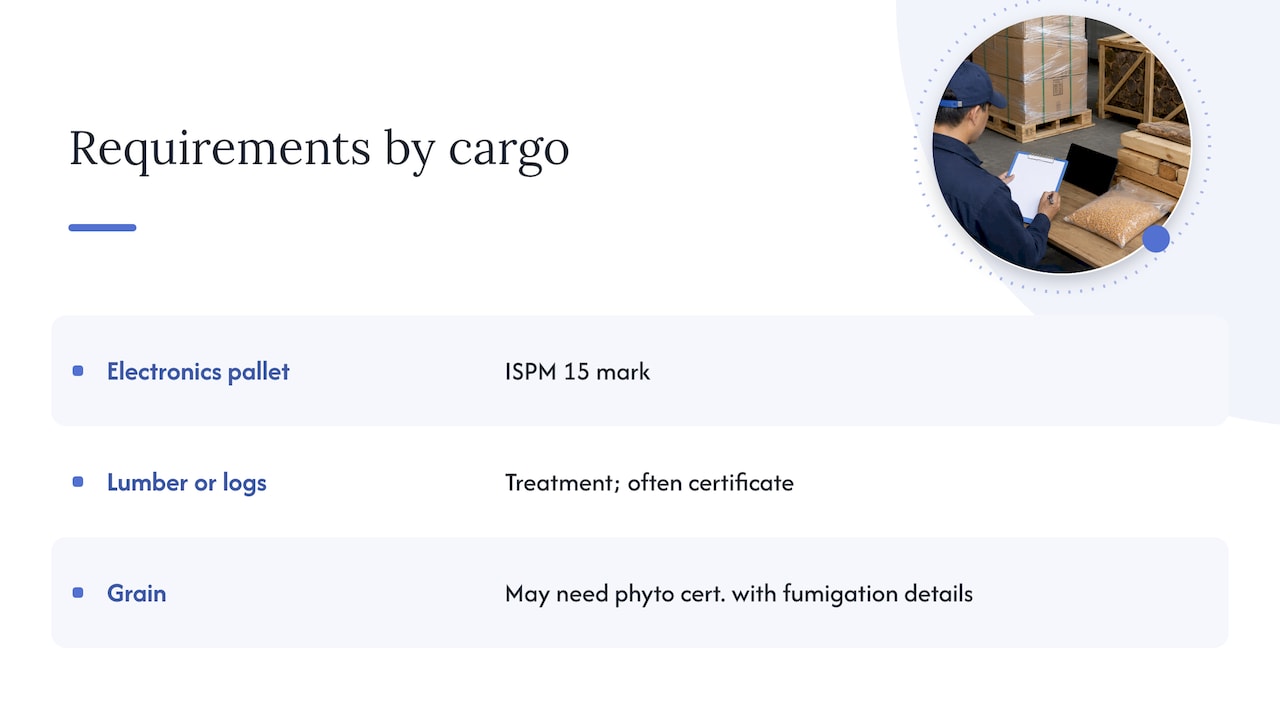
So a pallet of electronics needs the mark. A container of lumber or raw logs needs treatment and often a certificate. A bag of grain may need a phytosanitary certificate with fumigation details inside it.
For the full stamp anatomy, see our guide to ISPM 15 wood packaging rules, stamps and treatments.
What the U.S. requires for wood packaging on imports
U.S. Customs and Border Protection (CBP) and APHIS enforce the same baseline. APHIS requires that all WPM entering or transiting the United States be pest-free, debarked, treated by heat or fumigation, and marked with an ISPM 15 logo. Shipments with non-compliant WPM are not allowed to enter.
Under 7 CFR 319.40-3, regulated WPM can come in under a general permit only if it was treated under 7 CFR part 305 and bears a legible, permanent mark. The mark should preferably appear on at least two opposite sides and must show four elements:
- The IPPC-approved symbol.
- The two-letter ISO country code of the producing country.
- A unique producer number assigned by that country’s national plant protection agency.
- A treatment abbreviation: HT for heat treatment or MB for methyl bromide.
Approved treatments
CBP lists three treatments approved under ISPM 15:
| Treatment | Requirement |
|---|---|
| Heat treatment (HT) | Minimum core temperature of 56°C for at least 30 minutes |
| Methyl bromide fumigation (MB) | Enclosed area for at least 16 hours, followed by aeration |
| Dielectric heating (DH) | Minimum core temperature of 60°C for one continuous minute |
Methyl bromide is being phased out in some countries for environmental reasons but remains approved under the standard. Most suppliers now heat-treat, which is why “HT” is the abbreviation you will see most often on pallets.
What is covered and what is not
CBP says most WPM is covered: pallets, crates, boxes and wood used to support or brace cargo. Manufactured wood materials, loose wood packing materials and pieces under 6 mm thick are excluded. APHIS adds that plywood, pressboard, plastic pallets, oriented strand board, hardboard, parallel strand lumber, synthetic foam and metal frames are not subject to its WPM regulation.
That gives you a simple cost-saving option for many loads: if the cargo can ride on plastic or engineered-wood pallets, the ISPM 15 question largely disappears.
When a separate fumigation certificate is required
A stand-alone fumigation certificate is not a universal requirement. It comes up in three situations.
1. The goods themselves are regulated
Some wood products must be treated and documented as cargo. Under 7 CFR part 319 subpart I, Monterey pine logs from Chile or New Zealand and Douglas-fir logs from New Zealand must be debarked before fumigation and fumigated within 45 days of felling, in the same sealable container or hold used for export, accompanied by a certificate stating the logs meet the requirements.
The same subpart allows wood mulch, humus, compost and litter to be imported if accompanied by an importer document stating the material was fumigated or heat treated. Wood chips and bark chips from certain Asian locations face extra conditions. If you import raw wood or wood-derived material, read this subpart before you buy.
2. The destination country asks for it on agricultural cargo
USDA’s Foreign Agricultural Service publishes country-by-country export certificate reports. Two examples show how specific the demands get:
- Under the 2025 U.S. wheat protocol with Indonesia, if live insects are found at export inspection, the grain must be fumigated in transit with phosphine, with the treatment details stated in the phytosanitary certificate.
- For Peru, products needing fumigation must be treated before shipment with methyl bromide at set dose and temperature schedules, with at least 12 hours of ventilation, or with phosphine at specified doses.
The lesson: the rule lives in the importing country’s regulation, and it is product-specific.
3. Your buyer or letter of credit asks for it
Even where no law demands it, a contract may. If your purchase order or letter of credit lists a fumigation certificate among the required documents, a missing certificate can block payment. Check the document list before you ship, not after.
What a fumigation certificate should contain
The United States does not publish one universal template for the commercial certificate, so content follows the destination’s rules. Australia’s plant export guidance is a useful picture of how strict a destination can be. A licensed fumigator must state the active ingredient, dosage rate, exposure period, treatment temperature, date and a threshold-limit-value (gas-free) statement. Where the importer sets no timeframe, the certificate is valid for 120 days from completion of treatment.
Use that as a checklist when reviewing any certificate you receive:
- Name and license details of the treatment provider
- Date and place of treatment
- Fumigant and dose, exposure time, temperature
- Description and quantity of the goods or packaging treated
- Container or shipment reference numbers matching your bill of lading and packing list
Mismatched quantities or container numbers between the certificate and the other shipping documents are a common reason for a hold. Treat the certificate as one page of a document set that must agree with itself.
Who is allowed to treat and certify
For U.S. wood packaging exports under the methyl bromide program, APHIS states that WPM must be treated by fumigators certified in the program, working under inspection agencies enrolled with the American Lumber Standard Committee (ALSC). Those agencies monitor the fumigations and the marking. The ALSC quality mark may only be applied on WPM, and exporters may buy already-marked WPM on the secondary market.
In practice that means you rarely fumigate pallets yourself. You buy pallets that already carry the mark, or you hire a certified provider, and you confirm the credentials before the treatment, not after.
How to prepare a shipment, step by step
This is the routine, with where each step typically goes wrong and what we take off your hands.
Step 1: Identify what the destination requires
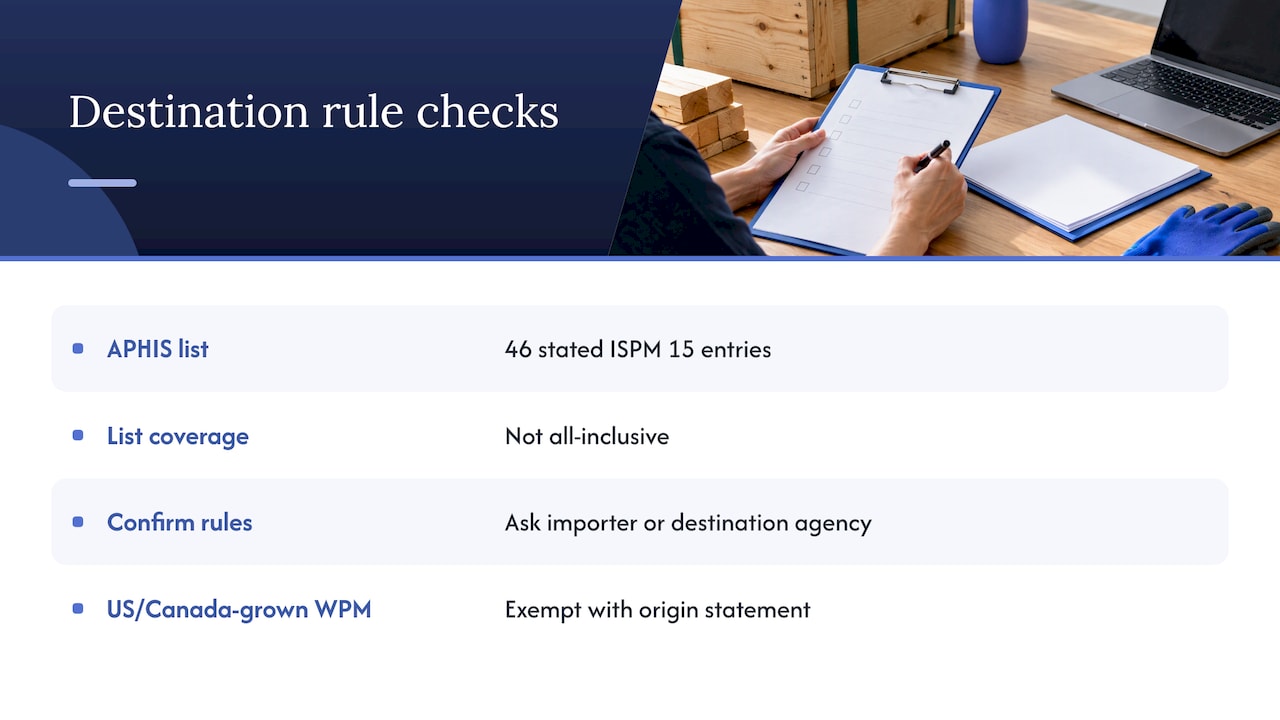
Start with the commodity and the destination country, not the carrier. APHIS lists 46 entries that have stated in writing they require ISPM 15-compliant WPM, including Canada, Mexico, the European Union, the United Kingdom, India, Japan, Australia, Brazil and Vietnam. The list is not all-inclusive, and the exporter is responsible for meeting the destination’s rules.
Where it goes wrong: assuming a country is not on the list, so nothing applies. Confirm with the importer or the destination’s plant protection agency.
There is one notable exemption. WPM made from wood grown in the continental United States or Canada is exempt between the two countries, provided the import documentation carries the statement that the packaging originated in the Continental US or in Canada, as APHIS describes.
Step 2: Decide the packaging before the cargo is built
Choose between marked wood, plastic, or engineered-wood pallets and crates. Switching after the load is built means unstacking it. Our guide to palletizing freight for LTL covers the build itself, and our Specialty Freight Packing Services are listed on our services page for cargo that needs custom crating.
Step 3: Verify the supplier’s compliance on imports
APHIS tells importers to ask their WPM provider whether it is ISPM 15-compliant and accredited, review the certification from the exporting country’s national plant protection organization, and write ISPM 15 compliance into the contract. The exporter should inspect WPM for signs of pests at delivery or before use.
Where it goes wrong: a supplier’s verbal assurance with no mark on the wood. A pallet either carries a legible, permanent mark with the four required elements or it does not.
Step 4: Book the treatment and collect the certificate
If your cargo needs treatment, schedule it ahead of the cut-off date. Fumigation with methyl bromide takes at least 16 hours plus aeration, and some destinations apply time limits to the certificate. Get the certificate in hand before the cargo is gated in.
Step 5: Reconcile the document set
Check the certificate against the commercial invoice, packing list and bill of lading. Quantities, marks and container numbers must match. If a customs power of attorney is involved, see our customs POA compliance checks. Imports also have their own filing deadlines, covered in our ISF 10+2 guide.
This is the step where a single freight forwarder handling transportation and customs brokerage under one roof pays off, because the person booking the freight is also the person reading the paperwork. Our freight forwarding process shows how a shipment moves from quote to delivery.
Step 6: Plan for arrival
On arrival, inspectors look at the wood first. Having the producer number and country code readable on two sides makes inspection fast.
What happens when the mark or certificate is missing
Under 7 CFR 319.40-3(b)(3), an inspector at the port of first arrival may order immediate re-export of regulated WPM imported without the required mark, in addition to or instead of other port-of-arrival procedures. A Department of Defense exception allows DOD packaging of nonregulated articles to enter without the mark.
The cost of a re-export order is the return freight, the replacement packaging, the delay to your customer, and often storage while the problem is sorted. That is why checking before loading beats fixing at the port.
If a shipment is already in this position, contact your forwarder and customs broker immediately so the response is coordinated, and ask whether the cargo can be repacked on compliant material.
Perspective
Most of the fumigation problems we hear about are not really treatment problems. They are planning problems. Someone assumed the pallet was fine, or that one document would cover another, and nobody caught it until the cargo was sitting at a port.
Our approach at Universal Shipping is to treat transportation, warehousing and customs paperwork as one connected process rather than three hand-offs. When freight forwarding, customs brokerage and packing sit on one platform with real-time tracking, a question like “does this load need a treatment record?” gets asked at booking, not at arrival.
For importers and exporters moving wood-packed freight, our advice is short: decide the packaging first, confirm the destination’s rules second, and make every document agree with every other. Do those three things and fumigation stops being a surprise.
Akbar
Getting this handled with your freight
If you ship internationally and want packaging, customs and transport coordinated in one place, our freight forwarding and customs brokerage services cover air, ocean and land freight across all 50 states. If your cargo also needs storage or fulfillment before it moves, our warehousing and fulfillment solutions sit on the same platform, and the pricing page lists what we publish, including pallet storage at 17-19 USD per month per pallet.
Tell us the commodity, the origin and the destination, and we can help you work out the packaging and document set before the booking is made.
FAQ
Do I need a fumigation certificate to ship pallets from the U.S.?
Usually you need the ISPM 15 mark on the wood, not a separate certificate. APHIS does not issue a phytosanitary certificate for packaging that only carries cargo. Check the destination’s rules, because 46 listed entries have stated they require ISPM 15-compliant packaging, and some buyers also request a treatment record by contract.
Who issues a fumigation certificate?
Generally the licensed company that performed the treatment. For U.S. methyl bromide treatment of wood packaging, fumigators must be certified in the program and work under ALSC-enrolled inspection agencies. Phytosanitary certificates for U.S. exports come from APHIS.
Which materials do not need ISPM 15 treatment?
CBP excludes manufactured wood materials, loose wood packing materials and wood pieces under 6 mm thick. APHIS also lists plywood, plastic pallets, OSB, hardboard, synthetic foam and metal frames as outside its WPM regulation.
What happens if my imported pallets have no mark?
An inspector at the port of first arrival may order the regulated wood packaging re-exported. To avoid this, require ISPM 15 compliance in your supplier contract and confirm the mark is legible on at least two sides before loading.
Can I ship wood packaging between the U.S. and Canada without treatment?
Packaging made from wood grown in the continental United States or Canada is exempt, provided the import documentation carries the required origin statement. Confirm the exact wording on the APHIS export page before you ship.
Sources
- APHIS: Import ISPM 15-Compliant Wood Packaging Material into the U.S.
- APHIS: Export ISPM 15-Compliant Wood Packaging Material From the U.S.
- APHIS: Wood Packing Treatment Programs
- APHIS: Wood Packaging Material
- CBP: Wood Packaging Materials
- eCFR: 7 CFR 319.40-3, General permits
- eCFR: 7 CFR Part 319 Subpart I, Logs, Lumber, and Other Wood Articles
- USDA FAS: FAIRS Export Certificate Report, Indonesia 2025
- USDA FAS: FAIRS Export Certificate Report, Peru 2025
- Australian Government: Supporting documents for plant exports