
What U.S. Fulfillment Pricing Actually Costs in 2026
Fulfillment pricing for a domestic direct-to-consumer order runs $8 to $15 all-in, including shipping, based on 2026 industry pricing surveys. Strip out the carrier cost and you’re left with $3.50 to $8.00 per order for the fulfillment-only work: pick, pack, and handling. Here’s the part most quotes bury: shipping and dimensional weight, not warehouse labor, usually decide which end of that range you land on.
That’s the number to anchor on before you read a single vendor’s rate card.
- All-in domestic DTC: a typical range per order
- Fulfillment-only (no shipping): $3.50–$8.00 per order
- Biggest cost lever: carrier rates and dimensional weight, not pick and pack labor
Key Takeaways
Fulfillment pricing runs $8 to $15 per order all-in for domestic DTC brands, and carrier shipping costs, not warehouse labor, decide where you land in that range.
| Point | Details |
|---|---|
| Know your benchmark range | Budget $8–$15 all-in per order, or $3.50–$8.00 for fulfillment-only work, and question quotes far outside that band. |
| Itemize before you sign | Ask every vendor for a sample invoice broken into pick and pack, storage, receiving, and shipping rather than one blended rate. |
| Watch the volume breakpoints | Meaningful discounts typically start around 5,000 orders a month, with further tiers near 25,000 and 100,000. |
| Fix packaging to cut dimensional weight | Right-sizing boxes for your actual SKUs reduces the shipping penalty that drives most of your per-order cost. |
| Consolidate to remove pass-through fees | Universal Shipping Inc. combines freight, warehousing, fulfillment, and customs brokerage on one platform, cutting the handoff fees that appear when separate vendors bill each other. |
Table of Contents
- What Makes Up a Fulfillment Pricing Quote
- How Does Order Volume Change Your Rate?
- Why Shipping Usually Dominates the Bill
- The Fees That Show Up After You Sign
- How to Calculate Your Cost Per Order
- How Universal Shipping Inc. Removes the Guesswork
- Negotiation Levers and Cost-Reduction Tactics
- How Order Profiles Change Your Real Cost
- Where Automation Actually Lowers Your Bill
- In-House Fulfillment vs. Third-Party Logistics Costs
- What SLAs Mean for Your Fulfillment Bill
- Does Fulfillment Center Location Change Your Price?
- What the Benchmarks Actually Tell You
- Get a Fulfillment Cost Audit From Usiship
- Frequently Asked Questions
- Sources
What Makes Up a Fulfillment Pricing Quote
A fulfillment invoice is really five or six separate charges stitched together, and most confusion comes from vendors bundling them differently. Break the quote into its parts and you can actually compare two providers instead of just comparing two lump numbers.
Pick and pack is usually structured in tiers: a charge for the first item in an order, then a smaller per-unit fee for each additional item. The 2026 working midpoint sits around $2.75 for the first item and $0.50 for each additional pick, though published ranges run from $1.50 to $3.50 for that first pick depending on SKU complexity.
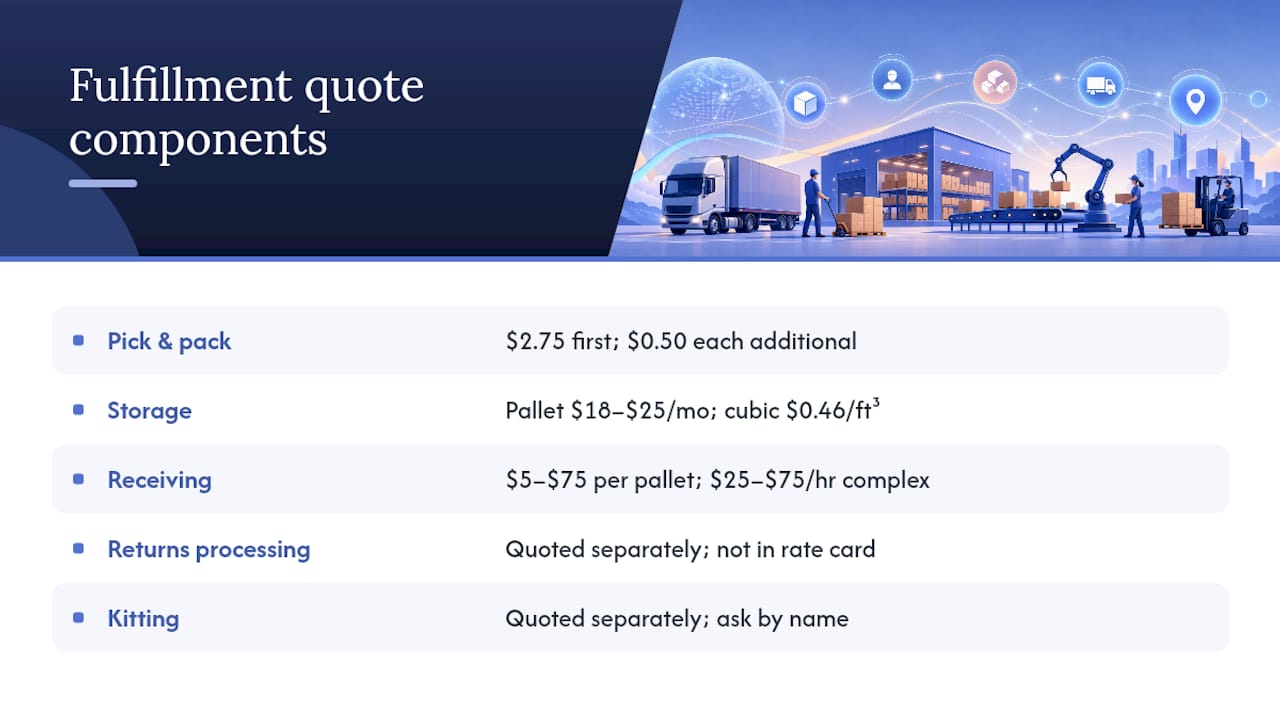
Storage splits into two common billing models. Pallet-based storage averages roughly $18 to $25 per month, with survey data putting the mean closer to $20. Cubic-foot billing, more common for smaller or oddly shaped inventory, runs about $0.46 per cubic foot. Sellers with a handful of SKUs sometimes get bin pricing instead, typically $1 to $5 per bin per month.
Receiving (unloading and checking in inbound inventory) ranges from $5 to $75 per pallet, or $25 to $75 per hour for complex container unloads that need extra labor or inspection.
Returns processing and kitting sit outside the standard rate card in most contracts and get quoted separately, so ask for them by name rather than assuming they’re included.
How Does Order Volume Change Your Rate?
Volume is the single biggest negotiating chip you have, and the pricing bands break at fairly predictable points.
- Under 500 orders/month: Expect higher per-order rates, plus a monthly minimum that can make small-volume fulfillment feel disproportionately expensive.
- 500 to 5,000 orders/month: This is the mid-market band most growing DTC brands fall into, with all-in costs typically landing at $8 to $12 per order.
- 5,000 to 50,000+ orders/month: Enterprise-level discounts kick in here, though some providers add platform or technology fees to offset the lower per-unit rate.
Three breakpoints matter most when you’re negotiating: 5,000 orders a month, where blended-rate proposals become realistic; 25,000, where dedicated account management usually enters the conversation; and 100,000, where custom infrastructure and volume-based carrier rates change the math entirely. If you’re near one of these thresholds, it’s often worth timing a contract renewal to land just past it.
Why Shipping Usually Dominates the Bill
Carrier ground minimums set a hard floor under every parcel you ship, and that floor has been climbing. Reported 2026 carrier ground minimums sit around $11 to $12 per package once general rate increases are factored in, meaning even a featherweight, cheap-to-pick item still carries a shipping cost that can exceed the pick and pack fee itself.
Dimensional weight, where carriers bill based on box size rather than actual weight, is the other silent cost driver. A lightweight but bulky item can get charged as if it weighs far more than it does.
Pro Tip: Ask your fulfillment provider for box-size optimization data on your top 10 SKUs. Switching from an oversized generic box to a properly sized mailer routinely cuts the dimensional-weight penalty without touching the product itself.
- Right-size packaging for your actual SKU dimensions, not a one-box-fits-all default
- Ask for the carrier and fulfillment line items itemized separately, not blended
- Renegotiate carrier rates independently of your fulfillment contract once you hit volume tiers
The Fees That Show Up After You Sign
The headline per-order rate rarely tells the whole story. A handful of recurring add-ons are where budgets quietly blow past projections.
- Account management fees: Flat monthly charges for a dedicated rep, common once you clear the mid-market volume tier.
- Long-term storage surcharges: Extra fees for inventory that sits past 60 or 90 days, separate from standard monthly storage.
- Address correction and dimensional re-bills: Carriers adjust and rebill after the fact when an address is wrong or a box measures larger than declared.
- Peak-season surcharges: Q4 typically brings a per-parcel uplift on top of standard rates, plus tighter inbound receiving windows.
- Inventory removal or exit fees: Charged when you pull stock out or terminate a contract, often overlooked until you’re trying to switch providers.
Ask every prospective vendor for a sample invoice, not just a rate sheet, so you see how these line items actually get billed.
How to Calculate Your Cost Per Order
You don’t need a finance degree to model this. You need six numbers and one formula.
- Gather your inputs: monthly order volume, average line items per order, average units per order, pallets stored, inbound pallets received per month, and your average shipping label cost.
- Amortize fixed costs: Divide monthly account management and minimum fees by your order volume to get a per-order fixed cost.
- Add variable pick and pack: First-item fee plus (additional items × per-unit fee).
- Add storage per order: Monthly pallet or cubic-foot cost divided by orders shipped that month.
- Add shipping: Your average label cost, informed by carrier minimums and dimensional weight.
- Add a returns reserve: Amortize your historical return rate as a small per-order buffer.
Here’s a worked example for a 500-order-per-month DTC brand, showing how fixed fees amortize per order and combined with typical rates for pick and pack, storage, shipping, and returns add up to a total per order cost within the standard benchmark range.
How Universal Shipping Inc. Removes the Guesswork
Most of the hidden cost in fulfillment pricing comes from handoffs: your freight forwarder is one company, your warehouse is another, your customs broker is a third, and every seam between them is a place where a fee can get added without you seeing it coming.
Universal Shipping Inc. runs freight forwarding, warehousing, ecommerce fulfillment, Amazon FBA prep, customs clearance, and last-mile delivery under one platform across all 50 states. That matters practically, not just organizationally.
- One provider means one invoice to audit instead of three vendors’ worth of pass-through markups.
- Real-time tracking across the full chain, from inbound freight to final delivery, cuts the receiving and cross-docking fees that show up when handoffs go undocumented.
- Customs brokerage and fulfillment under the same roof avoids the double-brokerage fees that stack up when importers and 3PLs use separate customs agents.
Consolidation doesn’t eliminate every fee on your invoice, but it removes the ones that exist purely because two separate vendors needed to bill each other.
Negotiation Levers and Cost-Reduction Tactics
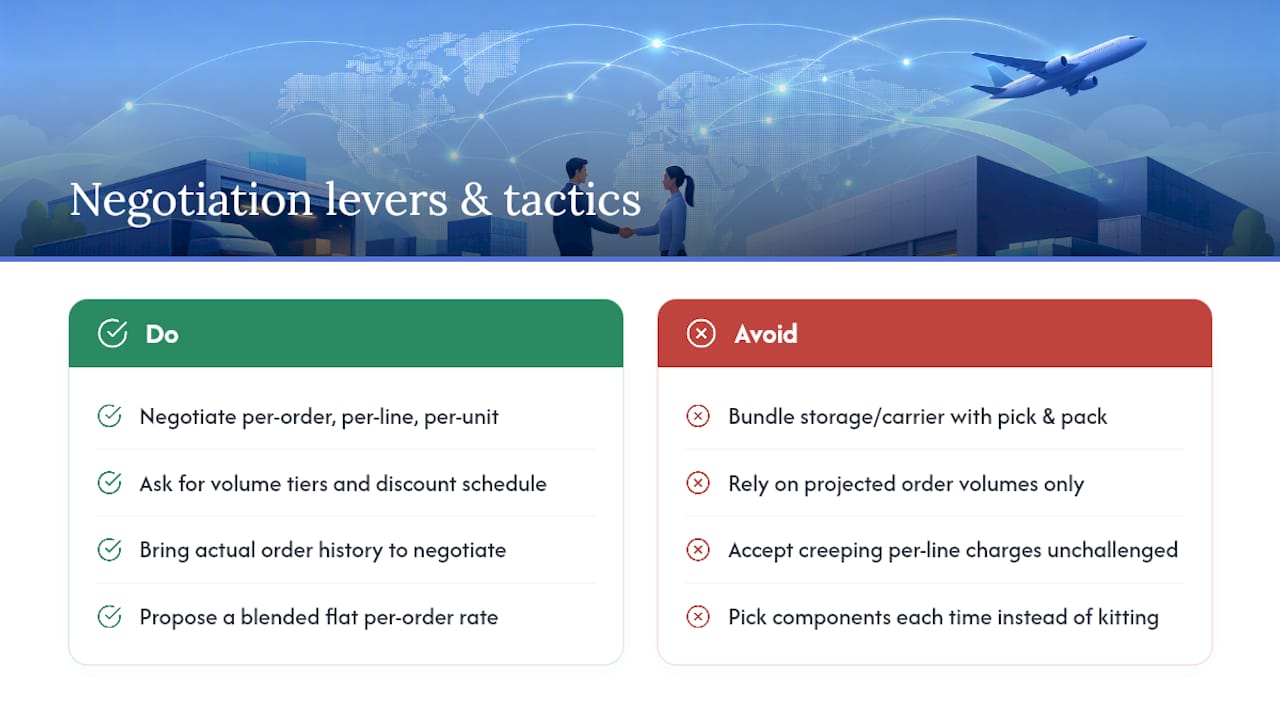
Pick and pack is the most negotiable line item on your invoice, and the three-tier structure, per-order, per-line, and per-unit, gives you three separate places to push.
Volume tiers are your strongest lever; you can explore detailed options and costs through FreightSuite Pricing | Freight Forwarding TMS Plans. Most 3PLs build in a discount schedule that kicks in around 5,000 orders a month, but that schedule is rarely offered upfront. Ask for it directly and bring your actual order history to the conversation instead of a projection.
A blended flat rate can work in your favor if your order profile is consistent. Rather than paying separately for first-item picks, additional-item picks, and packaging, propose a single per-order rate based on your historical average. Providers often accept this because it simplifies their billing too, and it protects you from creeping per-line charges as your catalog grows.
Pre-kitting is underused. If you regularly ship the same bundle of items together, ask your provider to kit them in advance rather than picking each component separately for every order. That collapses what would be a three or four item pick into a single unit pull, and the labor savings usually get passed back to you in the rate.
Finally, negotiate storage and carrier costs separately from pick and pack. They’re governed by different market forces, regional real estate for storage, carrier contracts for shipping, and bundling them into one negotiation usually means you lose leverage on at least one.
How Order Profiles Change Your Real Cost
Two brands with identical order counts can have wildly different fulfillment bills, and the difference almost always comes down to order profile.
Average items per order is the first variable. A single-SKU order with one unit is cheap to pick. An order with four different products from four different bins takes longer, and most 3PLs price that complexity into the additional-item fee rather than a flat multiplier, so a five-item order can cost meaningfully more than five separate one-item orders would in aggregate labor.
Product size and weight variation is the second, and it interacts directly with dimensional weight. A catalog that mixes a small phone accessory with a bulky home good forces your fulfillment partner to hold more box sizes in inventory and pick the right one every time, which adds handling time. Oversized or irregularly shaped items, furniture being the extreme case, often get quoted entirely outside the standard rate card because they need specialized furniture shipping services rather than a standard parcel pick.
If your catalog is genuinely mixed, ask for pricing broken out by product category rather than a single blended average. A single number that averages a phone case and a end table together tells you almost nothing useful about what either one actually costs to fulfill.
Where Automation Actually Lowers Your Bill
Technology in a fulfillment operation earns its keep in three specific places: order routing, inventory accuracy, and pick-path optimization. Each one maps to a real line item on your invoice.
Automated order routing sends each order to the nearest fulfillment center automatically, based on inventory availability, which shortens the shipping zone and reduces the carrier cost per package. That’s a direct hit on the largest line item in your bill.
Warehouse management systems that track inventory in real time cut down on the labor-intensive cycle counts and manual reconciliation that show up as account management overhead. They also reduce the long-tail cost of shipping the wrong item, since mispicks generate a return, a reship, and sometimes a customer service credit, three costs stacked on top of the original fulfillment fee.
Pick-path optimization, where software directs a warehouse worker along the most efficient route through the building rather than a random sequence, shortens the time spent on each pick. That labor saving is exactly what shows up as a lower additional-item fee in a 3PL’s rate card.
None of this means automation is free. Providers with more sophisticated systems sometimes charge slightly higher account management fees to cover the technology investment. The tradeoff is usually worth it once your order volume is high enough that the per-order labor savings outpace the flat technology fee.
In-House Fulfillment vs. Third-Party Logistics Costs
Running fulfillment in-house means paying for warehouse lease, staff, packaging materials, and shipping software directly, with no markup layered on top by a third party. It also means carrying every fixed cost yourself regardless of order volume, which is exactly why in-house fulfillment tends to make sense only above a certain scale or below it, when volume is so low a 3PL’s minimums don’t pencil out either.
Third-party logistics providers spread their fixed costs (warehouse space, technology, labor) across many clients, which is how they offer per-order pricing that a single brand usually can’t match at low-to-mid volume. The tradeoff is exactly the layered fee structure this article has walked through: pick and pack, storage, receiving, and the various add-ons that come with using shared infrastructure.
The crossover point varies by catalog and volume, but the comparison between in-house and 3PL fulfillment usually favors outsourcing until a brand is shipping enough volume to justify dedicated warehouse space and a full-time operations staff. Below that line, a 3PL’s blended rate almost always beats the fully loaded cost of leasing space, hiring pickers, and building your own shipping software stack from scratch.
What SLAs Mean for Your Fulfillment Bill
A service level agreement defines the turnaround time, accuracy rate, and uptime a fulfillment provider commits to, and every tightening of those terms tends to show up as a price increase somewhere on your invoice.
Same-day order processing, for instance, usually costs more than next-day processing because it requires the provider to staff for peak-hour cutoffs rather than batching orders overnight. A 99.9% inventory accuracy guarantee costs more to deliver than a 98% guarantee, because hitting that last fraction of a percent requires more frequent cycle counts and tighter warehouse management systems.
Read the penalty clauses as closely as the price. A provider offering an aggressive SLA with no real financial penalty for missing it isn’t actually offering you protection, just a marketing number. A meaningful SLA ties a missed deadline or accuracy miss to a credit or fee waiver, and that clause is worth more than the headline promise itself.
Before signing, ask what happens during peak season, since many providers quietly widen their SLA windows in Q4 without changing the contract language, and that gap is where holiday-season complaints usually originate.
Does Fulfillment Center Location Change Your Price?
Where your inventory sits physically determines how far the average parcel has to travel, and that distance is priced directly into carrier zones.
A fulfillment center near the geographic center of the country, or one of several centers positioned to cover different regions, shortens the average shipping zone for a nationwide customer base. Shorter zones mean lower carrier costs per package, since carrier pricing tiers are built around zone distance from origin to destination.
Storage costs also vary by region. Warehouse space in dense coastal markets, particularly around Los Angeles and the New York metro area, tends to carry a premium over storage in the central United States, which factors into your monthly storage line even before a single order ships.
If your customer base skews to one coast, a single fulfillment center on the opposite coast can quietly inflate your average shipping cost by pushing every order into a higher carrier zone. Multi-node fulfillment, splitting inventory across two or more regional facilities, solves this but adds a layer of inventory management complexity that needs to be weighed against the shipping savings it produces.
What the Benchmarks Actually Tell You
The $8 to $15 all-in range gets treated like a target, but that’s the wrong way to use it. It’s a diagnostic tool. If your quote lands well above $15 and your order profile is standard, single or dual SKU, no oversized items, you’re not paying for better service. You’re paying for a provider that hasn’t unbundled its fee structure clearly enough for you to negotiate against it.
The advice most guides give, shop three quotes and pick the cheapest, misses the actual lever. The real gap between a good deal and a bad one isn’t the headline rate. It’s whether shipping, storage, and pick and pack are itemized separately or folded into one number you can’t audit.
My honest read: readers should stop asking “what’s your per-order rate” and start asking for a sample invoice with every fee broken out by category. A provider that hesitates to show you that is telling you something about how their pricing model works. Ask for a per-SKU cost estimate too, not just a blended average, because that’s where storage premiums and long-tail fees actually hide.
Get a Fulfillment Cost Audit From Usiship
If your current 3PL quote reads like a single blended number with no itemized breakdown, that’s the actual problem this article has been circling. Usiship runs omnichannel fulfillment, Amazon FBA prep, and licensed customs brokerage under one platform, which means the fee categories this guide walked through, receiving, storage, pick and pack, and shipping, come from one system instead of three vendors passing charges between each other.
That structure gives you something most fulfillment quotes don’t: a bill you can actually audit line by line. If you’re evaluating providers or suspect your current invoice is padded with pass-through fees you can’t see, request a tailored quote through Usiship’s ecommerce fulfillment page and ask specifically for an itemized breakdown against your current order profile. Brands with imported inventory can also loop in customs clearance directly, since brokerage fees are one of the most common places double billing sneaks in.
Frequently Asked Questions
What is a normal fulfillment cost per order?
Most U.S. domestic DTC brands see $8 to $15 all-in per order, or $3.50 to $8.00 if you’re only counting fulfillment work and excluding shipping.
Why is my fulfillment quote higher than the published benchmarks?
Usually because of order profile complexity, oversized items, dimensional weight penalties, or unbundled add-on fees like account management and long-term storage that aren’t reflected in a headline rate.
How much does storage typically cost at a fulfillment center?
Pallet storage averages $18 to $25 per month, while cubic-foot billing runs around $0.46 per cubic foot for smaller or irregular inventory.
Is in-house fulfillment cheaper than using a 3PL?
It depends on your volume. Below a certain order threshold, a 3PL’s shared infrastructure beats the fixed cost of leasing warehouse space and hiring staff. Above a high-enough volume, in-house can become competitive again.
What’s the biggest hidden fee to watch for?
Long-term storage surcharges and peak-season Q4 uplifts are the two most commonly missed line items when comparing initial quotes.
Sources
- How Much Does a 3PL Cost? (2026 Pricing Data)
- Average ecommerce 3PL pick and pack cost by order size, 2026: $2.75 first item, $0.50 each additional | Eightx
- How Much Does a 3PL Cost in 2026? 16 Fee Benchmarks
- Pick and pack fees explained (2026)