
Verify Fuel Surcharge Index: Spreadsheet Formulas for U.S. Freight
A fuel surcharge index is the published diesel price a carrier uses to adjust freight rates when fuel costs move. Most U.S. freight contracts anchor to the EIA weekly national average on-highway diesel price, updated every Monday. Before you approve any invoice, pull the index value for the actual ship or pickup date, then match it against your contracted base price or band table and confirm the carrier used the correct formula for that mode.
TL;DR:
- Most fuel surcharge disputes result from incorrect invoice dates, expired band tables, or mismatched calculation formulas rather than fraud.
- Relying solely on weekly EIA diesel prices can lag actual costs, while route-specific daily data offers more precise and timely insights despite higher administrative effort.
- Small input changes, like base fuel price, MPG assumptions, or the index used, can cause surcharge variations larger than many shippers realize.
- Automated invoice audits that verify dates, tables, and formulas can significantly reduce billing errors and improve cost control.
- Managing contract language around fuel prices, MPG assumptions, and band cadence empowers shippers to lower surcharge costs before they occur.
Table of Contents
- What a Fuel Surcharge Index Is and Why Carriers Use It
- How Fuel Surcharge Is Calculated: Two Methods You’ll Actually See
- Where to Find Authoritative Index Data and Route Pricing
- Common Fuel Surcharge Billing Errors and How to Audit Them
- Building a Fuel Surcharge Calculator: Inputs and Formulas
- Reducing Fuel Surcharge Exposure Without Renegotiating Everything
- What Actually Moves the Needle on Fuel Surcharge Costs
- How Universal Shipping Helps You Control Freight Costs
- Sources
What a Fuel Surcharge Index Is and Why Carriers Use It
Fuel prices swing enough, week to week, that neither carriers nor shippers want to renegotiate a base rate every time diesel moves. A fuel cost adjustment clause solves that by tying a small, formula-driven charge to a published index instead. It is the same logic utilities use with fuel adjustment clauses to pass through volatile input costs without reopening the entire rate structure.
In U.S. freight, three data sources matter:
- EIA/DOE weekly diesel average. The dominant reference for truckload and most LTL contracts, published every Monday for the prior week.
- Atlas/DOE fuel surcharge tables. These break the index down by shipment type and effective date, useful when a contract references a modal table rather than the raw national number.
- FuelSurchargeIndex.org. Pulls daily pricing from thousands of truck stops for shippers who want route-level precision instead of a national blend.
The tradeoff is speed versus precision. EIA updates weekly, which is predictable but can lag a fast price swing by several days. Route-specific daily data closes that gap but adds administrative overhead, since you are now tracking prices lane by lane instead of pulling one national number.
How Fuel Surcharge Is Calculated: Two Methods You’ll Actually See
Truckload and LTL carriers calculate surcharges differently, and mixing up the two formulas is one of the most common billing mistakes shipping managers catch.
- Truckload per-mile formula. Subtract the contracted base fuel price from the current index price, divide by the truck’s assumed miles per gallon, then multiply by loaded miles:
(current index − base price) ÷ MPG × loaded miles. - LTL/parcel band tables. Carriers publish a table where each diesel price range (“band”) maps to a fixed surcharge percentage. You look up which band the current index falls into and apply that percentage to the freight charge.
Statistic Callout: A truckload carrier with a $3.20 base price, a current EIA index of $3.65, and a 6.5 MPG assumption on a 450 mile load calculates: $(3.65 − 3.20) ÷ 6.5 × 450 = $31.15$ in surcharge on that load.
The band table works differently. If diesel sits at $3.61 and the carrier’s table charges 24% for the $3.55 to $3.64 band, a $500 line haul carries a $120 surcharge. Cross into the next band at $3.65 and the rate might jump to 25%, adding another $5 for a one-cent price move. That cliff effect at band boundaries is exactly where billing disputes tend to cluster.
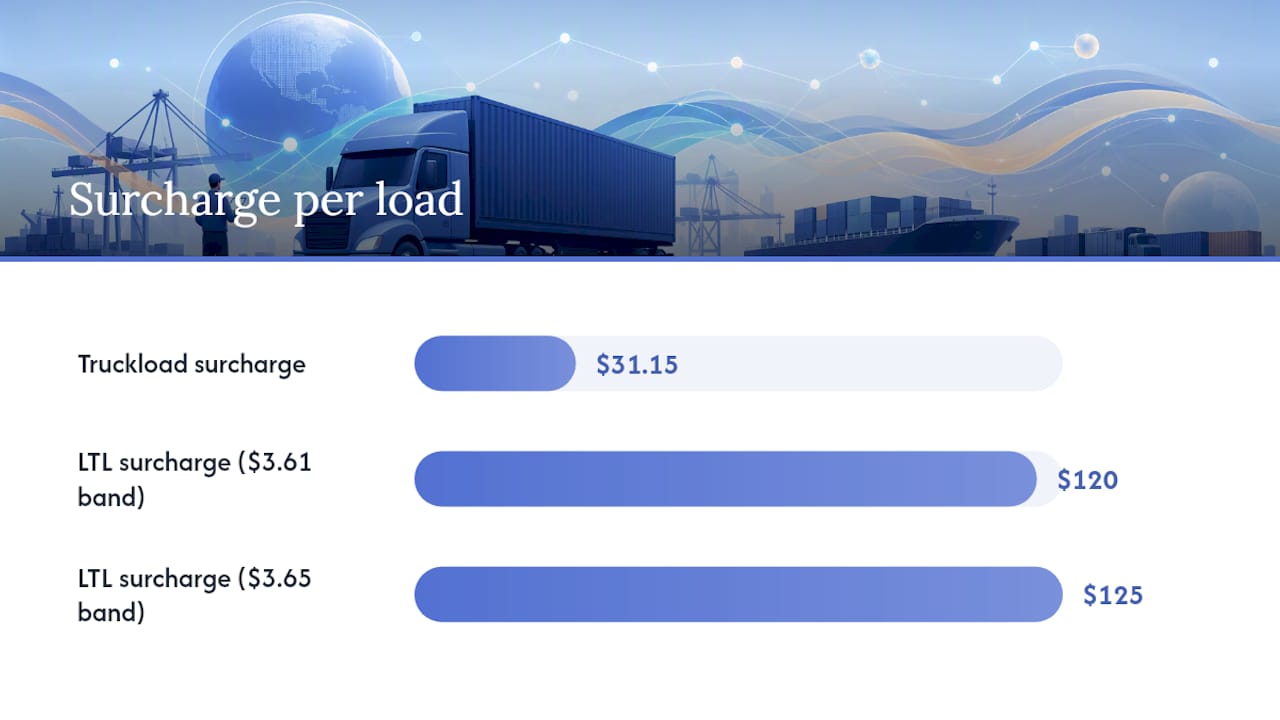
Small changes in any input, the base price you negotiated, your MPG assumption, or which day’s index the carrier used, shift the result more than shippers expect.
Where to Find Authoritative Index Data and Route Pricing
The EIA’s weekly diesel price series is the single most-cited number in U.S. freight contracts, and it’s free to pull directly from the source rather than trusting a carrier’s summary of it.
- EIA weekly series. Bookmark the on-highway diesel page directly; it updates every Monday with the prior week’s national average.
- Atlas/DOE fuel surcharge pages. These show modal breakdowns and rate tender data tied to specific effective dates, useful when your contract references a table rather than the raw EIA number.
- FuelSurchargeIndex.org. Offers daily truck-stop pricing by route rather than a weekly national blend, which matters most for high-value or irregular lanes where a few days of lag can cost real money.
Check publication dates carefully. A Monday EIA release reflects the prior week, so any contract clause that says “current week’s index” needs a shared definition of exactly which Monday applies.
Common Fuel Surcharge Billing Errors and How to Audit Them
Most disputed surcharges trace back to one of four mismatches, not fraud. A carrier’s system pulls the wrong date, applies the wrong band, or references a stale table, and nobody catches it because nobody checks.
The most frequent errors include:
- Using the invoice date instead of the actual ship or pickup date to look up the index.
- Applying a band table that expired before the shipment date.
- Mismatching the formula to the mode, using a per-mile calculation on an LTL shipment or vice versa.
- Referencing a regional or spot price instead of the contracted index source.
To audit an invoice, collect four pieces of data before you dispute anything: the exact ship/pickup date, the published index value for that date, the contracted base price or band boundaries, and the correct formula for that mode. Recalculate the surcharge yourself and compare it to the billed amount. Correcting just the date-mismatch error alone resolves a majority of surcharge disputes, according to industry audit data.
Pro Tip: Ask carriers to cite the exact index date and table version on every invoice line. If they can’t produce it on request, that’s your first sign the surcharge wasn’t calculated correctly in the first place.
Building a Fuel Surcharge Calculator: Inputs and Formulas
A working calculator needs five inputs: base fuel price, current index value, MPG assumption, loaded miles (for truckload) or freight charge (for LTL), and the applicable band table if your contract uses one.
- Truckload spreadsheet formula:
=((current_index_cell - base_price_cell) / mpg_cell) * loaded_miles_cell - LTL/percentage formula:
=freight_charge_cell * band_percentage_cell
Statistic Callout: Route-specific daily pricing from Fuelsurchargeindex reduces the “winners and losers” swing that comes from averaging an entire week into one national number, though it does add a lane-by-lane tracking burden that most fleets only take on for their highest-value routes.
Use the per-mile formula for verification whenever a lane has a defined loaded-mile count. Fall back to the percentage method whenever the contract explicitly cites a band table, since forcing a per-mile calculation onto a percentage-based contract produces a number that won’t match the invoice no matter how correct your math is.
Reducing Fuel Surcharge Exposure Without Renegotiating Everything
You have more leverage over surcharge exposure than most shipping managers assume, and most of it lives in the contract language itself.
- Negotiate the base fuel price and band cadence when the contract renews, not mid-term.
- Push back on unrealistic MPG assumptions baked into truckload formulas; a low assumed MPG inflates every surcharge calculation.
- Consolidate shipments and optimize routing to reduce loaded miles, which shrinks the surcharge base even when the index itself doesn’t move.
- Automate invoice audits so mismatched dates or expired bands get flagged before payment, not after a dispute.
What Actually Moves the Needle on Fuel Surcharge Costs
Most guides treat fuel surcharge audits as a compliance chore. That’s backwards. The index itself is public and free, which means the entire surcharge calculation is fully reproducible by anyone willing to pull the EIA number and do the math. The leverage isn’t in disputing charges after the fact, it’s in negotiating the inputs, base price, MPG assumption, band cadence, before the contract is signed.
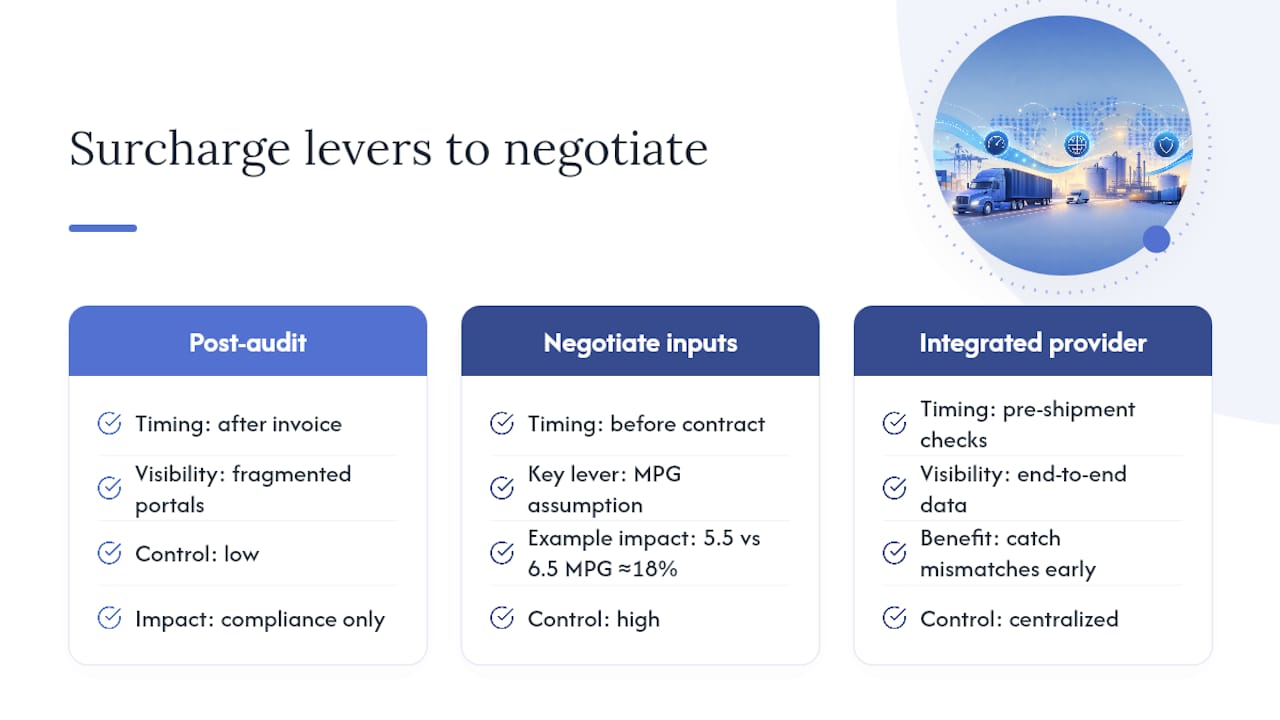
The MPG assumption gets less attention than it deserves. A carrier quoting 5.5 MPG instead of 6.5 MPG on a truckload formula inflates every single surcharge on that lane by roughly 18%, compounding over hundreds of loads a year. Shipping managers who focus only on the index number while ignoring the denominator are auditing half the formula.
Universal Shipping doesn’t build surcharge index publishing into its own operations, but a provider that handles freight forwarding and logistics transportation end to end is positioned to catch these mismatches before they ever hit an invoice, simply because visibility into the shipment date, mode, and contract terms lives in one place instead of scattered across carrier portals.
— Akbar
How Universal Shipping Helps You Control Freight Costs
Chasing down index dates and band tables across multiple carrier portals eats hours that a shipping manager doesn’t have, especially when managing multiple carriers with varying practices. Universal Shipping brings freight forwarding, FTL and LTL management, and real-time tracking into one system, so the shipment date and mode a surcharge should reference are never in question.

For businesses juggling multiple carriers and contract types, the choice between managing that complexity in-house or handing it to a 3PL partner often comes down to how much staff time gets burned on invoice review versus revenue-generating work. Universal Shipping’s team builds contract visibility and billing accuracy into the shipping process itself, from initial rate negotiation through final invoice reconciliation, including cases where customs and cross-border charges complicate the fuel-related line items further.
If fuel surcharge disputes are eating into your logistics budget, start by requesting a freight cost review through Universal Shipping’s services page to see where your current contracts leave money on the table.