
Freight Forwarding Process: 12 Steps From Quote to Delivery
The freight forwarding process is the chain of steps a forwarder runs to quote, book, move, clear, deliver and bill a shipment on your behalf. In practice it comes to 12 steps: inquiry, quote, booking, pickup, warehouse receiving, export documents, export customs, main transport, arrival handling, import customs, final delivery and billing. This guide walks through each one, shows what you must prepare, explains how a forwarder differs from a broker and a carrier, and covers how to choose a forwarder or 3PL.
TL;DR
- A forwarder organizes your shipment end to end: it books space, coordinates pickup, prepares documents, handles customs and arranges delivery.
- Most delays come from mismatched paperwork, so the commercial invoice, packing list and transport document must agree.
- A carrier moves the freight, a broker arranges it without taking cargo responsibility, and a forwarder organizes it and assumes transportation responsibility.
- Choose a forwarder on licensing, customs capability, visibility, claims handling and written service levels, not on the lowest quote alone.
- If you also need storage and fulfillment, a 3PL agreement should set measurable targets, reporting and remedies.
Table of Contents
- What a freight forwarder actually does
- The freight forwarding process in 12 steps
- Domestic vs. international: what changes
- Documents and data to prepare
- Freight forwarder vs. broker vs. carrier
- How to choose a freight forwarder
- How to choose a 3PL and what the service agreement should say
- Where Usiship fits
- Common mistakes that slow the process
- FAQ
- Sources
What a freight forwarder actually does
A forwarder is your shipping project manager. FIATA describes forwarding and logistics services as covering carriage, consolidation, storage, handling, packing, distribution, customs and fiscal matters, insurance procurement, documentation and supply-chain management. You rarely need all of that on every shipment, but a good forwarder can scale the scope to what the shipment needs.
Customs is a good example. A forwarder can clear goods itself or subcontract the work to a customs-broking specialist. Either way, clear written instructions and accurate documents are what make it work. That guidance comes from the UK, but the principle applies to any border.
The freight forwarding process in 12 steps
The sequence below follows the 12-step model and adds the U.S. details that matter to an importer or exporter.
Steps 1 to 3: Inquiry, quote and booking
1. Shipment inquiry. You describe the move. A complete inquiry includes shipper and consignee, origin and destination, cargo description, package count, weight and dimensions, cargo value, required delivery date, transport mode, Incoterms and any special handling needs. The more precise you are, the fewer re-quotes you get.
2. Quote and rate planning. The forwarder compares modes (air, ocean, truck), routings and carriers, then sends a quote. Check what it includes: pickup, origin fees, main freight, customs, destination charges and final delivery are often priced separately.
3. Booking and carrier coordination. Once you approve the quote, the forwarder books space with the carrier or partner and confirms the schedule, transit time, cutoff dates, equipment availability, booking number, routing, pickup instructions, documentation deadlines and special cargo requirements. Cutoffs are the dates that most often catch first-time shippers out, so ask for them in writing.
Steps 4 to 7: Pickup, receiving, documents and export clearance
4. Cargo pickup and export haulage. A truck collects the goods from your factory, supplier or warehouse and takes them to the terminal, port or airport. Have the cargo packed, labeled and ready before the driver arrives.
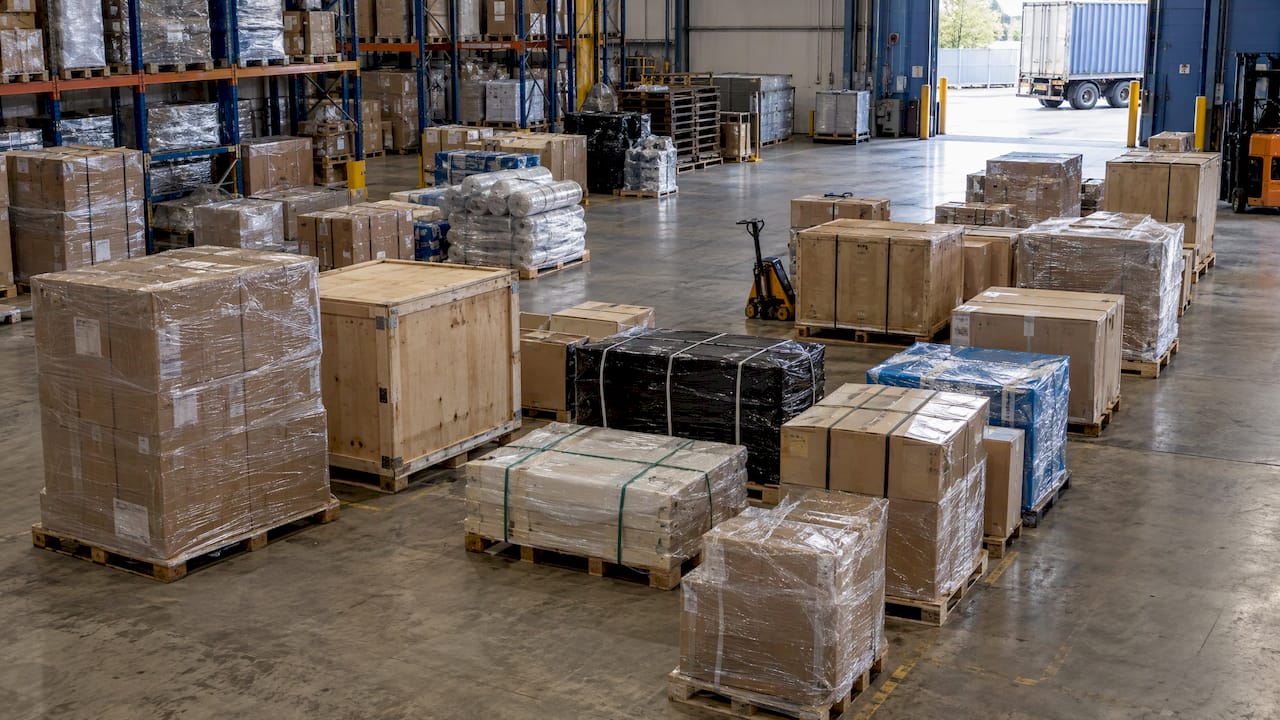
5. Receiving, inspection and consolidation. At the forwarder’s facility or a partner warehouse, the cargo is checked against the booking, and smaller shipments may be consolidated with others to fill a container or pallet position. This is where count and condition discrepancies should be caught.
6. Export documentation. The forwarder issues or collects the transport document (an air waybill for air, a bill of lading for ocean) and aligns it with your invoice and packing list. Our guide to commercial invoice requirements and the packing list checklist cover the fields most often wrong.
7. Export customs clearance. The export declaration is filed and the cargo is released to leave the country of origin. Some goods need licenses, and hazardous goods need a declaration prepared by the shipper.
Steps 8 to 12: Transport, import clearance, delivery and billing
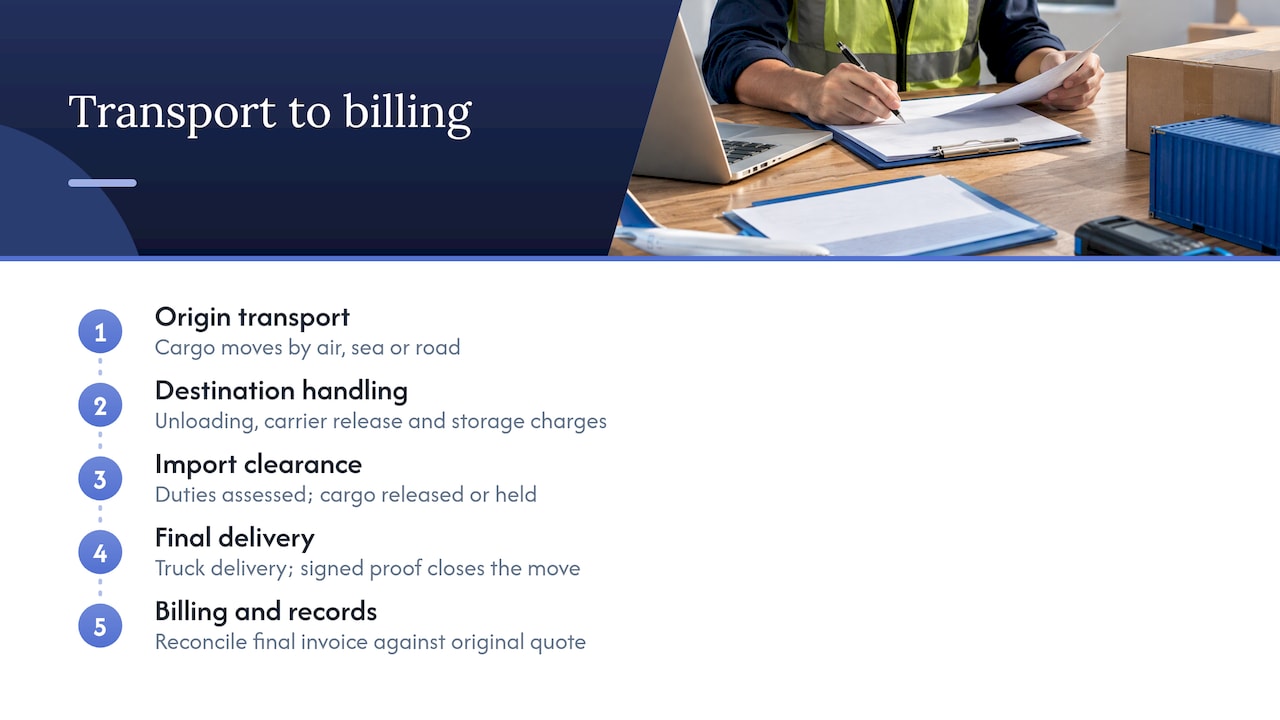
8. Origin handling and main transport. The cargo is loaded and moves by air, sea or road. The forwarder tracks milestones and tells you about delays or rollovers.
9. Arrival and destination handling. The cargo is unloaded, and the forwarder deals with the terminal, carrier release and any storage charges that start to accrue if pickup is slow.
10. Import customs clearance. Entry is filed, duties and fees are assessed, and the authority releases or holds the cargo. For U.S. imports this is where documentation quality decides whether you get a quick release or a hold. See the section on documents below, and our overview of customs clearance services.
11. Final delivery and proof of delivery. A truck takes the goods to the consignee, often by appointment. If your receiver is a big-box warehouse or distribution center, read how to book delivery appointments and avoid fees. The signed proof of delivery closes the physical move.
12. Billing, invoicing and recordkeeping. The forwarder invoices freight and charges, and you keep the entry, invoice and transport records. Reconcile the final invoice against the original quote line by line.
Domestic vs. international: what changes
A domestic move skips steps 6, 7 and 10 and the border documents, so the process shrinks to quote, booking, pickup, line-haul and delivery. A domestic shipment is typically a full truckload (FTL) or less-than-truckload (LTL) move, where the paperwork is mainly the bill of lading. International freight adds export and import clearance, longer cutoffs, Incoterms and more parties.
For cross-border moves, the mode matters too. Air is faster and suits high-value or urgent goods, while ocean is slower and suits volume. If your goods arrive at a port and need to reach a warehouse or store, the port to door timeline and entry checklist shows the handoffs to plan for. If speed is the priority, read about air freight and avoiding customs holds.
Documents and data to prepare
Most forwarders can only be as accurate as the data you give them. UK government guidance advises preparing written shipping instructions, invoices, packing lists and any licenses, using the right transport document (air waybill, bill of lading or CMR consignment note), and having the shipper prepare any hazardous-goods declaration.
For U.S. imports, CBP’s guide for commercial importers says the commercial invoice must identify the parties, port of entry, detailed merchandise descriptions, quantities, values, currency and itemized applicable charges. It also lists packing lists, when appropriate, among entry documents and notes that entry documentation can be reduced or eliminated through ABI, CBP’s Automated Broker Interface.
A simple pre-booking checklist:
- Product descriptions that are specific and identical on every document.
- Quantities, weights and values that reconcile between invoice, packing list and transport document.
- Package marks, buyer and seller details and transport instructions.
- Incoterms agreed with your supplier or buyer, so everyone knows who pays for and controls each leg.
- A signed customs power of attorney if the forwarder will file entries. Our customs POA compliance checks explain what to verify.
- For importers who need one, the right bond. See customs bond types.
If you want the full door-to-door picture, including who is responsible for what at the border, read about keeping customs roles clear on door-to-door freight.
Freight forwarder vs. broker vs. carrier
These three terms get mixed up, and the difference affects who is liable if something goes wrong. The FMCSA’s definitions are the U.S. reference.
| Role | What it does | Cargo responsibility |
|---|---|---|
| Motor carrier | Operates the commercial motor vehicles that haul the freight | Moves the freight itself |
| Broker | Arranges transportation but does not transport property | Does not assume cargo responsibility |
| Freight forwarder | Organizes and may consolidate shipments, and may transport freight itself | Assumes transportation responsibility |
FMCSA counts a vehicle as a commercial motor vehicle when its gross vehicle weight rating or gross combination weight is 10,001 pounds or more.
For ocean moves, there is another layer. U.S.-based ocean freight forwarders and NVOCCs must hold a license from the Federal Maritime Commission. Ask any forwarder handling your ocean freight for its status.
The practical takeaway: a carrier sells you a lane, a broker sells you a connection to carriers, and a forwarder sells you the managed shipment, including documents and customs. Understanding who carries responsibility in each model is a theme across the industry, as shown in this explanation of transport manager responsibilities.
Our perspective
Most shipping trouble we see starts before the cargo moves: an incomplete inquiry, a description that differs between documents, or a supplier who was never told the cutoff. We built Universal Shipping around the idea that the quote, the truck, the warehouse and the customs filing should not live in four different places.
That is why we combine freight forwarding, customs brokerage, warehousing, fulfillment and last-mile delivery on one platform with real-time tracking and 24/7 personalized service. When one team sees the whole chain, handoffs get cleaner and you get one point of contact instead of a relay of emails.
Our advice to shippers is simple: give us complete data at the start, tell us how the goods will be used after arrival, and let one provider own the sequence from pickup to the shelf.
Akbar
How to choose a freight forwarder
When you search for a forwarder, compare candidates on criteria you can verify:
- Scope. Can they handle your modes (air, ocean, FTL, LTL) and your lanes, and do they offer customs brokerage in-house or through a partner?
- Licensing and authority. Ask for the relevant authority for the work they do: FMC licensing for ocean moves, and the FMCSA authority type that matches how they operate.
- Quote clarity. A good quote itemizes origin, freight, customs and destination charges, and states what is excluded.
- Visibility. Look for milestone tracking and proactive exception alerts, not just a tracking number.
- Claims and insurance. Know how cargo insurance is arranged and how a claim is filed and handled.
- After-arrival services. If goods need storage, cross-docking, transloading or fulfillment, one provider for both halves removes a handoff.
- Responsiveness. Test how quickly they answer a detailed question during the quoting stage.
Get quotes from two or three providers using the same inquiry data, so you compare like with like.
How to choose a 3PL and what the service agreement should say
If your goods land in a warehouse and then ship to customers, retailers or Amazon, you are also choosing a third-party logistics (3PL) provider. Selection criteria overlap with forwarder criteria, plus a few specific to the building: receiving speed, pick accuracy, order cutoffs, integrations with your storefront and clear returns handling.
Whatever you choose, put the expectations in writing. A 3PL agreement checklist says the SLA should define services, measurable targets, reporting, data access, exceptions, escalation, corrective action and remedies. It should also allocate fees, inventory and transportation liability, insurance, claims, security, term, termination, transition and governing law.
Metrics worth putting in the SLA
The same checklist suggests targets for receiving times, order cutoffs, pick accuracy, shipping handoff, support response, inventory discrepancies, reporting and audit or correction procedures. A scorecard built by following an order and its inventory through the building works well, with each metric having a definition, clock, exclusions, source system, reporting frequency and remedy.
For exceptions, the same source recommends setting targets for detection, acknowledgment, ownership assignment, resolution and customer notification, and using percentile measures and aging buckets rather than averages. One example is reporting the 95th-percentile resolution time and every exception older than 24 hours.
Don’t track everything. Contract practitioners describe a tiered approach: core metrics, typically the six to ten most important to the business and within the provider’s control, carry breach, penalty, goal and incentive thresholds, while non-core metrics carry no contractual consequence beyond a duty to report.
Where Usiship fits
We run freight forwarding, customs brokerage and air freight alongside 3PL fulfillment, warehousing, FBA prep and last-mile delivery, so a shipment can go from origin pickup to a shelf or customer doorstep under one team. If you are planning a move, start with our freight forwarding services page.
If the goods need to be stored or fulfilled after arrival, our warehousing and fulfillment solutions and 3PL fulfillment services cover receiving, pick and pack, returns and packaging. Published warehouse pricing on our pricing page includes bin storage at 5-6 USD per month per bin, pallet storage at 17-19 USD per month per pallet, and additional services at 37 USD per hour. Other fulfillment fees are quoted to your volume and profile.
Common mistakes that slow the process
- Vague descriptions. Wording such as “parts” or “accessories” invites questions from customs. Use the specific description everywhere.
- Mismatched numbers. If the invoice says 500 units and the packing list says 480, expect a delay while it is reconciled.
- Missing cutoff awareness. Late cargo can miss the vessel or flight and roll to the next one.
- Unclear Incoterms. If buyer and seller disagree about who handles export clearance or destination charges, someone gets a surprise bill.
- No appointment at delivery. Many receivers refuse or charge for unscheduled trucks.
- Skipping the final reconciliation. Compare the invoice against the quote and flag discrepancies promptly.
FAQ
What is the process of freight forwarding in simple terms?
You send shipment details and get a quote. After you approve it, the forwarder books the carrier, collects the cargo, prepares documents, clears customs at origin and destination, moves the freight and delivers it. It then invoices you and you keep the records.
Is a freight forwarder the same as a freight broker?
No. Under FMCSA definitions, a broker arranges transportation without transporting property or assuming cargo responsibility, while a forwarder organizes shipments and assumes transportation responsibility. A forwarder may also consolidate and move freight itself.
What documents do I need to ship internationally?
At minimum, a commercial invoice and a packing list, plus the transport document such as an air waybill or bill of lading. Some goods need licenses, and hazardous goods need a declaration from the shipper. Keep descriptions, quantities and values identical across documents.
How do I find a freight forwarder?
Shortlist providers that handle your mode and lanes, confirm the licensing relevant to your shipment, and send each the same inquiry. Compare itemized quotes, tracking, claims handling and whether they can also warehouse and fulfill your goods.
What should a 3PL service level agreement include?
It should define services, measurable targets, reporting, exceptions, escalation, corrective action and remedies. It should also cover liability, insurance, claims, term, termination and transition. Limit contractual consequences to a handful of core metrics.
Sources
- Freight Forwarding Process: 12 Steps From Quote to Delivery
- About Freight Forwarding, FIATA
- Freight forwarding: moving goods, GOV.UK
- Importing into the United States: A Guide for Commercial Importers, CBP
- Definitions of motor carrier, broker and freight forwarder, FMCSA
- Apply for a License or Request a Foreign Registration, Federal Maritime Commission
- 3PL Service Agreement Checklist For Ecommerce Brands
- The 3PL Fulfillment Operating Model Is Changing
- Making Sense of Logistics Service Provider SLAs and KPIs, Lexology
- Transportleder: krav, opgaver og ansvar