
File Freight Claims in Nine Months: A U.S. Shipper’s Playbook
A freight claim is a written demand for money from the motor carrier that hauled your goods when cargo arrives lost, damaged, or short. The moment you spot a problem, inspect the shipment, note specific exceptions on the delivery paperwork, photograph everything, and hold onto the damaged goods and packaging. You have nine months from delivery to file the written claim, and two years from a denial to sue.
TL;DR:
- Filming visible and concealed damages clearly with photos and detailed notes before signing the delivery receipt is essential to support a claim.
- Claims must be filed within nine months of delivery, with precise documentation, including a specific dollar amount and request for payment, to avoid denial.
- Proper classification of damage, shortage, or loss at the time of delivery impacts the validity of your claim and how you document subsequent issues.
- Administrative errors like vague POD notations or missing proof of value frequently lead to claim denial, so thorough record-keeping is critical.
- Preventing claims relies on pre-shipment inspections, specialized handling, and organized digital files, reducing the likelihood of disputes and delays.
Table of Contents
- What Counts as a Freight Claim (And What Type You’re Filing)
- The Carmack Amendment: Your Legal Foundation for Filing
- Freight Claim Deadlines You Need on Your Calendar
- Building a Claim Package That Actually Gets Paid
- How to File a Freight Claim the Right Way
- Why Carriers Deny Freight Claims (and How to Fix It)
- What to Do After a Freight Claim Denial
- How Universal Shipping Prevents Claims Before They Start
- Where to Verify the Legal Details Yourself
- The Playbook Most Shippers Never Write Down
- Let Usiship Handle the Paperwork Before There’s a Problem
- Sources
What Counts as a Freight Claim (And What Type You’re Filing)
Not every shipping problem is the same claim, and the type you’re dealing with changes what you do next. Getting this classification right at the moment of delivery, or shortly after, determines whether your paperwork holds up later.
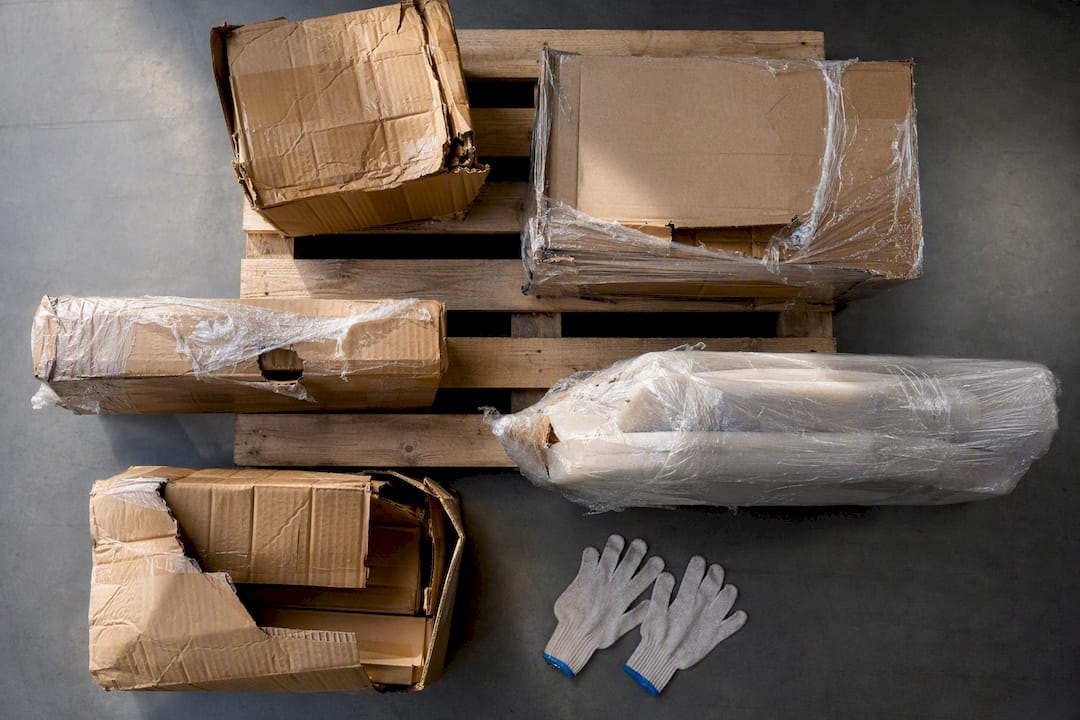
Visible damage is the easiest to catch: crushed boxes, torn shrink wrap, leaking pallets you can see the second the driver opens the trailer door. You have to note it on the delivery receipt before you sign, full stop.
Concealed damage hides inside intact-looking packaging. You don’t discover it until you open the box, sometimes days later, which is why prompt reporting matters even more here than with visible damage.
Shortage means fewer units, cartons, or pallets arrived than the bill of lading says should have. Loss covers freight that never shows up at all, whether it’s misrouted, stolen, or simply vanished somewhere in transit. OS&D (over, short, and damaged) is the catch-all term carriers and warehouses use internally to flag any of these discrepancies for review.
- Visible damage: note it on the POD before signing, photograph immediately
- Concealed damage: report to the carrier as soon as it’s discovered, ideally within a few days
- Shortage: count pieces against the BOL at delivery, not later
- Loss: track with the carrier’s tracing department before filing, since freight sometimes surfaces late
- OS&D: often the label a warehouse or carrier uses to route your issue internally
The Carmack Amendment: Your Legal Foundation for Filing
Every freight claim against a motor carrier in interstate commerce rests on one federal statute: the Carmack Amendment, 49 U.S.C. § 14706. It makes the carrier that received your goods in good condition liable for loss or damage that happens anywhere along the route, regardless of which subcontractor actually had the trailer at the time.
To win a Carmack claim, you generally need to prove three things: the carrier received the freight in good condition, the freight arrived damaged, lost, or short, and you can put a dollar figure on the loss. That’s your entire burden.
The carrier, in turn, can raise a handful of defenses that shift the outcome back in its favor: an act of God, inherent defect in the goods, improper packing by the shipper, or an act of a public enemy. Improper packing is the one that trips up shippers most often, especially with furniture, electronics, and anything shipped on non-standard pallets.
The nine-month rule has no grace period. Courts enforce it strictly under Carmack. File one day late and the claim is typically dead, no matter how strong the evidence.
Procedural expectations for how carriers must handle your claim once filed live in 49 CFR Part 370, which governs claim disposition and investigation standards.
Freight Claim Deadlines You Need on Your Calendar
Treat the delivery date as day zero and work backward from there. Miss any one of these dates and you likely lose your right to recover, no exceptions for a busy warehouse or a lost email.
- At delivery: note exceptions on the POD before signing, take photos on the spot
- Within days of discovery: report concealed damage to the carrier, don’t wait for a “convenient” time
- Within 9 months of delivery: submit the formal written claim, the statutory deadline under Carmack
- Within 2 years of a written denial: file suit if you intend to pursue it in court
Miss the nine-month window and the claim is generally gone for good. Miss the two-year suit window after denial and the same applies, even if the carrier’s own conduct caused the delay. Set automated reminders the day you receive the shipment rather than the day you notice a problem. That single habit saves more claims than any legal argument.
Building a Claim Package That Actually Gets Paid
A freight claim lives or dies on paper. Carriers process thousands of these a year, and the ones with thin documentation get denied almost reflexively, regardless of how legitimate the loss really is — using effective freight claims management software and process improvements can help recover more and deny less.
Here’s what belongs in a claims-ready file:
- Bill of lading (BOL) showing the freight was tendered in good condition
- Proof of delivery (POD) with specific, detailed exceptions noted before signature
- Photographs of the damage, the packaging, and the POD notation itself, all in the same frame where possible
- Commercial invoice or purchase order establishing the value of the goods
- Repair or replacement estimates if the goods weren’t a total loss
- Inspection report, if the carrier or a third party conducted one
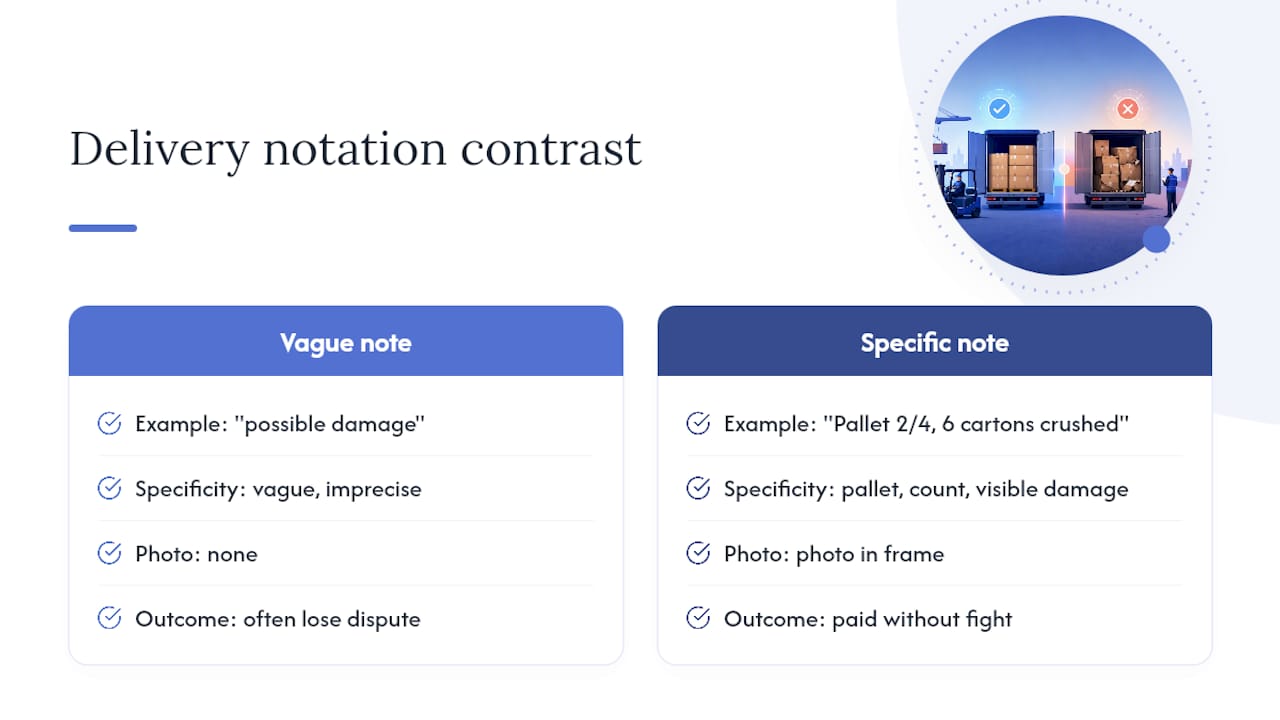
The POD language matters more than most shippers realize. Writing “possible damage” or “subject to inspection” is close to useless in a dispute. Instead, specific numeric notation wins: “Pallet 2 of 4: 6 cartons crushed, contents visibly damaged, photos taken.” Include pallet numbers, carton counts, and SKU references wherever you can.
To calculate your claimed amount, use the actual invoice or replacement cost of the goods, not speculative lost profits. The purpose of a freight claim is to put you back where you’d have been had the shipment arrived intact, not to compensate for a deal you might have made with the goods.
Pro Tip: Photograph the POD notation and the damaged freight together in the same shot whenever possible. A time-stamped photo showing both eliminates the “that damage happened after delivery” argument before a carrier can even raise it.
Never discard damaged goods or packaging without written authorization from the carrier. If a carrier asks to inspect salvage, get that request in writing and ask for a salvage accounting before you let anything go.
How to File a Freight Claim the Right Way
File the claim against the motor carrier that physically hauled the freight, not the broker who arranged the shipment. Brokers generally carry no Carmack liability unless they explicitly accepted it in writing, which is rare. Reporting damage to a broker feels like progress, but it doesn’t start your legal clock or preserve your rights the way a formal claim to the carrier does.
A compliant written claim needs four elements:
- Identification of the shipment (BOL number, PRO number, date, origin, and destination)
- A clear statement of the loss type (damage, shortage, loss, or concealed damage)
- A specific dollar amount claimed, not a range or an estimate to be determined later
- A demand for payment, stated plainly rather than implied
Once the claim package is complete, submit it the smart way:
- Send it by certified mail, tracked courier, or a method that generates delivery confirmation
- Address it to the carrier’s claims department, not a regional dispatcher or driver
- Keep a copy of everything, including the transmittal email or mailing receipt
- Log the submission date on your claims calendar so the 120-day and 9-month clocks are both visible
Follow up in writing if you haven’t heard back within 30 to 60 days. A polite written check-in creates a paper trail that helps later if the carrier drags its feet past the 120-day disposition window.
Why Carriers Deny Freight Claims (and How to Fix It)
Most denials trace back to a handful of repeat offenders, and most of them are preventable with better habits at the dock, not better lawyers later.
- Vague POD notation like “possible damage,” which carriers argue proves nothing specific
- Missing documentation, especially invoices or proof of value
- Late filing past the nine-month statutory window
- Improper packing claims, where the carrier argues the shipper’s packaging caused the damage
- Disposed salvage, where damaged goods were thrown out before inspection
Documentation-based denials are often curable. If a carrier denies your claim for a missing invoice or an unclear photo, you can frequently fix it by resubmitting the missing paperwork and requesting reconsideration. Denials built on an asserted defense, like improper packing, are harder to overturn and usually require you to rebut the specific defense with photos or packing specifications rather than simply resending the same file.
Pro Tip: Keep a standing digital folder per shipment from the moment it leaves your dock, photos, packing specs, and invoices included. A claim assembled in ten minutes from an existing folder beats one built from scratch under deadline pressure.
What to Do After a Freight Claim Denial
A denial letter isn’t the end of the road, but it does start a clock. Read it carefully to determine whether the carrier is disputing your documentation or invoking a legal defense, because that distinction shapes your entire next move.
- Request reconsideration if the denial cites a fixable gap, missing invoice, unclear photo, incomplete BOL
- Negotiate a partial settlement if liability is murky but the carrier wants to avoid litigation costs
- Consider arbitration if your contract with the carrier includes an arbitration clause
- File suit under Carmack within two years of the written denial if negotiation fails
- Bring in counsel or a claims recovery specialist for high-dollar losses or disputed liability findings
Realistic recovery calculations matter here. A carrier weighing a $50,000 lawsuit against a $30,000 settlement offer often settles, but only if your documentation makes the legal outcome look likely to go against them. Weak paperwork invites weak offers.
How Universal Shipping Prevents Claims Before They Start
The best freight claim is the one you never have to file. Usiship builds claim prevention into the shipping process itself rather than treating it as damage control after the fact, starting with how freight gets packed, inspected, and documented before it ever leaves the dock.
- Pre-shipment inspection and photo documentation at pickup, creating the evidence trail before a claim is ever needed
- Specialized handling for furniture and fragile freight, where improper packing is the single most common carrier defense
- Warehousing and fulfillment services that catch shortages and concealed damage before goods reach the end customer
- Coordinated claims documentation support if a loss does occur, so shippers aren’t assembling a BOL, POD, and invoice trail from scratch under a nine-month deadline
| Risk factor | Where it typically originates | How prevention helps |
|---|---|---|
| Concealed damage | Discovered after delivery, often days later | Pre-shipment photos establish condition at origin |
| Improper packing defense | Furniture, electronics, non-standard pallets | Specialized handling reduces the carrier’s strongest defense |
| Missing documentation | Rushed claims assembled after the fact | Ongoing digital records available before a claim is needed |
| Shortage disputes | Miscounts between BOL and delivered pieces | Warehouse inspection catches discrepancies early |
For businesses shipping specialized or high-value furniture, or managing multi-leg freight through logistics and transportation services, that upfront documentation habit is often the difference between a five-minute claim filing and a denied one.
Where to Verify the Legal Details Yourself
The statutes and regulations governing freight claims are public record, and it’s worth reading the primary source rather than relying on secondhand summaries when real money is on the line.
- 49 U.S.C. § 14706, the Carmack Amendment itself, covering carrier liability and filing deadlines
- 49 CFR § 370.3 on Cornell’s Legal Information Institute, defining claim scope and purpose
- Practice guides like LegalClarity’s claim form walkthrough and O Trucking’s shipper guide for sample language and forms
The Playbook Most Shippers Never Write Down
Most freight claim advice treats the nine-month deadline as the headline and everything else as footnotes. That’s backward. The deadline rarely kills claims, sloppy POD notation does. I’ve seen the pattern repeat across the research on this topic: shippers who write “possible damage” at delivery lose disputes they should have won, while shippers who write “Pallet 2 of 4, 6 cartons crushed” with a photo in frame get paid without a fight.
The conventional wisdom says file fast. The better advice is document specifically, then file within the window you already have. Nine months is generous. What’s not generous is a carrier’s willingness to accept vague evidence, and that’s where most claims actually fail.
If you take one thing from this, prioritize the digital folder habit over the legal reading. Know the statute, but build the habit of photographing and specifically notating every shipment before there’s ever a problem to document. The law protects shippers who show up with proof, not shippers who show up with a good story.
— Akbar
Let Usiship Handle the Paperwork Before There’s a Problem
Filing a freight claim after the fact is manageable. Avoiding the need to file one in the first place is better business. Usiship builds inspection, photo documentation, and specialized packing directly into its freight and warehousing services, so the evidence trail carriers demand already exists before a shipment ever leaves the dock.
That matters most for businesses moving furniture, electronics, or anything else where “improper packing” is the carrier’s easiest denial. Usiship’s logistics and transportation services cover the full chain, from pickup inspection through delivery confirmation, and its furniture shipping services apply specialized handling to the freight categories most prone to disputes. For companies weighing whether to manage this in-house or bring in a partner, comparing 3PL services against in-house shipping is a useful next step. Visit Usiship to get a quote and start building shipments with the documentation already in place.
Sources
- 49 U.S.C. § 14706 – Liability of carriers under receipts and bills of lading (Carmack Amendment)
- How to Complete and Submit a Freight Loss and Damage Claim Form – LegalClarity
- How to File a Freight Claim: Shipper Guide (O Trucking)