
Cut 15–20% First Mile Logistics Handoff Tax With 30/90/180 Rollout
First mile logistics covers everything between an order leaving its origin, a factory, supplier, or store, and the moment it hits the first distribution hub or carrier network. It matters because errors here don’t stay contained: a missed pickup or a mislabeled pallet ripples straight through to last-mile delays and blown SLAs. Fixing it comes down to three levers: tighter scheduling, smarter consolidation, and real visibility into what’s moving.
TL;DR:
- Most first-mile delays are caused by fragmented pickups, inaccurate labeling, and missed dock appointments, which lead to downstream delays and higher costs.
- Improving visibility and communication at handoff points between warehouses, carriers, and hubs is essential to reduce inefficiencies and avoid ripple effects.
- Fleet capacity utilization can be increased by standardizing palletization rules, enforcing appointment windows, and consolidating shipments based on geography and timing.
- Implementing demand-signal integration and real-time ETA tracking can significantly cut costs and lead times by optimizing truck loads and rerouting proactively.
- Partnering with integrated logistics providers that unify transportation and warehousing services minimizes handoff errors, reduces first-mile failure rates, and improves overall efficiency.
Table of Contents
- What Does First Mile Logistics Actually Cover?
- How Much Does First-Mile Failure Actually Cost You?
- What Goes Wrong Most Often in First-Mile Operations?
- How Do You Optimize First Mile Logistics Step by Step?
- Which KPIs Actually Tell You First Mile Is Working?
- What’s the Fastest Path to Fixing First Mile?
- Why Integrated Logistics Partners Cut First-Mile Risk
- How Usiship Handles Your First-Mile Operations
- Sources
- FAQ
What Does First Mile Logistics Actually Cover?
First mile starts wherever inventory originates, a supplier’s dock, a factory floor, a retail backroom, and ends at the first distribution center or carrier handoff. Everything in between is the operational engine room that most shippers never audit closely, even though it drives the cost structure for every mile that follows.
The core tasks are consistent across industries:
- Picking and packing orders at the origin point
- Consolidating shipments to fill trailers efficiently
- Labeling and generating documentation for customs or carrier scanning
- Staging freight at the dock for pickup windows
- Handing off to the carrier or transferring into the first hub
Middle mile and last mile logistics run on volume and route density. First mile runs on timing and coordination, since a single missed appointment or partial load creates costs that compound downstream rather than resolving on their own. That distinction is why first mile vs last mile strategy requires different tools: last mile optimizes for delivery density, first mile optimizes for pickup precision and dock throughput.
How Much Does First-Mile Failure Actually Cost You?
A missed pickup doesn’t just delay one shipment. It forces re-dispatch, eats overtime labor, and often means paying for expedited transport to recover the lost time. Siloed optimization between first, middle, and last mile causes roughly 15 to 20 percent efficiency loss at handoffs, according to Locus, and that loss shows up as re-dispatch events, idle dock time, and fragmented loads that never get resolved downstream.
The handoff tax: Every time freight moves between systems or teams without shared visibility, that 15 to 20 percent efficiency gap widens. Unified orchestration and demand-signal integration close it.
Picture a distributor whose morning pickup slips two hours because a pallet wasn’t staged. The carrier reroutes to its next stop, the shipment rebooks for the following day, and the receiving DC now has a same-day cutoff it can’t hit. The customer’s last-mile delivery window, promised at checkout, breaks. Nobody upstream even knows it happened until the complaint lands. Combining forecasting, planning, and visibility tools reduces both costs and lead times by catching exactly this kind of break before it compounds.
What Goes Wrong Most Often in First-Mile Operations?
Most first-mile breakdowns trace back to a short list of repeat offenders. Knowing the pattern is the fastest way to audit your own operation.
- Fragmented pickups. Multiple small shipments leave separately instead of consolidating, driving up per-unit transport cost.
- Wrong or missing labels. Inconsistent labeling formats slow scanning at the first hub and trigger manual rework.
- Underfilled vehicles. Trucks leave at 60% capacity because load planning happens too late to consolidate.
- Missed dock appointments. Pickup windows slip because staging isn’t finished when the carrier arrives.
- Documentation gaps. Customs paperwork or bills of lading are incomplete, stalling freight at the handoff point.
Visibility typically breaks at the exact moment ownership changes hands, from warehouse to carrier, from carrier to hub. That’s usually where operations, carrier management, and supply planning teams stop talking to each other, and it’s the first place worth looking when first-mile costs start creeping up.
How Do You Optimize First Mile Logistics Step by Step?
Fixing first mile logistics is a sequencing problem as much as a technology problem. Start with what you can control this month, then layer in systems that need longer lead times.
Quick operational fixes you can run without new software:
- Cluster pickups by geography and time window instead of dispatching truck by truck
- Enforce appointment discipline with buffer time built into dock schedules
- Standardize labeling formats across every origin site
- Set palletization rules (max height, weight, wrap standard) before freight ever reaches the dock
Technology and orchestration moves that pay off once the basics are stable: feed forward-looking demand signals into carrier allocation so trucks show up sized for what’s actually coming, unify dispatch visibility across a transportation management system (TMS) so every team sees the same pickup status, and use real-time ETA tracking to catch a slipping pickup while there’s still time to reroute rather than after the truck is already gone. Because first-mile vehicles start empty, treating pickups as a dynamic routing and packing problem rather than a fixed schedule tends to produce better capacity utilization across the board.
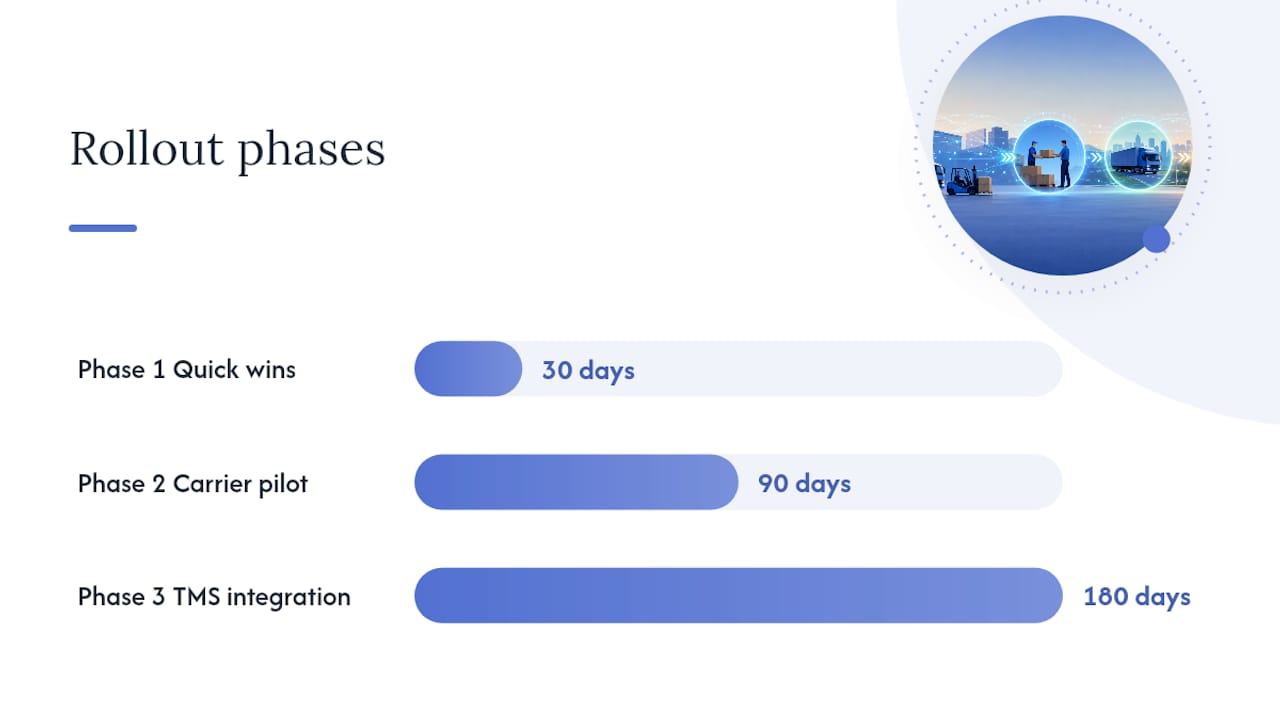
Sequence the work in three phases. In the first 30 days, run quick wins: labeling standards, appointment SLAs, and a pilot on consolidated pickups for your highest-volume lane. In the next 90 days, pilot carrier orchestration with one region and test demand-signal feeds against real order data. By 180 days, integrate your TMS with warehouse and carrier systems so exceptions route automatically instead of surfacing in a phone call.
Pro Tip: Run your first consolidation pilot on your busiest single lane, not your whole network. A 30 to 60 day pilot on one lane gives you clean before-and-after data without risking a network-wide disruption if something doesn’t work as planned.
The non-obvious leverage point most teams miss: feeding forward demand signals into your distribution center allocation decisions before trucks are even scheduled. Enterprises that do this reduce inbound staging conflicts and get better route density on the last-mile side as a direct result, because the DC isn’t scrambling to absorb loads it didn’t see coming.
Which KPIs Actually Tell You First Mile Is Working?
Five metrics cover most of what matters, and none of them require exotic tooling to track.
- On-time pickup rate. The percentage of pickups made within the scheduled window. Track weekly; owned by carrier management.
- Inbound dock utilization. How much of available dock capacity gets used per shift. Track daily; owned by operations.
- Load fill / cube utilization. How full trucks leave relative to capacity. Track per shipment; owned by supply planning.
- Inbound exceptions per 1,000 shipments. Counts mislabeled, damaged, or documentation-flagged loads. Track weekly; owned by operations.
- Handoff dwell time. Time freight sits between arrival and processing at the first hub. Track daily; owned by carrier management.
Fill rate deserves particular attention. AI-driven routing that improves ETA accuracy and route density can cut per-delivery cost 15 to 30 percent in the first year, and that gain traces directly back to how well trucks are loaded at the first-mile stage.
What’s the Fastest Path to Fixing First Mile?
A realistic rollout runs in three stages, each with its own owner and success metric.
- Days 1 to 30: Enforce standardized labeling, pilot consolidated pickups on one lane, and set hard appointment SLAs with buffer windows. Success metric: on-time pickup rate up by a measurable margin over baseline. Owners: operations and carrier management.
- Days 31 to 90: Launch a carrier orchestration pilot in one region, connect a demand-signal feed to DC allocation, and roll out packing rules across all origin sites. Success metric: reduced inbound exceptions and improved load fill. Owners: supply planning and IT.
- Days 91 to 180: Integrate TMS and warehouse visibility systems, automate exception routing so flagged shipments don’t wait for a manual review, and stand up a performance dashboard visible to all three teams. Success metric: sustained dwell-time reduction and dashboard adoption across departments.
Why Integrated Logistics Partners Cut First-Mile Risk
Most first-mile failures happen at the seams, the handoff between warehouse, carrier, and hub, where no single system owns the full picture. Platforms that combine transportation and warehousing services under one roof close that gap because pickup, staging, and dispatch run on shared data instead of three disconnected handoffs. Before signing with any integrated partner, confirm the SLA terms, exactly which systems talk to each other, and how often you’ll get performance reporting. Integration only helps if it’s real integration, not three separate teams sharing a logo.
— Akbar
How Usiship Handles Your First-Mile Operations
Most first-mile breakdowns come from too many disconnected handoffs, one team for pickup, another for labeling, a third for dock scheduling. Usiship runs these under one platform instead of three vendors and three timelines.
Its Freight Forwarding Services cover air, ocean, and land pickup coordination so origin scheduling doesn’t depend on juggling separate carrier contacts. 3PL Fulfillment Services and Warehousing & Fulfillment Solutions handle consolidation and staging before freight ever reaches a dock, which is where most fragmented-pickup problems start. For sellers moving goods into Amazon’s network, FBA prep and labeling services at Usiship address the exact documentation gaps that stall shipments at the first handoff.
If your first-mile costs have been creeping up without a clear cause, the fastest next step is checking current service pricing and getting a quote against your actual shipment volume.
Sources
- Logistics optimization | Inbound Logistics
- First-Mile vs Last-Mile Logistics Optimization | Locus
- Optym — optimization and routing platform (product page)
FAQ
What Is First Mile Logistics?
First mile logistics is the movement of goods from their point of origin, a supplier, factory, or store, to the first distribution center or carrier handoff. It includes picking, consolidation, labeling, and dock staging, and it sets the cost and timing baseline for everything that happens further down the supply chain.
Who Delivers Last-Mile Packages?
Last-mile delivery is typically handled by national parcel carriers, regional couriers, or dedicated last-mile fleets depending on the shipper’s network and delivery commitments. An integrated platform that connects last-mile execution to the same system handling first-mile pickup and warehousing helps unify these logistic stages.
How Long Until My Package Arrives Once It Reaches the Last-Mile Provider?
Transit time from handoff to a last-mile provider typically runs one to three days depending on distance, service level, and carrier network density. Delays at the first-mile stage, a missed pickup or a mislabeled shipment, are one of the most common reasons that window slips.
What Causes Most First-Mile Delays?
The most common causes are fragmented pickups, missed dock appointments, and inconsistent labeling that slows processing at the first hub. Standardizing appointment scheduling and labeling formats resolves a large share of these delays without requiring new technology.
Does Consolidating Shipments Actually Reduce Cost?
Yes. Consolidating shipments improves load fill and reduces the number of partial-capacity trucks leaving the origin, which directly lowers per-unit transport cost. Combining forecasting and visibility tools to build more efficient distribution networks is one of the most reliable ways to reduce both cost and lead time in a first-mile operation.