
FBA Prep Cost in 2026: What You’ll Pay Per Unit
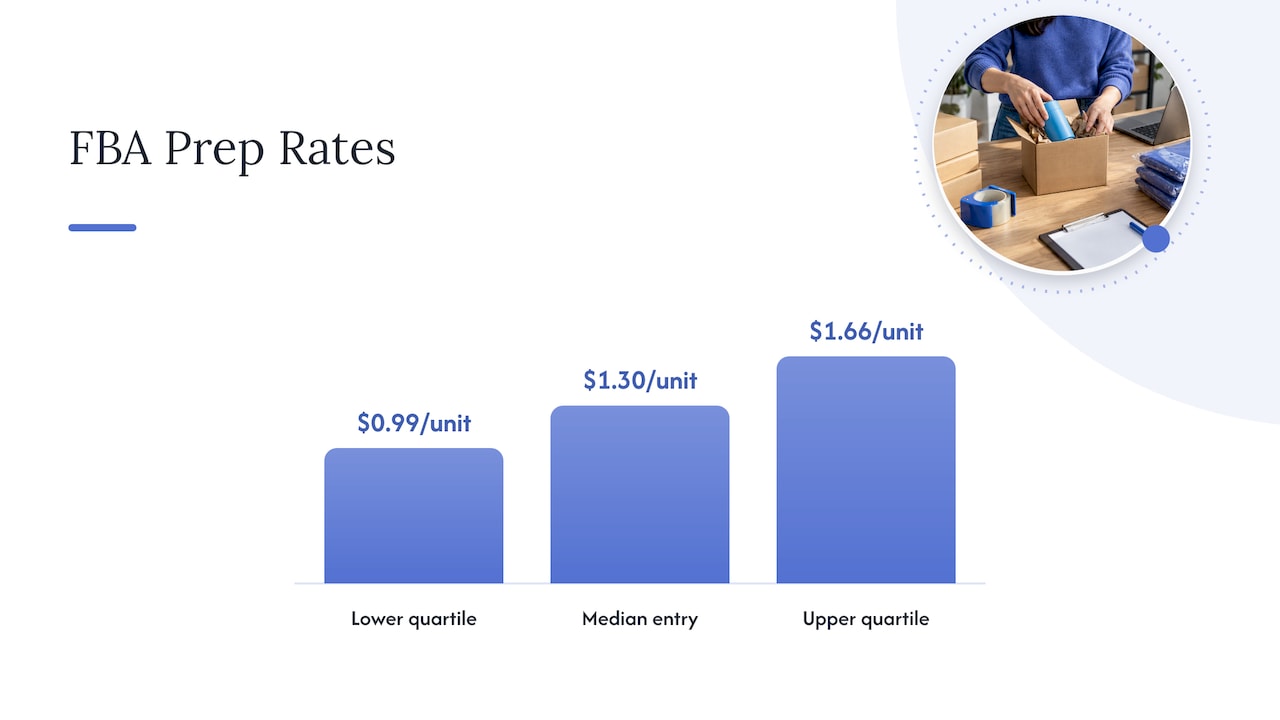
Most U.S. prep centers charge about $1.30 per unit for entry-level FBA prep. Half of them publish rates between $0.99 and $1.66, according to a review of 44 verified U.S. centers’ published rate cards. That figure is only the start. Receiving, storage, packaging, special handling and Amazon’s own fees all land on the same invoice trail, and they decide whether a shipment is profitable.
This guide shows what each line costs, where the extras hide, and how to budget a shipment before it leaves your supplier.
TL;DR
- Entry-level prep (FNSKU labeling plus basic handling) has a median published rate of $1.30 per unit. The middle half of providers charge $0.99 to $1.66.
- Amazon stopped offering prep and labeling for U.S. FBA shipments on January 1, 2026, so every unit has to arrive compliant. Prep is now a cost you plan for, not one you can skip.
- The real cost is the sum of prep, receiving, storage, packaging and add-ons. Ask whether receiving is charged per carton, per pallet or per unit.
- Amazon’s fees sit on top: a 3.5% fuel and logistics surcharge, inbound placement fees and storage charges.
- At Usiship, storage is published at $5-$6 per bin and $17-$19 per pallet per month. Prep and handling are quoted to your SKUs.
Table of Contents
- What FBA prep includes, and why you now pay for it
- What the market charges per unit
- The line items that change the total
- A worked example: 1,000 units
- Amazon’s fees sit on top of prep
- Where sellers overspend
- Our perspective
- How to get a quote you can compare
- Prep with Usiship
- FAQ
- Sources
What FBA prep includes, and why you now pay for it
FBA prep is everything done to your goods between the supplier’s carton and Amazon’s receiving dock: inspection, FNSKU labeling, poly bagging, bubble wrapping, bundling, carton labeling and palletizing. Each step has a labor cost, and a prep center bills it either per unit or per task.
Until recently some sellers let Amazon do part of this. That option is gone. Amazon discontinued its FBA prep and item labeling services in the U.S. store from January 1, 2026. Sellers also report that every item must now arrive fully prepped and labeled, and that non-compliant goods can be rejected, disposed of or block a whole shipment.
So the cost question is no longer “prep or no prep”. It is “do it yourself, or pay someone who does it accurately at volume”.
What the market charges per unit
The best public benchmark is the 2026 rate-card review from fbaprepfinder:
| Measure | Per unit |
|---|---|
| Median entry rate | $1.30 |
| Lower quartile of providers | $0.99 |
| Upper quartile of providers | $1.66 |
That same review notes that these base rates usually cover basic FNSKU labeling and receiving. Bubble wrapping, bundling and oversized handling cost extra. Rates also fall with volume on most cards, so a seller moving 200 units a month and one moving 20,000 will not see the same price.
Treat these numbers as a market range, not a quote. Your price depends on size, fragility, category and how clean your inbound cartons are.
The line items that change the total
A headline per-unit price hides several separate charges. When you compare prep centers, break each quote into these lines.
Receiving
This is where quotes diverge most. Some centers bill receiving per container, some per pallet, some per carton, and some per unit. The fbaprepfinder review warns that billing receiving per unit while also charging prep per unit can mean paying twice for the same handling. Always ask which unit the receiving fee uses before you sign.
Labeling and standard prep
FNSKU labeling is the baseline. Label quality matters as much as price: a smudged or low-resolution barcode gets a shipment held up at the dock. Our guide to checks that prevent FBA receiving rejections covers the label specifications to verify.
Packaging and protective materials
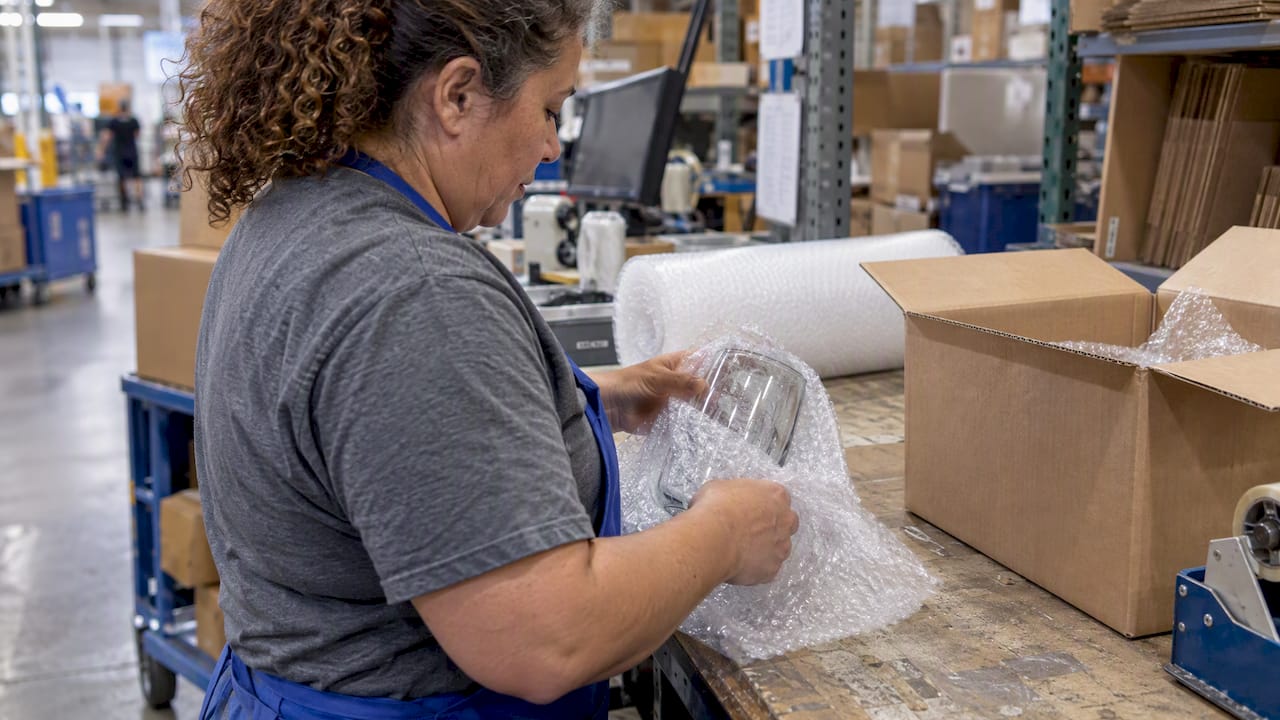
Poly bags, bubble wrap, boxes and stickers are billed either as a flat per-unit add-on or at material cost. Do not cut corners here. Seller discussions on Amazon’s own forum describe the standard that goods must survive a 4-foot drop and rough handling. Damage fees and negative reviews from under-protected glass or liquids can easily exceed the savings.
Special handling
Bundling, kitting, relabeling, inspection photos, expiry dating and battery packaging are usually quoted per task or by the hour. Batteries, for example, have their own rules: Amazon requires that dry batteries be secured so terminals cannot touch metal. Expect time-based billing for anything non-standard. Our published rate for additional services is $37 per hour.
Storage
If stock waits at the prep center before you send it in, storage applies. Our published rates are $5-$6 per month per bin and $17-$19 per month per pallet. Bin storage suits small, fast-moving SKUs. Pallets suit cartons you plan to ship in bulk. For a wider view of how rates are moving, see our 2026 warehouse storage fee benchmarks.
Freight to Amazon
Finally, someone has to carry the goods to the fulfillment center. Pallets and cartons go by LTL or parcel, and the price depends on weight, distance and appointment requirements. Our Send to Amazon workflow guide walks through the dock and pallet fixes that avoid delays.
A worked example: 1,000 units
The numbers below are an illustration built on the market median above, not a Usiship quote.
| Line | Assumption | Cost |
|---|---|---|
| Entry prep and labeling | 1,000 units at $1.30 | $1,300 |
| Protective packaging on 300 units | assume an extra $0.40 each | $120 |
| Special handling | 2 hours at $37 per hour | $74 |
| Pallet storage for 1 month | 2 pallets at $17-$19 | $34-$38 |
| Subtotal before freight and Amazon fees | $1,528-$1,532 |
That is about $1.53 per unit before shipping to Amazon. A seller who only looked at the $1.30 headline would underbudget by roughly 18%. Change the assumptions to match your SKUs, then ask each provider to quote the same list.
Amazon’s fees sit on top of prep
Prep is only the first layer. In 2026, Amazon’s own charges add to landed cost, and they affect how much inventory you should send.
- Fuel and logistics surcharge. Amazon applies a 3.5% surcharge to fulfillment fees, effective April 17, 2026.
- Inbound placement fees. The same source puts them at $0.27-$0.70 per unit for standard-size items shipped to a single fulfillment center.
- Low-inventory-level fees. These run $0.32-$1.11 per unit for sellers without enough stock depth.
- Storage. Non-peak monthly storage is $0.78 per cubic foot, and units stored longer than 271 days carry an added $1.50 per cubic foot per month.
The analysis in that article suggests that holding around two months of inventory in Amazon’s network balances storage cost against low-stock fees. That changes how prep is budgeted: smaller, more frequent shipments mean more handling events, while large infrequent ones tie up cash and raise storage exposure. Our ABC inventory analysis guide shows how to set different replenishment rules for fast and slow SKUs.
Where sellers overspend
Paying per unit for work billed per carton elsewhere. Receiving by the unit on a case-packed product inflates the bill with no benefit to you.
Skipping prep to save pennies. A rejected or disposed shipment costs far more than a labeling fee. The Amazon seller guide frames compliance as the point of the exercise: items should pass checks on the first attempt to protect Prime eligibility and sales velocity.
Ignoring landed cost upstream. Prep savings disappear if freight terms from your supplier are unfavorable. If you import from China, it is worth understanding the hidden risks in CIF terms compared with FOB before you negotiate.
Storing too much at the prep center. Pallets left for months add up. Better racking and tighter inventory control keep this lower, and modular boltless racking is one way operations that hold their own stock keep space costs down.
Unclear tiers. Ask where the price drops and what volume it takes. A rate that falls at 5,000 units a month does nothing for you at 500.
Our perspective
We handle freight, warehousing and prep under one roof, and that changes how we think about the price of prep. A per-unit rate is the easiest number to advertise and the least useful to compare. What sellers actually pay is the sum of receiving, handling, storage and transport, and the gaps between those lines are where surprises happen.
That is why we publish what we can. Our storage rates are listed, and add-on work is billed at a stated hourly rate. Prep itself depends on your product, so we quote it against your SKU list instead of printing a number that would only be true for a perfect box. Our advice is to ask any provider, including us, for a quote that itemizes receiving, prep, packaging, storage and outbound freight, with the billing unit named on each line.
We also think prep should be judged on accuracy as much as price. Since Amazon stopped doing it, a labeling mistake at the prep center becomes your rejected shipment. The cheapest rate is rarely cheapest after a rework.
— Akbar
How to get a quote you can compare
- List your SKUs. Include dimensions, weight, fragility, category and whether each unit needs bagging, wrapping or bundling.
- State your volume. Give monthly units and shipment frequency so tiers can apply.
- Ask for the billing unit on receiving, prep, storage and returns.
- Ask what is excluded: setup fees, minimums, relabeling, photos, disposal.
- Request the outbound plan: carrier, pallet or parcel, and who books the Amazon appointment.
- Price a pilot. Send one small shipment and compare the invoice with the quote.
Prep with Usiship
Universal Shipping offers FBA prep alongside warehousing, 3PL fulfillment and freight forwarding, so inbound freight, storage, prep and delivery to Amazon sit on one platform with real-time tracking. You can see our published storage and handling rates on the pricing page, or explore warehousing and fulfillment. To get FBA prep quoted against your products, start from our main site.
FAQ
How much does FBA prep cost per unit?
Most U.S. centers charge between $0.99 and $1.66 per unit for entry-level prep, with a median of $1.30, based on published 2026 rate cards. Packaging, bundling and oversized handling raise that. Volume usually lowers it.
Does Amazon still prep my items for me?
No. Amazon ended its prep and labeling services for U.S. FBA shipments on January 1, 2026. Items must arrive compliant, either prepped by you or by a prep partner.
What fees does Amazon charge on top of prep?
In 2026 these include a 3.5% fuel and logistics surcharge, inbound placement fees and low-inventory-level fees, plus monthly storage. Check your own Seller Central rate card for the figures that apply to your products.
Is outsourcing prep cheaper than doing it myself?
It depends on volume and your time. At low volume, doing it yourself looks free but costs hours and risks errors. At higher volume, a provider’s per-unit rate usually undercuts the cost of space, labor and mistakes. Price a pilot shipment both ways.
Sources
- FBA prep fees: 2026 rates from real published cards
- Amazon FBA vs. FBM in 2026, Ecommerce Times
- Amazon Seller Policy Updates You Should Know
- Amazon Seller Forums: receiving requirements
- Amazon FBA beginner’s guide 2026
- Amazon: Packaging batteries