
Expedited Freight Decision Matrix for U.S. Logistics Managers
Expedited freight is the priority movement of goods on a compressed timeline, using dedicated vehicles, direct routing, and minimal handling to beat standard transit times. Use it when the cost of a delay (a stalled production line, a stockout, a missed surgery) exceeds the shipping premium. The right move is to work with a carrier or broker offering dedicated capacity, 24/7 live dispatch, and real-time GPS tracking rather than gambling on general freight networks.
TL;DR:
- Expedited freight offers direct, dedicated transportation that bypasses hubs, reducing transit times significantly when delays could cause costly production or service disruptions.
- Service options range from same-day ground and air carrier to dedicated trucks or air charters, with costs increasing rapidly as urgency and complexity rise.
- Accurate quotes require detailed shipment information, including dimensions, handling needs, and precise deadlines, to avoid delays and surprises.
- Speed-oriented shipping must comply with all regulations, including hours-of-service limits and permit requirements, especially for oversize or international freight.
- Choosing a provider with 24/7 dispatch, real-time tracking, clear documentation, and dedicated capacity ensures reliability for urgent, time-sensitive shipments.
Table of Contents
- What Does Expedited Freight Cover, and When Do You Actually Need It?
- Which Expedited Service Type Fits Your Shipment?
- What Drives Expedited Shipping Costs?
- What Information Do You Need Ready for an Accurate Quote?
- What Compliance and Risk Issues Matter Most in Expedited Moves?
- How Do You Choose the Right Expedited Freight Partner?
- Which Service Mode Fits Your Scenario?
- How Usiship Executes an Expedited Freight Move
- Why Most Expedited Freight Advice Undersells the Real Decision
- Get an Urgent Freight Quote from Usiship
- Sources
What Does Expedited Freight Cover, and When Do You Actually Need It?
Expedited freight means a shipment gets its own vehicle, a direct route, and priority handling from pickup to delivery. There’s no waiting for a trailer to fill up, no routing through a regional hub, no sitting in a dock queue behind forty other pallets. The truck (or plane) goes when your freight is ready, and it goes straight to the destination.
That structure is why same-day freight skips the consolidation delays that standard LTL and even most FTL shipments accept as normal. A dedicated vehicle moves your load point-to-point, and nothing else competes for space or schedule priority.
The business case usually comes down to one question: what does an hour of delay actually cost you? A few scenarios where the math almost always favors paying the premium:
- A production line goes down waiting on a single replacement part or component shipment.
- A hospital or clinic needs a medical device, implant, or specimen moved same-day.
- An e-commerce retailer faces a stockout during a peak sales window and needs emergency replenishment.
- A trade show, event, or client delivery has a hard deadline with real financial or reputational consequences.
If a delay costs you more in lost revenue, contractual penalties, or downstream disruption than the expedited rate itself, it’s worth paying for. If the delay is merely inconvenient, standard freight usually wins on cost.
Which Expedited Service Type Fits Your Shipment?
Not every urgent shipment needs the same solution, and picking the wrong tier either wastes money or fails to meet the deadline. Here’s how the main options break down:
- Same-day ground and hot shot. Best for smaller, time-critical loads moving relatively short distances, typically under a few hundred miles. A single driver in a straight truck or cargo van handles pickup through delivery with no stops.
- Dedicated truck (solo driver). Suited to full or partial truckload freight that needs guaranteed exclusivity but doesn’t require overnight coverage. One driver, one truck, one shipment, subject to standard hours-of-service limits.
- Team drivers. Two drivers alternate behind the wheel so the truck keeps moving around the clock. This is the go-to option for long-haul expedited freight that has to cross multiple time zones without an overnight stop.
- Next-flight-out (NFO) air. Books your shipment on the next available commercial flight, moving it airport-to-airport in hours instead of days. Ground transportation on both ends still has to be coordinated.
- Air charter. A dedicated aircraft for the highest-urgency, highest-value moves, often used when even NFO isn’t fast enough or no commercial flight aligns with the deadline. Charter and NFO options convert cross-country transit into a matter of hours, but at a steep cost premium.
For sub-70-pound parcels, USPS Priority Mail Express is worth a look too. It offers delivery within a few days with a money-back guarantee and flat-rate pricing, which can beat a dedicated truck for small, urgent parcel shipments.
The tradeoff across all five is straightforward: speed climbs, cost climbs faster, and available capacity shrinks the more specialized the service gets.
What Drives Expedited Shipping Costs?
Expedited freight pricing runs on four main levers: how urgent the request is, how far it’s traveling, what type of vehicle or aircraft it needs, and whether the load requires exclusive use of that vehicle. Change any one of those and the quote moves.
Carriers structure the actual charges a few different ways:
- Flat rush fees added on top of a base rate for last-minute bookings, especially anything requested same-day or after normal dispatch hours.
- Per-mile dedicated pricing, common for solo-driver and team-driver truck moves, often with a minimum mileage or minimum charge built in regardless of actual distance.
- Wait-time and after-hours surcharges when a driver arrives on schedule but the shipper isn’t ready to load, or when delivery falls outside standard business hours.
- Permit and escort fees for oversize or overweight loads that require state-specific permitting or a pilot car.
Fast fact: dedicated vehicle pricing is built around exclusivity and speed, which is why per-mile rates and minimum charges apply even on short hauls. You’re paying for the truck’s undivided attention, not just the miles it covers.
Costs jump sharply in a few predictable situations: booking air charter with less than a day’s notice, needing permits and escorts for an oversized load, or requiring a Sunday or holiday pickup. If your freight regularly hits any of those triggers, it’s worth negotiating standing rates with a provider instead of shopping the spot market every time.
What Information Do You Need Ready for an Accurate Quote?
Dispatchers can only quote as fast as you can hand them clean data. Missing details are the single biggest cause of quote delays and mid-route surprises, so have this ready before you call:
- Exact pickup and delivery addresses, including dock or gate access notes.
- Pickup window and required delivery time, stated as a firm deadline if one exists.
- Dimensions, weight, and packaging type (palletized, crated, loose) for every piece.
- Any special handling needs: temperature control, hazmat classification, fragile or high-value cargo.
- Required permits for oversize or overweight freight.
- Preferred contact method for dispatch updates and who signs for proof of delivery (POD).
Pro Tip: Keep a standing shipment template with your most common origin and destination details pre-filled. When a line-down call comes in at 6 a.m., you shouldn’t be hunting for a loading dock’s gate code.
Attach any documentation the load requires up front, like a packing list, hazmat paperwork, or a certificate of insurance for high-value freight. A dispatcher who has to chase down documents after the truck is already rolling is a dispatcher who’s about to miss your delivery window.
What Compliance and Risk Issues Matter Most in Expedited Moves?
Speed doesn’t override federal trucking regulations, and a provider who suggests otherwise is a red flag on its own. A few areas deserve specific attention:
- Hours-of-service (HOS) limits. A solo driver is legally capped on daily and weekly driving hours. If your shipment needs to move continuously across a long distance without a break, you need team drivers, not a promise that one driver will “push through.”
- Oversize and overweight permits. Requirements vary by state, and moves crossing multiple states may need separate permits for each one, sometimes with escort vehicles required above certain dimensions.
- Insurance coverage and claims. Confirm cargo insurance limits before you book, especially for high-value freight, and ask what the claims process looks like if something goes wrong in transit.
- Chain-of-custody documentation. For sensitive or regulated cargo, insist on signed POD at every handoff point, not just final delivery.
Trucking capacity itself fluctuates with broader industry conditions. Data from the American Trucking Associations tracks utilization trends that affect how easily carriers can staff last-minute expedited requests, particularly during high-demand periods.
How Do You Choose the Right Expedited Freight Partner?
A capable expedited provider should be able to answer basic operational questions without hesitation. If a sales rep gets vague when you ask about dispatch hours or tracking, that’s your answer.
Look for these baseline capabilities before signing anything:
- 24/7 live dispatch. Urgent freight doesn’t wait for business hours, and neither should your carrier’s phone line.
- Dedicated capacity, meaning access to trucks, drivers, or air options that aren’t shared with lower-priority freight.
- Real-time GPS tracking with visibility you can check yourself, not just a status update relayed secondhand.
- Documented proof of delivery and a clear claims process in writing.
- Licensed brokerage and customs clearance capability if your expedited move crosses international borders.
Watch for red flags: no written service level agreement (SLA), no live tracking link, or a claims process nobody can describe clearly when you ask. Industry guides on expedited carriers consistently point to network coverage and tracking technology as the real differentiators between providers, not marketing language.
Pro Tip: Ask a prospective carrier for their average time-to-dispatch on a same-day request placed after 5 p.m. The answer tells you more about their real capacity than anything on their website.
Before booking, get specifics in writing: guaranteed pickup window, guaranteed delivery window, what happens (financially) if either is missed, and who to call if the driver goes dark mid-route.
Which Service Mode Fits Your Scenario?
Different urgency levels call for different tools, and matching the right mode to the situation saves both time and money.
- A production line-down call for a single critical part usually points to hot shot or a dedicated straight truck, moving fast over a short-to-medium distance.
- A hospital or medical device emergency often needs NFO air for cross-country distance, paired with a local courier on each end for the last mile.
- Urgent e-commerce replenishment during a demand spike typically works best with a dedicated truck route feeding directly into fulfillment, especially when omnichannel fulfillment operations are already in motion.
- Oversized equipment moves almost always require a dedicated truck with permits, sometimes escort vehicles, and longer lead times even within an “expedited” framework.
| Scenario | Delivery window needed | Typical shipment size | Recommended mode |
|---|---|---|---|
| Production line-down | Hours, same day | Small to medium | Hot shot / dedicated truck |
| Medical emergency | Hours | Small | NFO air + local courier |
| E-commerce restock | 1 to 2 days | Medium to large | Dedicated truck |
| Oversized equipment | 1 to 3 days | Large / oversize | Dedicated truck with permits |
The booking workflow follows a similar shape regardless of scenario: confirm the deadline, gather dimensions and special handling needs, get a quote against dedicated capacity, and lock the pickup window immediately once the deadline is firm.
How Usiship Executes an Expedited Freight Move
Some expedited freight providers run shipments through a coast-to-coast trucking network with licensed customs brokerage available for shipments crossing international borders. Every move follows the same operational sequence: you submit shipment details and a required delivery window, dispatch returns a quote against available dedicated capacity, the load gets assigned and picked up, and you get real-time GPS tracking for the full route.
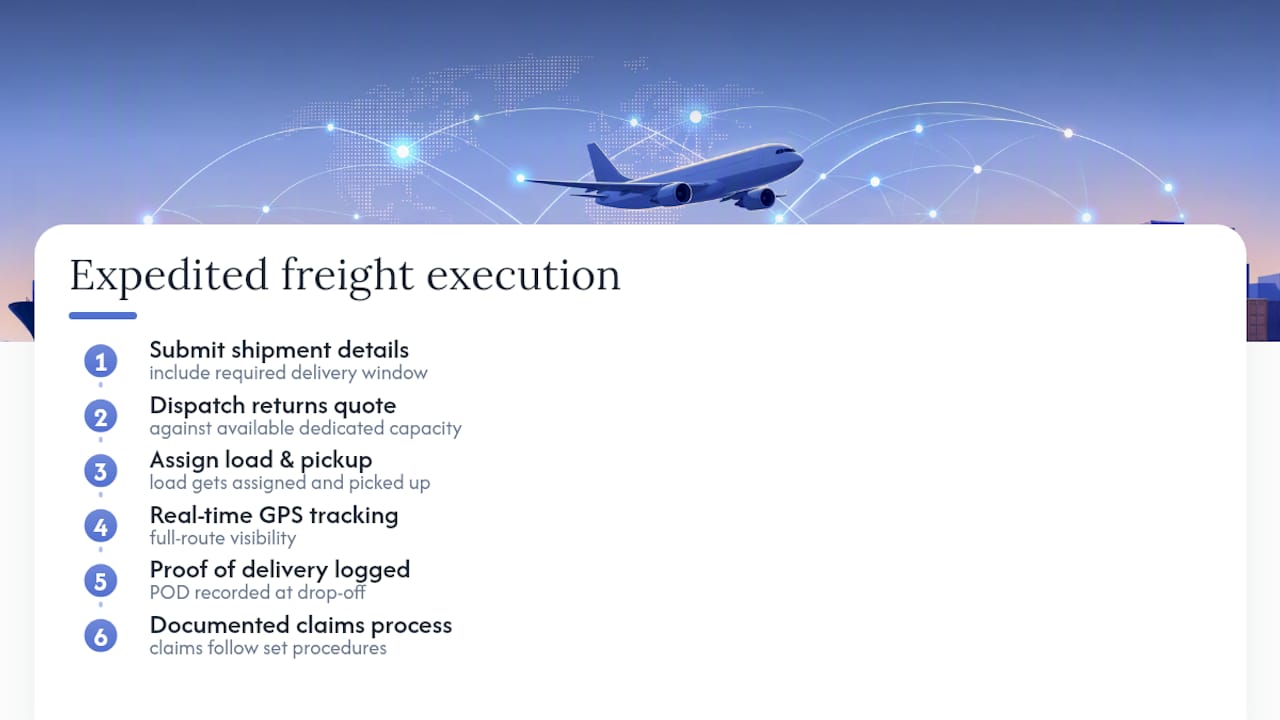
Proof of delivery gets logged at drop-off, and any claims follow a documented process rather than a guessing game. The distinguishing factor isn’t any single piece of technology. It’s pairing that visibility with a dispatch team that actually picks up the phone at 2 a.m., because urgent freight rarely announces itself during business hours.
That combination, technology-driven tracking plus a person accountable for your shipment start to finish, is what separates a genuinely reliable logistics and transportation partner from one that just says the right things in a sales call.
Why Most Expedited Freight Advice Undersells the Real Decision
Most guidance on this topic treats expedited freight as a single yes-or-no switch: either you pay the premium or you don’t. That framing misses the actual decision, which is choosing the right tier of urgency, not just whether to go fast. A hot shot truck and an air charter are both “expedited,” but they solve different problems at wildly different price points, and picking the wrong one wastes money in one direction or blows a deadline in the other.
The conventional advice also underweights documentation. Shippers obsess over finding the fastest truck and then lose an hour at pickup because nobody prepped the packing list or hazmat paperwork. Speed on the road means nothing if the shipment sits at the dock waiting on a signature.
If you take one thing from this, prioritize partner evaluation over price shopping. A provider with real dedicated capacity and live dispatch will consistently outperform a cheaper quote from a broker who has to scramble for a truck after you’ve already called. In an emergency, that gap in performance costs far more than the difference in rate.
— Akbar
Get an Urgent Freight Quote from Usiship
Usiship runs the full range of expedited options this guide covers: dedicated truck dispatch, hot shot and team-driver moves for long-haul urgency, and coordination for air-based options when a shipment needs to cross the country in hours instead of days. For international moves, licensed customs brokerage is handled in-house instead of getting outsourced to a third party who slows everything down.
To get a fast, accurate quote, have your pickup and delivery windows, dimensions and weights, and any special handling requirements ready when you reach out. A reliable dispatch team works around the clock, so a line-down call at midnight gets the same response as one placed at noon. If you’re managing recurring urgent shipments, ask about dedicated transportation solutions built around your specific lanes rather than one-off spot quotes. Request an urgent freight quote directly through Usiship’s site to get dispatch working on your shipment today.
Sources
For deeper background on the topics covered here, consult the American Trucking Associations’ industry data, USPS Priority Mail Express details, and the Inbound Logistics expedited carriers guide. For tracking best practices across complex moves, see this partner guide on logistics tracking.
- Economics & industry data | American Trucking Associations
- Priority Mail Express® | USPS
- Expedited Carriers Guide 2024 | Inbound Logistics