
EEI Filing Requirements: The Complete U.S. Exporter Guide
Electronic Export Information (EEI) is the electronic export declaration U.S. exporters submit to the Automated Export System (AES) before a shipment leaves the country. If the value of any commodity under a single Schedule B number exceeds $2,500, or if the shipment requires an export license, involves ITAR-controlled goods, or is destined for an embargoed country, you must file. The filing goes through ACE AESDirect, the U.S. Census Bureau’s free portal, or through an authorized U.S. agent. Once submitted, the system returns an Internal Transaction Number (ITN) — that number is your proof of filing, and the carrier needs it before loading.
Quick reference before you read further:
- $2,500 threshold: EEI is required when any single Schedule B commodity value exceeds $2,500 per shipment.
- License/ITAR/ECCN triggers: Any export requiring a license, involving ITAR-controlled items, or classified under a controlled ECCN requires EEI regardless of value.
- Predeparture timing: Filing must be completed before export — vessel shipments 24 hours before loading, air 2 hours before departure, truck 1 hour before border arrival.
- ITN requirement: The ITN generated after a successful AES submission must be cited on the bill of lading or air waybill before the carrier loads the shipment.
- Filing channel: ACE AESDirect is free and requires only an ACE account registration. Certified software and authorized agents are also permitted under 15 CFR § 30.2.
Key Takeaways
EEI filing is a legal requirement under 15 CFR Part 30 for any U.S. export exceeding $2,500 per Schedule B number or involving a controlled, licensed, or restricted commodity, and the ITN generated by AES is the carrier’s required proof of filing before loading.
| Point | Details |
|---|---|
| Filing trigger | EEI is required when any commodity exceeds $2,500 per Schedule B number, or when a license, ITAR, ECCN, or restricted destination applies. |
| Who files | The USPPI is legally responsible; a foreign USPPI must appoint a U.S.-based authorized agent under 15 CFR § 30.3. |
| Timing deadlines | Vessel: 24 hours pre-loading; air: 2 hours pre-departure; truck: 1 hour before border arrival; used vehicles: 72 hours. |
| ITN as proof | The ITN returned by AES must appear on the bill of lading or air waybill before the carrier loads the shipment. |
| Usiship support | Usiship provides licensed customs clearance, EEI filing, classification support, and ITN delivery integrated with freight forwarding services. |
Table of Contents
- What is Electronic Export Information and why does it matter?
- When do you need to file EEI?
- Who is responsible for filing EEI?
- How to file EEI: methods and step-by-step AESDirect workflow
- What data fields does EEI require?
- When to file and how the ITN works
- How to amend EEI and fix AES rejections
- Penalties and enforcement for EEI noncompliance
- How a licensed forwarder can help with EEI compliance
- What exporters get wrong about EEI compliance
- Usiship handles EEI filing and customs clearance so you can focus on your business
- Sources
What is Electronic Export Information and why does it matter?
EEI is the U.S. government’s electronic export declaration. When you file it through the Automated Export System, you are reporting commodity, party, and transportation data to the Census Bureau and making that data available to U.S. Customs and Border Protection (CBP) for screening. The governing regulation is 15 CFR Part 30, commonly called the Foreign Trade Regulations (FTR).
The practical stakes go beyond statistics collection. EEI is the primary mechanism through which the government screens shipments against export license requirements, ITAR controls administered by the State Department’s Directorate of Defense Trade Controls (DDTC), and Export Administration Regulations (EAR) controls administered by the Commerce Department’s Bureau of Industry and Security (BIS). A missing or inaccurate EEI filing can trigger a CBP hold at the port, a BIS or DDTC investigation, or both.
Carriers also have skin in the game. Under the FTR, a carrier cannot load a shipment that requires EEI unless the shipper has provided a valid ITN or a proper NOEEI exemption citation. That means your compliance problem becomes the carrier’s problem fast, and most carriers will simply refuse to load rather than risk their own liability.
When do you need to file EEI?
The short answer: more often than most exporters expect. Here are the mandatory filing triggers under the FTR:
- Value over $2,500 per Schedule B number: The threshold applies per commodity classification, not per shipment total. A single shipment with three Schedule B numbers, each valued at $2,000, does not require EEI. Change one of those to $2,600 and that commodity line requires a filing.
- Export license required: Any shipment requiring a Commerce, State, or other U.S. government export license requires EEI regardless of value.
- ITAR-controlled items: Defense articles and defense services controlled under the U.S. Munitions List (USML) always require EEI.
- EAR-controlled items with a license requirement or license exception reporting obligation: Certain ECCN-classified items require EEI even below $2,500.
- Embargoed and sanctioned destinations: Shipments to Cuba, Iran, North Korea, Syria, and other OFAC/BIS-restricted destinations require EEI.
- Rough diamonds: All exports of rough diamonds (HS 7102.10, 7102.21, 7102.31) require EEI under the Clean Diamond Trade Act.
- Used self-propelled vehicles: Required regardless of value or destination (with limited exceptions).
- Shipments valued over $2,500 to Puerto Rico or U.S. territories: These are treated as exports for statistical purposes and require EEI.
Major exemptions and NOEEI citations
Trade identifies the most commonly used exemptions. When a shipment qualifies, you must annotate the commercial invoice, air waybill, or bill of lading with the applicable NOEEI citation instead of an ITN.
- NOEEI 30.36: Shipments from the U.S. to Canada (most goods, with exceptions for controlled items, rough diamonds, and used vehicles).
- NOEEI 30.37(a): Shipments valued at $2,500 or less per Schedule B number, when no license is required.
- NOEEI 30.37(h): Shipments of technology and software that are not subject to EAR or ITAR.
- NOEEI 30.39: Shipments by or for the U.S. government.
The annotation format on the shipping document reads: “No EEI required — NOEEI [cite].” Getting that citation wrong is treated the same as a missing filing by CBP.
How value is defined
Value for EEI purposes is the selling price of the goods plus inland freight, insurance, and other charges incurred to move the goods to the U.S. port, airport, or land border of export. It is not the FOB port price alone, and it is not the invoice total if that invoice includes post-export charges. Get this right before you decide whether a filing is required.
Scenario A: You ship machine parts valued at $2,200 per Schedule B number, with $400 in domestic freight to the port. Total EEI value = $2,600. Filing required.
Scenario B: You ship three product lines, each under $2,500 per Schedule B, no license required, destined for Canada. No EEI required; annotate documents with NOEEI 30.36.
Who is responsible for filing EEI?
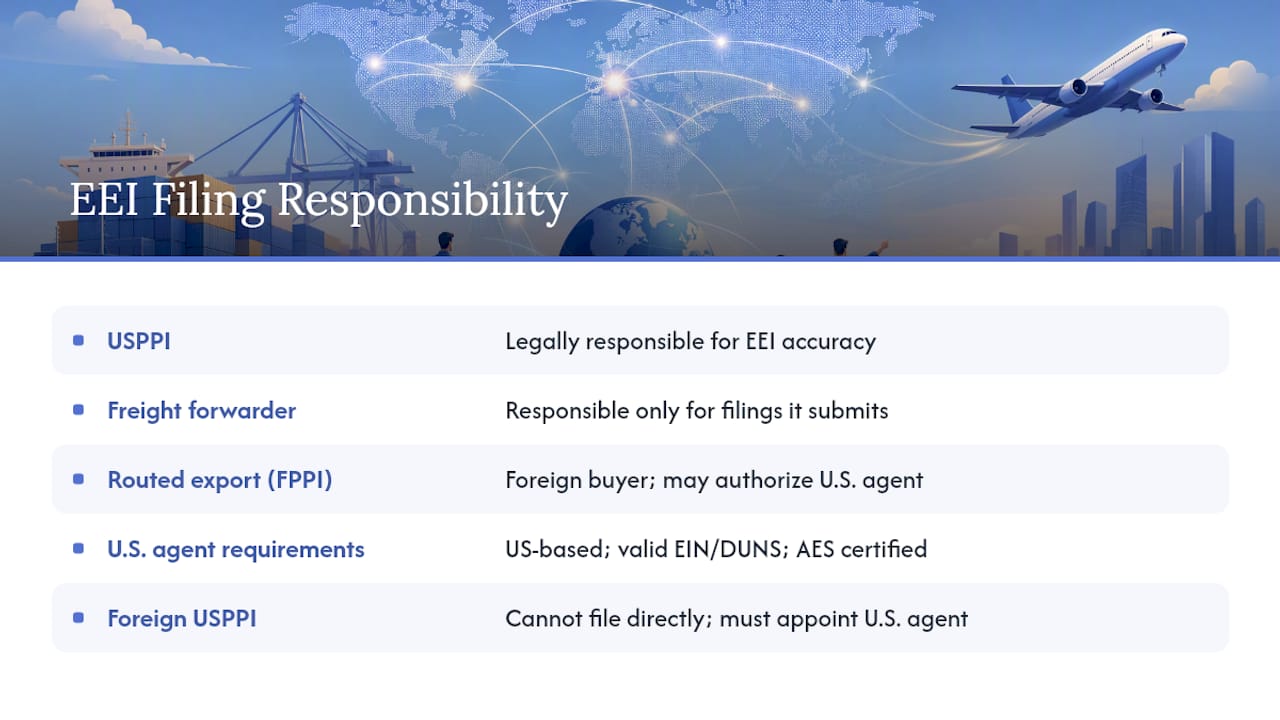
Filing responsibility sits with the United States Principal Party in Interest (USPPI) — typically the U.S. manufacturer, seller, or order party that receives the primary benefit of the export. Under 15 CFR § 30.3, the USPPI is legally responsible for the accuracy and completeness of the EEI even when an agent files on its behalf. That last point trips up a lot of exporters who assume their freight forwarder carries the liability. The forwarder is responsible for what it files; the USPPI is responsible for the accuracy of the data it provides.
A Foreign Principal Party in Interest (FPPI) is the foreign buyer or consignee. In a routed export transaction, the FPPI controls the movement of the goods and may authorize a U.S. agent to file EEI on its behalf. In that case, the U.S. agent assumes filing responsibility, but the USPPI must still provide the agent with accurate commodity and value data.
A foreign USPPI cannot file EEI directly. If the exporter is a foreign entity, it must appoint a U.S.-based authorized agent to file. That agent must be physically located in the United States, hold a valid EIN or DUNS number, and meet AES certification requirements.
What exporters must provide when using an agent
When you outsource EEI filing, your compliance exposure does not disappear. Protect yourself with this documentation checklist:
- A written Power of Attorney (POA) or written authorization from the USPPI to the agent.
- A copy of the filed EEI or the ITN for every shipment.
- The agent’s Filer ID/EIN and confirmation of AES certification.
- Retention of supporting documents: commercial invoices, packing lists, classification analyses, and the POA for a minimum of five years from the date of export.
How to file EEI: methods and step-by-step AESDirect workflow
Choosing a filing method
15 CFR § 30.2 permits three filing methods, and the AES overview page explains participant eligibility for each:
| Filing Method | Best For | Cost | Certification Required |
|---|---|---|---|
| ACE AESDirect (web portal) | Small to mid-volume exporters filing directly | Free | ACE account registration |
| Certified software / direct connection (AESTIR) | High-volume exporters with ERP/TMS integration | Software cost varies | AES certification + AESTIR compliance |
| Authorized agent (freight forwarder/broker) | Routed transactions, foreign USPPIs, low-volume exporters | Agent fees | Agent holds certification |
For most U.S. exporters filing fewer than a few hundred shipments per year, ACE AESDirect is the practical choice. High-volume operations that want to push filings directly from their ERP systems use the AESTIR technical specification and must complete AES certification before going live.
Step-by-step: filing EEI in ACE AESDirect
The AESDirect User Guide documents the full Shipment Manager workflow. Here is the practical sequence:
- Register for an ACE account at ACE.CBP.DHS.gov if you do not already have one. Select the AESDirect role during setup.
- Log in to ACE AESDirect and navigate to the Shipment Manager.
- Create a new export filing. Select “Create Export Filing” and choose your filing option: predeparture (standard) or postdeparture (only if your company holds approved postdeparture authorization from the Census Bureau).
- Enter shipment-level data: port of export, country of destination, mode of transport, estimated departure date, and in-bond code if applicable.
- Enter party information: USPPI name, EIN, and address; ultimate consignee name and address; intermediate consignee if applicable; authorized agent if filing on behalf of USPPI.
- Enter commodity data for each line: Schedule B or HTS number, commodity description, quantity and unit of measure, value (as defined above), shipping weight, and ECCN or USML category if the item is controlled. Add the export information code (e.g., OS for domestic goods, FP for foreign goods).
- Enter transportation details: carrier SCAC (for vessel/truck/rail) or IATA code (for air), conveyance name or flight number, and port of unlading.
- Preview the filing and review all fields for accuracy before submission.
- Submit. AES will return either an ITN (a 14-character alphanumeric confirmation number beginning with “X”) or a Fatal Error requiring correction before the filing is accepted.
- Record the ITN and provide it to the carrier on the bill of lading or air waybill before loading.
Predeparture vs. postdeparture filing
Standard EEI must be filed predeparture, with timing windows that vary by mode (covered in detail in the timing section below). Postdeparture filing is available only to exporters who have applied for and received written authorization from the Census Bureau. It is not a default option, and most exporters do not qualify. If you are unsure whether your company holds postdeparture authorization, assume predeparture rules apply.
What data fields does EEI require?
Getting every required field right before you submit is the single most effective way to avoid AES rejections. The table below covers the core data elements.
| Data Element | Notes |
|---|---|
| Filing option | Predeparture or postdeparture (if authorized) |
| USPPI name, EIN, and address | U.S. address required; EIN is mandatory |
| Ultimate consignee name and address | Foreign buyer or end-user |
| Intermediate consignee | If goods pass through a third party before reaching the ultimate consignee |
| Authorized agent name and EIN | Required when an agent files on behalf of USPPI |
| Schedule B or HTS number | 10-digit; use Schedule B for exports (see below) |
| Commodity description | Plain-language description matching the Schedule B |
| Quantity and unit of measure | Must match the Schedule B unit (e.g., kg, number, dozen) |
| Value | Selling price plus domestic freight/insurance to port of export |
| Shipping weight | In kilograms |
| Export information code | OS (domestic), FP (foreign), etc. |
| ECCN | Required for EAR-controlled items; enter “EAR99” if applicable |
| License type and number | Required when an export license is needed |
| USML category | Required for ITAR-controlled defense articles |
| Mode of transport | Vessel, air, truck, rail, mail, etc. |
| Carrier SCAC or IATA code | Identifies the carrier |
| Conveyance name or flight number | Vessel name or flight identifier |
| Port of export | U.S. CBP port code |
| Country of destination | Final destination country |
| Estimated departure date | Date goods leave the U.S. |
| In-bond code | If goods are moving in-bond |
Schedule B vs. HTS: which one do you use?
Both Schedule B and the Harmonized Tariff Schedule (HTS) use the same first six digits (the international HS code), but they diverge at the 7th digit. For exports, use the Schedule B number. HTS numbers are technically for imports, though CBP and Census accept HTS numbers in AES when a valid Schedule B does not exist for a commodity.
The Census Schedule B search tool is the official classification resource. If you cannot identify the right number, call the Census Bureau’s trade help line at 1-800-549-0595, option 2. Getting the Schedule B wrong is one of the top causes of AES rejections and, more seriously, one of the most common triggers for regulatory scrutiny.
ECCN and ITAR classification
If your product has any military, dual-use, or technology component, you need to determine its Export Control Classification Number (ECCN) under the EAR Commerce Control List (CCL) before filing. Items not on the CCL are classified as EAR99. Items on the U.S. Munitions List require a USML category designation and are subject to ITAR, not EAR.
When in doubt, request a commodity classification ruling from BIS (for EAR items) or DDTC (for ITAR items). Commercial invoices often omit Schedule B or ECCN data entirely, so teams that require technical classification sign-off from engineering or product management before filing reduce misclassification risk significantly. Misclassifying a controlled item as EAR99 when it belongs on the CCL is not a paperwork error — it is a potential criminal violation.
When to file and how the ITN works
15 CFR § 30.4 sets the predeparture filing deadlines by mode of transport:
- Vessel: 24 hours before cargo is loaded onto the vessel.
- Air: 2 hours before the scheduled departure of the aircraft.
- Truck (road): 1 hour before the truck arrives at the U.S. border.
- Rail: 2 hours before the train departs.
- Mail: 2 hours before the postal shipment is tendered to the postal service.
- Used self-propelled vehicles (vessel): 72 hours before loading — a special rule that catches many exporters off guard.
Missing these windows is not a minor administrative issue. A carrier that loads without an ITN or valid NOEEI citation is in violation of the FTR, and CBP can hold or seize the shipment.
The ITN: what it is and what to do with it
The ITN is the 14-character alphanumeric number AES returns when a filing is accepted (format: X followed by 13 digits, e.g., X20260101123456). Per the AESDirect User Guide, the ITN is the official proof of filing. It must appear on the bill of lading, air waybill, or other shipping document presented to the carrier before loading. Never hand off a shipment to a carrier without confirming the ITN is documented.
System downtime
If AES is unavailable, 15 CFR § 30.4 provides a downtime citation procedure. Filers may use the official downtime citation on shipping documents and must file as soon as the system is restored. For certain controlled shipments, the export must be delayed until an ITN is obtained — the downtime procedure does not waive the filing requirement.
Recordkeeping
The FTR requires exporters to retain all EEI-related documentation for five years from the date of export. That includes the filed EEI or ITN, the commercial invoice, packing list, POA, any export license, and classification analyses. Store these in a retrievable format — Census and CBP auditors will ask for them.
How to amend EEI and fix AES rejections
Amending a prior filing
Errors happen. The AESDirect Shipment Manager lets you retrieve any prior filing by ITN or Shipment Reference Number (SRN) and edit it. The AESDirect User Guide covers the amend workflow in detail. The key identifiers you need: the ITN, the SRN, and your Filer ID. Once retrieved, edit the incorrect fields, preview, and resubmit. AES will return a new response — either a revised ITN confirmation or a new error message.
File amendments as soon as you discover an error, not at the end of the month. Proactive correction before CBP or Census identifies the discrepancy is treated far more favorably than a correction made in response to an inquiry.
Top AES rejection causes and how to fix them
- Incorrect Schedule B/HTS number. Cross-check against the Census Schedule B search tool before every filing. If the commodity description does not match the Schedule B, AES will reject it.
- Missing mandatory fields. AES will return a Fatal Error listing the specific field. Review the error code, fill the missing field, and resubmit.
- Invalid carrier SCAC or IATA code. Verify the carrier code directly with the carrier before filing. SCAC codes change when carriers merge or rebrand.
- Value mismatches. The EEI value must include domestic freight to the port. If your invoice shows FOB factory and you file that number, the value is likely understated.
- Mismatched party information. USPPI EIN must match Census records exactly. A transposed digit will cause a rejection.
- Incorrect ECCN or missing license citation. If a license is required and the license number is missing or the ECCN is wrong, AES will reject or flag the filing for review.
- Bad transport dates. Departure dates in the past or formatted incorrectly (AES requires MM/DD/YYYY) cause rejections.
- Formatting errors in addresses or descriptions. Special characters, abbreviations not recognized by AES, and truncated descriptions are common culprits.
Pro Tip: Build a preflight checklist your team runs on every outbound booking before the filing is created: confirm Schedule B, verify carrier SCAC, confirm value calculation includes domestic freight, and confirm ECCN/license status. Five minutes before filing prevents hours of amendment work after.
Penalties and enforcement for EEI noncompliance
The FTR’s penalty provisions are not theoretical. Under 15 CFR Part 30, civil penalties for failing to file EEI, filing late, or filing inaccurate information can reach $10,000 per violation. Criminal penalties for willful violations can reach $10,000 per violation and include imprisonment. Seizure of the shipment is also a tool CBP uses for egregious or repeat violations.
Misclassification carries a separate and often more serious exposure. If an incorrect Schedule B or ECCN results in an unlicensed export of a controlled item, the exporter faces potential BIS or DDTC enforcement action, which operates on a different penalty scale entirely — BIS administrative penalties can reach $300,000 per violation or twice the value of the transaction, whichever is greater.
The USPPI remains legally liable for EEI accuracy even when a forwarder files on its behalf. Exporters who assume their agent carries full responsibility for errors are mistaken. The agent is responsible for what it files; the USPPI is responsible for the accuracy of the data it provides to the agent.
Recordkeeping as audit defense
A well-maintained documentation file is your first line of defense in any audit. Retain the following for five years from the export date:
- Filed EEI or ITN confirmation
- Commercial invoice and packing list
- POA or written authorization to agent
- Export license (if applicable)
- Classification analysis or commodity jurisdiction determination
- Correspondence with BIS or DDTC if a ruling was requested
How a licensed forwarder can help with EEI compliance
Most U.S. exporters eventually face a choice: file EEI in-house or outsource to a licensed freight forwarder or customs broker. The right answer depends on your volume, commodity complexity, and internal compliance resources.
A qualified forwarder or broker provides:
- EEI preparation and filing on behalf of the USPPI or FPPI (routed transactions).
- Commodity classification support for Schedule B and ECCN determination.
- ITN delivery to the carrier before loading, eliminating the risk of a missed deadline.
- Amendments and rejection handling when AES returns errors.
- AES certification assistance for exporters who want to file in-house eventually.
- Certified software integration for high-volume operations using ERP or TMS platforms.
- Customs brokerage coordination for import clearance on the receiving end.
Questions to ask before you hire an agent
Not every freight forwarder is equally equipped for EEI compliance. Before signing a POA, ask:
- Are you AES-certified, and can you provide your Filer ID?
- Do you maintain a physical U.S. filing location?
- Do you provide a written POA template, and do you retain a copy?
- How do you deliver ITNs to carriers — and what is your process if AES is down?
- Do you hold a licensed customs broker designation?
- How do you handle ECCN/ITAR classification — do you have in-house expertise or do you refer out?
Pro Tip: Ask any prospective agent for a sample ITN delivery confirmation from a recent shipment. An agent who cannot produce one quickly probably does not have a reliable process for getting ITNs to carriers on time.
When outsourcing makes sense versus filing in-house: if your shipments are high-value, involve controlled commodities, or go to complex destinations, a licensed forwarder’s expertise reduces your exposure materially. For straightforward commercial goods under $10,000 with no license requirements, in-house filing through ACE AESDirect is manageable once your team is trained. The 3PL vs. in-house shipping comparison covers the broader cost-benefit analysis.
What exporters get wrong about EEI compliance
Most EEI problems are not caused by ignorance of the rules. They are caused by process gaps: a classification that never got updated after a product redesign, a carrier SCAC that changed when a shipping line merged, or a value calculation that has been wrong for two years because nobody questioned the template.
The exporters who stay out of trouble treat EEI as a data quality problem, not a paperwork problem. That means building classification sign-off into the product launch process, not just the shipping process. It means requiring your forwarder to deliver ITN confirmations in writing, not just verbally. And it means auditing a sample of your own filings quarterly — comparing what was filed against the commercial invoice and the actual commodity — before Census or CBP does it for you.
The other underestimated risk is the routed transaction. When the foreign buyer controls the shipment and appoints the forwarder, the USPPI often assumes it has no EEI responsibility. Under 15 CFR § 30.3, the USPPI still has an obligation to provide accurate data to whoever is filing. “The buyer’s forwarder handled it” is not a defense.
Usiship handles EEI filing and customs clearance so you can focus on your business
EEI compliance is detailed work. One wrong Schedule B number, a missed ITN, or a late filing can hold your shipment at the port and expose your business to civil penalties. Usiship’s licensed customs clearance services cover EEI preparation and filing, commodity classification support, ITN delivery to carriers, and amendment handling when AES returns errors. The team holds AES certification, maintains a U.S. physical filing location, and integrates EEI filing directly with freight forwarding and logistics operations so your documentation and shipment move together.
Whether you are filing for the first time or looking to reduce rejections on a high-volume export program, Usiship can step in at any point in the process. Request a quote or speak with a compliance specialist at Usiship to get started.
Sources
Use these official resources to register, classify, file, and get compliance help:
- ACE AESDirect | U.S. Census Bureau
- Trade
- 15 CFR § 30.2 – General requirements for filing Electronic Export Information (EEI). | Electronic Code of Federal Regulations (e-CFR) | US Law | LII / Legal Information Institute
This article is general information, not a substitute for advice from a qualified lawyer. Consult a qualified legal professional about your own circumstances before acting on anything here.