
Avoid Chargebacks: ASN Accuracy with EDI in Logistics
EDI in logistics is the standardized, machine-readable exchange of shipment, order, and invoice data between trading partners’ systems, moving ahead of the physical freight itself. It replaces faxed paperwork and manual re-entry with structured messages that update your ERP, TMS, and WMS automatically. The payoff is fewer keying errors and earlier visibility into what’s arriving. Of every document in the set, the advance ship notice (EDI 856) matters most operationally.
TL;DR:
- EDI in logistics relies on standardized transaction sets like X12 and UN/EDIFACT to automate data exchange before physical freight arrives, improving planning accuracy.
- Key documents include advance ship notices, purchase orders, shipment updates, and invoices, all timed to ensure proper dock and labor scheduling.
- EDI functions across the entire shipment lifecycle, from first mile inbound planning to last mile delivery confirmation and reverse logistics.
- Most carriers require EDI for large freight moves, but APIs handle real-time updates, so a hybrid approach benefits complex, multi-modal networks.
- Ensuring proper setup, testing, continuous validation, and governance is essential to prevent silent failures that can cause inventory issues or chargebacks.
Table of Contents
- What Is EDI in Logistics: Standards and System Components
- How EDI Works in Logistics: Data Flow and Integration Points
- Key EDI Documents Logistics Teams Actually Use
- Where EDI Delivers Value: First Mile to Last Mile
- EDI vs API in Logistics: When Each One Fits
- Building an EDI Implementation Checklist That Actually Holds
- Benefits and ROI: What EDI Actually Moves on the P&L
- Why EDI Breaks Quietly and How to Stop It
- How a 3PL Applies EDI Across Fulfillment and Freight
- What to Prioritize First When Building Out EDI
- How Usiship Supports EDI-Enabled Logistics Operations
- Standards and Resources Worth Bookmarking
- Sources
- FAQ
What Is EDI in Logistics: Standards and System Components
Electronic data interchange in logistics works as an information layer that outruns the truck. A purchase order, shipment notice, or invoice travels between systems in a fixed format long before the pallet reaches the dock, so receiving teams plan labor and slots instead of reacting cold.
Two standards dominate. X12 governs most North American transaction sets, while UN/EDIFACT handles the syntax for international interchanges, especially in Europe and Asia. A working EDI setup has three moving parts:
- A translator/mapper that converts internal data formats into X12 or EDIFACT structure
- A transmission channel, typically a VAN, AS2 connection, or SFTP server
- An integration platform that routes translated data into ERP, TMS, or WMS systems
Many large retailers and distribution centers often require EDI as a condition of doing business.
How EDI Works in Logistics: Data Flow and Integration Points
EDI in supply chain operations follows a predictable document lifecycle rather than a single file transfer. Each step triggers the next, and each one has to complete cleanly for the chain to hold.
- Buyer sends a purchase order (850); supplier responds with an acknowledgment (855)
- Supplier transmits an advance ship notice (856) before or at pickup
- Carrier or warehouse posts status updates (214) as the shipment moves
- Supplier issues an invoice (810) once delivery is confirmed
- Both sides exchange functional acknowledgments (997 or the newer 999) confirming the message itself was received and syntactically valid
Mapping and translation happen either inside dedicated middleware or through an in-house parser tied to the ERP. Transmission runs over a VAN, direct AS2, SFTP, or occasionally HTTPS webhooks for hybrid setups. Before going live, most trading partners require a testing window with sample envelopes and a formal certification sign-off, confirming your ISA and GS segments parse correctly on their end.
Key EDI Documents Logistics Teams Actually Use
A handful of transaction sets carry almost all the operational weight in freight and warehousing.
- 856 (ASN): the advance ship notice, structured as shipment, order, pack, and item nested inside each other. It has to mirror the physical carton exactly, or receiving mismatches follow.
- 850 / 855: purchase order and the supplier’s order acknowledgment.
- 204 / 990: load tender from shipper to carrier, and the carrier’s accept or reject response.
- 214: shipment status updates, tracking the load from pickup to delivery.
- 210 / 810: freight invoice and standard invoice, respectively.
- 997 / 999: functional acknowledgments confirming a message was received and structurally valid, the digital equivalent of a certified receipt.
- 940: warehouse shipping order, instructing a 3PL to pick and ship.
Timing matters as much as content. Retailers commonly expect an ASN transmitted within a set window before the truck arrives, not after, since late data defeats the entire point of dock planning.
Where EDI Delivers Value: First Mile to Last Mile
EDI’s usefulness changes shape depending on where in the shipment lifecycle you’re standing. Seeburger’s analysis of logistics EDI use cases maps clean lines across the journey.
- First mile: suppliers send ASNs ahead of pickup, letting inbound teams plan dock labor and staging space before trucks show up.
- Middle mile: shippers tender loads (204) to carriers, track status (214) in transit, and exchange customs data on cross-border moves.
- Last mile: proof-of-delivery confirmations and returns data flow back, closing the loop for reverse logistics and chargeback disputes.
- 3PL and fulfillment: EDI feeds link warehouse management systems to marketplace requirements, including FBA prep workflows and omnichannel order routing across multiple sales channels.
Each stage depends on the one before it. A weak ASN at first mile creates status noise in the middle mile and delivery disputes at the last mile.
EDI vs API in Logistics: When Each One Fits
EDI vs API is less a rivalry than a division of labor. EDI handles standardized, batch-oriented B2B documents that partners have agreed on for years. APIs handle real-time, granular interactions, like checking a single package’s live location or pulling a rate quote on demand.
A rough breakdown for logistics teams:
- Use EDI for: purchase orders, ASNs, invoices, load tenders, anything a large retail or enterprise partner has already standardized on X12 or EDIFACT.
- Use APIs for: live tracking pings, dynamic rate shopping, parcel carrier integrations, and anything needing sub-minute freshness.
- Use a hybrid layer for: networks that mix legacy freight partners with modern parcel carriers, translating EDI documents into JSON on one side and REST calls on the other.
IBM’s comparison of the two protocols describes exactly this pattern: a translation layer sits between legacy EDI trading partners and API-first internal systems, so internal apps stay modern while external partners keep the format they require. Most large US LTL and FTL carriers still mandate EDI, while parcel carriers lean almost entirely on APIs, which is exactly why mixed carrier networks end up running both.
Pro Tip: Don’t force every carrier onto one protocol just to simplify your stack. A broker/translation layer costs less in engineering time than trying to convince a major LTL carrier to abandon EDI for your API.
Building an EDI Implementation Checklist That Actually Holds
Getting EDI integration in transport operations right takes more than flipping on a connection. Skipping steps here is exactly how silent failures creep in later.
- Define scope first. Identify which transaction sets each partner requires and get their implementation guide, since field requirements vary by trading partner even within the same X12 version.
- Decide your mapping approach. Choose between full data snapshots or change-only updates, and map fields at a granular level, not just document by document.
- Test before going live. Exchange test envelopes, verify ISA/GS flags parse correctly, and get formal certification sign-off from the partner.
- Validate continuously. Build automated checks that catch malformed ASNs or missing acknowledgments before they hit your WMS.
- Monitor and reconcile. Track acknowledgment rates, flag exceptions, and tie EDI accuracy to chargeback data so problems surface fast.
- Govern the relationship. Set SLAs with partners, run scorecards on their data quality, and keep strict version control on every mapping change.
Pro Tip: Treat your EDI maps like production code. A single unreviewed field change from a trading partner’s IT team can silently corrupt every ASN until someone notices a chargeback three weeks later.
Benefits and ROI: What EDI Actually Moves on the P&L
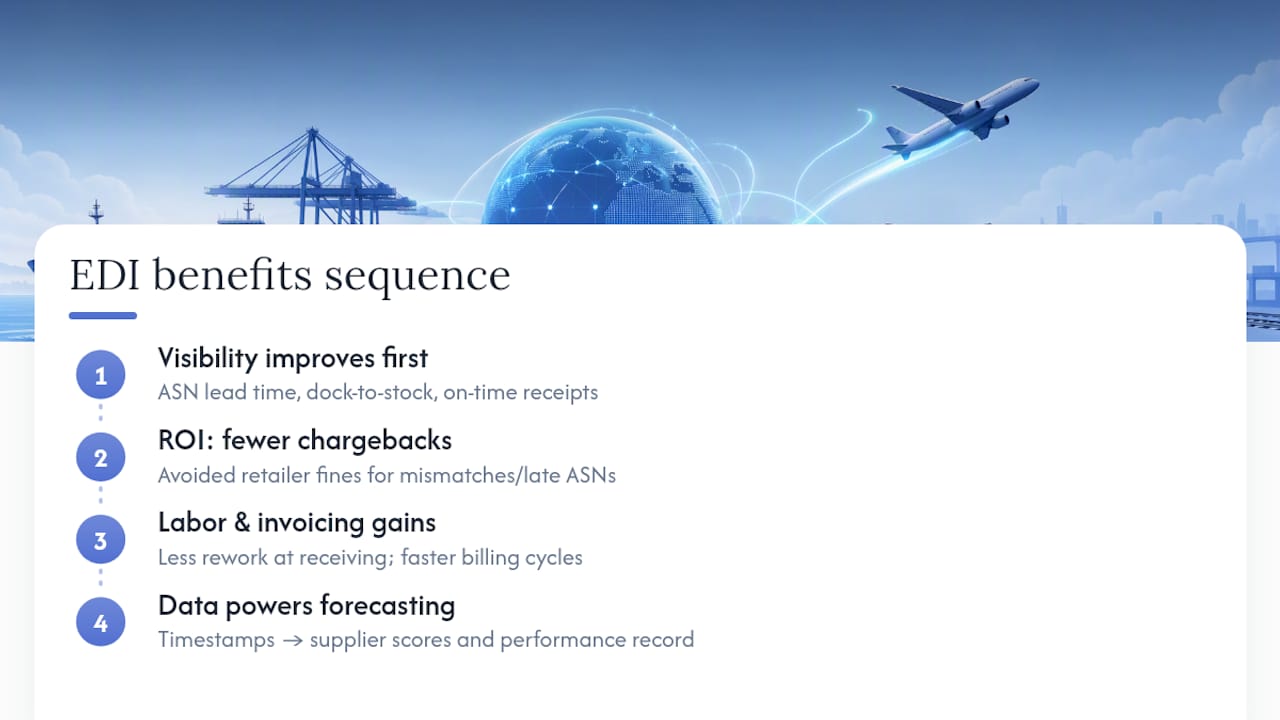
The case for EDI in logistics comes down to timing and error reduction, both of which show up in numbers operations teams already track.
Visibility metrics improve first: ASN lead time, dock-to-stock time, and on-time receipt rates all tighten once ASNs arrive accurately and on schedule. Seeburger notes that the core value of EDI is delivering data before goods physically arrive, giving receiving operations time to plan labor instead of reacting to a truck at the door.
The real ROI signal: chargeback and penalty reductions. Retail partners fine suppliers for ASN mismatches and late shipment notices, so cleaner EDI data translates directly into avoided deductions, not just faster processing.
Labor savings and speed-to-invoice follow close behind, since fewer manual corrections mean less rework at receiving and faster billing cycles. EDI timestamps also feed forecasting models and supplier reliability scoring, turning routine transaction data into a performance record over time.
Why EDI Breaks Quietly and How to Stop It
Most EDI failures don’t crash anything. They just stop updating, and nobody notices until inventory counts drift or a chargeback lands.
- Silent failures happen when a partner stops sending acknowledgments and no one is watching for the gap; build exception workflows that flag missing 997s or 999s automatically.
- Data integrity issues originate upstream. Bad source data propagates automatically into ERP and WMS systems the moment it’s transmitted, so validation belongs at the point of creation, not after the fact.
- Mapping brittleness creeps in when partners update their implementation guides and nobody versions the change, breaking a map that worked fine for two years.
- Carrier onboarding gaps multiply when growth outpaces governance. Migrating from a VAN to AS2 or a cloud EDI platform works best in phases, one partner segment at a time, not as a single cutover weekend.
Pro Tip: Run a weekly reconciliation between ASN counts sent and 997/999 acknowledgments received. A gap of even a few percent usually means a partner-side mapping issue, not a fluke.
How a 3PL Applies EDI Across Fulfillment and Freight
Warehousing and freight forwarding services depend on EDI to keep omnichannel fulfillment, FBA prep, and expedited freight moving without manual data entry at every handoff. Integrated EDI feeds link directly into inventory counts, tracking systems, and fulfillment rules engines, so an inbound ASN updates warehouse availability the moment it’s transmitted.
- ASN accuracy tied to FBA prep inbound scheduling
- Load tender and status data feeding expedited freight decisions
- Dock-to-stock time and chargeback rates as core performance metrics
What to Prioritize First When Building Out EDI
Get ASN accuracy right before anything else. A perfect 850/855 exchange means nothing if the 856 doesn’t match what’s on the pallet, and that mismatch is where most chargebacks originate. Build monitoring and alerts before adding partner volume, not after. Once the core loop is solid, layer in a hybrid EDI/API architecture rather than forcing every carrier onto one protocol. Start with one or two partners as a pilot, prove the reconciliation process works, then scale.
— Akbar
How Usiship Supports EDI-Enabled Logistics Operations
Getting EDI right internally still leaves the harder problem: running the fulfillment, freight, and warehousing operations that data actually describes. Usiship builds that operational layer, combining 3PL fulfillment, warehousing and fulfillment solutions, and freight forwarding into one platform with real-time tracking rather than a patchwork of disconnected vendors.

That matters most in the moments EDI is designed to protect: ASN timing at inbound receiving, FBA prep windows, and customs documentation on cross-border freight. Usiship’s customs brokerage and specialized handling services are built to work alongside the transaction data your systems generate, not around it. If you’re scaling partner connections and need warehousing or fulfillment operations that keep pace with your EDI accuracy targets, check current service tiers and pricing to see which fits your volume.
Standards and Resources Worth Bookmarking
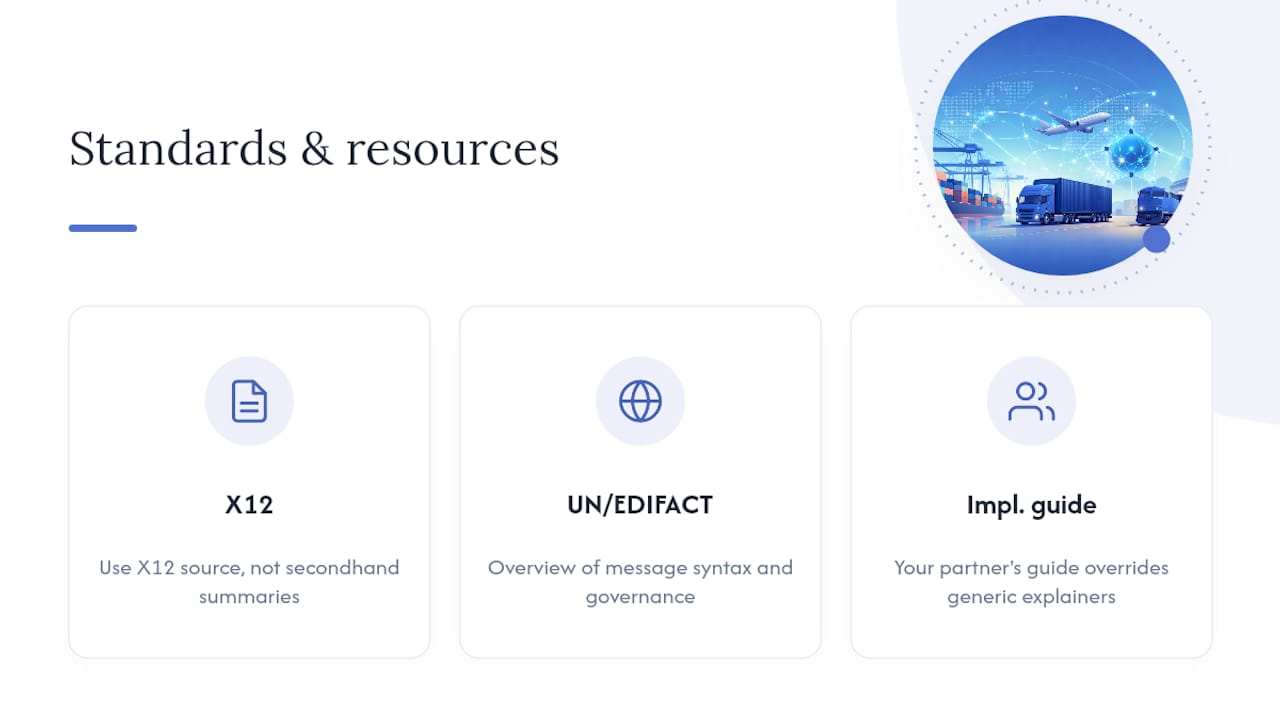
For transaction set specifics, go to X12 directly rather than a secondhand summary. For international interchanges, UNECE’s UN/EDIFACT overview covers message syntax and governance. Beyond that, request your trading partner’s own implementation guide. It overrides any generic explainer.
Sources
- EDI vs API: Differences, When to Use Each, and Hybrid | IBM
- EDI in Logistics: Benefits, Use Cases and Systems | SEEBURGER
- What Does EDI Mean in Logistics? Documents, Benefits & Supply Chain Impact | Carro
- EDI integration for logistics and freight carriers | TwinCore
- X12 — Accredited Standards Committee X12
FAQ
What Does EDI Stand for in Logistics?
EDI stands for electronic data interchange, the structured exchange of business documents like purchase orders, ASNs, and invoices between trading partners’ computer systems. In logistics specifically, it lets shipment data travel ahead of the physical freight so receiving teams can plan before trucks arrive.
What Has Replaced EDI?
Nothing has fully replaced EDI. Large retail and freight partners still require it, but APIs have taken over the real-time, high-frequency tasks EDI was never built for, like live tracking pings or on-demand rate quotes. Most logistics platforms now run EDI and APIs together rather than choosing one.
Is EDI the Same as SAP?
No. EDI is a data exchange standard, while SAP is an ERP software platform. SAP systems often include EDI capability or connect to an EDI translator, but EDI itself works independently of any specific ERP vendor and predates most modern ERP software by decades.
What Is EDI With an Example?
A common example is a retailer sending an EDI 850 purchase order to a supplier, who responds with an 855 acknowledgment and later transmits an 856 advance ship notice before the shipment arrives. That ASN tells the receiving warehouse exactly what’s coming, down to the pack and item level, before the truck reaches the dock.