
EDI for 3PL: Documents, Setup and What to Verify
EDI (Electronic Data Interchange) is how your order system and a 3PL’s warehouse system trade standardized business documents without anyone retyping them. For a brand shipping to big retailers, the useful question is not whether the 3PL “has EDI.” It is whether the warehouse can turn your order into a pick, and the shipment into a correct confirmation, fast enough to meet the retailer’s rules. This guide covers the warehouse documents, how the connection is built, and what to verify before you sign.
TL;DR
- A 3PL runs on warehouse-specific X12 documents: the 940 tells the warehouse what to ship, and the 945 tells you what actually left the dock.
- The 945 feeds the 856 advance ship notice (ASN) your retailer expects. A 945 that reports ordered instead of shipped quantities becomes a wrong ASN.
- Connection is usually via SFTP, a VAN (value-added network, a third-party document hub) or AS2, followed by testing with each trading partner.
- Before signing, ask how often 945s are sent, who owns mapping, and who pays for chargebacks caused by bad data.
- Inbound transfers use the 943 and 944; inventory uses the 846 and 947.
Table of Contents
- What EDI does between a brand and its 3PL
- The document flow from order to invoice
- The warehouse transactions, one by one
- Retailer requirements the 945 has to support
- After the dock: carrier messages
- How the connection gets built
- Where EDI projects stall
- What to verify before you go live
- Our perspective
- Fulfillment that keeps the data and the dock aligned
- FAQ
- Sources
What EDI does between a brand and its 3PL
EDI stands for Electronic Data Interchange. SPS Commerce describes 3PL EDI as the technology logistics companies use to send information digitally to another company in a standardized format, with fewer manual processes, better data accuracy and faster processing as the payoff.
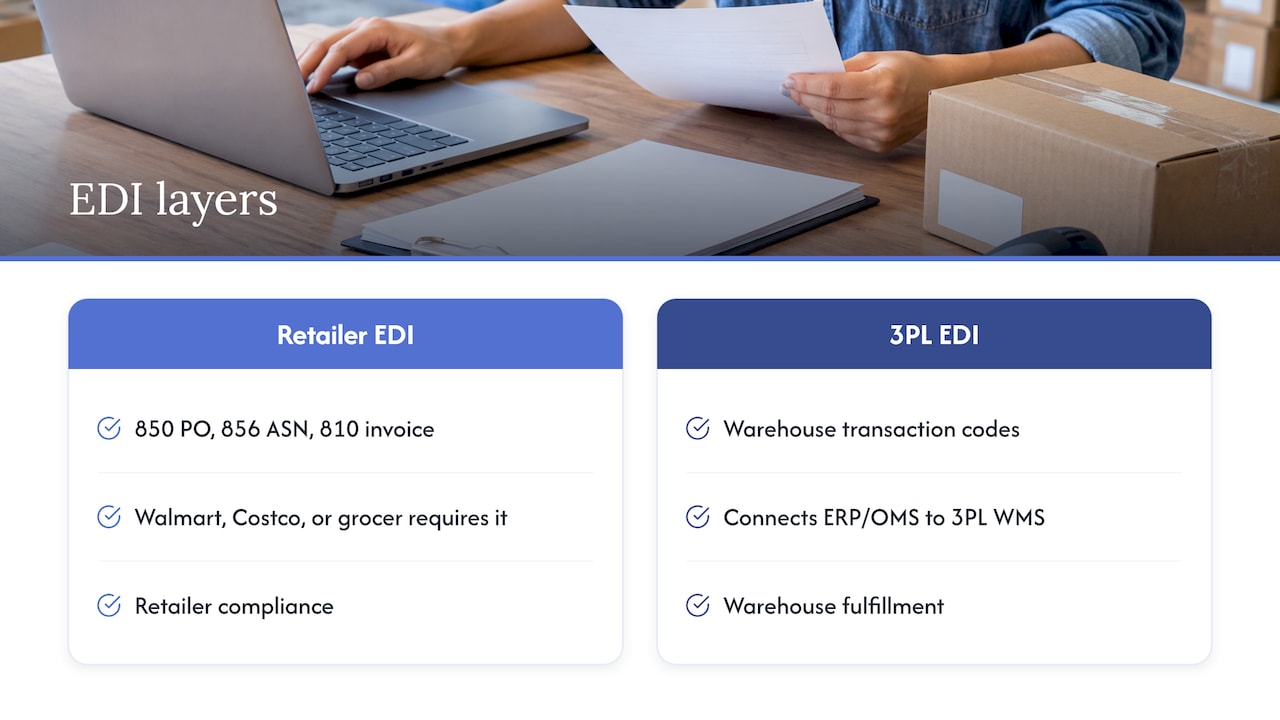
There are two layers, and brands often confuse them. Retailer-facing EDI (850 purchase order, 856 ASN, 810 invoice) is what Walmart, Costco or a grocer requires from you. 3PL EDI is a separate set of warehouse transaction codes that connects your ERP or order management system to the 3PL’s warehouse management system (WMS). Many businesses need both: the retailer layer for compliance, the 3PL layer for fulfillment.
The 3PL layer matters because the warehouse is where the data originates. The 945 shipment confirmation is what lets you build an accurate ASN for the retailer on time.
The document flow from order to invoice
Here is the sequence OrderSync lays out for a retailer order fulfilled from a 3PL:
| Step | Document | Who sends it | What it carries |
|---|---|---|---|
| 1 | 850 Purchase Order | Retailer to you | What the retailer wants |
| 2 | 940 Warehouse Shipping Order | You to the 3PL | Ship-to address, items, quantities, handling instructions |
| 3 | Pick, pack, ship | 3PL | Carrier tracking created |
| 4 | 945 Warehouse Shipping Advice | 3PL to you | Items shipped, quantities, carton counts, carrier, tracking, ship date |
| 5 | 856 ASN | You (or the 3PL on your behalf) to the retailer | Shipment contents and delivery estimate |
| 6 | 810 Invoice | You to the retailer | The bill |
Commport describes a variant where the 3PL sends the 856 to the retailer on the brand’s behalf and the 945 to the brand. Which variant you use is a setup decision, so settle it in writing during onboarding.
Underneath, every document passes through a technical handshake. Commport’s retail EDI walkthrough covers it: the document is created in the ERP, translated to ANSI X12 or EDIFACT, sent by VAN, AS2 or an API-connected platform, and acknowledged, typically with a 997.
The warehouse transactions, one by one
SPS Commerce’s list of core 3PL transactions is the clearest reference:
- 940 Warehouse Shipping Order. You authorize a shipment to a retailer, grocer, distributor or another location.
- 945 Warehouse Shipping Advice. The 3PL tells you a shipment is complete, so you can reconcile shipped against ordered quantity, invoice and generate the ASN.
- 943 Warehouse Stock Transfer Shipment Advice. You tell the 3PL a transfer is coming from another warehouse, or authorize it to accept a return.
- 944 Warehouse Stock Transfer Receipt Advice. The 3PL confirms receipt and reports overages, shortages, damage and product status.
- 846 Inventory Inquiry/Advice. Inventory levels, common in ecommerce and drop-shipping.
- 947 Warehouse Inventory Adjustment Advice. Quantity or status changes, usually after a physical count.
Inside the 940 and 945
The field-level detail is where accuracy is won or lost. Cleverence’s guide to X12 940 and 945 explains that the 940 carries an order status (N for original, F for cancel), order and PO numbers, ship-to loops and per-line quantities with item qualifiers such as UP for a U.P.C. The 945 echoes your order number, names the carrier and reports, per line, quantity ordered, units shipped and the difference.
That guide’s warning is worth repeating: a 945 that reports ordered instead of shipped quantity turns into a wrong ASN at the retailer’s dock. Its habits for keeping the 945 honest:
- Report short lines as short (ordered 40, shipped 36, difference 4) with a partial or backorder status and a reason code.
- Substitute items only if your implementation guide allows it.
- Check for cancellations, meaning a new 940 with status F, before picking.
- Answer one 940 with one 945 unless the guide says to split or combine.
- Keep each client’s stock in its own warehouse record.
Receiving with the 943 and 944
On the inbound side, EDI2XML’s explanation of EDI and WMS integration and the 943/944 pair work together. The 943 creates an expected receipt in the WMS so the dock team can plan doors and labor. After receiving, the 944 references the original 943 and reports actual quantities and discrepancies. If you are tightening inbound, our warehouse receiving process checklist walks through the physical side, and our guide to the advanced shipping notice and single-scan receiving shows how the data levels behind an ASN speed up check-in.
Retailer requirements the 945 has to support
When a 3PL ships to Walmart, Costco or Amazon, the retailer still expects your 856, GS1-128 labels and routing requests on its schedule. Where required, that includes the 753 (request for routing instructions) and 754 (routing instructions). Supporting documents include the 861 receiving advice, 214 carrier status and 997 acknowledgment. Linking the 945 to the 856 is how 3PL EDI helps you avoid chargebacks.
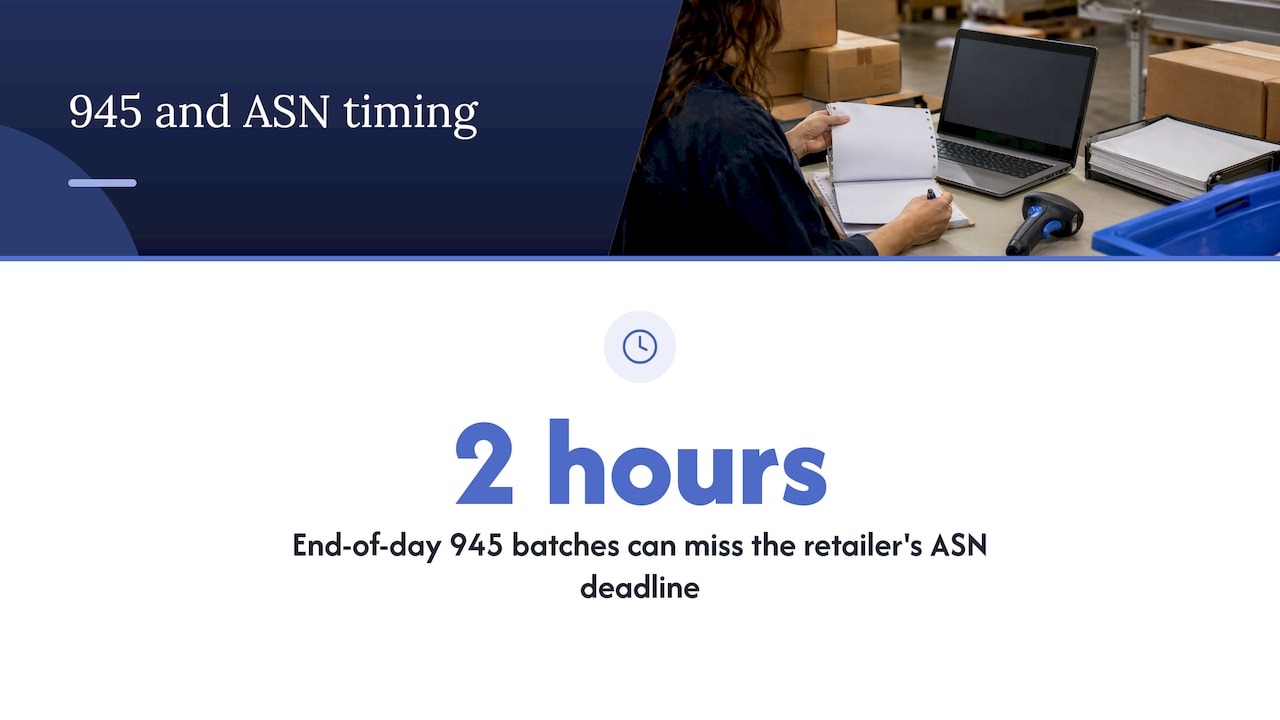
Timing is where this goes wrong. OrderSync points out that if a 3PL batches 945s at the end of the day while the retailer expects an ASN within two hours of shipment, you have a problem. Negotiate 945 frequency as part of the 3PL agreement. Our article on ASN accuracy and chargebacks goes deeper on that link.
After the dock: carrier messages
Once goods leave the building, the freight layer takes over. Per OrderSync, the shipper or 3PL tenders the load with a 204 Load Tender, the carrier accepts with a 990, reports progress with 214 status messages and bills with a 210 freight invoice.
The 210 is where finance gets involved. Whatever the format, the habit is the same: matching signed delivery tickets to invoices and accounts-payable records before you pay, so disputed charges are caught early. For the wider journey from quote to delivery, see our freight forwarding process.
How the connection gets built
The mechanics are less exotic than the acronyms suggest. EDI2XML describes the pattern: a trading partner drops EDI files on a secure SFTP server or sends them through a VAN or AS2. An integration layer parses the X12 data and maps fields into the WMS by direct database or API. It returns 997 functional acknowledgments and sends outbound documents back, with a mapping configuration for each trading partner.
IntuitionLabs’ technical guide explains the transmission options. VANs are third-party hubs that route files and hold mailboxes. AS2 is internet-based, encrypted and signed, and widely used in retail. Integration models range from direct point-to-point to a hub or a managed service.
What implementation involves
A formal implementation, as shown in one published implementation guide, means agreeing on the X12 transaction sets, separate test and production interchange IDs (usage indicator T for test, P for production), acknowledgment timeframes (a 997 within 24 hours in that guide), separator characters and the transmission method. Step-by-step functional testing comes before production.
Retailers add their own gates. Walmart’s supplier guide, published in 2011 and last changed in 2014, requires AS2 communication testing before data testing and sets a two-week target for completing testing, with six weeks as the maximum. Check the retailer’s current version before you plan your timeline.
A real-world example: a US 3PL in Indianapolis automated its 940, 943, 944, 945 and 997 traffic through a managed service that processes every 15 minutes. That cut the maximum order-to-WMS delay from hours to 15 minutes and removed manual entry. Fifteen minutes is a sensible cadence to ask about: near real time without hammering the WMS database.
Where EDI projects stall
Onboarding is usually the slowest part. IntuitionLabs notes that partners differ in what they mean by a field, in identifiers and in X12 versions (4010 versus 5010), so each partner may need a custom mapping for things like the order number or SKU.
SPS Commerce names three reasons 3PL integrations are hard: each customer sends data in a different form (portals, APIs, spreadsheets, EDI), each has unique packing and labeling rules, and many 3PLs lack IT bandwidth for long projects. Practical advice from the Piper case study: start with one trading partner and build a reusable profile, so adding the next becomes configuration, not re-engineering.
What to verify before you go live
A good checklist covers the contract as well as the code. Drawing on Golyath’s WMS-EDI integration checklist:
- Operating contract. For item master, inventory, orders, shipments and returns, who is the source of truth, who may send, and what the receiver does on receipt?
- Stable identifiers. Customer, facility, item, order, shipment, pallet, lot and carrier IDs: are they unique, case-sensitive, reusable?
- Units and conversions. Test each with realistic examples such as each, case and pallet.
- Control totals. Reconcile document counts, line counts and quantities at an agreed frequency.
- Acknowledgments. A 997 or 999 confirms technical validation, not commercial acceptance.
And from the 3PL itself, ask which EDI codes and retail partners it is already live with, who owns mapping and fixes rejected documents, and what ASN accuracy and on-time rate it will commit to in writing, with agreed chargeback accountability. The readiness test: both teams can explain every message, recover a failed transaction and reconcile the system record to physical work.
Our perspective
Most EDI trouble we see described in the industry is not a connection problem. It is a mismatch between what the system says happened and what happened on the floor. A clean 945 depends on accurate receiving, accurate bin and pallet inventory and a pick that matches the order.
That is why we treat transportation, warehousing and fulfillment as one platform rather than three vendors, supported by real-time tracking and inventory management. When the physical work and the data live in one place, there is less to reconcile.
Our advice: write down your document flow, your 945 timing and your chargeback responsibilities before the first order ships. The paperwork is cheaper to fix than the pallets.
Akbar
Fulfillment that keeps the data and the dock aligned
If you are choosing a 3PL for retailer orders, start with the warehouse and fulfillment itself. Our 3PL fulfillment services and warehousing and fulfillment solutions combine receiving, storage, picking, packing, returns and inventory management with real-time tracking. Published storage rates on our pricing page are $5 to $6 per month per bin and $17 to $19 per month per pallet, and additional services are billed at $37 per hour. Tell us your retailer requirements and we will scope the rest with you.
If you are weighing outsourcing against doing it yourself, our comparison of 3PL services versus in-house shipping lays out the trade-offs.
FAQ
What is EDI 940 and 945 in a 3PL?
The 940 is the warehouse shipping order: you send it to the 3PL to authorize and describe a shipment. The 945 is the warehouse shipping advice: the 3PL sends it back once the shipment is complete, with quantities, carrier and tracking. Together they close the loop between order and shipment.
What are EDI 943 and 944?
The 943 tells the warehouse a stock transfer shipment is coming, or authorizes it to accept a return. The 944 is the receipt advice the warehouse sends after receiving, reporting overages, shortages and damage. They cover inbound inventory the way the 940 and 945 cover outbound orders.
How do I connect my systems to a 3PL’s EDI?
The usual routes are SFTP, a VAN or AS2, with documents mapped into the WMS and acknowledged by 997. Expect partner-specific mapping and test cycles before production. Starting with one trading partner keeps the first project manageable.
Do I need both retailer EDI and 3PL EDI?
If you sell to retailers that mandate EDI and also use a 3PL, usually yes. Retailer EDI (850, 856, 810) covers compliance, while 3PL EDI (940, 945 and related documents) covers fulfillment. The 945 is the link that lets you produce the 856 on time.
Sources
- SPS Commerce: 3PL EDI integrations and solutions
- OrderSync: 3PL EDI integration
- Commport: How EDI helps 3PL providers
- Commport: EDI for retail, ecommerce and 3PL providers
- Cleverence: EDI 940 and 945 for 3PL warehouses
- Vantree: 3PL EDI integration
- EDI2XML: EDI and WMS integration
- EDI2XML: Piper Warehouse case study
- IntuitionLabs: X12 EDI format technical guide
- Access Business Group EDI implementation guide
- Walmart EDI implementation guide
- Golyath: WMS and EDI integration checklist