
Distributed Warehousing: How It Works and When It Pays Off
Distributed warehousing means storing your inventory in several smaller facilities instead of one central warehouse, so each order ships from a location closer to the customer. It can shorten transit times and cut parcel costs. It also adds fixed costs and makes inventory harder to manage. Whether it pays off depends on where your customers are, how many SKUs you carry and how well you can see your stock.
This guide explains how a distributed network works, what you trade away, how it relates to omnichannel fulfillment, and how to test the idea before you commit.
TL;DR
- Distributed warehousing spreads stock across several locations so orders travel shorter distances. NetSuite describes it as syncing inventory location with demand.
- The core trade-off: more nodes lower transportation cost and delivery time, but raise fixed facility cost and inventory complexity.
- Omnichannel fulfillment is the order-routing layer on top. It needs one source of truth for inventory, or you will oversell.
- Start with two locations, measure your shipping zones, and pilot a slice of your SKUs before expanding.
- Plan for a 3 to 5 year horizon, because network decisions are expensive to reverse.
Table of Contents
- What distributed warehousing actually is
- The trade-off nobody should skip
- When distributed warehousing makes sense
- Distributed warehousing and omnichannel fulfillment
- Returns in a multi-node network
- Our perspective
- How to plan a distributed network, step by step
- Moving freight between nodes
- What it costs to start small
- How Usiship can support your network
- What the big retailers are doing
- Common mistakes
- FAQ
- Sources
What distributed warehousing actually is
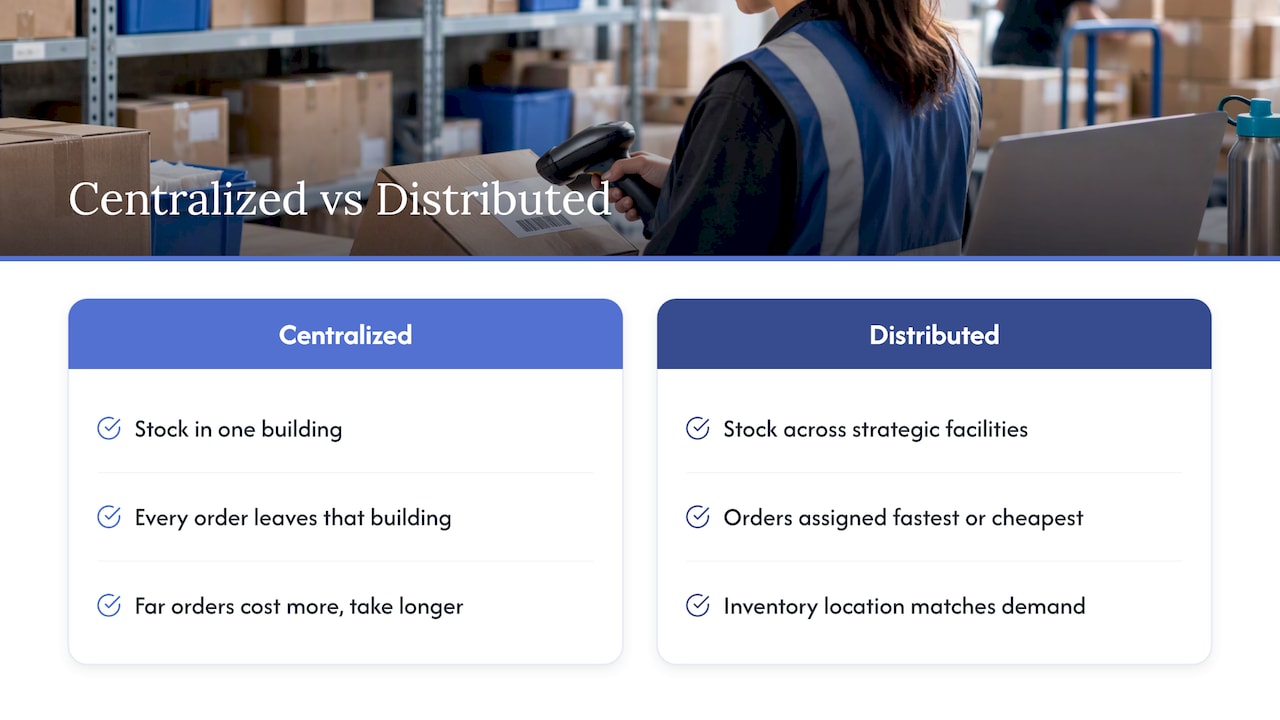
In a centralized model, every unit sits in one building and every order leaves from it. A customer in the same state may get a two-day parcel. A customer 2,500 miles away pays more for shipping and waits longer.
In a distributed model, you split stock across multiple facilities placed in strategic geography. NetSuite defines distributed inventory as products spread across warehouses or distribution centers, with the aim of matching inventory location to demand. Each order is then assigned to the node that can serve it fastest or cheapest.
You will see the same idea under other names: multi-node fulfillment, regional fulfillment centers, or a split-inventory network. They all describe one thing. Your stock is no longer in one place, and a rule decides where each order ships from.
It helps to separate this from other warehouse types. Supply chain literature commonly lists seven warehouse types: raw-material, work-in-process, finished goods, distribution, fulfillment, local or regional, and value-added service warehouses. A distributed network usually mixes several of these. Your regional nodes might be fulfillment warehouses for small consumer orders, with one finished goods location holding the deep reserve.
The trade-off nobody should skip
The appeal is easy to grasp. The cost is less obvious.
According to the network planning material used in supply chain courses, moving from centralized to distributed warehousing reduces customer lead times, but it significantly increases fixed facility costs and complicates inventory management. The goal is a sweet spot where transportation savings outweigh the cost of running extra inventory nodes.
That same material makes two points that most blog posts skip:
- Adding warehouses lowers transportation cost but raises fixed operating and inventory-holding costs, so you look for the lowest total cost, not the lowest freight bill.
- Network decisions should hold up over a planning horizon of roughly 3 to 5 years to justify the investment.
Where the money goes
| Cost area | Effect of adding nodes |
|---|---|
| Outbound parcel cost | Usually falls, because fewer orders travel to far shipping zones |
| Inbound freight | Rises, because you ship to more destinations, often in smaller loads |
| Safety stock | Rises, because each node needs its own buffer against demand swings |
| Facility and labor | Rises, because you pay for storage, receiving and handling in each location |
| Systems and management time | Rises, because inventory and orders must be synchronized |
The inbound side is where small brands get hurt. If you used to send one full container or truckload to one address, you now split it. That can push you into less-than-truckload shipments or extra drayage. Our guide on palletizing freight so it passes LTL covers the pallet prep that keeps those smaller inbound moves from turning into reclassification charges.
If you run your own trucks between nodes, remember that vehicle operating costs are part of the total too. Fuel logistics are one piece, and it is worth reading how fuel delivery reduces fleet labor costs when you are modeling a private replenishment loop.
When distributed warehousing makes sense
Not every business needs it. These signals suggest you are ready to look seriously.
- Your orders are spread nationwide. If a large share ships to far-away zones from a single building, you are paying a distance premium on every parcel.
- Delivery speed affects conversion. If customers abandon carts because the estimated delivery date is too far out, closer stock directly protects revenue.
- You have enough volume per region. A node that ships ten orders a day cannot justify its fixed costs.
- You have stable best-sellers. Fast-moving items are the easiest to split. Slow, long-tail items are better kept in one place.
- You already sell through several channels. Wholesale, marketplace and direct-to-consumer orders can each be served from different nodes.
And these suggest you should wait:
- Your volume is low or highly seasonal with unpredictable peaks.
- Your inventory data is unreliable. Splitting bad data across three buildings gives you three problems.
- Most of your customers already sit within a short ground-transit radius of your current warehouse.
- You carry thousands of SKUs with very slow sell-through.
Use ABC analysis to decide what to split
You rarely need to move every SKU. Rank products by sales velocity: the A items drive most of your volume, B items sit in the middle, and C items sell slowly. Position A items in multiple nodes, keep B items in one or two, and hold C items centrally. We explain why each class needs different rules in our piece on ABC inventory analysis for 3PL planning.
Distributed warehousing and omnichannel fulfillment
Many readers arrive here looking for omnichannel fulfillment. The two ideas are related but not the same.
Distributed warehousing is about where inventory sits. Omnichannel fulfillment is about how you use every inventory location to deliver orders. Shopify’s overview explains that a business might ship an order from a warehouse, route it from a nearby store, or offer buy online, pickup in-store.
You can have a distributed network without omnichannel logic, such as three warehouses each serving fixed regions. You cannot run real omnichannel without some form of distributed stock, because routing needs more than one place to route from.
Execution beats strategy
The hard part is not drawing the map. Shopify’s analysis says successful omnichannel fulfillment depends more on execution than strategy, and that integrating online and offline inventory visibility is the main friction point. An effective system acts as a single source of truth for orders and inventory, and routes each order to the most cost-effective location without risking overselling.
Research from the MIT Center for Transportation and Logistics points the same way. In its omnichannel survey, integrating online and offline channels was the top challenge at 51%, with fulfillment decisions close behind at 50%. The difficulty lies less in deciding whether to go omnichannel and more in doing it.
That is why real-time stock accuracy matters before you add nodes. Our Capture to ATP playbook on inventory visibility walks through how to make available-to-promise numbers trustworthy.
A simple routing rule set
You do not need a complex engine on day one. A workable first rule set looks like this:
- Ship from the node with stock that is closest to the customer’s ZIP code.
- If that node is out of stock on any line, check whether a single other node can fill the whole order. Avoid splitting orders unless there is no alternative.
- For low-stock items, hold a reserve so that one region cannot sell the last units another region needs.
- Review the rules monthly against split-shipment rates and average cost per order.
Returns in a multi-node network
Omnichannel returns are a common blind spot. When a return lands at the wrong node, you may carry stock where there is no demand, or leave it out of sellable inventory for days.
Decide up front where returns go. Some brands route all returns to one inspection point and then redistribute. Others return items to the nearest node and re-list them immediately. The second approach is faster, but it needs the receiving team at every node to grade condition consistently, and your system must update availability the moment a return is accepted. Whichever route you choose, write the grading criteria down and apply them everywhere.
Our perspective
We see the same pattern with growing ecommerce brands. They hear that closer inventory means faster delivery, and they jump to three or four locations. Then inventory accuracy slips, the safety stock bill climbs, and the savings they expected on parcels get absorbed by inbound freight and handling.
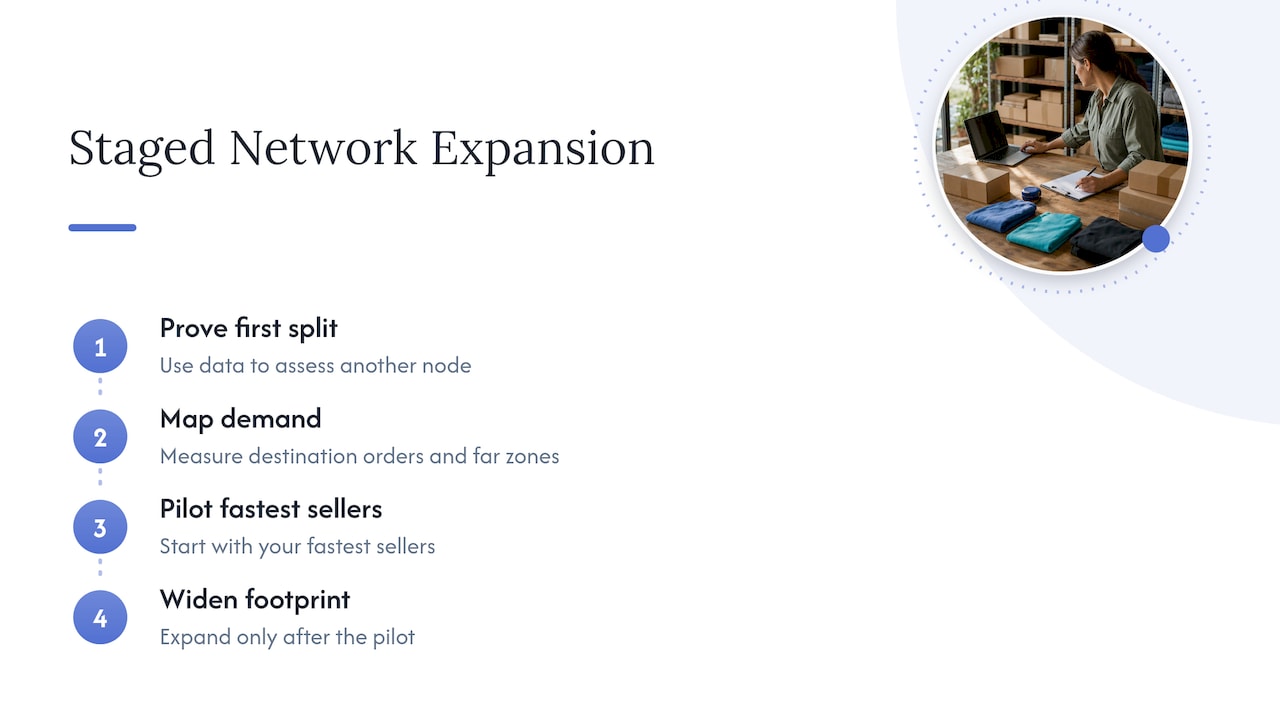
Our view is that distributed warehousing is a staged decision, not a switch. Prove the first split with data. Map your orders by destination, measure how many ship to far zones, and see what a second node would realistically move. Pilot with your fastest sellers. Only then widen the footprint.
We also believe the technology layer comes before the buildings. Without live inventory counts and tracking, a network is just several piles of stock. Our platform approach ties transportation, warehousing and shipping together, with real-time tracking and personal support, because the handoffs between those pieces are where cost and delays hide. A brand that can see each unit and each shipment can run two nodes well. A brand that cannot will struggle with five.
Finally, be honest about fixed costs. If a node cannot reach reasonable volume, a flexible 3PL arrangement usually beats a lease or a long commitment. Pay for the space and labor you use, then grow as volume proves out.
— Akbar
How to plan a distributed network, step by step
1. Map your demand
Export 6 to 12 months of orders with destination ZIP codes, order value, units and shipping cost. Group them by carrier zone or by region. This shows how much of your cost comes from long-haul parcels.
2. Classify your inventory
Use velocity to decide which SKUs would go to each node. Also note size and weight, because bulky items cost more to move twice.
3. Model total cost, not just freight
Build a simple comparison for one node, two nodes and three nodes. Include outbound parcels, inbound freight, storage, labor, safety stock and software. The lowest total, over a 3 to 5 year view, is your answer. Storage rates matter here, and our 2026 storage fee benchmarks show how much they have moved in the U.S.
4. Choose locations by shipping time
Pick sites that cover the most customers within your target delivery window. For many U.S. brands that means starting with a coastal pair or a coastal location plus a central one. Let your own order map decide, not a template.
5. Standardize the floor
If every node runs differently, quality drifts. Use the same layout logic, labeling, pick paths and receiving checks. Our guides on warehouse layout design and the two-week pick and pack pilot show how to measure first and change one zone at a time.
Lean practice helps here. The 5S method (Sort, Set in order, Shine, Standardize, Sustain) is a cornerstone of lean warehousing, and a case study in a third-party logistics warehouse describes it as a visual management tool for safe, organized and efficient workstations. Keeping floors and equipment clean is part of that discipline, as it is for any production line.
6. Pilot, then expand
Send a limited set of A items to the new node for 60 to 90 days. Track cost per order, delivery time, stockouts and split shipments. Expand only when the numbers hold.
Moving freight between nodes
A distributed network lives or dies on replenishment. A few tactics keep inbound costs in check:
- Consolidate before you split. Bring inbound goods into one point, then divide by node. Our freight consolidation pilot checklist outlines a 60 to 90 day test for smaller shippers.
- Use cross-docking. Where goods can pass through without being stored, cross docking cuts handling and shortens the time stock waits before reaching a node.
- Use transloading for imports. Moving ocean containers into domestic trailers near the port can feed several regions efficiently. See our notes on transloading to cut turn time.
- Check customs steps. If imports are part of the flow, the choice of a container freight station affects duty and exam delays. Read how to choose a CFS warehouse.
What it costs to start small
You do not need to build anything to test a second node. A third-party logistics partner lets you rent storage and handling by usage. Our published storage rates are 5 to 6 USD per month per bin and 17 to 19 USD per month per pallet, and additional services are billed at 37 USD per hour. Receiving, order processing, additional picks, returns and packaging are priced on our pricing page.
Those are inputs for your model, not a quote. Your total depends on volume, SKU count and handling needs, so use them to estimate a pilot and then confirm the details with us.
How Usiship can support your network
We handle freight forwarding, warehousing, order fulfillment, customs clearance and last-mile delivery under one platform across the United States. If you are testing a distributed model, our omnichannel and ecommerce fulfillment services are the place to start. For the storage and picking side, see our warehousing and fulfillment solutions. Tell us your order map and your best-selling SKUs, and we will help you size a pilot before you sign on to anything large.
What the big retailers are doing
Large retailers treat the distribution network as a design problem with several layers: what flows through the network, which speed models apply to different products, and what that means for suppliers. McKinsey’s work on the retail supply chain network of the future frames it this way. You do not need their scale to borrow the thinking. Different products can have different speed promises. Your best sellers might ship from regional nodes with fast delivery, while niche items ship from one central location with a longer window.
Common mistakes
- Adding nodes before fixing inventory accuracy. Cycle count and reconcile first.
- Splitting every SKU. Duplicating slow movers ties up cash.
- Ignoring split shipments. If one order leaves from two nodes, you pay twice for shipping and the customer gets two boxes.
- Choosing locations by gut feel. Use your destination data.
- Treating it as permanent. Review the network yearly, since demand shifts.
FAQ
What is the difference between centralized and distributed warehousing?
Centralized warehousing keeps all stock in one facility. Distributed warehousing spreads it across several, so orders ship from a location nearer the customer. The distributed model usually lowers delivery time and parcel cost but raises fixed costs and inventory complexity.
How many warehouses do I need?
There is no fixed number. Many brands begin with two locations, then add a third only if their order data shows a large share of parcels still traveling to far zones. Model total cost for one, two and three nodes before you decide.
Is omnichannel fulfillment the same as distributed warehousing?
No. Distributed warehousing is where your inventory sits. Omnichannel fulfillment is how you use all locations, including stores, to fill orders from any channel. Omnichannel depends on accurate, shared inventory data.
Can a small business use distributed warehousing?
Yes, but usually through a flexible 3PL rather than owned facilities. Paying per bin, pallet and order lets you test a second location without a long lease. Start with your fastest-selling SKUs and measure results for 60 to 90 days.
Sources
- Distributed Inventory Defined: How It Works & When to Use It, NetSuite
- A Theoretical Model of Lean Warehousing
- Chapter 3: Network Planning
- Omnichannel Fulfillment: Meaning, Benefits & Options, Shopify
- Omnichannel: From Strategy to Performance, MIT Center for Transportation and Logistics
- Improving Warehousing Process with Lean Management
- The retail supply chain network of the future, McKinsey