
Delivery Appointment Freight: How to Book, Avoid Fees
Delivery appointment freight is any shipment that must arrive at a pre-scheduled time at the receiving dock, instead of showing up whenever the driver gets there. You book the slot with the consignee (or have your carrier or forwarder book it), the truck arrives inside that window, and a late or early arrival can mean a rejected delivery, a rebooked slot or waiting charges. This guide covers how appointments work, what a missed one costs, how to choose between live unload and drop trailer, and how Amazon FBA inbound appointments fit in.
TL;DR
- An appointment shipment has a fixed delivery slot set by the receiver. Miss it and you can be turned away, pushed to the back of the queue or billed.
- Two hours of free time at the dock is the common baseline, and one published tariff sets detention at $85 per hour after that. Your own rate confirmation is what actually governs.
- Book early, pick off-peak slots, and put the appointment number on the bill of lading and in your carrier’s instructions.
- High-volume receivers favor drop trailer programs over live unload, but they need volume and yard space.
- For Amazon LTL and FTL inbound, the carrier must schedule the delivery appointment in advance.
Table of Contents
- What delivery appointment freight means
- How the appointment process works
- What a missed appointment costs
- Live unload vs. drop trailer
- How to pick a good appointment window
- Amazon FBA inbound appointments
- Our perspective
- Where Usiship helps
- Checklist before you book
- FAQ
- Sources
What delivery appointment freight means
Standard freight can often arrive during general business hours, first come, first served. Appointment delivery freight is the opposite: the receiving facility requires a pre-scheduled delivery time. Distribution centers, big-box retailers, grocery warehouses, hospitals and fulfillment centers use appointments because a dock has a limited number of doors and a limited number of people unloading.
Without appointments, six trucks arrive at 8 a.m., five wait in the yard, and the dock sits idle by 2 p.m. A schedule smooths that out. High-volume distribution centers commonly restrict deliveries to windows somewhere between 30 minutes and two hours, according to the research behind this guide.
If you ship to a business that says “appointment required” on its receiving instructions, the delivery is an appointment shipment, whatever the mode: LTL, full truckload, or a drayage move from the port.
How the appointment process works
The details vary by receiver, but the sequence is nearly always the same.
- Get the receiving rules. Ask the consignee for its routing guide or vendor compliance manual. It lists lead times, accepted windows, required references (PO number, shipment ID) and penalties.
- Confirm the ready date. The appointment must follow a realistic pickup and transit time. Booking a slot the truck cannot reach is the most common avoidable mistake.
- Request the slot. Depending on the receiver, this happens through a portal, by email, by phone, or through the carrier. Many large receivers only accept bookings from the carrier.
- Put the reference on every document. The appointment number, PO and any shipment ID belong on the bill of lading so the gate can match the truck to the booking.
- Track the move. Watch the truck against the window. If transit slips, rebook before the slot passes, not after.
- Check in on arrival. Drivers usually check in at the gate or guard shack, then wait for a door assignment. Record arrival and departure times, because those timestamps settle any detention dispute.
Who books the appointment
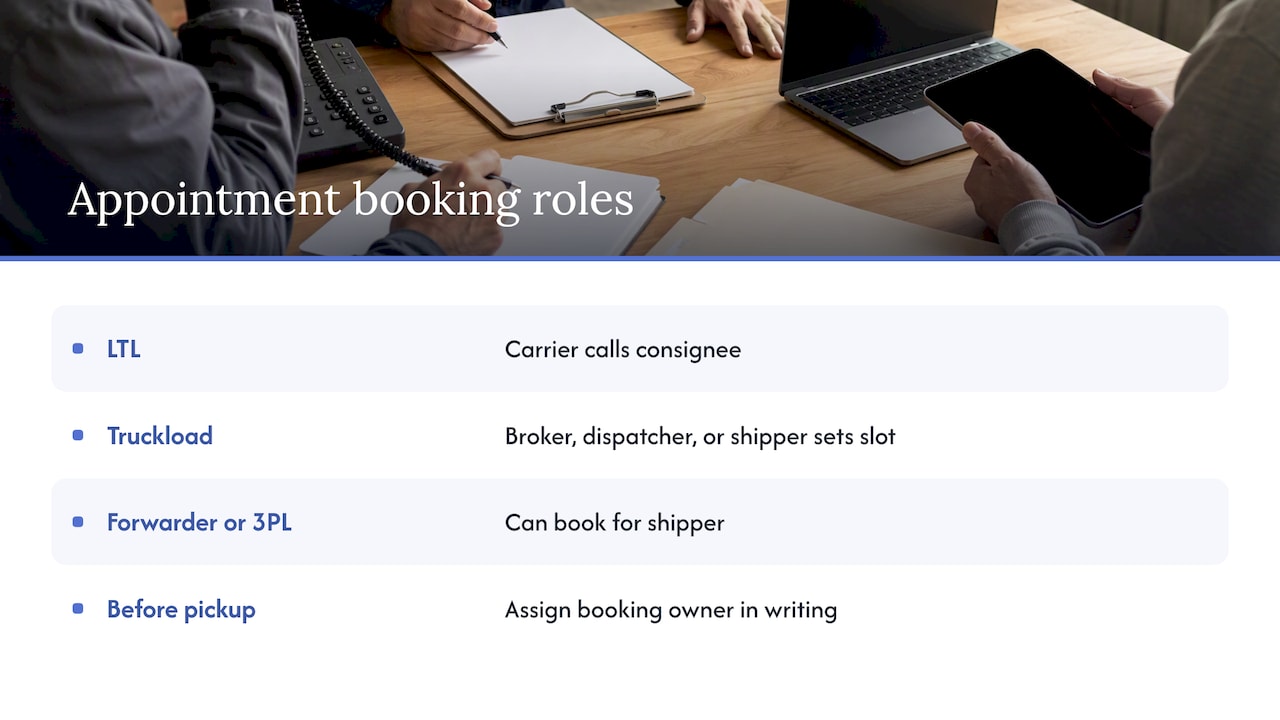
On an LTL shipment the carrier typically calls the consignee to schedule, and the shipper pays an appointment accessorial. On a truckload, the broker, dispatcher or shipper often sets the slot. With a freight forwarder or 3PL in the middle, the forwarder can hold the receiver’s requirements and book on your behalf. Decide this in writing before pickup, so two parties do not book two slots or nobody books any.
What a missed appointment costs
The main cost is detention: the charge for a driver and truck held beyond the free time allowed. A published example is the FEMA Uniform Rules Tariff for transportation service providers. Its 2023 edition allows 2 hours of free time for loading and 2 for unloading, then $85 per hour. That tariff applies when a tender or rate agreement references it. Most commercial freight is governed by the terms in your own contract or rate confirmation, so read those first.
Other sources describe the same pattern. A carrier-side guide puts the industry standard for free time at typically one to two hours and recommends putting the free time, the hourly rate and the billing increment (15 minutes, 30 minutes or full hour) in writing.
Detention is not the only cost of a bad appointment:
- Rescheduling fees. Some receivers charge for a missed slot and push you to the next available date, which can be days away in peak season.
- Retailer chargebacks. Large retailers can fine suppliers for late or early deliveries under their compliance programs.
- Truck re-delivery. If the truck is refused, you may pay for a second delivery attempt plus storage.
- Downstream delays. A pallet sitting in a yard is a pallet that is not on a shelf, which matters most for ecommerce sellers with stock-outs.
A worked example
Say a truck arrives on time for a 10:00 appointment, but the receiver’s crew only starts unloading at noon, and unloading takes three hours. With two hours free for unloading, the driver is detained for the one extra hour of unloading under a 2-hour free time term, plus any time that falls outside the free period depending on how your contract starts the clock. At $85 per hour that one hour costs $85. At a different contract rate, it costs that rate. The point: the clock usually starts at your appointment time or arrival time, whichever your terms say, so find out which before the shipment moves.
Live unload vs. drop trailer
Two models dominate appointment deliveries, and the choice changes your cost profile.
| Live unload | Drop trailer | |
|---|---|---|
| How it works | Driver arrives, waits while staff unload, leaves with the empty trailer | Driver drops a loaded trailer and picks up an empty one |
| Detention risk | Higher: driver waits at the dock | Lower: driver does not wait |
| Volume needed | Any, down to a single shipment | Enough freight to justify dedicated trailers |
| Yard space | Minimal | Enough to stage multiple trailers |
| Coordination | Simple booking | More planning up front |
Experienced dispatchers say that for high-demand retailers, drop trailer programs are often more cost-effective than live unload despite the extra coordination, because they remove driver detention fees. The catch is volume: drop programs only make sense if you ship enough freight and have room to stage trailers. If you ship a few pallets a week to one receiver, live unload with a good slot is the realistic option.
Vehicle choice matters too. A box truck, a sprinter van and a 53-foot trailer each have different dock requirements and appointment expectations. This overview of types of delivery vehicles is useful when you need to match a vehicle class to a receiver’s dock.
How to pick a good appointment window
Choosing a slot is capacity management, not only scheduling. The same dispatcher guidance points out that a slot that is too popular, during peak season or peak hours, raises the chance of detention from dock congestion. Practical rules:
- Avoid the first and last hour of the day. Early slots collide with shift changes, and late slots leave no room for overruns.
- Avoid the weeks before major retail peaks. Receivers fill their calendars first, and delays cascade.
- Leave a buffer. Book a day later than the earliest possible arrival if your transit time has any uncertainty.
- Ask about unload speed. Palletized, labeled freight unloads faster than floor-loaded cartons. If your freight is floor-loaded, say so when booking, since the dock may need more time.
- Know the cutoffs. Some receivers cancel if you are outside the window by even a few minutes.
Dock congestion and slot selection are a recurring theme in logistics. This article on parts networks in logistics shows how equipment availability shapes the same delivery planning decisions.
Amazon FBA inbound appointments
Sellers searching for FBA inbound appointments are usually shipping pallets by LTL or FTL to an Amazon fulfillment center. Amazon-partnered carriers handle shipments over a certain weight, and one seller guide lists what the carrier must do: put the Amazon shipment ID, PRO number and reference ID on the bill of lading, and schedule the delivery appointment in advance. Always check Seller Central for the current requirements, since Amazon changes them.
Common mistakes for FBA freight:
- Shipping before the labels, pallet labels and box content information are complete.
- Booking a slot that the carrier cannot reach after the cargo clears the port or the warehouse.
- Sending a pallet to the wrong fulfillment center because the shipment ID was swapped.
- Not allowing time for prep. If your units need labeling or bagging, that work has to finish before the appointment, not after.
For sellers that do not want to manage this themselves, prep and consolidation before the truck leaves removes most of the risk.
Our perspective
Appointment freight is rarely a transportation problem. It is a handoff problem. The truck is usually fine; the failure is in the gap between the pickup, the warehouse and the receiving dock, where nobody owns the time.
That is why we run transportation, warehousing and shipping on one platform. When the same team knows what is ready on the shelf, which trailer is moving it and what the receiver requires, the appointment is a scheduled event, not a scramble. We would give shippers three habits:
- Treat the receiver’s routing guide as part of your shipping instructions, not an afterthought.
- Build in buffer between warehouse cutoff and the appointment, and measure how often you use it.
- Keep arrival and departure timestamps for every delivery. They are the only evidence in a detention dispute.
If your freight crosses a border before it reaches the dock, add customs timing to that buffer. A hold at the port moves every downstream appointment.
— Akbar
Where Usiship helps
If appointment deliveries are eating your time, we can take on the coordination. Our freight forwarding service covers air, ocean and land moves, including customs brokerage, so the delivery slot is set against a realistic arrival date. For sellers who want stock staged and ready, our warehousing and fulfillment solutions hold inventory near your receiving points.
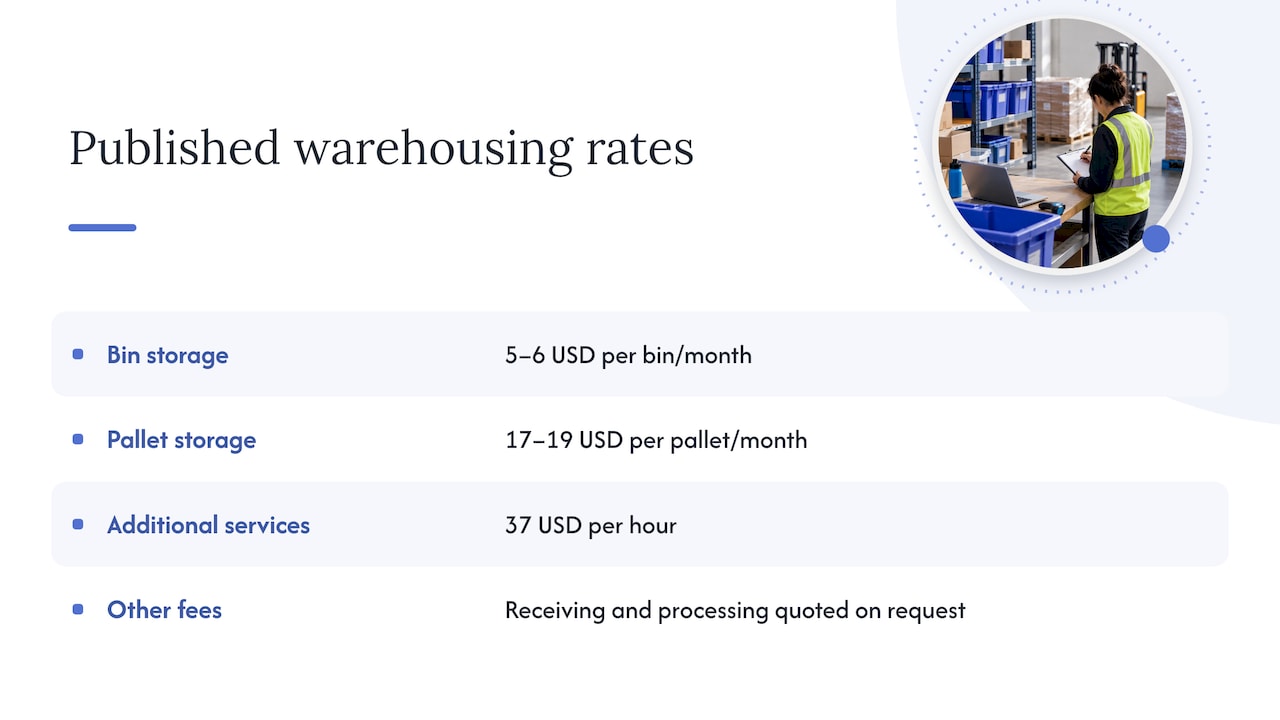
Warehousing rates on our pricing page are published: storage is 5-6 USD per month per bin and 17-19 USD per month per pallet, and additional services are billed at 37 USD per hour. Other fees, including receiving and order processing, are quoted on request.
Two more resources help when appointments are driven by port or dock constraints: our guide to cross-docking shows how freight moves through a facility without long storage, and our page on transloading explains how to move cargo between container and truck. If delays at the port are the cause of missed slots, see how per diem charges stack up when containers sit.
Checklist before you book
- Receiver’s routing guide in hand and read.
- Appointment requirement, window length and lead time confirmed.
- Who books (shipper, carrier, forwarder) agreed in writing.
- Free time, hourly detention rate and billing increment in the rate confirmation.
- Appointment number, PO and any shipment ID on the bill of lading.
- Buffer built between ready date and slot.
- Arrival and departure times recorded at the dock.
FAQ
Is a delivery appointment always required for freight?
No. Many smaller receivers accept freight during business hours without a booking. Large distribution centers, retailers, hospitals and Amazon fulfillment centers usually require one. Check the consignee’s receiving instructions before you ship.
Who pays when a delivery appointment is missed?
It depends on your contract and who caused the delay. Detention is charged by the carrier to the party named in the rate agreement, usually the shipper. Ask for the free time and hourly rate in writing so the answer is not a surprise afterward.
How far in advance should I schedule a delivery appointment?
As soon as you know the pickup date. Receivers set their own lead times, and peak weeks fill fast. For Amazon LTL and FTL freight, the carrier is expected to schedule the delivery appointment in advance, so confirm that it has done so before the truck leaves.
What is the difference between live unload and drop trailer?
In a live unload, the driver waits while the trailer is unloaded. In a drop trailer program, the driver leaves a loaded trailer and takes an empty one. Drop programs reduce driver detention but need enough volume and yard space.
Sources
- Appointment Delivery Freight: Complete Industry Guide
- Fleetworks
- FEMA Uniform Rules Tariff (2023)
- Amazon LTL Shipping: Requirements and Guidelines