
$50,000 Minimum: Customs Bond Types for U.S. Importers in 2026
A customs bond is a financial guarantee that Customs and Border Protection collects owed duties, taxes, and fees, and that importers follow entry rules. Most importers choose between a single-transaction bond for a one-off shipment and a continuous CBP Form 301 bond that covers a full year of entries. Occasional importers typically pick single-entry; anyone importing regularly should default to continuous.
TL;DR:
- Most importers should opt for a continuous bond if they plan to make more than three shipments per year, as it reduces paperwork and overall costs.
- CBP sets a minimum continuous bond amount of 50,000 dollars, usually calculated as 10% of an expected year’s duties, taxes, and fees.
- A bond is required for formal entries, goods regulated by federal agencies, ocean shipments with ISF obligations, and temporary importation, to avoid port holds and extra fees.
- Activity Code 1 covers standard imports and is most relevant for first-time or occasional importers, while other codes address specialized import activities.
- Licensed customs brokers can help reduce risks by properly calculating bond amounts, selecting activity codes, and ensuring timely submission of Form 301.
Table of Contents
- What a CBP customs bond is and why it exists
- Primary bond types importers will see
- Single-entry versus continuous bonds: which fits your import volume
- How CBP calculates bond amounts and minimums
- When you actually need a customs bond
- Getting and filing a CBP bond step by step
- How a licensed broker reduces bond-related risk
- What matters most when choosing a bond
- How Universal Shipping supports customs bonds and clearance
- Sources
- FAQ
What a CBP customs bond is and why it exists
A CBP bond is a three-party contract among the importer (principal), a surety company, and CBP. The surety promises to pay CBP if the importer fails to meet its obligations, and the general rules governing that arrangement sit in 19 CFR Part 113, which covers bond conditions, approval procedures, and continuous bond applications.
A bond exists to secure a few specific commitments:
- Payment of duties, taxes, and fees owed on imported merchandise
- Compliance with entry, examination, and reporting requirements
- Liquidated damages if the importer breaches a bond condition
Part 113 also addresses carnets, which function as a specialized bond substitute for certain temporary imports, though most commercial importers will never need one.
Primary bond types importers will see
CBP organizes bonds by activity code, and each code maps to a specific role or transaction type. CBP Form 301 is the document used to file nearly all of them, whether single-transaction or continuous.
- Activity Code 1: the standard importation bond covering basic entry, available as either single-entry or continuous, and the code most importers use
- Activity Code 1a: a drawback bond, used when a company is claiming a refund of duties on goods that are exported or destroyed
- Activity Code 2: covers custodial bonded warehouses and the carriers that move goods in and out of them; issued only as continuous
- Activity Codes 3 and 3a: apply to international carriers and instruments of international traffic, such as containers and vehicles crossing the border repeatedly
- Activity Code 4: the Foreign Trade Zone operator bond, required for businesses running or operating within an FTZ
- Activity Code 16: the standalone Importer Security Filing bond described in Appendix D, used when ISF coverage isn’t already included in an Activity 1 through 4 repeat bond
Most first-time importers only need to understand Activity Code 1. The rest become relevant once a business starts operating a bonded facility, claiming drawback, or running its own FTZ.
Single-entry versus continuous bonds: which fits your import volume
The choice between single-transaction and continuous bonds comes down to how often you import and how much paperwork you want to repeat.
- Single-transaction bonds cover one shipment, one entry, and expire once that entry is fully liquidated. They suit businesses importing rarely, such as a one-time equipment purchase or a sample shipment.
- Continuous bonds cover every entry for a full year regardless of volume, and they’re the more practical option for anyone shipping more than a handful of times annually. A continuous Activity Code 1 bond typically remains the preferred choice for regular commercial importers because it also satisfies ISF bonding needs across multiple shipments.
- Cost and administration favor continuous bonds at scale: a single annual premium replaces repeated single-entry filings, each of which carries its own calculation and paperwork.
Ask yourself three questions before choosing: How many shipments do you expect this year? Do you already have ISF obligations tied to ocean freight? Would repeated single-entry filings cost more in broker fees than one annual continuous bond?
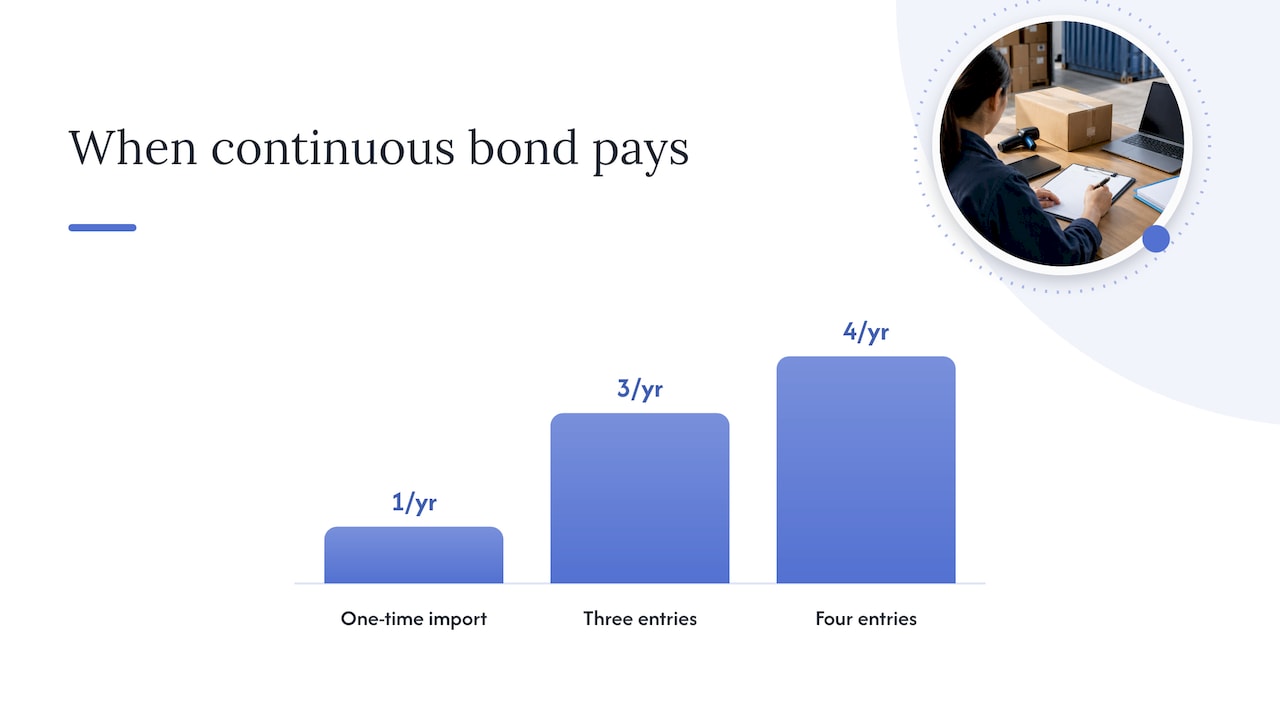
Pro Tip: If you’re not sure whether you’ll import again within 12 months, price both options. Continuous bonds often cost less per shipment once you clear three or four entries a year.
How CBP calculates bond amounts and minimums
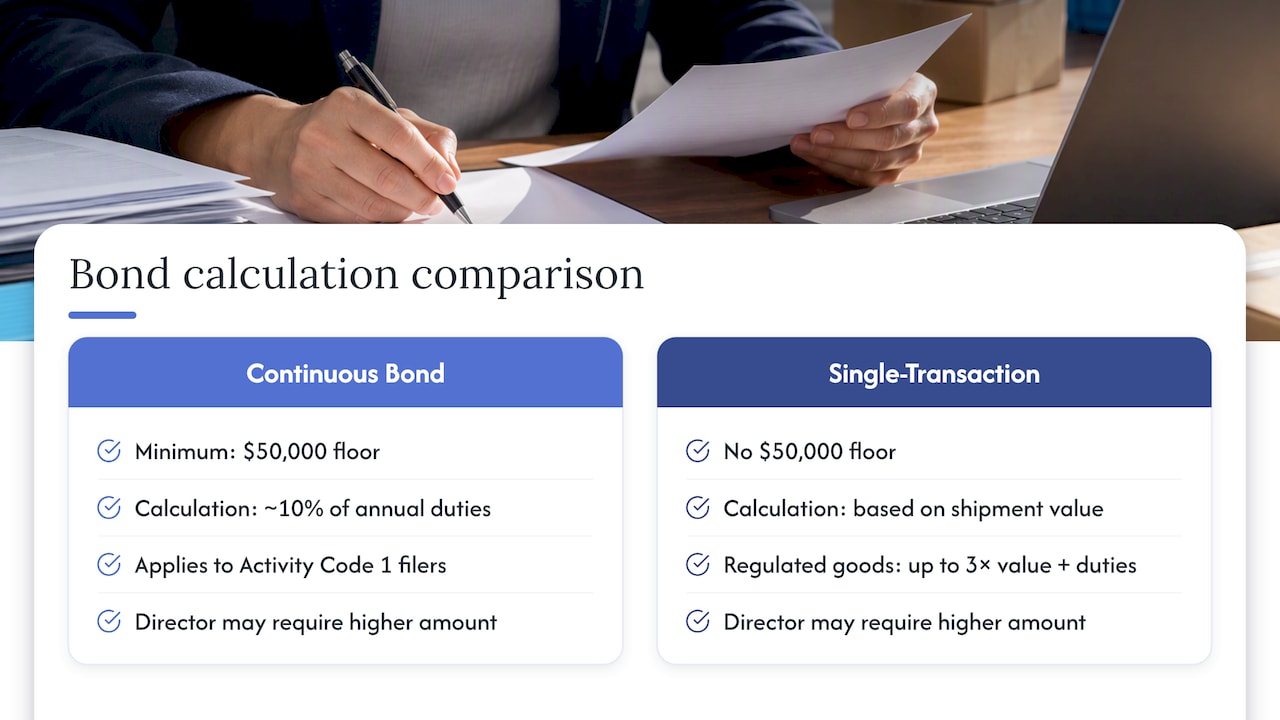
CBP’s monetary guidelines set the baseline for continuous bond amounts at not less than $50,000 for many Activity Code 1 bonds, with a reviewer formula that generally targets around 10% of the duties, taxes, and fees an importer paid or expects to pay over the coming year.
Single-transaction bonds follow a different logic. They’re typically calculated based on the value of the specific shipment, and certain regulated categories, such as goods subject to other federal agencies’ requirements, can trigger a multiplier of up to three times the entered value plus duties. District directors also retain discretion to require a higher bond amount than the standard formula would produce, particularly for importers with a history of compliance problems or entries involving higher-risk goods.
CBP’s monetary guidelines set the continuous bond floor at a minimum amount for many Activity Code 1 filers, calculated using roughly 10% of a year’s duties, taxes, and fees. That formula means a business paying a high amount annually in duties should expect a continuous bond proportional to that duty spend, above the minimum floor.
When you actually need a customs bond
Not every shipment requires one, but most commercial imports do.
- Formal entries, generally those valued above the informal entry threshold, require a bond regardless of product type
- Goods regulated by other federal agencies (FDA, USDA, EPA, and similar) often carry stricter bonding requirements even at lower values
- Ocean shipments require Importer Security Filing, and that filing needs bond coverage either through your Activity 1 through 4 continuous bond or a standalone Appendix D bond
- Temporary Importation Under Bond (TIB) allows certain goods to enter without paying duty, subject to a time limit that cannot exceed three years, and it still requires its own bond
Skipping a required bond doesn’t just risk a rejected entry. It typically means a port hold, and the storage and demurrage fees that accumulate during a hold often cost more than the bond premium would have.
Getting and filing a CBP bond step by step
Filing a bond is procedural, but the details on Form 301 matter, and small errors cause delays.
- Decide single-entry or continuous based on your expected import frequency over the next 12 months.
- Estimate the bond amount using the duty, tax, and fee totals from recent entries, or the shipment value for a single-transaction bond.
- Choose a surety company or work through a licensed customs broker who already holds relationships with approved sureties.
- Complete CBP Form 301, listing the correct activity code, bond amount, and principal information; use Form 301A when multiple co-principals need to be added to the same bond.
- Submit for CBP approval, and for continuous bonds, confirm the bond is active in CBP’s system before your next entry files, since a lapsed or unrecorded bond will trigger an entry rejection.
For ISF-specific bonds under Appendix D, timing matters more than usual: the bond needs to be active before the ISF filing, which itself is due at least 24 hours before cargo loads at the foreign port.
Pro Tip: Keep a copy of your continuous bond’s effective and expiration dates somewhere visible. Renewal gaps are one of the more common, and most avoidable, causes of entry holds.
How a licensed broker reduces bond-related risk
A licensed customs broker handles the parts of bond filing where importers most often make mistakes: activity code selection, bond amount calculation, and Form 301 submission. A licensed customs broker pairs filing work with the operational pieces that determine whether a bond actually holds up in practice.
- Licensed brokerage staff select the correct activity code and calculate bond amounts using current duty and fee history
- Bonded warehouse vetting confirms a facility’s bond status before goods are stored there, avoiding surprises at release
- Denied-party screening catches restricted parties before a shipment reaches the port, preventing the kind of hold that a bond alone can’t resolve
- Duty planning support, including guidance on shipments from China, helps importers estimate the duty exposure that feeds directly into their continuous bond amount
What matters most when choosing a bond
Most importers overthink the bond type and underthink the bond amount. Activity Code 1 covers the overwhelming majority of import scenarios, and the real decision is single versus continuous, which should be driven by shipment frequency rather than instinct.
The bigger risk isn’t picking the wrong bond category. It’s under-calculating the amount and getting hit with a district director’s discretionary increase mid-year, or letting a continuous bond lapse during a renewal window nobody was tracking. Treat your bond amount as a number to revisit annually, tied to your actual duty spend, not a figure you set once and forget.
— Akbar
How Universal Shipping supports customs bonds and clearance
Universal Shipping’s customs brokerage service handles Form 301 filing, activity code selection, and bond amount calculation as part of a broader freight forwarding and clearance package, so importers aren’t coordinating a surety, a broker, and a warehouse separately.
That same team supports ISF filing timing, bonded warehouse vetting, and duty planning, which means the bond decision doesn’t happen in isolation from the rest of your shipment. Businesses running regular import volume can pair brokerage with Universal Shipping’s freight forwarding and customs services to keep bond renewals, entry filings, and duty exposure under one point of contact. Check current service tiers on the pricing page or request a quote to see how bond and clearance support fits your import schedule.
Sources
This article is general information, not a substitute for advice from a qualified financial advisor. Consult a qualified financial professional about your own circumstances before acting on anything here.
FAQ
What are the different types of customs bonds?
The main types are single-transaction bonds, which cover one entry, and continuous bonds, which cover a full year of entries under CBP Form 301. Beyond those, activity codes cover specialized needs like drawback, bonded warehouses, carriers, Foreign Trade Zones, and standalone ISF bonds.
What are the four main types of bonds?
Importers most commonly encounter Activity Code 1 (basic importation, single or continuous), Activity Code 1a (drawback), Activity Code 2 (custodial bonded warehouses), and Activity Code 4 (Foreign Trade Zone operator bonds). Each code corresponds to a distinct role or transaction under 19 CFR Part 113.
What are the different types of CBP bonds?
CBP recognizes bonds by activity code, ranging from Activity Code 1 for standard entries through Activity Code 16 for standalone Importer Security Filing coverage. The CBP ISF FAQ explains that Appendix D continuous ISF bonds carry a $50,000 minimum, while single-transaction ISF bonds are set at $10,000.
What are the different types of bonds in the USA?
Within U.S. import compliance, the relevant bonds are customs bonds issued under CBP’s activity code system, not general surety bonds used in construction or licensing. For imports specifically, the choice is almost always between single-transaction and continuous coverage, with specialized activity codes applying to warehouses, carriers, and FTZs as needed.
Do I need a customs bond for every shipment?
You need a bond for formal entries, generally those above the informal entry value threshold, and for most goods regulated by other federal agencies. A continuous bond covers unlimited entries for a year, so once you have one active, you don’t file a new bond for each shipment.