
Cross Docking for Logistics Managers: 4 Dock Steps and a Pilot
Cross-docking moves inbound freight straight to outbound trailers with little or no storage in between, cutting dwell time and the cost of holding inventory. It works best for high-turn, time-sensitive goods that are already sorted and labeled for their next destination. Operations teams use it to shrink lead times, improve trailer utilization, and reduce warehouse handling for products that do not need to sit on a shelf.
TL;DR:
- A shipment qualifies only when it bypasses rack storage, follows an outbound schedule set before arrival, and stays at the facility roughly 2 to 4 hours, rarely exceeding 24 hours.
- Use continuous cross docking for high volume, single product flows; consolidate smaller supplier loads for shared destinations, or split large inbound shipments for multiple customers.
- Accurate advance shipping notices and reliable carrier arrivals are essential; late trucks, mislabeled pallets, limited dock doors, or forklift shortages can disrupt departures.
- Test one steady lane for 60 days, tracking dwell time, scheduled departures, and dock use before expanding; keep slower or seasonal stock in warehousing.
Table of Contents
- What Separates True Cross-Docking From Put-Away-and-Pick
- How Cross-Docking Works Step by Step on the Dock Floor
- Types of Cross-Docking and When to Choose Each
- The Efficiency and Cost Gains Operations Teams Track
- Challenges and Practical Limits to Plan For
- Cross-Docking vs Traditional Warehousing: Direct Comparison
- Facility Design Choices That Make Cross-Docking Work
- Industries Where Cross-Docking Delivers Real Value
- A Pilot Checklist Built From Operational Experience
- What Logistics Managers Should Know Before Committing
- How We Help Logistics Teams Launch a Cross-Dock Pilot
- FAQ
- Sources
What Separates True Cross-Docking From Put-Away-and-Pick
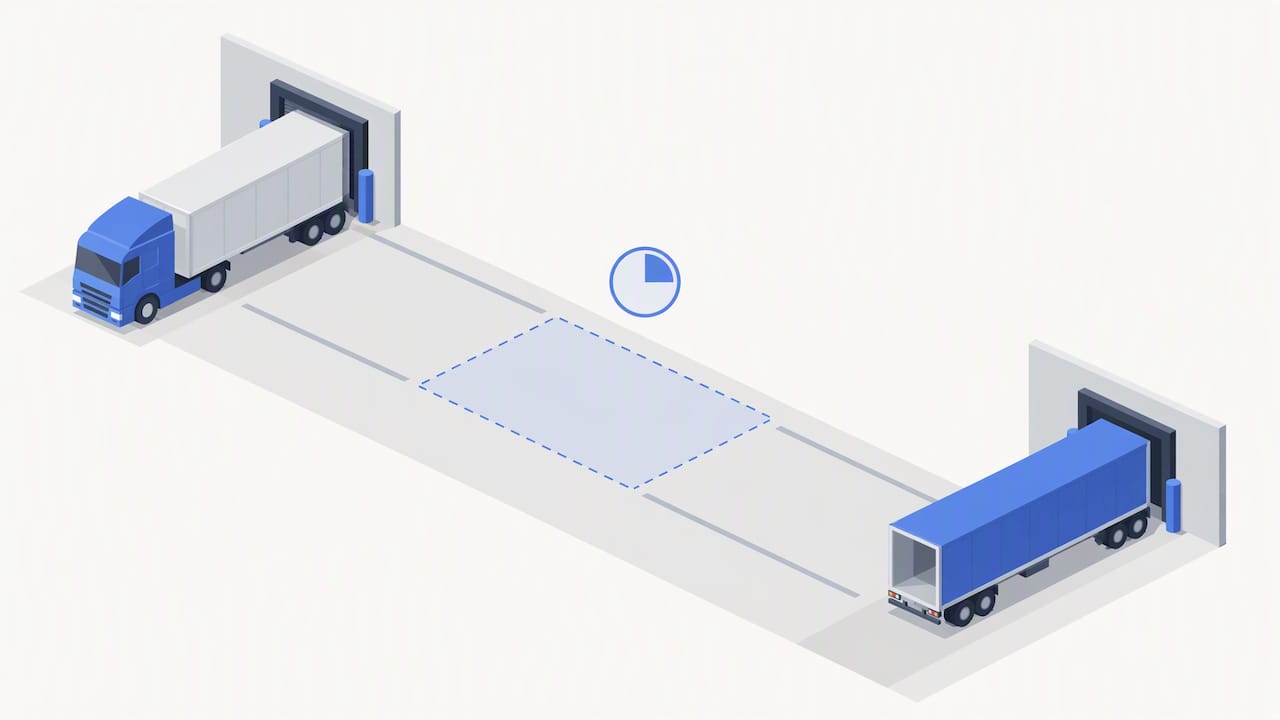
A shipment only counts as cross-docked when it skips rack, shelf, or bin storage entirely and moves based on an outbound schedule that already exists. If a pallet gets put away and picked later, that is traditional warehousing with a faster cycle, not cross-docking. The distinction matters for how you staff, schedule, and measure the operation.
A shipment qualifies as cross-docked when:
- It arrives with sortation already assigned to an outbound destination, not a storage location.
- It never enters rack, shelf, or bin inventory at any point in the process.
- The outbound trailer or route is already scheduled before the inbound truck arrives.
- Dwell time at the facility stays in the 2 to 4 hour range and rarely exceeds 24 hours, per the operational definition of cross-docking.
Anything that lingers past that window starts to behave like short-term storage, which changes the cost and staffing math.
How Cross-Docking Works Step by Step on the Dock Floor
The sequence is simple to describe but demands precision in execution, since every step depends on the one before it running on time.
- Receiving and ASN verification: Dock staff check inbound freight against the advance shipping notice, confirming quantity, condition, and destination codes before anything moves.
- Staging and sortation: Pallets or cases get routed to staging lanes organized by outbound destination, not by product type or supplier.
- Consolidation: Freight bound for the same route or customer gets grouped, sometimes held briefly for a complete load rather than shipping partial trailers.
- Loading and departure: Outbound carriers load against a fixed departure window, and dock supervisors confirm the trailer matches the manifest before release.
Receiving clerks and forklift operators handle the physical movement, while a dock supervisor or warehouse management system tracks timing and flags delays. The TechTarget explainer on cross-docking notes that accurate advance shipping notices and carrier coordination matter more here than extra square footage.
Pro Tip: Build a 15-minute buffer into every staging lane so one late inbound truck does not force a missed outbound departure.
Types of Cross-Docking and When to Choose Each
Not every operation fits the same model. Matching the type to your product profile keeps the dock from becoming a bottleneck.
- Continuous cross-docking moves freight straight from production or a single supplier to outbound trailers with minimal sortation, suited to high-volume, single-SKU flows.
- Consolidation cross-docking combines smaller LTL shipments from multiple suppliers into one outbound load bound for a shared destination.
- Deconsolidation cross-docking breaks a large inbound shipment into smaller outbound loads for multiple customers or stores.
- Opportunistic or hybrid cross-docking handles freight case by case, shifting between direct outbound movement and brief temporary storage when timing does not align.
- Pallet-level operations suit bulk retail replenishment, while case-level and truck-rail variants fit mixed-SKU orders and intermodal transfers.
The Efficiency and Cost Gains Operations Teams Track
Cross-docking earns its place in a supply chain budget through measurable operational gains, not just faster-sounding workflows.
- Lower inventory carrying costs since goods are not held on racks waiting to be picked.
- Shorter lead times that translate into faster inventory turnover for high-demand SKUs.
- Better trailer utilization, since consolidating freight bound for shared destinations reduces the number of partially filled trailers on the road.
- Less obsolescence and handling damage for fast-moving or perishable goods that spend less time in transit touchpoints.
Consolidating freight through cross-docking increases outbound trailer utilization by grouping shipments bound for the same destinations, which directly reduces the number of partially filled trailers a fleet has to run, according to the cross-docking overview.
Challenges and Practical Limits to Plan For
Cross-docking rewards precision and punishes guesswork, so a few constraints deserve attention before committing a full operation to it.
- Accurate ASNs and carrier service-level agreements are non-negotiable, since the entire schedule depends on inbound freight arriving as promised.
- Dock-door and forklift availability can bottleneck throughput fast if the facility is not staffed or laid out for the volume.
- Inbound variability, like a delayed truck or mislabeled pallet, risks a missed outbound departure window.
- Mitigation strategies include buffer staging lanes, a mixed-door strategy that lets any door handle inbound or outbound as needed, and extra handling resources during peak periods.
Cross-Docking vs Traditional Warehousing: Direct Comparison
The two models solve different problems, and the choice usually comes down to how fast a SKU turns and whether it needs inspection or value-add work before shipping.
- Dwell time: cross-docking targets 2 to 4 hours and rarely exceeds 24, while warehousing holds inventory for days, weeks, or longer.
- Cost drivers: cross-docking trades storage cost for scheduling and handling precision, while warehousing trades handling simplicity for carrying cost.
- SKU suitability: warehousing fits products needing quality inspection, kitting, or broad assortment picking, while cross-docking fits high-turn, pre-sorted freight.
- Hybrid operations run both side by side, cross-docking the predictable fast movers while warehousing the slower or seasonal inventory.
Facility Design Choices That Make Cross-Docking Work
Dock layout and scheduling discipline determine whether a cross-dock operation hums or clogs. Most facilities use an I, T, or X-shaped layout, with door count scaled to daily throughput rather than square footage.
- Separate inbound and outbound doors suit high-volume, predictable flows, while a mixed-door strategy gives flexibility when volume swings day to day.
- Truck scheduling gets complex fast once multiple carriers and dozens of doors are involved. Mixed-integer programming models that jointly schedule trucks and allocate material-handling resources have been shown to reduce late departures and door conflicts, according to research on multi-door cross-dock scheduling.
- Forklift and buffer planning should assume peak-hour volume, not daily averages, to avoid bottlenecks during the busiest staging windows.
Pro Tip: Run a door-utilization audit before adding square footage. Most capacity problems are scheduling problems, not space problems.
Industries Where Cross-Docking Delivers Real Value
Cross-docking shows up wherever speed and predictable demand outweigh the need for storage flexibility.
- Retail and big-box replenishment uses it to keep store shelves stocked without warehousing every SKU centrally.
- Grocery and perishable supply chains rely on tight cross-dock windows to preserve shelf life.
- LTL carriers build entire networks around consolidation and deconsolidation cross-docking.
- Medical distribution uses scheduled cross-docking for time-critical deliveries to hospitals and clinics.
- E-commerce operations consolidate multi-supplier shipments into single outbound loads for faster customer delivery.
A Pilot Checklist Built From Operational Experience
Launching a cross-dock pilot works best on one lane with a narrow scope and clear metrics before scaling further.
- Pick a single lane with predictable volume and track turn time, on-time departures, and dock utilization.
- Confirm ASNs and carrier SLAs are accurate before the pilot starts, not after a missed window.
- Map staging lanes, assign forklift coverage, and set a KPI dashboard everyone on the floor can see.
- Lean on an integrated warehousing and 3PL partner to absorb the setup work and reduce the friction of running a first pilot in-house.
What Logistics Managers Should Know Before Committing
Cross-docking suits operations with predictable, high-turn volume and the discipline to keep ASNs accurate. Start with one lane, measure dwell time and on-time departures for 60 days, then decide whether to scale. Check an author’s credentials and published case studies before treating any single guide as the final word.
— Akbar
How We Help Logistics Teams Launch a Cross-Dock Pilot
We run 3PL fulfillment services and warehousing and fulfillment solutions built to absorb the receiving, order processing, and staging work a cross-dock pilot needs without forcing you to build that infrastructure from scratch.
Receiving, order processing, and additional pick services can plug directly into a pilot lane, and the team can help you map staging lanes and KPI targets before your first truck arrives. If you are ready to test cross-docking on a real lane, request pricing and a consultation and we will help you scope it.
FAQ
Is it cross dock or cross-docking?
Both terms describe the same practice: “cross dock” typically refers to the facility or process as a noun, while “cross-docking” describes the activity. Industry usage treats them interchangeably, with “cross-docking” more common in operational writing per the cross-docking definition.
What are the four types of logistics?
Logistics is commonly divided into inbound, outbound, reverse, and third-party logistics, each covering a different direction or ownership of freight movement. Cross-docking typically applies within inbound and outbound logistics, where speed and consolidation matter most.
What are the 7 C’s of supply chain management?
Definitions vary across sources, but a common version includes the right customer, product, cost, quantity, condition, time, and place. Cross-docking directly supports several of these, particularly time and condition, by minimizing the handling freight undergoes before reaching its destination.
What are the four main types of warehouses?
Common categories include public warehouses, private warehouses, bonded warehouses, and distribution or fulfillment centers, each serving different ownership and storage needs. Cross-dock facilities function more like distribution centers, since they are built around throughput rather than long-term storage.
Sources
- Cross-docking – Wikipedia
- Multi-Door Cross-Dock Scheduling with Material Handling Resource Restrictions (Georgia Southern digital commons)
- What is cross-docking? – TechTarget