
Cross-Border Shipping to the USA: A Practical Guide for Businesses
Shipping goods into the United States works when four things line up before the cargo moves: a clear transport plan, a complete set of customs documents, a licensed party filing the entry, and a U.S. warehouse or delivery plan on the far side of the border. Miss one and the freight sits at the port while storage and detention fees build. We handle freight forwarding, customs brokerage, warehousing and fulfillment under one roof, so this guide follows a shipment from the foreign dock, or the Mexican border, to the customer’s door.
TL;DR
- Pick the mode by speed and cargo size: ocean for large, slow freight, air for urgent goods, and trucking or rail for Mexico and Canada.
- Every commercial shipment needs a commercial invoice, packing list and a customs entry, and CBP expects entry documents within 15 calendar days of arrival.
- Budget for more than freight: duty, the Merchandise Processing Fee, the Harbor Maintenance Fee on sea cargo, and storage if clearance stalls.
- Duty-free de minimis entry has been suspended for all countries since August 29, 2025, and tariff rules have changed several times since, so confirm the current rate for your tariff code before you quote a landed cost.
- A broker, a forwarder and a U.S. warehouse that work together remove most of the handoffs where delays start.
Table of Contents
- How cross-border shipping into the USA works
- Choosing the mode: ocean, air, truck or rail
- Shipping to the USA from Mexico
- The documents CBP expects
- What it costs: freight, duty, fees and tariffs
- Goods that are prohibited or restricted
- How to prevent delays at the border
- What happens after the border: warehousing and fulfillment
- Our view on cross-border shipping
- Where we fit
- FAQ
- Sources
How cross-border shipping into the USA works
Domestic shipping is one trip with one carrier. A cross-border shipment is usually several legs with different parties: a pickup at the factory, a move to the port, airport or border crossing, customs clearance, and a U.S. delivery leg. Customs clearance is required at both ends, the paperwork is heavier, and several agencies can have a say on the same shipment.
The parties you will deal with are few:
- The importer of record. The business legally responsible for the entry and the duties. For most of our readers, that is you.
- The customs broker. A licensed professional who files the entry with U.S. Customs and Border Protection (CBP) on your behalf. See how customs clearance services fit into a booking.
- The freight forwarder. The company that arranges transport and books space with carriers. Our freight forwarding process runs 12 steps from quote to delivery.
- The warehouse or fulfillment partner. The place where freight is received, stored, split and shipped on to customers.
When these are four different companies, each one waits on the other for documents. When they are one platform, the broker sees the booking, the warehouse sees the entry status and you see one tracking record.
Choosing the mode: ocean, air, truck or rail
The right mode depends on how much you ship, how fast you need it and where it starts.
| Mode | Best for | Typical trade-off |
|---|---|---|
| Ocean freight (FCL or LCL) | Large, heavy, non-urgent inventory from Asia or Europe | Slowest, but lowest cost per unit |
| Air freight | Urgent, high-value or lightweight goods, restocks before a sales peak | Highest cost per kilo |
| Truck (FTL or LTL) | Mexico and Canada, and every domestic leg after the port | Border crossing and drayage handoffs |
| Rail | Heavy freight from Mexico or Canada | Slower than trucking, fewer pickup points |
A few notes that save money:
- Full truckload (FTL) means one shipper fills the trailer. Less-than-truckload (LTL) means your pallets share a trailer with other shippers’ freight, which costs less for small loads but adds terminal transfers.
- FCL and LCL are the ocean equivalents: a full container versus a shared one. If your goods fill roughly half a container or more, compare the FCL quote against LCL, because LCL charges add up per cubic meter.
- Ocean shipments need an Importer Security Filing, known as ISF or 10+2, submitted before the cargo is loaded. Read the ISF filing requirements and deadline before you book a vessel.
- For urgent goods, air freight shipping shortens transit, but it only avoids customs holds if the paperwork is right at departure.
If you want to know who is responsible for what on a door-to-door booking, our guide to door to door freight lays out where customs roles stay with you.
Shipping to the USA from Mexico
Mexico is the most common land route into the U.S. for manufacturers and retailers, and it runs on trucks and rail rather than ports. A typical truck move has four stages:
- Pickup and Mexican export clearance at the origin.
- Border transfer. A drayage carrier, the short-haul trucker licensed to cross, moves the trailer or its contents across the border to a U.S. carrier.
- U.S. customs entry. Your broker transmits the entry data to CBP and the load is released or examined.
- Linehaul and delivery by a U.S. carrier, often through a warehouse near the border where freight is cross-docked, meaning moved from one trailer to another without long storage.
Planning figures vary a lot by lane and season, so ask for quotes by lane rather than relying on a published average. What does not vary is the documentation.
USMCA and the Certificate of Origin question
Goods that qualify as originating under the U.S.-Mexico-Canada Agreement (USMCA) can enter at reduced or zero duty. Many importers still ask for a “USMCA certificate of origin” form. According to CBP’s USMCA FAQ, no specific certificate form is required. Instead, the certification must contain nine data elements, including the certifier, a description and tariff classification of the good, and the origin criteria. Your supplier or you, as importer, can provide it, as long as the data is complete and the signature and date are present.
The practical point: do not wait for a particular form from the Mexican factory. Agree on the nine data elements in your purchase order so the claim is ready when the truck is.
The documents CBP expects
CBP’s guide to importing into the United States says entry documents must be filed within 15 calendar days of the shipment’s arrival at a U.S. port of entry. The set includes the entry manifest (CBP Form 7533) or the immediate-delivery application (CBP Form 3461), evidence of the right to make entry, the commercial invoice and the packing list. If the goods are released at entry, the entry summary and the estimated duties must be deposited within 10 working days.
In practice, check these before the cargo leaves:
- Commercial invoice. Seller, buyer, a precise product description, quantity, unit value, currency, country of origin and terms of sale. Vague descriptions such as “parts” or “accessories” are a common cause of questions from CBP. Our guide to commercial invoice requirements lists every field.
- Packing list. Pieces, weights and dimensions that match the invoice and the carrier’s paperwork.
- Tariff classification. The Harmonized Tariff Schedule code for each product, which drives the duty rate.
- Customs bond. Most commercial imports need one, either per shipment or continuous. The customs bond types guide explains how the amount is set.
- Power of attorney. Your broker needs your signed authority to file. Three checks on the customs power of attorney page prevent most port holds from this cause.
The mismatch is the usual failure: an invoice that says 500 units, a packing list that says 480, and a carrier manifest with a third description. Fix it before departure, not at the port.
What it costs: freight, duty, fees and tariffs
The quote for transport is only part of the landed cost. Add these:
- Duty based on tariff classification, value and country of origin.
- Merchandise Processing Fee (MPF). According to CBP’s user fee table, formal entries pay 0.3464% of value with a $34.58 minimum and a $670.86 maximum, and informal entries pay a flat $2.77, $8.30 or $12.45 depending on how the entry is processed. These amounts are adjusted periodically, so read the live table for the current fiscal year.
- Harbor Maintenance Fee. The same table lists 0.125% of value on imports arriving by sea.
- Truck arrival fee. The table lists $7.60 per arrival, or a prepaid annual transponder at $138.32, for trucks entering the U.S.
- Storage, demurrage and detention. Not government fees, but the charges that grow quickly when documents are late.
Worked example
Say a retailer brings in a formal entry of goods valued at $40,000 by sea. At 0.3464%, the MPF is $138.56, which sits between the minimum and the maximum. The Harbor Maintenance Fee at 0.125% is $50. Those two fees total $188.56 before any duty, which depends on the tariff code and origin. Add the freight, the broker fee and the bond, and you have the landed cost per unit.
Tariffs and the end of de minimis
Two changes matter most to small and mid-sized importers. First, according to CBP’s U.S. Tariff Overview, duty-free de minimis entry was suspended for goods of all countries on August 29, 2025, although international postal shipments remained duty-free at that point. Small parcels that once slid in under the old $800 threshold now need to be treated as dutiable imports. Second, additional tariffs on top of the regular rate have shifted repeatedly through 2025 and 2026, with exemptions that depend on the product and the origin, and USMCA-originating goods are treated differently from the rest.
Because those rules move, price every quote against the tariff code, the origin and the date of entry, and check CBP’s tariff pages before you commit to a selling price. Duty rules for specialized goods can also look surprising: the 25-year import rule for vehicles is one example of a rule that depends on the product itself.
Goods that are prohibited or restricted
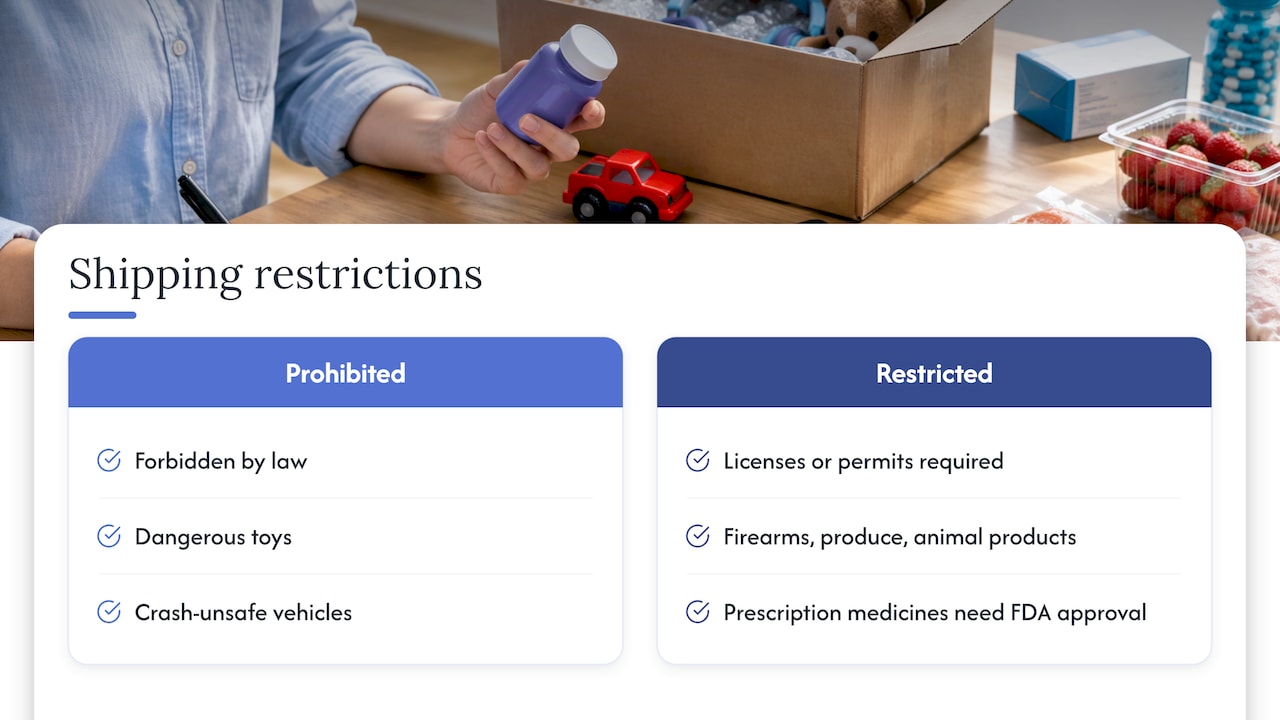
Before you ship, check the product against the lists. CBP’s prohibited and restricted items page separates the two groups: prohibited items, such as dangerous toys or vehicles that do not protect occupants in a crash, are forbidden by law, while restricted items, such as firearms, certain fruits and vegetables, animal products and some animals, need federal licenses or permits. It also notes that prescription medicines need FDA approval.
Biological material has its own rules. CBP states that biological materials must be documented, labeled, packaged, placarded and declared under federal and state regulations, and partner agencies such as USDA, FDA or CDC may require permits that travel with the shipment to the port.
If your product touches food, plants, animal products, cosmetics, electronics with batteries or anything regulated, confirm the agency and the permit before you book transport. A permit that arrives after the freight does is a storage bill.
How to prevent delays at the border
Most holds trace back to the same causes, and each has a plain fix.
- Send documents before the cargo moves. Give the broker the invoice, packing list and product details early enough to classify and review them.
- Classify with care. A wrong tariff code can change duty and trigger questions. Use specific product descriptions.
- Match the numbers. Quantity, value, weight and origin must agree across every document.
- Have the bond and the power of attorney in place before the first shipment.
- Plan where the freight lands. If a container needs inspection or devanning, a CFS warehouse that handles exams prevents extra drayage and duty delays.
- Book the delivery appointment. Large retailers and distribution centers reject or fine late arrivals, so see how to book a delivery appointment and avoid fees.
Tracking matters too. A single record that shows the pickup, the border crossing, the entry status and the warehouse receipt means you find out about a problem on day one rather than day ten.
What happens after the border: warehousing and fulfillment
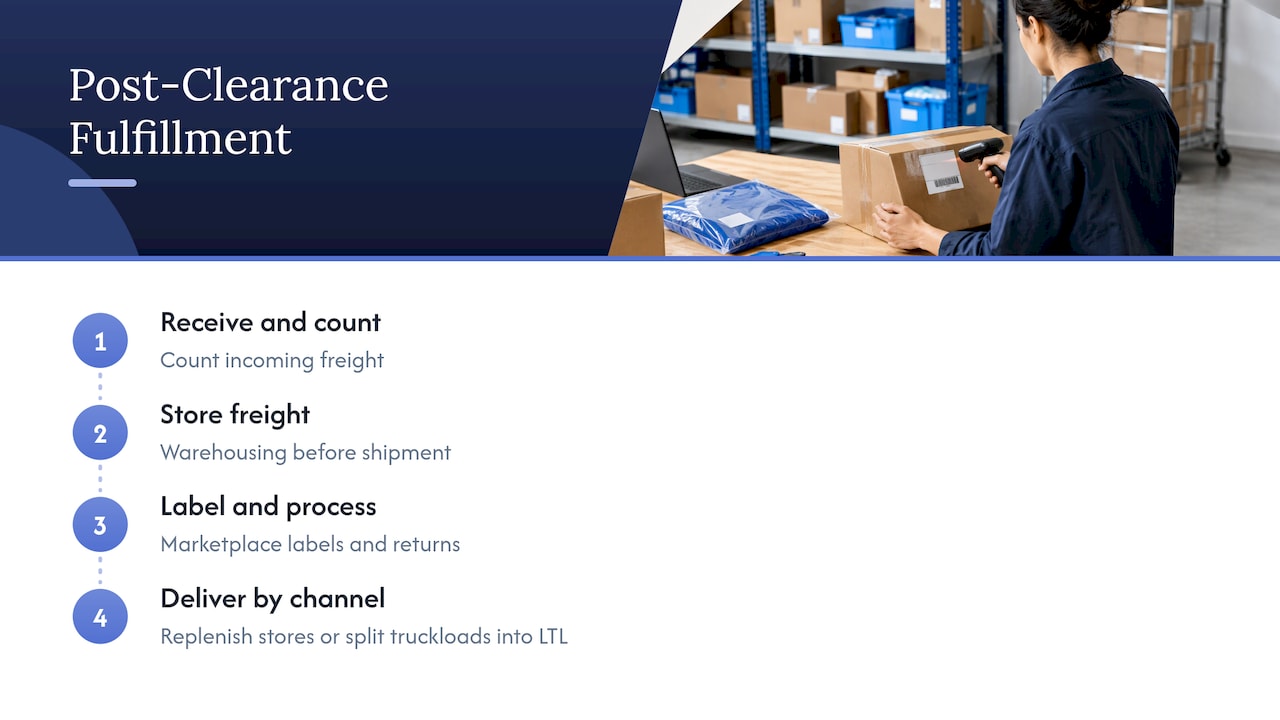
Clearing customs is not the end. The freight still has to be received, counted, stored and shipped. For ecommerce sellers, that includes labeling for marketplaces and returns. For retailers, it means replenishing stores. For manufacturers, it often means splitting a truckload into LTL deliveries.
Under our warehousing and fulfillment solutions, published storage rates are $5-$6 per month per bin and $17-$19 per month per pallet, and additional services are billed at $37 per hour. Receiving, order processing, additional picks, returns and packaging are priced on our pricing page. Whether you outsource or not, the comparison in our guide to 3PL services versus in-house shipping shows what to count.
Our view on cross-border shipping
Most importers we talk to think of cross-border shipping as a transport problem. We think it is a handoff problem. The truck, the vessel or the plane is the easy part. The delays come when the forwarder, the broker, the warehouse and the last-mile carrier each hold a different piece of the shipment and nobody sees all of it.
That is why we built Universal Shipping around one platform: transportation, warehousing and customs in the same place, with real-time tracking and personalized 24/7 service. Our approach is designed to give small and mid-sized businesses the visibility that usually belongs to much larger global firms, across all 50 states.
Our advice is simple. Settle the documents and the bond first, choose the mode second, and decide where the freight lands before it leaves. If one team sees the whole route, the border becomes a checkpoint rather than a surprise.
Akbar
Where we fit
If you import to the U.S. and want the border, the warehouse and the delivery handled together, our freight forwarding and customs brokerage team covers air, ocean and land freight, FTL and LTL, customs clearance and U.S. delivery. Ecommerce sellers can add omnichannel and ecommerce fulfillment after clearance, and Amazon sellers can use FBA prep. Tell us the origin, the product and the monthly volume, and we will map the route from the foreign dock to your customer.
Start on our home page to request a quote.
FAQ
Do I need a customs broker to import into the USA?
Most commercial importers use one. A licensed broker files the entry, classifies the goods and deals with CBP for you, which is hard to do correctly for the first time without help. We provide customs brokerage as part of our freight forwarding service.
Is there still a duty-free threshold for small shipments?
No. Per CBP, de minimis duty-free entry has been suspended for goods of all countries since August 29, 2025. Treat small parcels as dutiable imports, and confirm the current rate for your product and origin on CBP’s tariff pages.
Do I need a USMCA certificate of origin form to ship from Mexico?
No specific form is required. CBP asks for nine data elements in the certification of origin, and the importer, exporter or producer can supply them. Agree on that data with your supplier before the first shipment.
What can’t I ship into the United States?
Prohibited items are banned by law, and restricted items such as firearms, certain plant and animal products and prescription medicines need permits or approvals. CBP publishes both lists, and the agency that regulates your product sets the permit.
Sources
- CBP: USMCA frequently asked questions
- CBP: Importing into the United States, a guide for commercial importers
- CBP: User fee table
- CBP: U.S. Tariff Overview
- CBP: Prohibited and restricted items
- CBP: Importing biological materials into the United States