
Crate vs Pallet: What Shippers Need to Know
Use a pallet when you need fast, low-cost handling for uniform, boxed goods. Use a crate when the contents require six-sided protection, internal bracing, or ISPM 15 export treatment. Three rules decide it quickly:
- Fragile, high-value, or irregular cargo (precision equipment, medical devices, artwork): crate.
- Uniform, boxed goods moving through standard U.S. retail or warehouse distribution: pallet, typically the GMA 48×40 standard that dominates domestic retail channels.
- International wood packaging: both pallets and crates must carry an ISPM 15 heat-treatment stamp or your shipment risks rejection at the port.
Usiship handles both scenarios daily, from palletized LTL freight to custom-crated exports with full customs clearance.
Table of Contents
- How do pallets and crates compare side by side?
- What is a pallet, and when does it work best?
- What is a crate, and when do you actually need one?
- What materials and standards govern pallets and crates?
- How do you choose between a crate and a pallet?
- What do pallets and crates typically cost in the U.S.?
- How does a U.S. freight provider evaluate your packaging?
- Key Takeaways
- The detail most shippers miss
- What actually trips people up in pallet vs. crate decisions
- Usiship handles the packaging-to-delivery decision for you
- Useful standards and references
How do pallets and crates compare side by side?
Pallets are open platforms built for handling speed; crates are fully enclosed to protect cargo on all six sides against impact, moisture, dust, and theft. The table below maps the key decision dimensions.
| Dimension | Pallet | Crate |
|---|---|---|
| Best for / typical use case | Uniform boxed goods, retail distribution, warehouse racking | Fragile, high-value, oversized, or export-bound cargo |
| Protection level | Low (open sides, top exposed) | High (enclosed on all six sides, internal bracing) |
| Load capacity | Typically sufficient for standard wood pallets used in general purposes | Varies widely; custom-built to load specs |
| Stackability and racking | Excellent with standard racking systems | Limited; most crates are not racking-compatible |
| Handling | Forklift, pallet jack, conveyor | Forklift or crane; lift points must be specified |
| Materials and customization | Wood, plastic, metal; standard sizes | Plywood, engineered wood, steel; fully custom |
| ISPM 15 / export suitability | Required for wood pallets in export | Required for wood crates in export; often pre-treated |
| Typical U.S. cost | Varies depending on material and type, with wood pallets generally being less expensive than plastic ones | — |
| Reusability / lifecycle | High; pooling programs widely available | Moderate; collapsible designs improve return economics |
Scenario A: A retailer shipping 40 cases of packaged consumer goods from a Chicago distribution center to a Dallas store uses a standard wood pallet. Fast, cheap, compatible with every dock in the chain.
Scenario B: A manufacturer exporting a CNC milling machine to Germany builds a custom plywood crate with internal blocking, foam cushioning, and an ISPM 15 heat-treatment stamp. The crate adds freight weight and cost, but the machine arrives undamaged and clears customs without delay.
What is a pallet, and when does it work best?
A pallet is a flat, rigid platform that lets forklifts, pallet jacks, and conveyors slide underneath and lift a load as a single unit. Pallets include both a top and bottom deck; skids have only a top deck and are better suited to heavy stationary equipment. That structural difference matters when you are booking racking space or specifying lift equipment.
Standard sizes
| Pallet size | Common use |
|---|---|
| 48×40 in (GMA standard) | Common in U.S. retail and grocery distribution |
| 48×48 in | Used for drums and round containers |
| — | Used in telecom and paint industries |
| — | Suitable for beverage and smaller loads |
Pros: Low cost, universally compatible with U.S. warehouse racking, fast handling, widely available for rent or purchase, easy to repair.
Cons: No side or top protection, not suitable for fragile or irregular cargo, wood pallets require ISPM 15 treatment for export, limited customization.
Four-way entry pallets give forklifts access from any side, which matters in tight warehouse bays where a two-way pallet forces extra maneuvering and slows throughput.
What is a crate, and when do you actually need one?
A crate is an enclosed rigid container with framed wall panels attached to a pallet-style base, protecting cargo on all six sides. Industry terminology describes a crate as essentially a pallet with walls added, but that shorthand understates the structural difference. A crate’s walls, corner posts, and internal bracing absorb the shocks and compressive forces that would crush or shift an unprotected load.
Crate types and materials
Plywood crates are the workhorse for most commercial applications. Light enough to keep freight costs manageable, strong enough for most industrial and commercial cargo. Custom wooden crates use lumber frames and plywood panels, with internal blocking, foam, and bracing to secure fragile or irregular items.
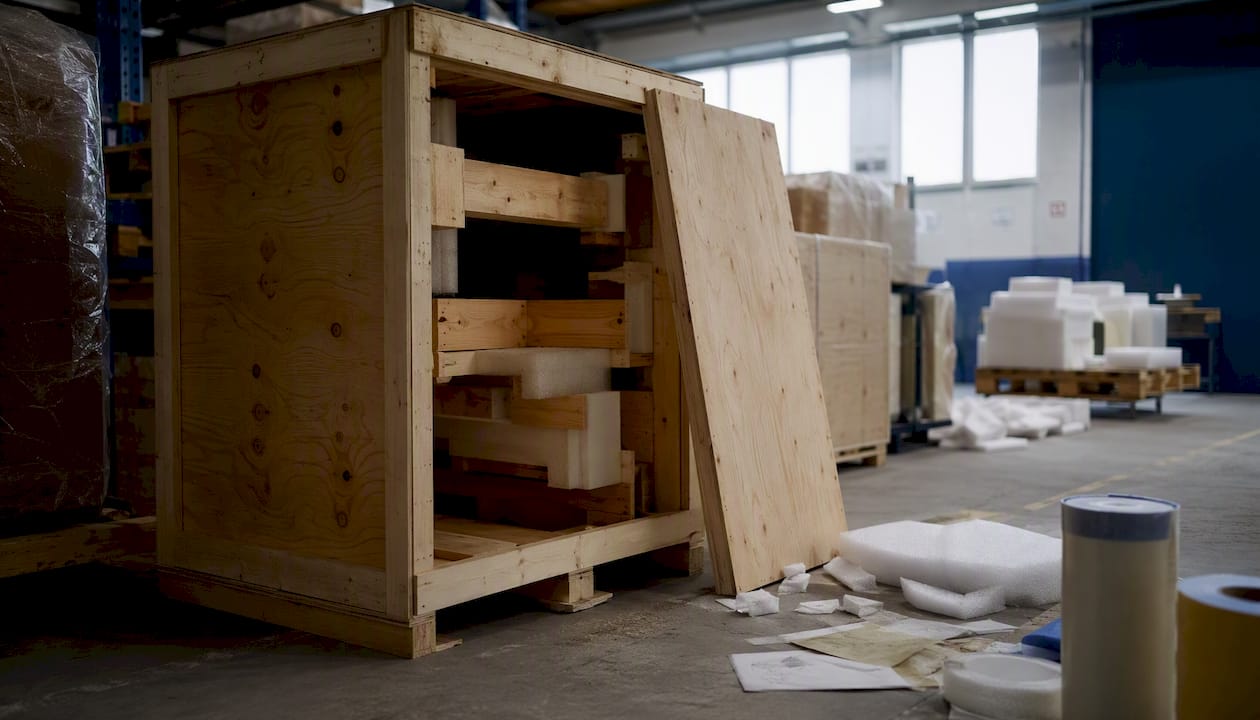
Engineered wood and OSB crates offer more moisture resistance than standard plywood and suit longer transit times or outdoor storage.
Steel crates handle extreme loads, corrosive environments, or repeated international trips. The weight penalty is real, so they make sense only when durability over many cycles justifies the freight premium.
Collapsible and reusable crates fold flat for the return trip, cutting return-freight volume significantly. For high-frequency routes, the savings add up fast.
Where specialized crates earn their cost
Crates are the right call for fragile, high-value, oversized, or rough-handling shipments: fine art, precision CNC equipment, medical imaging devices, semiconductor manufacturing tools, and large electronics all ship in custom crates. The internal blocking holds the item in exact position; the walls prevent forklift tines from ever touching the cargo.
Pros: Maximum protection, custom fit, theft deterrence, suitable for export with ISPM 15 treatment.
Cons: Higher material and labor cost, added freight weight, longer lead time for custom builds, limited racking compatibility.
Pro Tip: If your item is fragile but not oversized, a reinforced pallet with internal blocking, corner posts, and a shrink-wrapped top cap often provides adequate protection at a fraction of the crate cost. Reserve a full crate for cargo that genuinely cannot tolerate any side impact or compression.
What materials and standards govern pallets and crates?
The GMA 48×40 standard
The 48×40-inch pallet is the dominant format in U.S. retail and grocery distribution, designed to fit two across a standard 8-foot trailer. Its prevalence means virtually every U.S. warehouse rack, conveyor, and dock leveler is built around it. Deviating from this footprint without a good reason adds friction at every handling point.
ISPM 15 and IPPC compliance for export
Any wooden pallet or crate used in international trade must comply with ISPM 15, the international standard for wood packaging material. Compliance requires heat treatment (HT) to a core temperature of 56°C for 30 continuous minutes, or methyl bromide fumigation, followed by an official IPPC mark stamped on the wood. Shipments arriving without the mark face quarantine, treatment at the importer’s expense, or destruction at the port of entry.
ISPM 15 is enforced at ports worldwide, and IPPC publications provide the authoritative implementation guidance for exporters who need to verify their supplier’s treatment process. Planning for the stamp before your crate is built avoids the most common and costly export delay in wood packaging.
When to choose plastic or metal
Plastic pallets are the standard in food-grade and pharmaceutical supply chains where wood’s porosity creates sanitation risk. Metal pallets carry loads that would crack wood and are common in automotive and aerospace manufacturing. Neither requires ISPM 15 treatment, which is a meaningful advantage for frequent exporters.
How do you choose between a crate and a pallet?
Work through this checklist before you book packaging or freight.
- Export destination: — Any wood packaging crossing an international border needs ISPM 15 treatment. Confirm this with your packer before the crate is built.
Questions to ask your packer or carrier
- What is the lead time for a custom crate, and is ISPM 15 treatment included?
- How much weight does the crate add, and how does that affect my freight class?
- Where are the lift points, and are they compatible with the destination’s equipment?
- Can the crate be returned, collapsed, or reused on the next cycle?
- Does internal blocking eliminate movement, or do you recommend foam cushioning as well?
Pro Tip: Ask your carrier for the declared-value threshold above which they require crating. Some LTL carriers set this at $5,000 per shipment. Knowing that number before you pack can save you from a denied claim.
What do pallets and crates typically cost in the U.S.?
| Packaging type | Typical U.S. price range | Common lead time |
|---|---|---|
| Standard wood pallet (new) | — | Same day to 2 days |
| Recycled/used wood pallet | $4–$10 each | Same day |
| Plastic pallet | $50–$100 each | 1–5 days |
| Basic wood crate (small) | — | 2–5 business days |
| Custom crate (large/complex) | — | 1–3 weeks |
Crate weight is the hidden freight cost. A plywood crate adds weight to the shipment, which can increase freight costs, pushing it into a higher freight class on LTL. Choosing lighter plywood panels and internal blocking instead of solid timber reduces that weight penalty, and a collapsible design cuts return-shipping bulk when the crate needs to come back.
Rental vs. buying: Pallet pooling programs (where you rent standardized pallets and return them at the destination) reduce per-trip cost and eliminate the hassle of pallet recovery. For crates, reusable designs pay off on routes where the same item ships repeatedly. One-way custom crates make more sense for unique or infrequent shipments.
How does a U.S. freight provider evaluate your packaging?
When Usiship’s team reviews a shipment, the checklist runs in a specific order. Here is how that evaluation typically works for a domestic retail pallet versus an exported industrial component.
- Verify ISPM 15 status for export — Any wood packaging on an international booking gets flagged immediately. No stamp, no booking until treatment is confirmed.
Usiship’s warehousing and fulfillment services are built around standard pallet racking, and the customs clearance team coordinates ISPM 15 documentation for wood packaging on export shipments.
Pro Tip: Tell your freight provider the crate dimensions and weight before booking, not after. Freight class recalculations after pickup lead to surprise invoices that are almost always higher than the original quote.
Key Takeaways
Pallets win on cost and handling speed for standard boxed goods; crates win on protection for fragile, high-value, or export-bound cargo requiring ISPM 15 compliance.
| Point | Details |
|---|---|
| Default to pallets for standard goods | The GMA 48×40 pallet fits every U.S. dock, rack, and conveyor, keeping handling costs low. |
| Crate when protection is non-negotiable | Fragile, high-value, or oversized cargo needs six-sided enclosure and internal bracing a pallet cannot provide. |
| ISPM 15 is mandatory for wood export | Any wooden pallet or crate crossing an international border must carry a heat-treatment stamp or face port rejection. |
| Crate weight affects freight cost | Factor crate weight into your freight class calculation before booking, not after pickup. |
| Usiship covers both scenarios | Usiship handles palletized LTL freight to custom-crated exports with full customs clearance. |
The detail most shippers miss
What actually trips people up in pallet vs. crate decisions
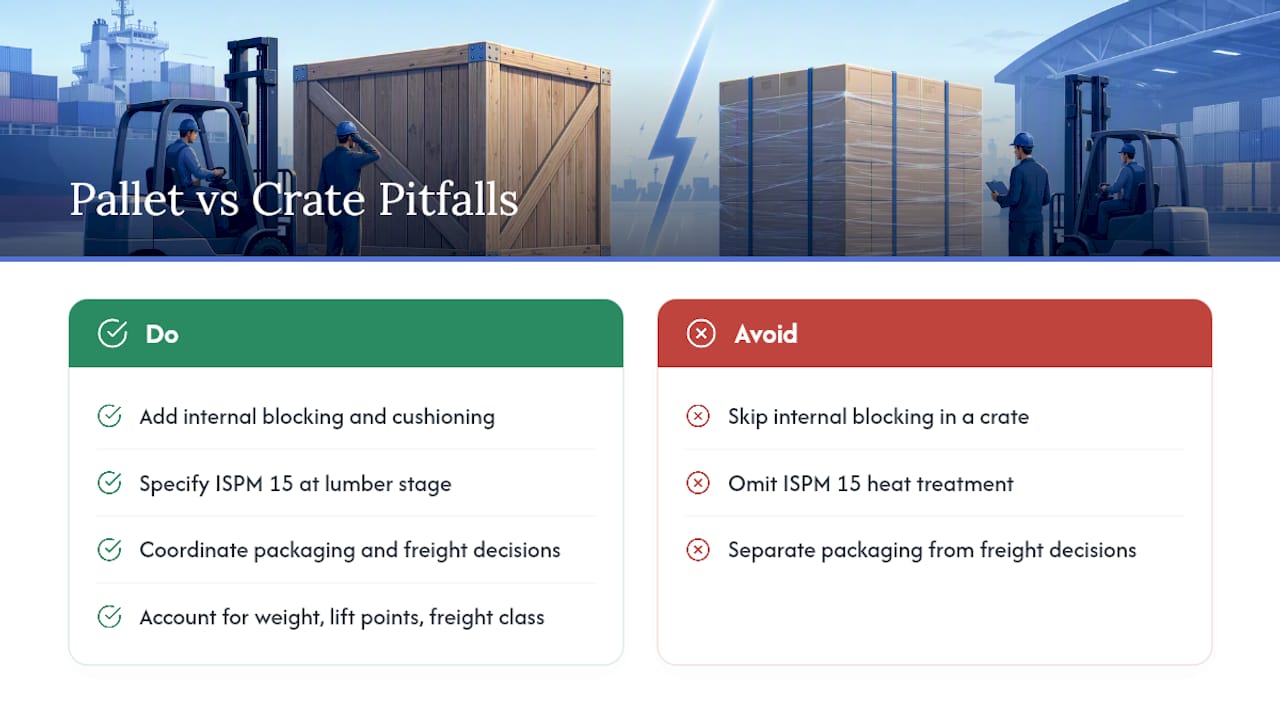
The conventional wisdom says “fragile goods need crates.” That is true, but it misses the subtler failure mode: shippers who choose a crate for protection and then undermine it by skipping internal blocking. A crate with empty space inside is not much better than a pallet. The walls stop external impact; blocking and cushioning stop the cargo from moving inside the crate and damaging itself.
The other thing that catches people off guard is the ISPM 15 requirement. Shippers who build a beautiful custom crate and forget to specify heat-treated lumber find out at the port, not before. The treatment has to be planned at the lumber stage, not added afterward. That single oversight has delayed shipments by weeks.
The smarter move is to think about packaging and freight as one decision, not two. The crate weight, the lift points, the ISPM 15 stamp, the freight class recalculation: all of these interact. A logistics partner who sees the full picture from packaging spec to customs clearance catches those interactions before they become expensive surprises.
Usiship handles the packaging-to-delivery decision for you
Choosing between a pallet and a crate is only the first call. Getting the freight class right, coordinating ISPM 15 treatment, clearing customs, and booking the right mode for the load: that is where most shippers lose time and money.
Usiship manages the full chain. The team quotes palletized LTL and FTL freight, coordinates custom crating and ISPM 15 treatment for export shipments, and handles customs clearance so your wood packaging clears every port without delay. For specialized cargo like furniture or high-value equipment, Usiship’s packaging advisors review your load specs and recommend the right solution before anything is built or booked. Get a quote at usiship.com and have a packaging and freight plan in hand before your next shipment moves.
Useful standards and references
- ISPM 15 official resource: The go-to reference for heat-treatment requirements, approved treatment methods, and the official IPPC mark specifications for wood packaging.
- IPPC — International Plant Protection Convention: Authoritative source for ISPM standard texts and implementation guidance used by customs authorities worldwide.
- Crate vs Pallet: Which Packaging Option Should You Choose?: Practical overview of the structural differences and decision factors between pallets and crates.
- When Do You Need a Crate Instead of a Pallet?: Use-case guidance on when crating is the right call versus a standard pallet.
- The Difference Between Crates, Skids, and Pallets: Clarifies the structural distinctions between skids, pallets, and crates for procurement and operations teams.
- A Guide to Pallet and Crate Industry Terminology: Helps shippers and packers use consistent language to avoid miscommunication on specs and orders.
- Custom Wooden Crate Guide: Covers crate construction, cost drivers, and how internal protection choices affect the final price.
- Wooden Crates vs Pallets for Export: Export-focused comparison covering pallet entry styles, GMA sizing, and handling efficiency considerations.