
Country of Origin Marking: U.S. Import Rules Explained
Every article of foreign origin that enters the United States must carry a mark in English naming the country where it was made, unless an exception applies. The mark has to be conspicuous, legible and permanent enough to reach the U.S. buyer intact. If it is missing or wrong, U.S. Customs and Border Protection (CBP) can hold the goods, require re-marking, and add a duty. The cheapest time to get it right is before the goods leave the factory, not at the port.
This guide is for importers, ecommerce sellers, retailers and manufacturers who bring product into the U.S. It covers the rule, how origin is decided, what the mark must look like, the main exceptions, the cost of getting it wrong, and a pre-shipment routine you can hand to your supplier.
TL;DR
- The law requires the English name of the country of origin on each imported article, or on its container when the rules allow, in a conspicuous, legible, indelible and permanent form.
- Origin is where the article was made, produced or grown. Work done in a second country changes origin only if it substantially transforms the product.
- Exceptions exist, including goods that cannot be marked, goods for the importer’s own use, and the J-list of articles that need only a marked outer container.
- Uncured defects can bring a 10 percent additional duty, plus re-marking, export or destruction of the goods.
- Fix marking at the supplier, confirm it on the packing list and commercial invoice, and keep your customs broker in the loop before the shipment sails.
Table of Contents
- What the U.S. marking rule actually requires
- How CBP decides the country of origin
- What the mark must say and how it must look
- Exceptions you can rely on, and those you cannot
- What happens if marking is missing or wrong
- Marking versus “Made in USA” claims
- A pre-shipment routine for importers
- Why a forwarder who handles customs saves you the rework
- Our perspective
- Getting your freight cleared with fewer surprises
- FAQ
- Sources
What the U.S. marking rule actually requires
The rule comes from Section 304 of the Tariff Act of 1930, codified at 19 U.S.C. §1304. It says that, unless an exception applies, every article of foreign origin imported into the U.S. (or its container, where the statute provides) must be marked with the English name of its country of origin. The purpose is to tell the “ultimate purchaser” where the goods came from. The ultimate purchaser is the last person in the U.S. who receives the article in its imported form, which may be a shopper, a factory using it as a part, or a retailer’s customer.
The detailed regulations are in 19 CFR Part 134. Section 134.11 requires the mark to be in a conspicuous place and to be legible, indelible and permanent as far as the nature of the article or container permits, at the time of importation.
A few points trip up first-time importers:
- The country name must be in English. “Hecho en México” alone does not satisfy the rule. “Mexico” does.
- The mark is about origin, not shipping. The country you shipped from and the country where the product originated can differ. A product made in Vietnam and exported from Singapore is marked “Vietnam.”
- Marking is separate from tariffs and trade agreements. CBP’s own guidance distinguishes marking rules from the preferential-origin rules that decide eligibility for lower duty rates. Passing one test does not mean you pass the other.
How CBP decides the country of origin
For a product made entirely in one country, the answer is simple. Trouble starts when parts, materials or assembly come from several places.
Under 19 CFR §134.1, the country of origin is the country of manufacture, production or growth. Further work or material added in another country changes origin only if it effects a “substantial transformation.” In plain terms, the processing must produce a new and different article, with a new name, character or use. Simple assembly, painting, packing, trimming or relabeling usually does not.
Three practical consequences follow:
- Final assembly is not automatically origin. If a finished product is assembled in one country from components made elsewhere, origin depends on whether that assembly created something fundamentally new.
- The critical component matters. When one part gives the product its essential character and the remaining work is minor, origin can stay with that part’s country.
- Special rules apply to Canada and Mexico. For goods of USMCA countries, the Part 102 rules decide origin for marking purposes, not the substantial transformation test alone. If you ship from those countries, see our guide to the USMCA certificate and its data fields.
If your product is made in more than one country and you are unsure where it lands, do not guess on the label. Have your customs broker review the bill of materials and, where the stakes are high, seek a binding ruling from CBP before you place a large order.
The Hong Kong example
Origin labels also follow policy changes. CBP’s guidance on Hong Kong goods states that goods produced in Hong Kong and entered for consumption after the transition period must be marked “China” for Section 1304 purposes. The same guidance says this does not change ordinary tariff-schedule origin determinations or entry-summary reporting, which continues to use the Hong Kong ISO code where required. If you buy from Hong Kong suppliers, check that their artwork and labels reflect this.
What the mark must say and how it must look
CBP’s informed compliance publication, Marking of Country of Origin on U.S. Imports, sets out the practical standards.
Wording
The mark must identify the country in English. “Made in” is generally optional, but it becomes important when another place name appears on the product and could mislead the buyer into thinking it was made there. If final assembly establishes origin, “Assembled in” can be used. A brand with a U.S. city name and an overseas factory is the classic case where an unqualified name risks a rejection, so the origin wording needs to be close to the place name and clearly legible.
Permanence and visibility
The mark must be legible, conspicuous and indelible, and it must survive normal handling until the article reaches the buyer. It should be visible without taking the article apart. CBP says the best form is one that becomes part of the article: branding, stenciling, stamping, printing or molding. Labels, tags and stickers are acceptable when they stay legible and conspicuous through to the ultimate purchaser.
The regulation gives examples such as die-sinking, molding or etching metal, glazing earthenware during firing, and imprinting paper articles. The principle is the same across materials: the more the mark is built in during manufacture, the less likely it is to fail. Precision manufacturers apply it in their own work, as in this explanation of fiducial marks on glass, where permanent marks are applied for traceability.
Choosing a marking method
| Product type | Marking that tends to hold up | Where it goes wrong |
|---|---|---|
| Metal parts and tools | Etching, stamping, die-sinking or molding | Paper stickers that peel in humid containers |
| Ceramics and glassware | Marking applied in firing or fused into the surface | Ink that rubs off in handling |
| Plastic goods | Molded-in text | Small labels hidden on the underside |
| Textiles and apparel | Sewn-in or printed labels at a visible position | Labels cut out or covered by retail tags |
| Boxed retail goods | Printed on the product and on the carton | Marking only on the master carton, which the consumer never sees |
The last row matters for ecommerce sellers. If the retail box is the container that reaches your customer, it is the container that must show the origin when the article itself is excepted.
Exceptions you can rely on, and those you cannot
Part 134 lists situations in which individual marking is not required. According to 19 CFR §134.32, these include:
- articles incapable of being marked;
- articles that cannot be marked before shipment without injury or economically prohibitive expense;
- crude substances;
- goods imported for the importer’s own use and not intended for sale;
- goods that will be processed so that the mark is necessarily destroyed or concealed;
- goods whose origin the ultimate purchaser must necessarily know;
- articles more than 20 years old;
- goods entered for immediate export or for transportation and exportation;
- U.S. products returned, and specified U.S., possession, USMCA and duty-exempt goods.
The J-list and containers
The J-list under 19 CFR §134.33 exempts listed classes of articles from individual marking, but generally requires the outermost container that ordinarily reaches the ultimate purchaser to show the origin of its contents. In other words, an exception for the article does not remove the duty to mark the box. Containers can remain subject to marking even when the article inside is excepted.
How to use exceptions safely
Treat an exception as a conclusion you document, not an assumption you make at the dock. Write down which paragraph of the regulation you rely on and why, and share it with your broker before the entry is filed. Exceptions are narrow. “Our product is small” is not an exception, while “the article is incapable of being marked” can be, if it is true.
What happens if marking is missing or wrong
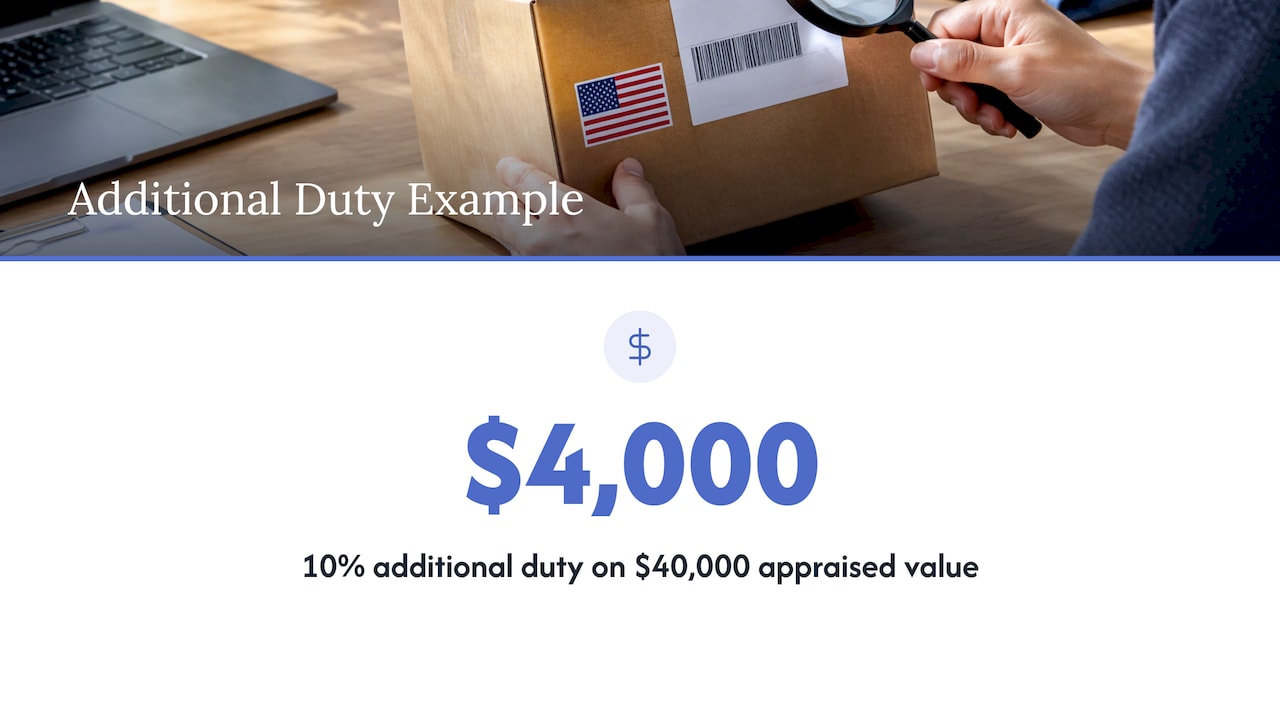
According to CBP’s informed compliance publication, CBP may require the goods to be marked, exported or destroyed under supervision before liquidation (the final calculation of duties on the entry). If the defect is not cured, Part 134 provides an additional duty of 10 percent of the final appraised value. That comes on top of the regular duty.
Section 1304 also allows recovery of customs officers’ expenses for supervising the correction. It authorizes criminal penalties for intentionally removing, destroying, altering, covering or obliterating origin marks to conceal origin.
A worked example shows how the costs stack up. Say a shipment of 2,000 units has a final appraised value of $40,000 and arrives with no origin mark. If the defect is not cured, the 10 percent additional duty comes to $4,000, before the regular duty, any storage while the goods wait, and the labor to re-mark. Re-marking 2,000 units in a warehouse before release usually costs far less than that, and it keeps the goods moving to your customers.
The bigger loss is often time. Goods held for marking delay replenishment, miss retail windows and can trigger inbound rejections at marketplace warehouses.
Marking versus “Made in USA” claims
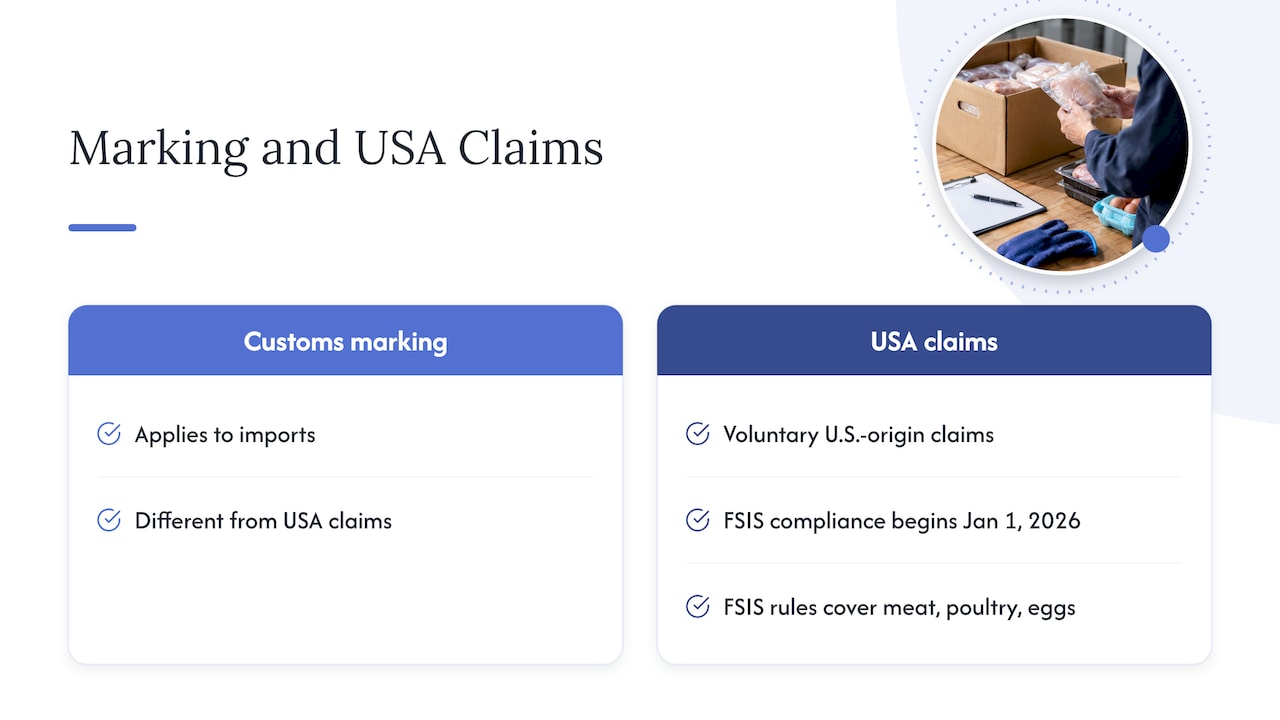
Customs marking applies to imports. A voluntary “Made in the USA” claim is a different matter, and the two should not be confused. One example of a recent rule is the USDA’s Food Safety and Inspection Service final rule, published March 18, 2024, effective May 17, 2024, with compliance for voluntary U.S.-origin claims on FSIS-regulated products beginning January 1, 2026. Under it, an unqualified “Product of USA” or “Made in the USA” claim on a single-ingredient FSIS-regulated product requires animals born, raised, slaughtered and processed in the United States. Multi-ingredient products also need domestic non-spice, non-flavoring ingredients and U.S. preparation and processing. That rule covers meat, poultry and egg products. Other goods are governed by other agencies, so check the rules for your category before printing a U.S.-origin claim.
A pre-shipment routine for importers
Marking is far easier to fix at the source. Use this sequence for every new product and every new supplier.
- Confirm the origin. Ask the manufacturer where the article is made, and where each major component comes from. If production spans countries, decide whether the work amounts to a substantial transformation.
- Specify the mark in the purchase order. State the exact wording (for example, “Made in Vietnam”), the position, the minimum legibility and the method. Prefer molded, etched, stamped or printed marks over loose labels.
- Mark the container too. Cartons that reach your customer need the origin. Master cartons help receiving teams but do not replace the product-level mark when the buyer sees only the retail box.
- Get a production sample. Photograph it. Check that the mark is visible without opening or disassembling anything, and that it survives rubbing and normal handling.
- Align your paperwork. The country of origin on the commercial invoice and the packing list should match the mark on the goods. Mismatches invite questions at entry.
- Check wood packaging separately. Pallets and crates carry their own stamp rules, covered in our guide to ISPM 15 wood packaging. That stamp is not an origin mark.
- Brief your broker before sailing. A licensed broker files the entry on your behalf under a customs power of attorney, and can flag marking questions while they are still cheap to solve. Note that you will also need the right customs bond in place.
- Plan for corrections. If a shipment arrives with a defect, you want a warehouse that can re-mark under CBP’s supervision before release. Bonded storage is one route, and our guide on how to vet U.S. bonded warehouses explains what to look for.
Common mistakes to avoid
- Marking only the master carton while the retail box and product carry nothing.
- Using an abbreviation or a language other than English.
- Placing a small label where it is hidden by another label or by packaging.
- Using a U.S. city or brand name more prominently than the origin, which may mislead the buyer.
- Assuming that a USMCA certificate settles the marking question. It addresses preferential treatment, while marking is decided under its own rules.
- Printing the origin on removable packaging for a product that is sold unpackaged.
Why a forwarder who handles customs saves you the rework
Marking problems are cheap to prevent and costly to repair, and the people best placed to catch them sit between your supplier and the port. A forwarder that coordinates the booking, the customs entry and the warehouse sees the product description, the invoice, the packing list and the physical goods in one workflow. That is where a mismatch shows up before it becomes a hold.
If you are importing from China, where tariffs and documentation checks are already demanding, a single mistake on the label compounds other costs. Our guide to China to U.S. shipping covers the duty exposure that makes clean paperwork and correct marking worth the effort.
Our perspective
Most marking problems we hear about have nothing to do with a rule being hard to understand. They happen because nobody owned the label between the factory and the port. The supplier assumes the buyer will fix it, the buyer assumes the forwarder will notice, and the goods arrive with a sticker that peeled in transit.
Our view is that origin marking belongs in the same workflow as booking, documents and customs entry. When transportation, warehousing and customs sit on one platform, the person reading your commercial invoice is working from the same file as the person receiving your pallets. Our approach is built around that integration, with real-time tracking and personalized service so you can raise a question while the goods are still moving, not after they have been held.
For importers, that means treating the origin mark like any other specification: written into the purchase order, checked on a sample, matched to the paperwork and confirmed before the container is loaded. We offer freight forwarding, customs brokerage and warehousing under one roof, so the people who see the paperwork and the people who handle the cartons are in the same conversation.
Akbar
Getting your freight cleared with fewer surprises
We are Universal Shipping Inc., a U.S. logistics provider offering freight forwarding by air, ocean and land, customs brokerage, warehousing and fulfillment, FBA prep and specialty freight packing across all 50 states. If you import goods that need clear origin documentation and a smooth path from port to warehouse, start with our freight forwarding and customs brokerage services.
For stock that needs a home after clearance, our published warehousing rates are 5-6 USD per month per bin and 17-19 USD per month per pallet, with additional services at 37 USD per hour. The full list of fulfillment fees is on our pricing page, and our customs clearance services page explains the brokerage side.
FAQ
Does every imported product need a country of origin mark?
Most do. The law requires every article of foreign origin, or its container where the rules provide, to be marked unless an exception applies. The exceptions in 19 CFR §134.32 and the J-list are specific and narrow, so confirm the paragraph you rely on with your customs broker before you ship.
Is “Made in” required on the mark?
Not generally. The mark must name the country in English, and “Made in” is typically optional. It becomes useful when another place name on the product could mislead the buyer about where it was made. If final assembly establishes the origin, “Assembled in” can be used instead.
Is the country of origin the same as the country I ship from?
No. Origin is where the article was manufactured, produced or grown, and work in a second country changes it only through substantial transformation. The shipping country can be different, for example when goods are consolidated or transshipped through another port. Your documents should state the true origin.
What is the penalty if my goods arrive unmarked?
CBP can require the goods to be marked, exported or destroyed under supervision. If the defect is not cured, an additional 10 percent duty on the final appraised value applies. Intentionally removing or altering a mark to hide origin carries criminal penalties under Section 1304.
Does a USMCA certificate replace a country of origin mark?
No. The certificate supports preferential duty treatment, while marking is a separate requirement under Section 304. For USMCA countries, the Part 102 rules decide origin for marking, but the goods still need to be marked unless an exception applies.
Sources
- 19 U.S.C. §1304: Marking of imported articles and containers
- eCFR: 19 CFR Part 134, Country of Origin Marking
- 19 CFR §134.33, J-List exceptions
- CBP: Marking of Country of Origin on U.S. Imports
- CBP: Chapter 13, Country of Origin Marking
- CBP: Guidance on Marking of Goods from Hong Kong
- Federal Register: USDA FSIS final rule on voluntary U.S.-origin claims, March 18, 2024
- Precision Glasses: Fiducial Marks on Glass