
Cut 3–5% in Costs With Actionable Control Tower Logistics for Shippers
A logistics control tower is a centralized hub of people, processes, and technology that gives a company end-to-end visibility across every shipment, warehouse, and carrier in its network. The real payoff isn’t the visibility itself. It’s what the tower does with it: converting a stream of alerts into automated rerouting, prioritized exceptions, and corrective action before a customer ever notices a problem. Control tower logistics, done right, replaces firefighting with orchestration.
TL;DR:
- Implement a control tower gradually by starting with high-impact use cases like port disruptions or last-mile exceptions to prove value early.
- Focus on building automated workflows and decision rights before scaling the system to avoid creating just a reporting dashboard.
- Connect carrier, warehouse, and logistics systems through real-time APIs and integrate decision-making processes to reduce blind spots.
- Track operational metrics such as on-time delivery rates and exceptions per thousand shipments, along with financial metrics like cost reduction and labor efficiency gains.
- Avoid the “news channel” problem by pairing alerts with automated actions and clear workflows to ensure the control tower guides proactive responses.
Table of Contents
- Key Capabilities of a Control Tower in Logistics
- Types of Control Towers and Which One Fits Your Operation
- How to Implement a Supply Chain Control Tower
- Control Tower Use Cases That Actually Move the Needle
- Measuring the Real Impact of Your Control Tower
- Why Most Control Towers Fail (and How to Avoid It)
- How Integrated Providers Bring Control Tower Thinking to Daily Operations
- The Case for Actionability Over Dashboards
- Sources
Key Capabilities of a Control Tower in Logistics
A control tower earns its name by pulling data from every corner of the network and turning that data into decisions, not just dashboards. Blue Yonder describes it as the shift from reactive problem-solving, where you find out about a delay from an angry customer, to proactive management, where you reroute the shipment before the delay even registers downstream.
The core capabilities that make this possible include:
- Real-time track and trace that ingests data from carriers, warehouse management systems, transportation management systems, and IoT sensors into one feed.
- Exception triage that ranks disruptions by business impact instead of dumping every alert into one inbox.
- Predictive ETA and impact analysis that connects a weather delay or port slowdown to the actual revenue or customer at risk.
- Collaboration portals that let carriers, warehouses, and internal teams resolve an exception in the same workflow instead of trading emails.
Pro Tip: If your team can’t answer “so what happens next?” after an alert fires, you have a monitoring tool, not a control tower.
The financial case is real. Accenture’s benchmarks put logistics cost reductions and labor efficiency gains for companies that build control towers around Accenture’s four pillars: use-case driven design, new operating models, flexible architecture, and strong data governance. Some organizations see revenue lift from fewer stockouts and missed delivery windows.
Types of Control Towers and Which One Fits Your Operation
Not every business needs a full end-to-end control tower on day one, and jumping straight to one often slows the payoff. IBM’s framework breaks control towers into four practical categories:
- Transportation control towers focus on carrier performance, in-transit visibility, and freight execution. Best fit for shippers whose biggest pain is missed pickups or unpredictable transit times.
- Inventory control towers track stock positions and replenishment across a network. Best fit for manufacturers protecting production-critical parts.
- Operational or fulfillment control towers manage warehouse throughput and order accuracy. Best fit for ecommerce operations scaling order volume fast.
- End-to-end (E2E) control towers combine all three. Best fit for large, complex networks that have already matured their data governance.
Purpose-built towers deliver value faster because they touch fewer systems and require less data cleanup. E2E towers cost more upfront in integration complexity, but they close the gaps that appear when a transportation delay triggers an inventory shortfall nobody connected until it hit the shelf.
How to Implement a Supply Chain Control Tower
Most failed rollouts start with software instead of decisions. Get the operating model right first, then let the technology support it.
- Define decision rights before buying anything. Who approves a reroute? Who escalates a customs hold? Supply Chain Management Review argues that a control tower is an operating model as much as a platform, and governance gaps are what sink most deployments.
- Prioritize your integrations. Start with carrier APIs or EDI feeds, then connect ERP, WMS, and TMS systems. Real-time carrier connectivity closes the visibility blind spots that cause the worst surprises. A fleet telematics integration can also feed live vehicle data into the same feed.
- Build a decoupled architecture. Use APIs so you can swap data sources or add new carriers without rebuilding the whole system.
- Roll out in use-case sprints. Pilot one high-value scenario, prove the ROI, then scale. Accenture’s research backs use-case driven rollouts over big-bang launches.
- Train teams for new roles. Exception managers and control tower analysts need different skills than dispatchers. Budget for that shift early.
Pro Tip: Pick your first pilot based on pain, not politics. The use case with the loudest customer complaints, not the one with the most executive attention, usually proves value fastest.
Control Tower Use Cases That Actually Move the Needle
Theory is easy. Here’s where control tower logistics earns its cost in daily operations:
- Disruption rerouting. A port closure or storm hits, and the tower flags every affected shipment, calculates the revenue at risk, and recommends an alternate route or carrier.
- Inventory assurance. A production-critical part is running low at a supplier plant. The tower flags the shortfall before the line stops, not after.
- Last-mile exceptions. A delivery misses its window. The system triggers a customer notification and a revised ETA automatically, instead of waiting for a support ticket.
- Customs exception coordination. A shipment gets flagged at the border. The tower routes it straight to the broker with the documentation attached, cutting the delay from days to hours.
Measuring the Real Impact of Your Control Tower
Track a mix of operational and financial metrics from day one, or you’ll never know if the investment worked. On the operations side, watch on-time delivery rate, exceptions per 1,000 shipments, and mean time to resolve (MTTR) for flagged issues.
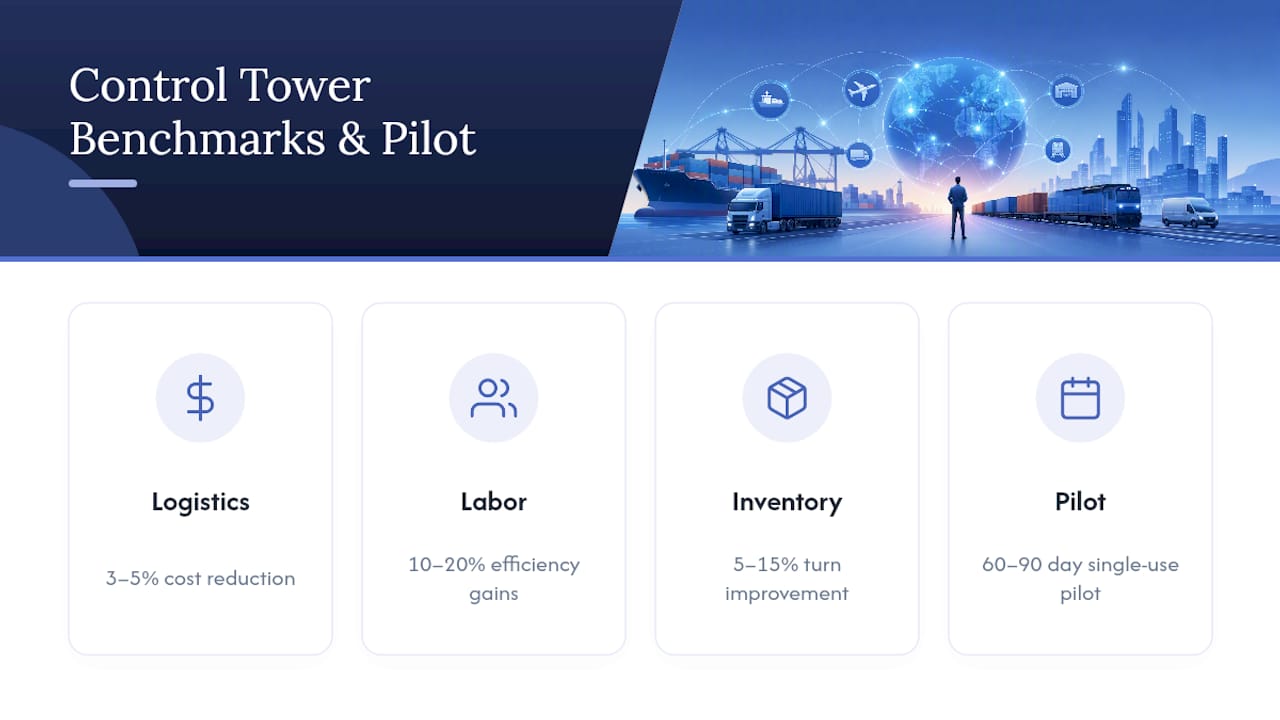
On the financial side, Accenture’s benchmarks suggest realistic targets: 3% to 5% logistics cost reduction, 10% to 20% labor efficiency gains, and inventory turn improvements in the 5% to 15% range for mature deployments. Build your baseline before launch. Run a 60 to 90 day pilot on one use case, measure the same metrics before and after, and use that delta to justify the next phase of rollout instead of guessing.
Why Most Control Towers Fail (and How to Avoid It)
The most common failure mode has a name in the industry: the “news channel” problem. Logistics Viewpoints describes it as a platform that fires alerts nonstop but never triggers a workflow, leaving teams to manually figure out what to do with every notification.
Avoid that trap with a few disciplined habits:
- Pair every alert type with a defined workflow or automated action, not just a notification.
- Start narrow. One use case, proven fast, beats a sprawling rollout that stalls in year two.
- Assign decision rights before go-live so nobody is guessing who approves a reroute at 2 a.m.
- Accept imperfect data early. Accenture notes that waiting for perfect data delays value with no real upside.
Pro Tip: If your control tower’s biggest feature is a pretty dashboard, you’ve built a reporting tool. The tower should be recommending the next move, not just displaying the problem.
How Integrated Providers Bring Control Tower Thinking to Daily Operations
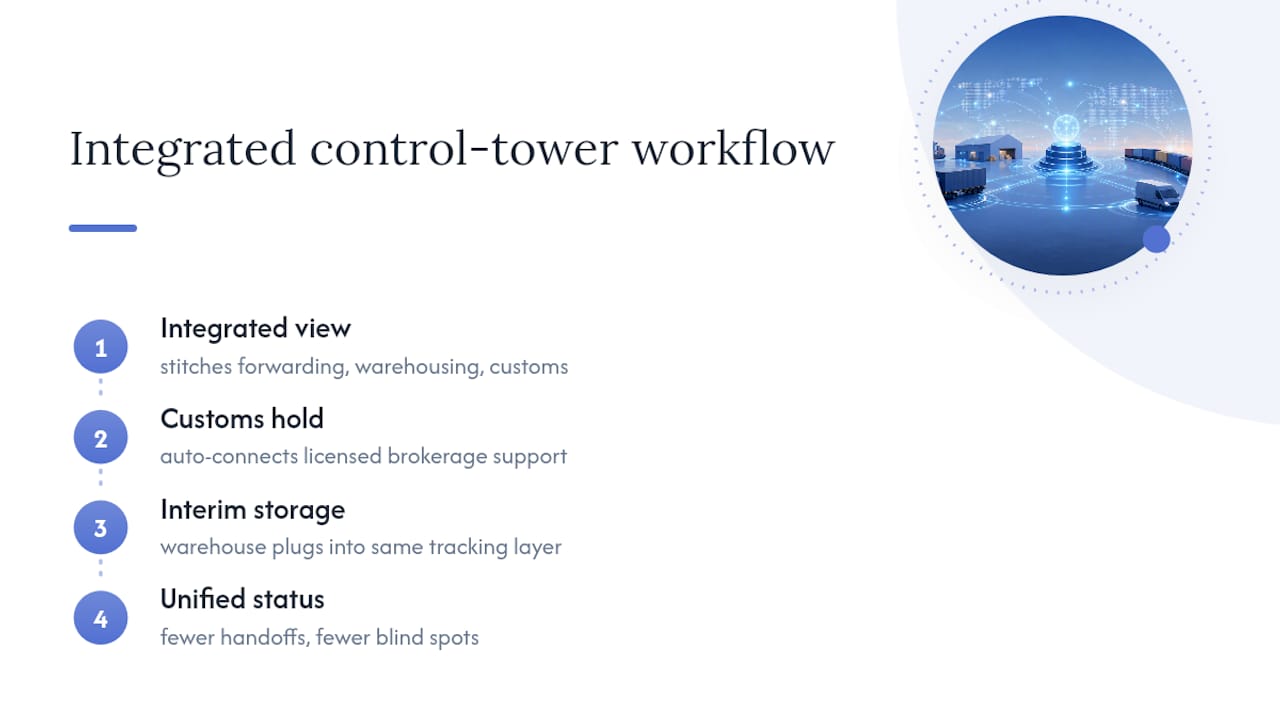
Usiship’s model reflects the same logic a control tower runs on: stitching freight forwarding, warehousing, and customs into one operational view instead of managing each in isolation. When a shipment hits a customs hold, that visibility connects directly to licensed brokerage support rather than a separate phone call to a third party. When inventory needs a home between transport legs, warehouse and fulfillment services plug into the same tracking layer. That’s the practical version of control tower logistics: fewer handoffs, fewer blind spots, and a shipment status that means the same thing to every team looking at it.
The Case for Actionability Over Dashboards
Most conventional advice on control towers still talks like visibility is the finish line. It isn’t. A dashboard that shows you a delayed container in real time is only marginally better than a phone call telling you the same thing a day later, if nobody on either end knows what to do next. The research backs this up plainly: the operations that see 3% to 5% cost reductions and double-digit labor efficiency gains are the ones that built decision rights and automated workflows into the tower from the start, not the ones that bought the flashiest visualization layer.
If you’re starting from zero, resist the urge to build the impressive, all-seeing E2E system first. Pick one painful, expensive problem, whether that’s port disruptions or last-mile exceptions, and prove that your tower can act on it, not just report it. Scale from there. The organizations struggling with control towers today aren’t struggling because their data is incomplete. They’re struggling because they built a very expensive notification system and called it done.
— Akbar