
Container Types: Sizes, Uses and How to Choose
Most freight moves in one of six container types: dry (general purpose), high cube, refrigerated (reefer), open top, flat rack and tank. For a typical pallet or carton shipment, the choice comes down to a 20-foot or 40-foot dry container, or a 40-foot high cube when your cargo is light and bulky. This guide covers what each type carries, the dimensions that matter, how many pallets fit, and how to calculate CBM so you book the right box.
TL;DR
- A 20-foot standard container offers about 33.2 m³ (roughly 1,170 cubic feet) inside. A 40-foot offers about 67.7 m³, and a 40-foot high cube about 76.4 m³, according to Triton’s fleet specifications.
- A 40-foot container holds about 20 to 21 standard 48 × 40 inch pallets in one tier, per the Florida Department of Agriculture and Consumer Services.
- CBM is length × width × height in meters, multiplied by the number of identical packages.
- Use reefers for temperature control, open tops for crane loading, flat racks for oversized loads and tanks for liquids, gases and powders.
- Real-world fill is always below the nominal volume, so plan for gaps, door-side space and weight limits.
Table of Contents
- The main container types and what each one carries
- Container dimensions: 20-foot, 40-foot and 40-foot high cube
- 20ft vs 40ft container: which one fits your cargo
- How many pallets fit in a 20ft or 40ft container
- How to calculate CBM
- Container ISO codes in plain terms
- Container grades: new, one-trip and used
- How to choose: a short checklist
- Our perspective
- What happens after the container arrives
- FAQ
- Sources
The main container types and what each one carries
Containers fall into two broad groups: general purpose boxes and specialized ones built for a specific kind of cargo. Here is how the common types compare.
| Type | Built for | Key feature |
|---|---|---|
| Dry (standard) | Boxed, palletized and bagged goods | Closed steel box, doors at one end |
| High cube | Light, bulky cargo, tall pallets | One foot taller than standard |
| Reefer | Frozen and chilled goods, pharmaceuticals | Insulated, built-in cooling unit |
| Open top | Tall or heavy pieces loaded by crane | Removable tarpaulin roof |
| Flat rack | Machinery, vehicles, oversized loads | Floor and end walls only |
| Tank | Liquids, gases, powders | Cylindrical tank in a 20-foot frame |
Dry (general purpose) containers
This is the box most people picture. It is a sealed steel container that suits cartons, pallets, bagged goods, furniture and most retail and ecommerce inventory. If your product does not need temperature control or special loading, a dry container is almost always the right starting point.
High cube containers
A high cube keeps the same footprint as a standard container but is one foot taller: 9 ft 6 in external height versus 8 ft 6 in. For a 40-foot unit that means roughly 76.3 m³ of internal volume against 67.7 m³, about 13 percent more, according to LoadOptimizer’s container guide. The extra height suits light, bulky cargo such as apparel, plastics, furniture and tall pallets.
Refrigerated (reefer) containers
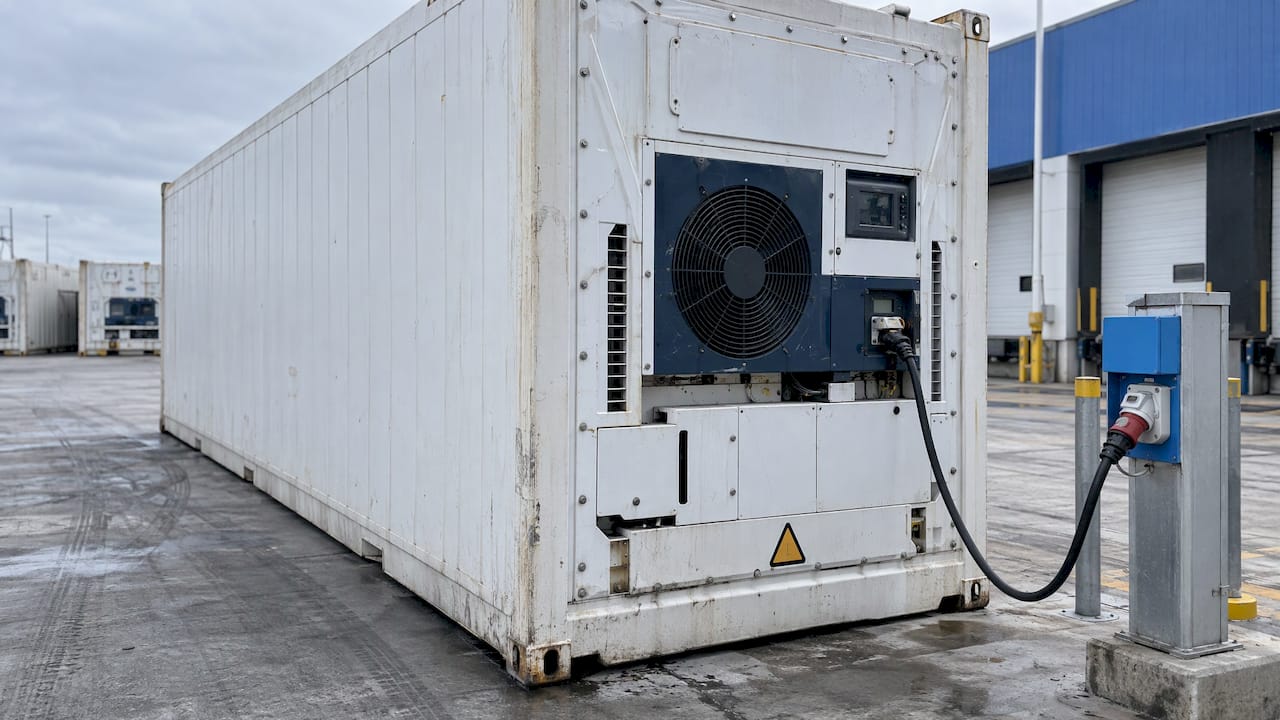
Reefers are insulated boxes with a built-in refrigeration unit. They hold set temperatures from about +30 °C down to -30 °C, and some units reach -40 °C, per ContSize. They carry frozen and chilled food, dairy, meat, produce and pharmaceuticals. The unit needs power from shore, the ship or a road generator. Because of the insulation and machinery, a reefer holds less than a dry high cube: about 67 m³ versus 76 m³.
Open top containers
An open top has a tarpaulin roof instead of a steel one. A crane can lower tall or heavy cargo in from above, which is useful for machinery, stone or anything that will not fit through the doors.
Flat rack containers
A flat rack has a floor and two end walls, with no sides or roof. It carries cargo that is too wide or too tall for a closed box. LoadOptimizer notes that a 40-foot high-cube flat rack can carry up to 54,200 kg. If your freight is this size, see how oversized moves get planned and what drives the cost of oversized freight.
Tank containers
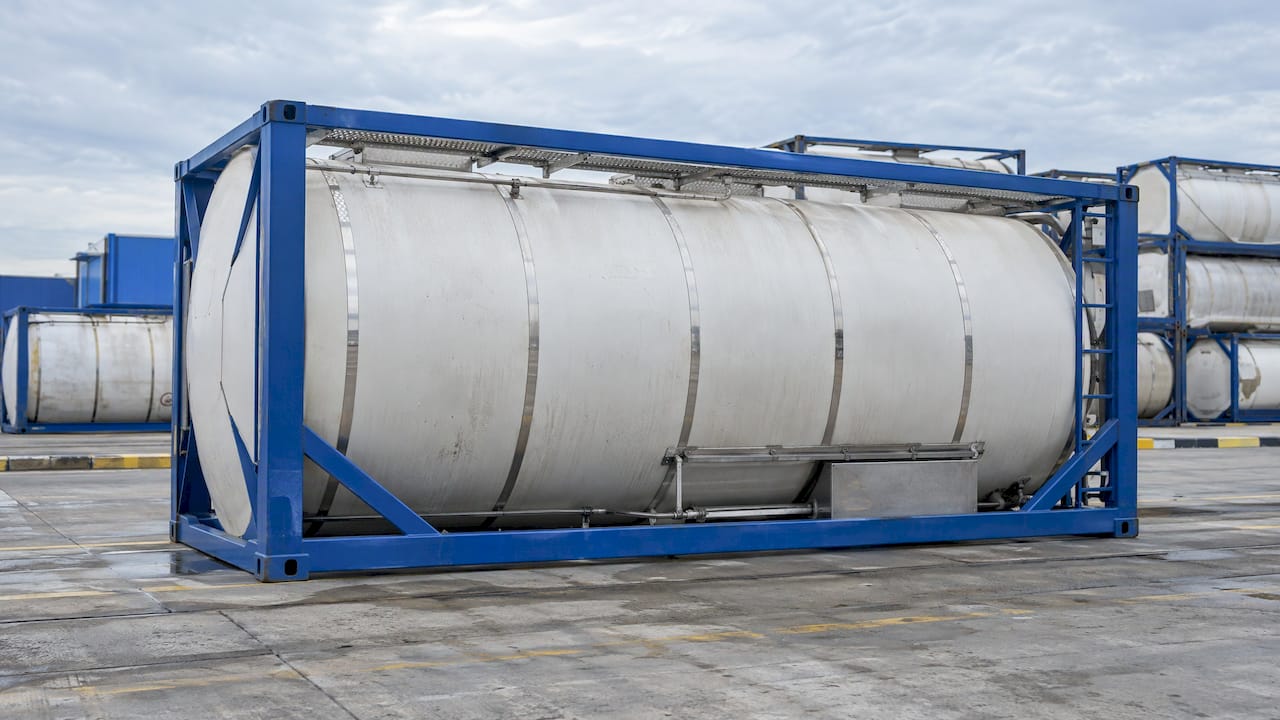
Tank containers are cylindrical tanks held in a standard 20-foot frame. They carry liquids, gases and powders, including chemicals and food-grade liquids. They must be filled to at least 80 percent but never to 100 percent, to avoid dangerous surge while moving, per the same LoadOptimizer guide.
Container dimensions: 20-foot, 40-foot and 40-foot high cube
The figures below are representative specifications from Triton International, a container lessor. Actual numbers vary slightly by unit, so treat them as planning values and confirm with your carrier or forwarder.
| Spec | 20-foot standard | 40-foot standard | 40-foot high cube |
|---|---|---|---|
| External length × width × height | 6.058 × 2.438 × 2.591 m | 12.192 × 2.438 × 2.591 m | 12.192 × 2.438 × 2.896 m |
| Internal length × width × height | 5.898 × 2.352 × 2.393 m | 12.032 × 2.352 × 2.393 m | 12.032 × 2.352 × 2.698 m |
| Door opening (width × height) | 2.340 × 2.280 m | 2.340 × 2.280 m | not listed here |
| Capacity | 33.2 m³ | 67.7 m³ | 76.4 m³ |
| Maximum payload | 28,380 kg | 28,960 kg | 28,800 kg |
In US units, a 20-foot box is about 19 ft 4 in long inside and a 40-foot box about 39 ft 6 in. Interior width is about 7 ft 8 in, and interior height is about 7 ft 10 in for a standard box and 8 ft 10 in for a high cube. Payload is roughly 62,500 lb for a 20-foot and 63,800 lb for a 40-foot standard.
Standard vs high cube
The high cube and the standard 40-foot share the same floor area. The difference is height: roughly 2.39 m versus 2.69 m inside, as LoadOptima explains. That has two practical consequences:
- Light, tall cargo gains. If your pallets are stacked high or your cartons are bulky but light, you fill the extra volume before you hit the weight limit.
- Dense cargo gains nothing. If you are close to the payload limit with heavy goods, the extra height does not help, because weight runs out first.
20ft vs 40ft container: which one fits your cargo
A 40-foot container has twice the length and a little more than twice the volume of a 20-foot, but the payload is almost the same: 28,380 kg against 28,960 kg in the Triton figures above. That detail drives the choice.
- Choose a 20-foot when cargo is dense and heavy. Tiles, machinery parts, canned goods and paper reach the weight limit before the box is full. A second 20-foot container can also make sense when you want to split a shipment between two destinations or two warehouses.
- Choose a 40-foot when cargo is voluminous. Cartons of consumer goods, furniture and ecommerce inventory fill space before weight. A single 40-foot is usually simpler to book and handle than two 20-footers.
- Choose a 40-foot high cube when cargo is light and tall. It gives the most cubic capacity per box.
- Consider LCL below a full container. If your freight is only a few CBM, less-than-container-load shipping avoids paying for empty space. Charges for LCL are often based on a minimum of 1 CBM, according to ContainerLoadCalculator.
Also think about what happens on the US side. A 40-foot box can need a chassis, a drayage truck and a dock that can take it. If you plan to break a container down near the port and move goods inland in smaller loads, transloading can shorten the turn time. For boxes moving by rail and truck, intermodal shipping is worth a look.
How many pallets fit in a 20ft or 40ft container
The US standard pallet is 48 × 40 inches (1,219 × 1,016 mm), as CHEP describes it, and CHEP gives 21 pallets as the optimum capacity of a 40-foot container. The Florida Department of Agriculture and Consumer Services gives a range for a 40-foot container: about 20 to 21 standard pallets or 23 to 24 Euro pallets in one tier.
For Euro pallets (about 1,200 × 800 mm), LoadOptima’s approximate positions are 11 in a 20-foot dry container and 25 in a 40-foot dry or high cube, as shown on its capacity page.
Two working rules of thumb:
- 40-foot container: plan on 20 to 21 US standard pallets on the floor. Double that only if the pallets can be stacked, which depends on cargo height, weight and whether the goods can bear the load.
- 20-foot container: a US standard pallet takes about half the floor of a 40-foot, so expect roughly half the 40-foot count. Confirm with a load plan, because the pallet’s 40-inch and 48-inch sides interact with the container’s 7 ft 8 in interior width.
Why the number on paper is rarely the number in the box
Practical fill is below nominal volume. LoadOptima points to pallet gaps, non-stackable cargo, door-side maneuvering space, dead corners and weight distribution as the things that consume space. Add overhang, securing and handling needs, and the usable count drops further.
A mixed load makes this more obvious. Odd carton sizes and partial pallets leave voids, and the same issue shows up in parcel shipping when you send boxes of different sizes together. The fix is the same at any scale: group similar sizes, and plan the load before you pack it. If your pallets are built poorly, the container is not the only place you pay. Our guides on palletizing freight and pallet stacking rules cover how to build loads that survive handling.
How to calculate CBM
CBM means cubic meters: the volume your cargo occupies. Carriers, forwarders and LCL consolidators use it to price and plan space.
Formula: length × width × height, all in meters, for one package. Multiply by the number of identical packages. ShipCalculators gives this example: a 1.2 × 0.8 × 1.0 m package is 0.96 m³, so 100 of them occupy 96 m³.
If your measurements are not in meters:
- In centimeters, multiply the three numbers and divide by 1,000,000.
- In inches, multiply the three numbers and divide by 61,024.
Worked example (centimeters): a carton of 60 × 40 × 40 cm is 96,000 ÷ 1,000,000 = 0.096 CBM. For 200 cartons, the total is 19.2 CBM, as ContainerLoadCalculator shows.
Worked example (inches): a carton of 24 × 16 × 16 in is 6,144 ÷ 61,024, which is about 0.1007 CBM. For 200 cartons, that is about 20.1 CBM.
Mixed sizes: calculate each size group on its own, then add the results.
Turning CBM into a container choice
ContainerLoadCalculator’s rough guide for cartons is 25 to 28 CBM in a 20-foot standard dry container, 55 to 60 CBM in a 40-foot and 65 to 70 CBM in a 40-foot high cube. These are practical figures, lower than the nominal capacities in the table above, which fits the point about gaps and handling space.
So the 200-carton example above, at 19.2 CBM, fits comfortably in a 20-foot box by volume. At 40 cartons per pallet layer you would also check weight, because 28,380 kg is a ceiling, not a target.
For LCL, carriers usually round CBM to two or three decimals, and a minimum charge of 1 CBM is common. For air freight, volume is converted differently, to chargeable weight. If you ship by air, our guide to air freight shipping and customs holds explains the process.
Container ISO codes in plain terms
Every container carries a type code that tells you its size and kind. The first characters describe length and height, and the later ones describe the type, such as general purpose, ventilated, reefer, open top, platform or tank. You do not need to memorize them. You do need to check that the code on your booking matches the unit you expect, especially when you order a high cube or reefer.
Container grades: new, one-trip and used
If you buy rather than rent space, you will see grades such as one-trip, cargo-worthy (CW) and A, B or C. They describe condition: one-trip boxes made a single voyage, CW units are certified for further sea transport, and A to C grades rate cosmetic condition. For shipping goods with a carrier, you usually do not choose the grade. For storage or conversion, it matters more.
How to choose: a short checklist
- Measure your cartons and pallets, and calculate total CBM.
- Weigh the full load and compare it with the payload of the container you are considering.
- Check whether cargo is stackable and how tall your pallets are.
- Decide whether you need temperature control, crane loading or an open frame.
- Compare FCL against LCL based on total CBM.
- Confirm what happens at the destination: dock access, chassis, delivery appointment and unloading. Our guide to delivery appointment freight covers how to book and avoid fees.
Our perspective
Choosing a container is only the first decision. The costs that surprise shippers usually come after the box arrives: unloading, sorting, storing and moving goods onward.
We build our service around that whole chain. Freight forwarding, customs clearance, warehousing, fulfillment and last-mile delivery sit on one platform, so a 40-foot container can move from the port into receiving and inventory without being handed between unrelated companies. Our systems are designed to give you real-time tracking and one point of contact.
Our advice for importers and ecommerce sellers: calculate CBM and weight before you book, choose the box that fits your cargo density, and plan the destination handling at the same time. That is how a good container choice turns into a smooth receiving day.
Akbar
What happens after the container arrives
The box is only part of the cost. Once a container lands, goods need receiving, put-away, storage and often pick and pack. We publish storage rates of $5–$6 per bin per month and $17–$19 per pallet per month, plus $37 per hour for additional services, and quote receiving per container on request. See our pricing page for the structure, and read how warehouse storage fees compare across the US.
If you are importing and need a partner from origin to shelf, our freight forwarding and customs brokerage team can plan the container and the clearance. For storage and order handling after arrival, see our warehousing and fulfillment solutions.
Send us your cargo list with dimensions, weights and destination, and we will help you match it to the right container and the right downstream handling at usiship.com.
FAQ
How many pallets fit in a 40-foot container?
About 20 to 21 US standard pallets (48 × 40 inches) fit in one tier, and 23 to 24 Euro pallets. Stacking can raise the count, but only if the cargo height, weight and strength allow it. Your load plan should confirm the final number.
What is the difference between a high cube and a standard container?
A high cube is one foot taller, 9 ft 6 in against 8 ft 6 in externally, with the same floor area. For a 40-foot box that is about 76.4 m³ versus 67.7 m³ inside. It helps with light, bulky or tall cargo, not with heavy cargo that hits the weight limit first.
How do I calculate CBM?
Multiply length, width and height in meters, then multiply by the number of packages. If you measure in centimeters, divide the product by 1,000,000. If you use inches, divide by 61,024. For mixed sizes, calculate each group and add them.
Is a 20-foot or 40-foot container better?
Choose a 20-foot for dense, heavy cargo, because payload is nearly the same in both sizes. Choose a 40-foot for bulky cargo that fills space first. A 40-foot high cube gives the most volume per box.
Sources
- Triton International fleet specifications
- Pallet Information and Calculation for Exporters, Florida Department of Agriculture and Consumer Services
- CHEP Export Mark 55 pallet
- Types of shipping containers: sizes, ISO codes and uses
- Types of Shipping Containers: 19 Kinds, Sizes and Uses
- Container loading calculator: pallets and CBM in 20ft and 40ft containers
- CBM and Chargeable Weight
- How to Calculate CBM for Shipping