
Container Rollover: What It Means and How to Avoid It
A container rollover happens when your booked, confirmed container does not load onto its scheduled vessel and is pushed to a later sailing. The cargo is not lost. It waits, usually a week or more, and you absorb the cost of that wait. Most rollovers trace back to two things: the carrier’s space decisions, which you cannot control, and missed cut-offs or paperwork errors, which you can. We forward ocean freight and clear customs for U.S. importers and exporters, so this guide covers both sides: why boxes get rolled, what it costs, and the routine that keeps your freight on the ship.
TL;DR
- A rollover (also called rolled cargo) means a confirmed container misses its booked vessel and moves to the next sailing, typically adding 7 to 14 days.
- Carriers roll boxes because of overbooking, vessel delays, port congestion, skipped ports, and shipper-side problems such as late documents or missed cut-offs.
- A booking confirmation is a place in the queue, not a loading guarantee. Confirm that the container actually loaded.
- Shipper-side causes are the most preventable: file documents early, gate in early, and book one sailing ahead for time-critical cargo.
- When a roll happens, ask why first, then protect the rest of the supply chain and check your demurrage and detention exposure.
Table of Contents
- What container rollover means
- Why containers get rolled
- What a rollover costs you
- Who pays when a container is rolled
- How to reduce the risk of a rollover
- What to do when your container is rolled
- How we approach it
- Where we can help
- FAQ
- Sources
What container rollover means
In ocean freight, a rollover (or rolled cargo, or cargo rollover) is a vessel sailing without picking up a container it was scheduled to carry, which delays that cargo (Vizion). The box may already be at the terminal, gated in and ready. The ship leaves anyway, and your container is reassigned to a later vessel.
The term gets confused with a blank sailing. A blank sailing is a voyage the carrier cancels in advance, so nothing is scheduled to load. A rollover is specific to your box losing its slot on a sailing that does go. If you want the cancellation side of the picture, see our guide to blank sailings and how to plan around them.
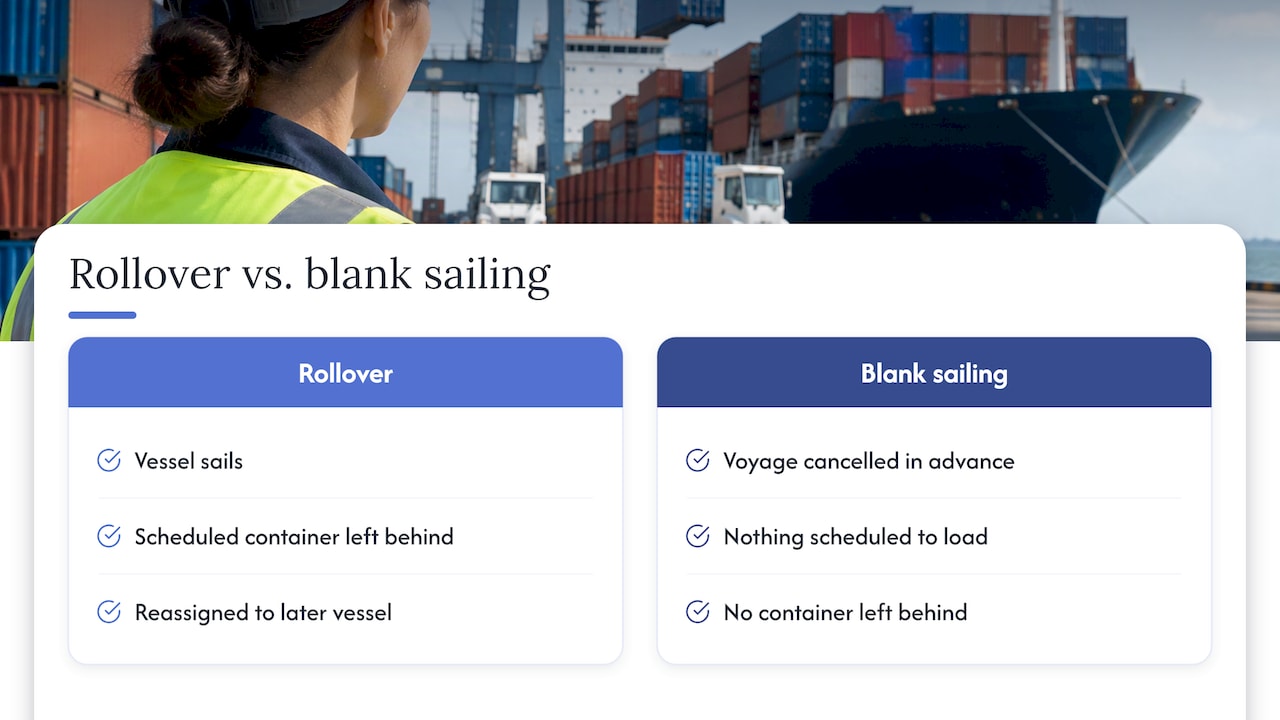
The distinction matters because the fix differs. With a blank sailing, you re-plan onto another service. With a rollover, the first question is why your container lost its place, because a cut-off or paperwork failure will repeat on the next booking.
Why containers get rolled
There is rarely a single cause. The common ones fall into two groups.
Carrier-side causes
- Overbooking. Carriers sell more space than a vessel holds, based on historical cancellation ratios. When fewer bookings cancel than expected, the excess boxes are rolled to the next sailing (Portcast).
- Weight limits. Cargo weight can exceed what the vessel is allowed to carry, so some containers stay behind (VS&B Containers).
- Skipped ports and delays. A vessel that omits a port, arrives late, or hits congestion may leave cargo behind to recover its schedule.
- Transshipment connections and mechanical problems. A missed connection at a hub or a vessel fault can push boxes to later sailings (VS&B Containers).
Shipper-side causes
- Missed cut-off times. Trucking delays, late documents or a customs hold can push a box past the terminal’s gate or documentation deadline. One ops guide calls missed cut-offs the single most preventable cause of rollovers (Tier2 Systems).
- Documentation errors. Wrong weights, mismatched descriptions or an unreleased bill of lading can keep a box off the manifest.
- Payment delays. Unpaid freight can lead the carrier to withhold release or loading.
Because you cannot see a carrier’s overbooking, the practical lesson is to remove every cause you can control. That leaves the carrier less reason to pick your box when space is tight.
What a rollover costs you
Time
The delay equals the gap to the next sailing. On a route with weekly service that is about a week. On routes with biweekly or ten-day rotations, it can be two to three weeks (Tier2 Systems). Rolled cargo can also carry lower priority on the next vessel, so a second roll is possible, particularly on congested lanes (Skypace).
| Service pattern | Typical added delay |
|---|---|
| Weekly sailings | About 1 week |
| Biweekly or ten-day rotations | 2 to 3 weeks |
| Second consecutive roll | Delay compounds further |
Charges at the far end
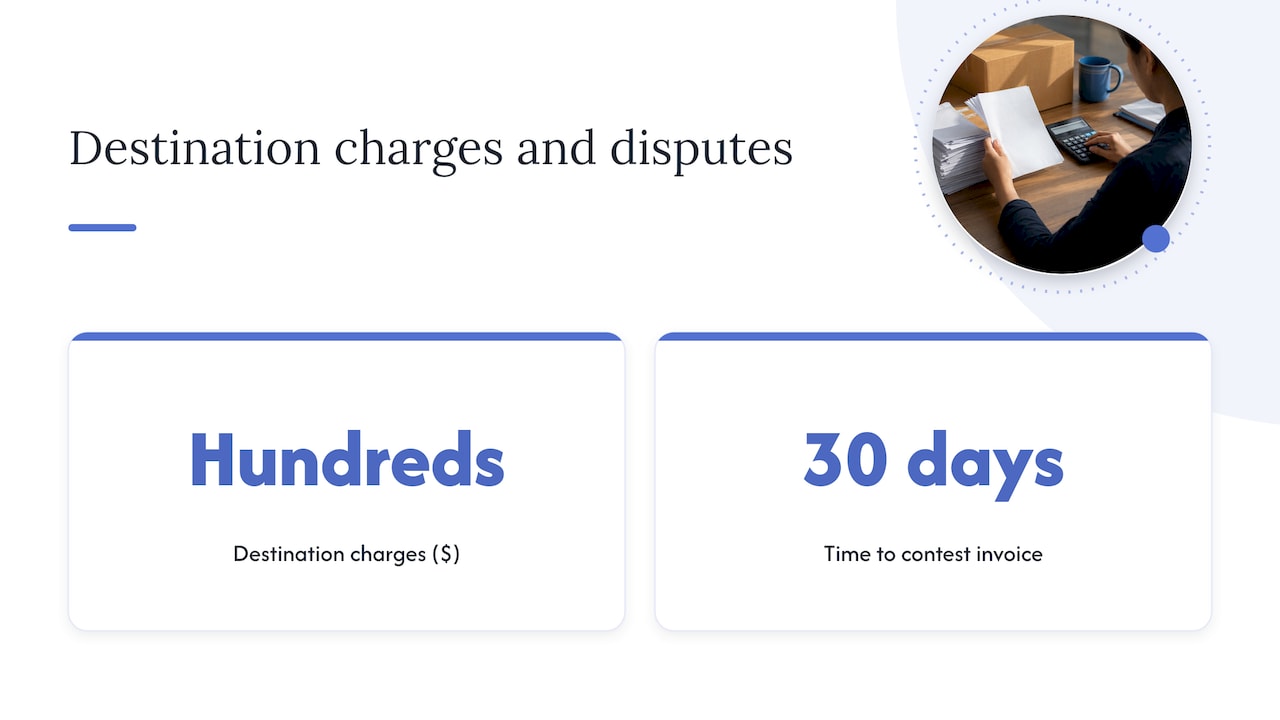
If the roll pushes your arrival past free time at the destination terminal, demurrage and detention start to accrue. A rollover that costs nothing at origin can generate hundreds of dollars in charges at the other end (Tier2 Systems). Since May 28, 2024, the FMC’s billing rule has given billed parties 30 calendar days from the invoice date to contest demurrage and detention charges (Federal Register). Our guide to per diem charges and the FMC 30-day rule shows how to review an invoice line by line.
Operations
A rolled container can leave a factory line short of parts, split a multi-container booking across vessels, or leave a retailer’s shelves empty during a promotion. Customers see the missed date, not the carrier’s reason. Refrigerated cargo adds another layer: a rolled reefer sits at the origin terminal drawing power, with storage charges attached.
Who pays when a container is rolled
The answer depends on the cause and on your contract. When the roll comes from overbooking or a vessel problem outside your control, the carrier is generally expected to reschedule the shipment, and some sources say it should cover the added charges (VS&B Containers). In practice, many shippers find carriers reluctant to reimburse downstream costs, so read the bill of lading terms and the service contract before you assume anything.
What you can reasonably ask for is a protected slot on the next named sailing, extra free time at destination, and priority consideration on later bookings. Ask in writing and ask early.
On the regulatory side, the FMC has defined what counts as an unreasonable refusal by an ocean common carrier to deal or negotiate over vessel space, and requires carriers to file an export policy with the Commission (Federal Register). If you believe a pattern of refusals is happening, that is a matter to raise with a maritime attorney or the FMC.
How to reduce the risk of a rollover
This is the routine we would hand any importer or exporter. Each step removes one cause from the list above.
- Book early. Space is sold in order of commitment. Booking late on a tight lane places you at the back of the queue. Book one sailing earlier than you need for time-sensitive cargo.
- Submit documents at least two business days before the vessel cut-off. This is the advice in one ops guide (Tier2 Systems). Check weights, descriptions, HS codes and consignee details against the commercial invoice. A mismatch discovered at cut-off is a roll waiting to happen.
- Gate in ahead of the cut-off. Containers that arrive early can gain loading priority, and a trucking delay then has room to absorb.
- Line up customs early. A customs hold on an export or an import-related document problem can push you past the cut. If you want the broader picture of holds, our guide on avoiding customs holds covers the document discipline that applies across modes.
- Confirm loading, not just the booking. A confirmation is a spot in the queue. Ask for confirmation that the container loaded, and watch tracking, not the booking email.
- Pay freight and fees on time. Payment holds are a shipper-side cause that costs nothing to remove.
- Track carrier reliability by route. Some services roll more often than others. Keep a simple log of which lanes and strings caused trouble.
- Consider less congested ports where it makes sense. East Coast gateways such as Newark and Charleston have been described as less congested than Los Angeles and Long Beach, though conditions change (Portcast). Check current congestion and inland cost before shifting.
- Plan buffers. Build one week of slack into inventory plans on weekly lanes. Forecasting and planning the flow of cargo well in advance is, in one expert’s view, the foundation for eliminating most controllable rollover causes (Portcast).
- Split large shipments. Putting a big volume on separate bills of lading can keep one problem from stranding everything.
The pattern is clear: nearly all of these are coordination tasks across the booking, the trucker, the terminal, the broker and the carrier. Each handoff is a place for a deadline to slip. That is where a forwarder who handles the booking, the customs filing and the inland leg earns its fee, because one team is watching the cut-off instead of four parties each assuming another has it.
What to do when your container is rolled
Act in this order.
- Find out why. Ask the carrier or your forwarder for the cause. If it was a paperwork or other shipper-side failure, correct it right away so the next sailing is not also missed. If it was beyond your control, focus on limiting the damage to the rest of your supply chain (Vizion).
- Get the new vessel and ETA in writing. Ask for a named sailing, not just “next available.”
- Recalculate free time. Work out whether the new arrival date eats into demurrage and detention free days, and ask the carrier for an extension in writing.
- Warn your customers and your warehouse. A heads-up lets the receiving team move appointments. Our guide to dock scheduling is useful for re-slotting inbound loads.
- Protect inventory. For stock-outs, consider moving a portion of the order by air or splitting what is left on the next vessel.
- Document everything. Keep emails, booking records and timestamps. If you later dispute charges or file a claim, the paper trail is your case. Our freight claims playbook explains the deadlines.
How we approach it
Universal Shipping offers freight forwarding by air, ocean and land, customs clearance, warehousing and fulfillment under one roof, with real-time tracking. For a rollover, that means the booking, the customs paperwork and the warehouse that receives the box are managed in one place, not scattered across vendors. We also offer transloading, which can shorten the move from port to inland destination; see transloading for logistics managers.
Our view on rollovers
A rollover is rarely one mistake. It is usually a chain: a document filed a day late, a truck that arrives at the gate after cut-off, a carrier with a full ship. You cannot control the ship, but you can make sure your box is the easiest one on the vessel to load.
That is why we think integration matters more than any single trick. When transportation, customs clearance and warehousing sit on one platform, with tracking that shows where each box is, there are fewer handoffs where a deadline can slip. Our approach is built around that: one team, one view of the shipment, and personalized service that is available around the clock.
If a roll does happen, we focus on the practical next moves: the cause, the new sailing, the free-time exposure, and where the cargo will be received.
Akbar
Where we can help
If you import or export by ocean and want one team handling the booking, customs and the warehouse that receives your freight, start with our freight forwarding services. Customs brokerage and air freight sit on the same page, which helps when a rolled box needs an air partial to protect stock.
When cargo arrives later than planned, it still needs somewhere to go. Our warehousing and fulfillment solutions include receiving, storage and order processing. Published storage rates are 5-6 USD per month per bin and 17-19 USD per month per pallet, and additional services are 37 USD per hour. Full details are on our pricing page. For the whole port-to-door picture, see our import checklist.
FAQ
What is a vessel rollover?
A vessel rollover is the same event seen from the ship’s side: the vessel departs without a container that was booked on it. The container is moved to a later sailing, so it arrives later than planned. The cargo itself is not lost.
How long does a rollover delay a shipment?
It depends on the next available sailing. On weekly services the delay is typically about a week, and on biweekly or ten-day rotations it can be two to three weeks (Tier2 Systems). A second roll can lengthen it further, and holiday weeks can stretch it.
Does a confirmed booking guarantee my container loads?
No. A confirmed booking secures a place in the carrier’s queue, but it does not guarantee loading on that vessel (Skypace). Meet documentation and gate-in deadlines early, and confirm that the box has actually loaded.
Can I be charged demurrage after a rollover?
Yes, if the later arrival pushes you past free time at the destination. Ask for extra free time in writing as soon as you learn of the roll. Under the FMC billing rule, you have 30 calendar days from the invoice date to contest charges (Federal Register).
Is a rollover the same as a blank sailing?
No. A blank sailing is a voyage the carrier cancels ahead of time. A rollover happens on a sailing that goes, when your container is left behind. Our blank sailings guide explains the difference in planning terms.
Sources
- Vizion: what rolled cargo is and how to manage it
- Portcast: container rollovers, causes and ways to minimize them
- VS&B Containers: what cargo rollover means
- Tier2 Systems: container rollovers ops guide
- Skypace: why a confirmed booking can still be rolled
- Federal Register: demurrage and detention billing requirements
- Federal Register: unreasonable refusal to deal or negotiate over vessel space