
Commercial Invoice Requirements for U.S. Imports and Exports
A commercial invoice must identify the buyer, seller and goods, and state quantities, values, currency and country of origin. For goods entering the United States, the rules sit in 19 CFR 141.86 and 142.6, and they are stricter than most shippers expect. For goods leaving the United States, the destination country sets the final format. Below you will find every field, how to fill it, the mistakes that hold freight at the port, and how to check what your destination requires.
TL;DR
- A U.S. import invoice must show the port of entry, the parties and place of sale, a detailed description, quantities, prices, currency, itemized charges and country of origin.
- Descriptions must be specific: commercial name, grade or quality, marks, package numbers and what is inside each package. “Parts” or “gifts” will not clear.
- The invoice and any attachments must be in English or come with an accurate English translation.
- For exports, the destination government can set the form, content, number of copies and language. Confirm with your buyer or forwarder before you print anything.
- Accurate structured data matters as much as the paper: many brokers transmit invoice data electronically.
Table of Contents
- What a commercial invoice does
- Commercial invoice requirements for goods entering the U.S.
- Language, originals and copies
- When no commercial invoice is required
- Commercial invoice for export from the U.S.
- Common errors that hold shipments
- A short pre-shipment checklist
- Our perspective
- Get your documents checked before the freight moves
- FAQ
- Sources
What a commercial invoice does
The U.S. Department of Commerce describes the commercial invoice as a legal document between the exporter and the foreign buyer. It identifies the goods and the amount payable, and customs uses it as a principal document to determine duties. That is why a sloppy invoice is never just paperwork. It decides what duty is assessed, whether the shipment is examined and how fast it moves.
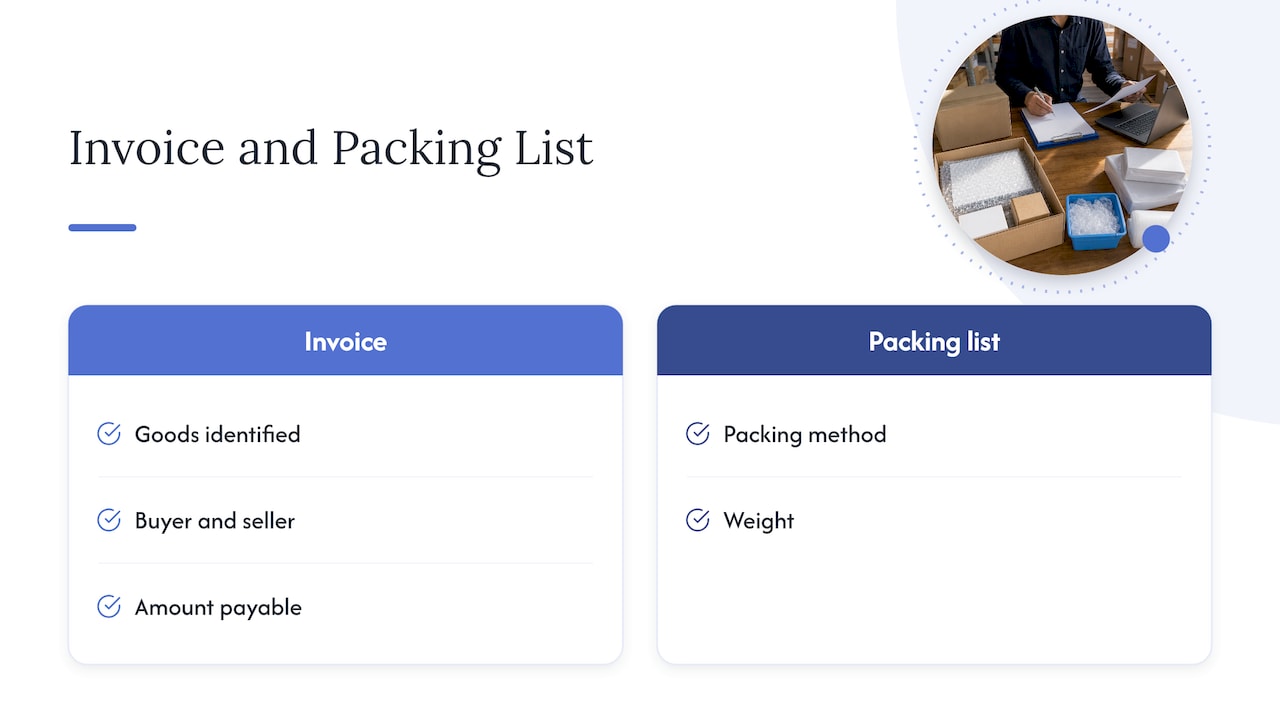
It is also not the same as the packing list. The invoice answers “what is it, who sold it, what was it worth?” The packing list answers “how is it packed, how much does it weigh?” You need both, and the details should agree. Our guide to packing list requirements covers the second document.
Commercial invoice requirements for goods entering the U.S.
For imports, the controlling text is 19 CFR 141.86, which sets the contents of invoices. Separately, 19 CFR 142.6 requires the invoice, or a permitted substitute, to accompany the entry before release. Together they call for the following.
| Field | What it must show |
|---|---|
| Port of entry | The U.S. port where the goods will be entered |
| Time, place and parties | When and where the sale or shipment took place, and who the parties are |
| Foreign invoicing party | The complete name and address of the party that issues the invoice |
| Description of goods | Commercial name, grade or quality, marks and numbers on packages |
| Package contents | What is in each individual package |
| Quantities | In recognized weights and measures |
| Value | Purchase price per item, or value for goods not sold, in the applicable currency |
| Itemized charges | The specific charges the regulation lists, shown separately |
| Rebates, drawbacks, bounties | Listed separately where they apply |
| Country of origin | Of the goods |
| Assists | Production assists not included in the price |
| Tariff classification | The appropriate eight-digit HTSUS subheading, under the entry-filing rule |
The first rows are easy to forget when you template an invoice for domestic customers. A U.S. customs invoice is more demanding than a standard sales invoice, so build a separate template for cross-border orders.
Port of entry and the parties
Name the U.S. port where the goods will enter. Then state when and where the sale or shipment occurred and who the buyer and seller are, as the regulation requires for the parties to the transaction. If the shipment is not a sale, such as a sample, a return or a transfer between your own entities, say so on the invoice instead of leaving the field blank.
The invoice also needs the complete name and address of the foreign invoicing party, according to 142.6. A post office box or a trade name with no address is a common reason for a query.
Describing the goods so they clear
The regulation asks for each item to be identified by its commercial name, with the grade or quality, plus the marks and numbers on the packages. The invoice must also explain what is in each individual package. In practice that means:
- Say what the item is made of and what it does. “Women’s cotton knit T-shirt, short sleeve” works. “Apparel” does not.
- Include model or SKU numbers so the line can be matched to the purchase order.
- State quantity per line, not just a total for the carton.
- Match package marks and numbers to what is physically on the cartons.
A good description also supports classification. If your team is still working out the right code, our walkthrough of the HS code classification workflow shows how a precise description leads to the correct subheading. The tariff number is not a substitute for the description, though. Customs reads both.
Quantities and measurements
Quantities must be in recognized weights and measures. This is more than a formality: according to the same regulation, missing measurements needed to compute duty can mean measurement is paid for by the importer before release. Put net quantities in the unit the tariff uses for that product, such as pieces, dozens, kilograms or square meters, and give gross weight separately for the carrier.
Value, currency and itemized charges
Declare value the way the regulation sets out:
- Goods that were sold: the price actually paid or payable for each item, in the currency of the purchase.
- Goods not sold: the value of each item in the currency ordinarily used for the transaction, or, if necessary, the ordinary-course wholesale price in the country of export.
- Charges: itemize the charges the regulation specifies, such as freight, insurance and packing, where they apply. Do not bury them in a single lump-sum price.
- Rebates, drawbacks and bounties: list them separately.
- Assists: list production assists not included in the price, for instance tooling, molds or materials the buyer supplied to the factory.
The value question trips up more importers than any other. A “discounted” invoice value that does not reflect what was really paid is a compliance risk, not a cost saving. Always declare the real transaction value, supported by the purchase order and payment record.
Country of origin
State the country of origin for each line. The origin of the goods may differ from the country they ship from, especially with multi-country supply chains. If you are moving goods from Canada or Mexico and claiming preferential treatment, the invoice should line up with the certification data. Our page on the USMCA certificate data fields explains what to prepare. For China-origin goods, where duty exposure is highest, see how to avoid duty shocks on China to U.S. shipments.
Language, originals and copies
English. The invoice and all attachments must be in English, or have an accurate English translation attached with enough information for examination and duty determination. If your supplier issues invoices in another language, ask for a bilingual template rather than translating at the port.
Copies. Under 19 CFR 141.83, customs may accept a copy instead of the original. A copy that is not photostatic or photographic must include a declaration by the foreign seller, shipper or importer that it is a true copy. For supporting paperwork across borders more generally, this overview of customs formalities in international transport lists the documents that typically travel with a consignment.
Electronic data. CBP’s importer guide states that importers and brokers using the Automated Broker Interface can transmit invoice data through the Automated Invoice Interface or EDIFACT and eliminate the paper document. The practical lesson: your invoice data has to be clean enough to be keyed or transmitted without guesswork. Consistent field names, one unit of measure per line and one currency per invoice make that easy.
When no commercial invoice is required
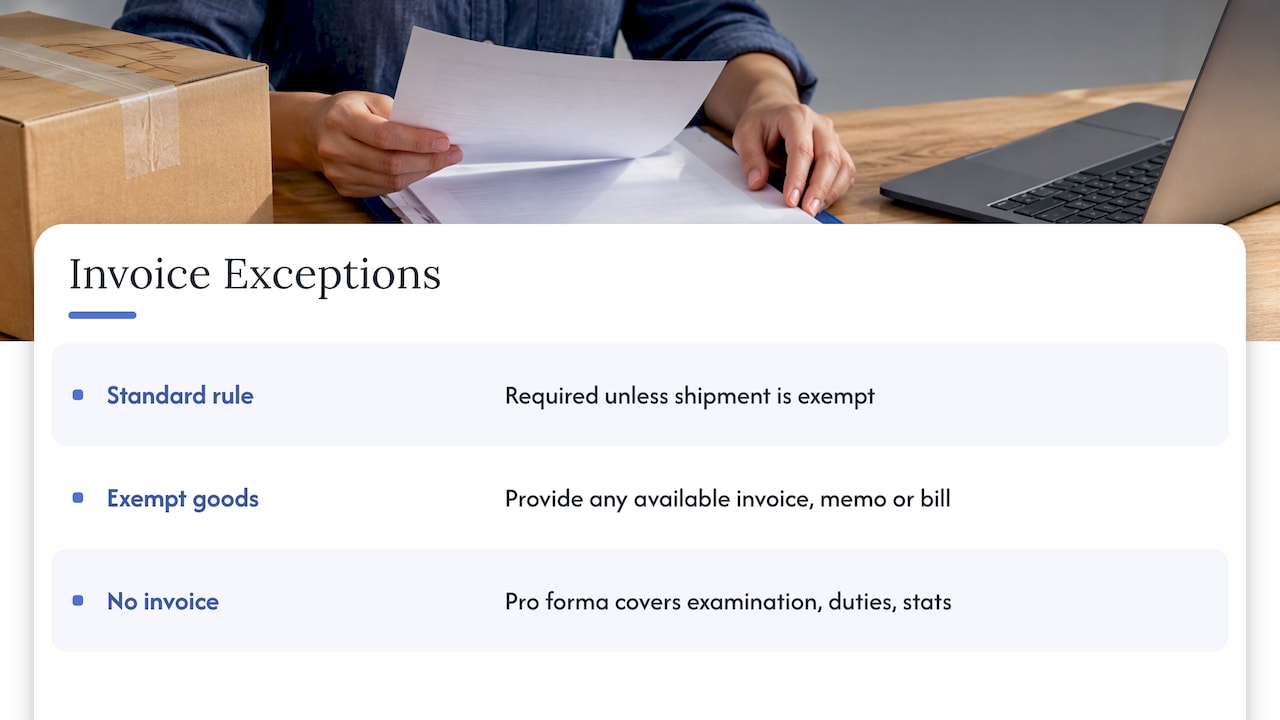
Not every entry needs a full commercial invoice. 19 CFR 141.83 requires one for each import shipment except those the section exempts, and the invoice must back up the statistical information on the entry documents. For exempt merchandise, the importer must provide any available invoice, memorandum invoice or bill. If none exists, a pro forma or substitute invoice must carry enough information for examination, duty determination and statistical verification.
So even without a formal commercial invoice, you still need something that tells customs what the goods are and what they are worth. Treat a pro forma invoice as a fallback, never a plan.
Commercial invoice for export from the U.S.
The second thing readers ask is how to prepare an invoice for goods leaving the country. The U.S. government lists the commercial invoice among the common export documents, and it notes that governments may specify its form, content, number of copies, language and other characteristics. There is no single universal export invoice.
Trade.gov advises starting with your foreign customer or importer, or with a freight forwarder, and consulting its Country Commercial Guides for destination requirements. Here is a workable sequence:
- Ask the buyer what their customs broker needs: tax or importer ID, number of originals, language and any required statements.
- Check the destination guidance in the official Country Commercial Guide for that market.
- Build the invoice with the core fields below, then add the destination extras.
- Match it to the other documents, including the packing list, the booking and any certificate of origin.
- Send a draft to your forwarder or broker before the cargo moves, not after.
Core fields most export invoices carry
- The words “Commercial Invoice” and a unique invoice number and date
- Seller or exporter name, address and contact details
- Buyer and, if different, the final recipient
- Description, quantity, unit price and total for each line
- Currency and payment or delivery terms, such as the Incoterms rule
- Country of origin, and gross and net weights
- Number of packages, marks and numbers
- A signed statement that the information is true and correct
These are standard practice rather than a single legal list, so treat the destination’s rules as the final word. For air shipments, where documents travel with the freight and delays are costly, see how to avoid customs holds on air freight.
Common errors that hold shipments
Most commercial invoice problems are small and preventable:
- Vague descriptions. Generic terms force customs to ask questions, which means exams and storage charges.
- Missing or wrong origin. Origin drives duty, so it is never optional.
- Values that do not match the payment. If the invoice says one thing and the wire transfer another, expect scrutiny.
- Charges lumped together. Freight, insurance and packing should be shown separately.
- Mismatched quantities. The invoice, packing list and bill of lading should tell the same story.
- Missing English. An untranslated invoice stalls the entry.
- Unclear roles. Who is the importer of record, and who is the broker acting for them? Our guide to customs power of attorney checks and the five steps for keeping customs roles clear on door to door freight cover that.
If your cargo arrives by ocean, remember the invoice is only one of several advance filings. See the requirements for ISF filing (10+2) so the data you give the filer lines up with the invoice.
A short pre-shipment checklist
Run this before every shipment leaves the supplier or your dock:
- Is the invoice in English, with a unique number and date?
- Are seller, buyer and foreign invoicing party named with full addresses?
- Does each line carry a specific description, quantity and unit price?
- Is the currency stated, and do totals add up?
- Are freight, insurance and other charges itemized?
- Are assists, rebates or discounts shown where they apply?
- Is the country of origin on every line?
- Do marks, package counts and weights match the packing list?
- Is the tariff subheading checked against the description?
- Has your broker or forwarder seen the draft?
Our perspective
Most delays we see are not caused by exotic regulations. They come from ordinary data that never made it onto the page: a description written for a sales team instead of a customs officer, a missing origin, a value that disagrees with the payment.
We think of the commercial invoice as the first data record of a shipment, not a form to be filled in at the last minute. When transportation, warehousing and customs brokerage run on one platform, the same item data flows from the invoice into the entry, the receiving record and the tracking view. That is why we push customers to settle descriptions, origin and values before the cargo moves.
Our approach is built around integration and visibility: one team that sees the booking, the documents and the warehouse, with real-time tracking and personalized service. We believe a clean invoice is the cheapest way to protect your delivery date, and we would rather fix a field on Tuesday than explain a hold on Friday.
Akbar
Get your documents checked before the freight moves
If you import or export regularly, a second pair of eyes on the invoice pays for itself. Our team handles freight forwarding and customs brokerage across air, ocean and land, and can review your draft invoice against the entry requirements. For clearance specifically, see our licensed customs clearance services.
If the goods then need to be stored, picked and shipped on, we also offer warehousing and fulfillment under the same roof.
FAQ
Is a commercial invoice always required?
For imports, a commercial invoice is required for each shipment that the regulation does not exempt. For exempt goods, you still provide an available invoice or bill, or a pro forma invoice with enough information for examination and duty determination. For exports, your buyer’s customs authority decides what it needs.
Does a commercial invoice have to be in English?
For goods entering the U.S., yes: the invoice and attachments must be in English or come with an accurate English translation. For exports, the destination government may specify the language, so confirm it with your buyer or forwarder.
Can I send a copy instead of the original?
CBP may accept a copy instead of the original. A copy that is not photostatic or photographic must include a declaration by the foreign seller, shipper or importer that it is a true copy. Many brokers also transmit the invoice data electronically.
What value should I put on the invoice?
For purchased goods, state the price of each item in the currency of the purchase. For goods that were not sold, state each item’s value in the currency ordinarily used for the transaction, or the ordinary-course wholesale price in the export country. List the itemized charges and any assists separately.
How do I find out what the destination country requires?
Ask your foreign customer or importer first, or your freight forwarder. Then check the relevant Country Commercial Guide on Trade.gov, which is the official starting point for destination requirements.
Sources
- 19 CFR 141.86, Contents of invoices and general requirements (eCFR)
- 19 CFR 141.83, Type of invoice required (eCFR)
- 19 CFR 142.6, Invoice requirements (Cornell LII)
- Common Export Documents (Trade.gov)
- Importing into the United States: A Guide for Commercial Importers (CBP)
- Customs formalities in international transport