
Avoid 45–60% Duty Shocks on China to U.S. Shipments in 2026
For most U.S. importers, ocean freight (FCL or LCL) is the cheapest way to move volume from China, while air or express becomes necessary for urgent or high-value cargo. Duties now stack across multiple tariff layers, and the Importer Security Filing (ISF) deadline can derail a shipment before it even leaves port. A forwarder like Universal Shipping typically handles both pieces so importers don’t have to juggle customs timing and mode selection alone.
TL;DR:
- Customs duties in 2026 can add 45% to 60% to landed costs due to stacking of MFN rates, tariffs, and additional tariffs on Chinese goods.
- Ocean freight from China to U.S. West Coast ports typically takes 14 to 18 days, with port-to-door adding 3 to 7 days depending on inland logistics.
- First-time importers often underestimate total costs by focusing only on freight rates and should request full landed-cost models that include all duty layers and fees.
- Peak season congestion, port delays, and incomplete paperwork, especially the ISF filing, can cause substantial delays, so early booking and thorough documentation are essential.
- Using an integrated forwarder that manages everything from pickup to last-mile delivery simplifies costs, improves visibility, and reduces coordination risks for shipments.
Table of Contents
- Which China to USA Shipping Method Fits Your Shipment?
- What Does Shipping From China to USA Cost in 2026?
- How Long Is Shipping From China to USA?
- What Paperwork Does U.S. Customs Require?
- How Do You Pick the Right Shipping Method?
- What Causes Delays and How Do You Avoid Them?
- How an Integrated U.S. Forwarder Handles the Whole Process
- What Should Importers Actually Prioritize in 2026?
- Get a Landed-Cost Quote Before Your Next Shipment
- Sources
Which China to USA Shipping Method Fits Your Shipment?
Choosing among express, air, ocean LCL, and ocean FCL comes down to two numbers: how much you’re shipping and how fast you need it. Get those two answers right and the rest of the decision practically makes itself.
Express works best for samples, prototypes, and anything under roughly 200 kg. Courier networks handle customs and delivery as one package, with door-to-door transit running 3 to 7 days. You pay a premium for that speed, but for a product launch or a rush restock, it beats explaining a stockout to your biggest retail buyer.
Air freight takes over once volume climbs past 200 to 500 kg or more, particularly when carrying cost or a tight deadline makes the ocean’s slower pace too risky. Airport-to-airport transit typically runs 2 to 3 days, though door-to-door (including trucking on both ends and customs clearance) stretches to 5 to 8 days. High-value goods often travel by air precisely because air freight carries a disproportionate share of value relative to its weight — the freight premium is small next to the inventory sitting idle on a slow boat.
LCL (less than container load) makes sense in the 2 to 15 CBM range, where you don’t have enough product to fill a container but still want ocean rates. The catch: LCL shipments get consolidated and deconsolidated at both ends, which adds time and, often, unexpected destination charges.
FCL (full container load) becomes the better economics past roughly 15 CBM, or any time you want full control over loading and security. Standard choices are the 20 foot container (about 28 CBM usable) and the 40 foot or 40 foot high cube (roughly 58 to 68 CBM).
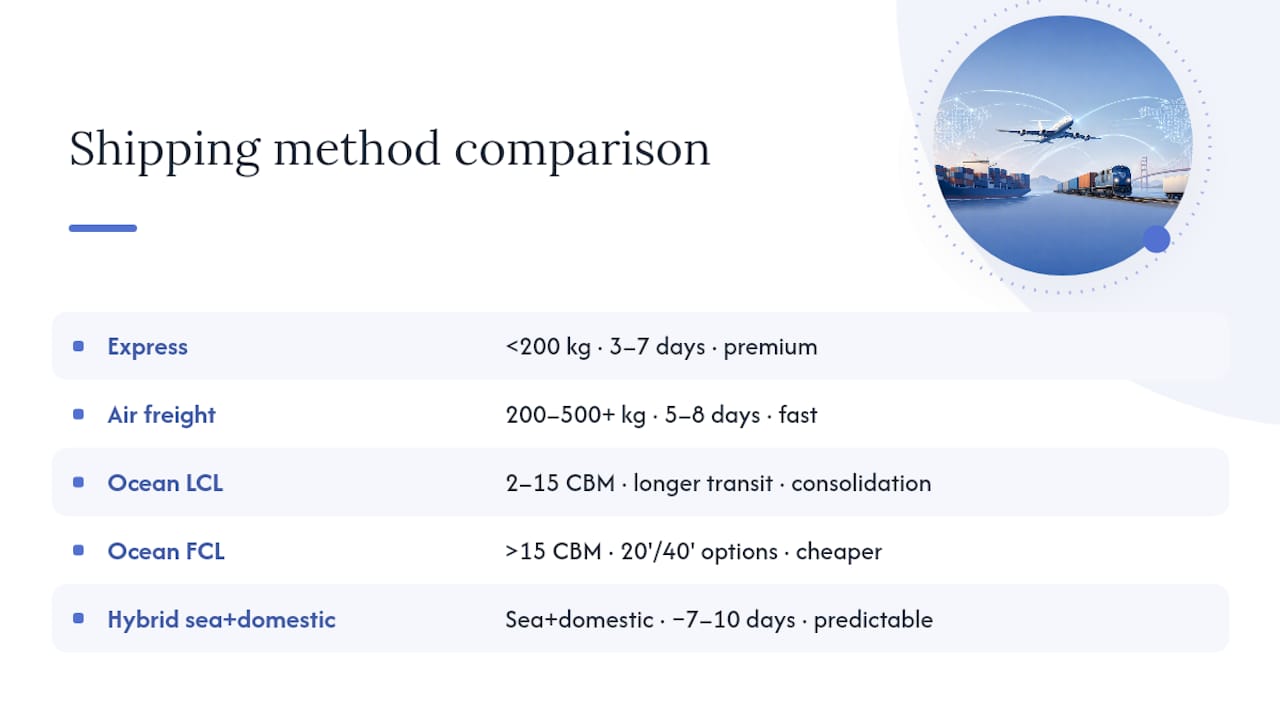
DDP (Delivered Duty Paid) and hybrid services bundle ocean transport with a U.S. domestic carrier handling the final leg, cutting the usual sea freight timeline. These setups suit Amazon FBA sellers and ecommerce operators who need predictable delivery windows more than they need the cheapest possible rate. Hybrid sea-plus-domestic-carrier services can shave roughly 7 to 10 days off door-to-door transit compared with a standard ocean shipment routed the traditional way.
What Does Shipping From China to USA Cost in 2026?
Rates swing hard depending on carrier contracts, fuel surcharges, and how close you are to a seasonal peak, but representative 2026 ranges give you a baseline to sanity-check any quote:
- Express courier: $6 to $12 per kg
- Air freight: $4 to $8 per kg
- LCL (West Coast): $80 to $220 per CBM
- FCL: $2,200 to $6,500 per container
These figures come from broad market observation across carriers and lanes, and they move with fuel costs, capacity, and season. Treat them as a planning range, not a locked quote.
The number that trips up first-time importers isn’t the base freight rate. It’s everything bolted onto it: origin trucking to the port, export customs clearance, terminal handling charges, peak season surcharges, destination handling, drayage from port to warehouse, customs broker fees, and the duty and tax bill itself. A detailed look at container freight cost structures shows just how many discrete line items sit between the sticker rate and what actually clears your bank account.
Duty stacking can add more to your landed cost than freight itself. In 2026, goods from China commonly stack the standard MFN rate, Section 301 tariffs, and an added IEEPA/fentanyl-related layer. Effective landed duty rates of 45% to 60% show up on some product categories once every layer is added together.
Spot rates (booked shipment by shipment) and contract rates (locked in with a carrier over months) can differ substantially, especially heading into peak season. A quote that only covers port-to-port freight looks cheap right up until destination fees and drayage add $400 to $900 or more to an LCL shipment that seemed like a bargain on paper. Always ask for a door-to-door landed-cost quote, not just a freight rate, before you compare two forwarders’ numbers side by side.
How Long Is Shipping From China to USA?
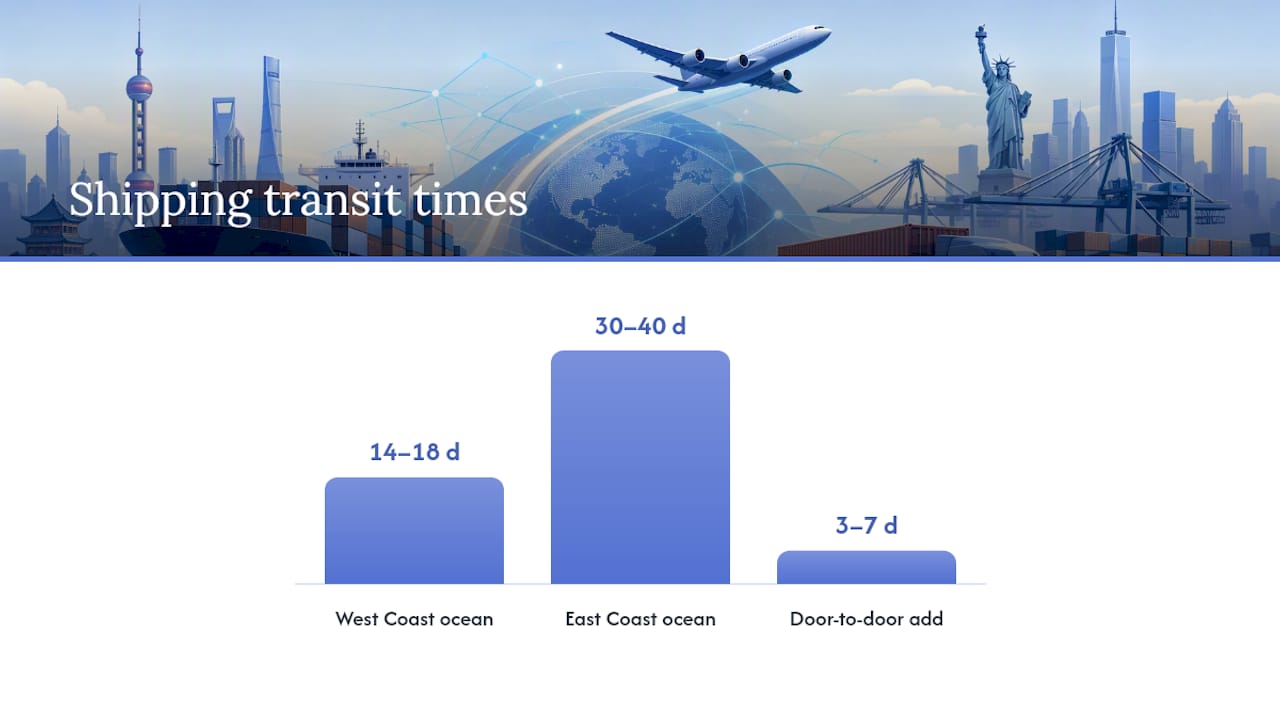
Transit time depends heavily on which coast you’re landing on and which origin port you’re shipping from. West Coast ports (Los Angeles/Long Beach) sit closer to Asia and skip the Panama Canal detour that East Coast routing requires.
| Origin Port | Destination | Typical Ocean Transit |
|---|---|---|
| Shanghai | Los Angeles/Long Beach | 14–18 days |
| Yantian (Shenzhen) | Los Angeles/Long Beach | 15–18 days |
| Ningbo | Los Angeles/Long Beach | 14–18 days |
| Qingdao | Los Angeles/Long Beach | 15–20 days |
| Shanghai | New York/Savannah (via Panama) | 30–40 days |
| Xiamen/Hong Kong | New York/Savannah (via Panama) | 30–40 days |
Trans-Pacific transit generally runs 14 to 18 days to U.S. West Coast ports and 30 to 40 days to U.S. East Coast ports via the Panama Canal. That gap of 15 to 20 extra days on the East Coast route is the tradeoff for skipping a cross-country rail or truck leg once cargo lands. If your warehouse sits in the Southeast or Northeast, you’re weighing a longer ocean leg against a shorter inland one.
Door-to-door timing adds another 3 to 7 days on top of the port-to-port number, depending on how fast drayage moves the container off the terminal and how quickly customs releases the entry. Shanghai, Yantian, Ningbo, Qingdao, Xiamen, and Hong Kong remain the dominant origin ports for this lane, which is still the largest ocean trade route by value in the world.
What Paperwork Does U.S. Customs Require?
Every ocean shipment into the U.S. needs an Importer Security Filing, commonly called the “10+2” rule, submitted at least 24 hours before the container is loaded at the origin port. This isn’t optional or negotiable on timing. CBP can assess a $5,000 civil penalty per violation for a missing or late ISF, and repeated failures can trigger increased inspection scrutiny on future shipments.
Beyond the ISF, expect to assemble:
- Commercial invoice detailing the goods, value, and terms of sale
- Packing list itemizing what’s in each carton or pallet
- Bill of lading (ocean) or air waybill (air freight)
- Arrival notice from the carrier once the shipment reaches port
- Formal entry filing submitted by a licensed customs broker
The bigger financial risk usually isn’t the paperwork. It’s the duty math. Most goods from China face a stack of at least three layers: the standard Most Favored Nation (MFN) rate, Section 301 tariffs tied to specific product categories, and an added IEEPA/fentanyl-related tariff layer. Depending on the HTS classification, these layers can combine into an effective duty rate of 45% to 60% on certain goods, which turns what looked like a healthy margin into a thin one.
Before you commit to a supplier or a shipment size, verify the exact HTS classification with a licensed customs broker and ask for a full landed-cost model that includes every duty layer, not just the base tariff rate. It’s the cheapest insurance you’ll buy all year.
How Do You Pick the Right Shipping Method?
Match the mode to three variables: how much inventory carrying cost you can absorb, how fast that SKU sells, and how tight your Amazon FBA or retail restock window is. High-velocity SKUs with thin margins usually justify air freight’s premium; slow-moving bulk goods almost never do.
Before you sign off on a quote, run through this checklist with your forwarder:
- What incoterm governs this shipment? (FOB, CIF, DDP, and so on all shift risk and cost differently.)
- Who files the ISF, and when?
- Is this quote port-to-port or door-to-door?
- What destination charges are included, and which ones aren’t?
- Which licensed customs broker handles the entry?
- What insurance coverage applies, and what’s the liability cap if cargo is damaged or lost?
Watch for red flags: a quote that omits destination fees entirely, vague answers about who’s liable for cargo, no named customs broker, or a spot rate with no stated validity window. Any one of those should send you back to the negotiating table.
Pro Tip: Ask every forwarder for the exact same landed-cost breakdown format so you’re comparing apples to apples, not a port-to-port number against a door-to-door one.
What Causes Delays and How Do You Avoid Them?
Chinese New Year and the pre-Christmas retail rush are the two predictable peaks that squeeze capacity and push rates up every single year. Book space weeks ahead of both if you can. Port congestion, container equipment shortages, and mandatory denied-party screening or customs inspections add unpredictable delays on top of the seasonal ones.
- Book cargo space early, ideally on a contract rate, before peak season hits
- Confirm your supplier and consignee clear denied-party screening before cargo moves
- Keep contingency stock for SKUs where a delay would cause a stockout
- Require accurate, complete paperwork from your supplier before booking
Rates are volatile enough that any static online estimate should be treated as a starting point, not a locked number. Verify against a live carrier sheet before you commit inventory dollars to a specific sailing.
How an Integrated U.S. Forwarder Handles the Whole Process
Running a China to USA shipment through a single point of contact removes a lot of the coordination risk that comes from juggling a freight broker, a separate customs broker, and a separate warehouse operator. Universal Shipping manages the full chain: origin pickup, export clearance, ISF filing, international ocean or air freight, customs brokerage, port drayage, warehousing, Amazon FBA prep, and last-mile delivery across all 50 states.
That single-vendor structure gives importers real landed-cost visibility before the shipment leaves China, rather than discovering the true cost after destination fees hit. It also simplifies claims handling if cargo arrives damaged, since one company, not three, is accountable for the shipment end to end.
What Should Importers Actually Prioritize in 2026?
The conventional advice on this topic obsesses over freight rates and mostly ignores duty exposure, which is backwards. A shipment with a rock-bottom container rate but a poorly classified HTS code can lose more money in one entry than a year of “expensive” freight quotes ever would. Get the tariff math right before you argue about $200 on a container rate.
The second blind spot is treating ISF as paperwork rather than a scheduling constraint. Miss that 24-hour window and you’re not just risking a penalty. You’re risking a delayed sailing that cascades into every downstream commitment you made to a retail buyer or an FBA restock date.
If there’s one thing worth doing differently this year, it’s asking for a full landed-cost model, duties included, before comparing any two quotes. Freight rate alone tells you almost nothing about what a shipment actually costs once it clears customs. Prioritize the broker relationship and the classification accuracy over chasing the cheapest per-CBM number you can find.
— Akbar
Get a Landed-Cost Quote Before Your Next Shipment
Universal Shipping offers an integrated service alternative to piecing together a freight broker, a separate customs broker, and a separate warehouse contract for every China shipment. One team handles ISF filing, ocean or air booking, customs entry, drayage, and warehousing, so the landed-cost number you get up front is the number you actually pay.
Whether you’re restocking Amazon FBA inventory, moving furniture shipments that need special handling, or scaling a retail import program past your first few containers, the same logistics and transportation services apply from pickup in China through last-mile delivery in the U.S. If duty stacking or HTS classification is the part you’re least sure about, start with a conversation through Universal Shipping’s customs clearance team and get a real landed-cost quote before you book your next container.
Sources
- U.S. Customs and Border Protection (CBP)
- GoFreight — Shipping From China to USA 2026
- Union Delta — Shipping From China to USA guide