
Chassis Split Fee: What It Is and How to Avoid It
A chassis split fee is an extra charge your drayage trucker adds when the chassis and your container are in two different places. The driver has to collect the chassis somewhere else first, then go to the terminal for the box, and the added mileage and time land on your invoice as a separate line. It is not the same as the daily chassis rental fee, and you can often see it coming, question it or reduce it.
This guide explains what the fee covers, what triggers it, how it sits next to chassis usage charges, and how to check it on an invoice before you pay.
TL;DR
- A split fee pays the trucker for extra miles and time when a chassis must be picked up or returned at a different location than the container.
- The chassis fee (rental or usage) is a daily charge for the equipment. The split fee is a one-time charge for an extra move. Both can appear on the same invoice.
- Splits usually come from terminal chassis shortages, a required chassis type held at another pool, or steamship line pool rules.
- Ask for the fee in your quote or rate sheet, check the chassis provider and the split on every invoice, and plan pickups to avoid peak days.
- Amounts differ by port, trucker and chassis pool, so get the number in writing before the container is dispatched.
Table of Contents
- What a chassis split fee actually is
- Chassis fee vs. chassis split fee
- What causes a chassis split
- A worked example
- How to check a split fee on an invoice
- How to reduce avoidable splits
- Our perspective
- When we can help
- Common mistakes
- FAQ
- Sources
What a chassis split fee actually is
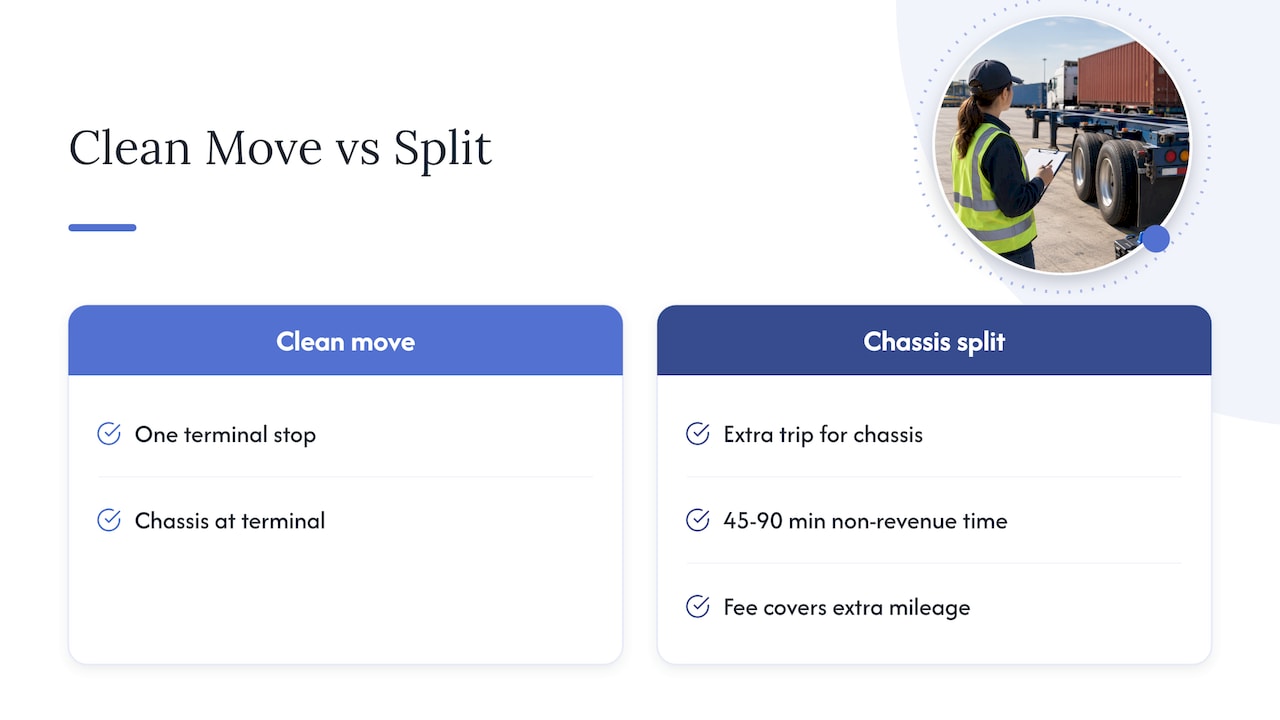
A container that leaves a port or rail ramp rides on a chassis, the wheeled steel frame the truck pulls. In a clean move, the driver arrives at the terminal, hooks up a chassis, loads the container and leaves. Everything happens in one stop.
In a split, those two pieces are not together. The container is at the terminal, but the chassis the driver needs is at an off-dock pool, a depot or a different terminal. The driver makes an extra trip to get it, or has to take it somewhere else when the job is done.
Industry trade documentation defines it plainly: a split chassis fee is an extra fee the trucker charges for the added mileage to pick up or return the chassis. That definition matters, because it tells you what the fee is for. It pays for the trucker’s extra distance, not for the chassis itself.
One carrier-side explanation describes the charge as compensation for additional driver time, fuel and equipment repositioning. The same source says each split commonly adds 45 to 90 minutes of non-revenue time to a move. That is a useful yardstick. If your invoice shows a split on a move where the driver visibly spent no extra time, the charge deserves a question.
Chassis fee vs. chassis split fee
People searching for “what is a chassis fee” often find the split fee in the same breath, and the two get confused. They pay for different things.
| Chassis fee (rental or usage) | Chassis split fee | |
|---|---|---|
| What it pays for | Use of the chassis equipment | An extra pickup or return trip |
| How it is counted | Per day, from pickup to return | Per occurrence |
| Who it goes to | The chassis provider or pool, often passed through by the trucker | The trucker |
| What triggers it | Every move that uses a rented chassis | Container and chassis in different places |
| Can it be avoided? | Reduced by returning fast | Sometimes, with planning and the right chassis source |
A chassis fee is a daily rental of the wheeled frame. A split fee is charged when the container and chassis are in different places and an extra move is needed to bring them together, as one overview of chassis costs puts it. The same overview stresses that they are distinct line items and can appear on one invoice.
How chassis usage is counted
Chassis usage means the time the chassis is out of the pool with your container on it. Most pools bill by the calendar day, and days often include weekends. Some pools also set a minimum number of billable days. A container that sits at your warehouse over a long weekend can therefore cost more in chassis days than the trip itself took.
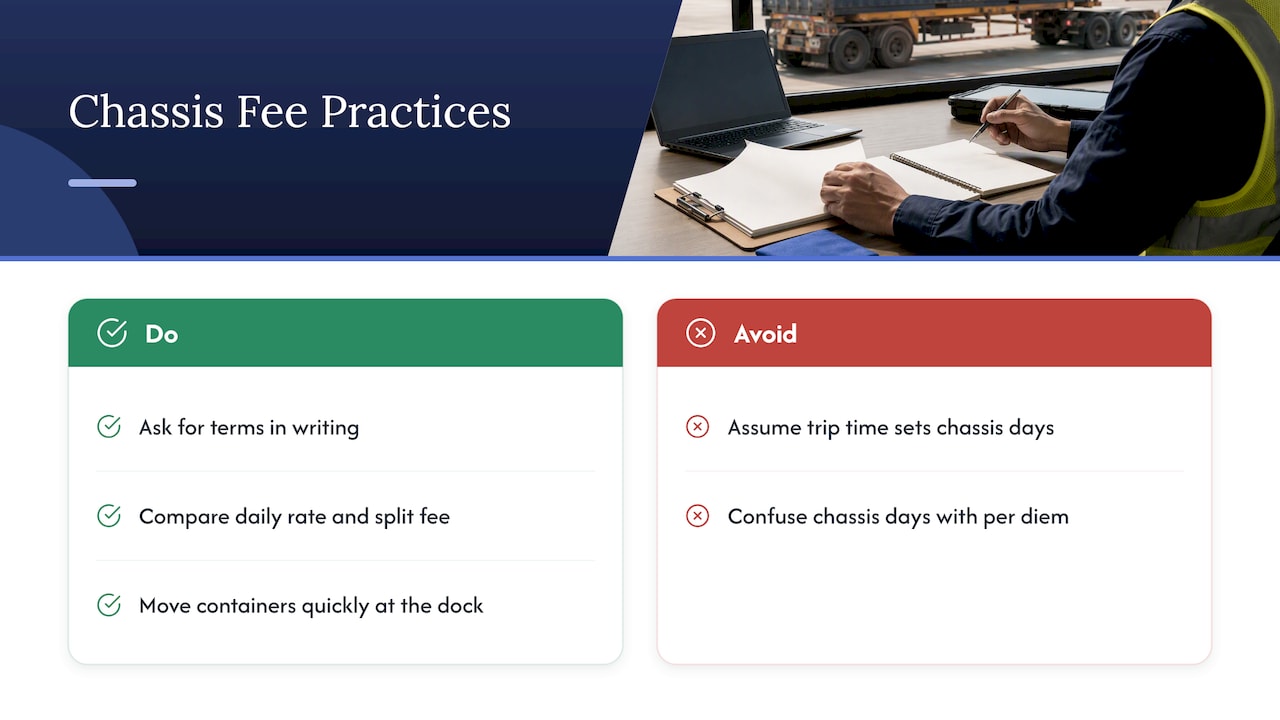
That is why speed at your dock matters. Truckers set their own pass-through terms, so the exact day count, the minimum and the rate depend on the pool and on your contract. Ask for those terms in writing. If you are comparing quotes, put the daily chassis rate and the split fee next to each other, because a low base rate with a high split charge can cost more than it looks.
Chassis days are also different from per diem. Per diem is the shipping line’s charge for keeping its container beyond free time, and it is a separate fight. We cover it in our guide to per diem charges and the FMC 30-day rule.
What causes a chassis split
Splits are rarely the shipper’s choice. They are usually a side effect of how chassis are stored and shared at ports. The common causes:
- Terminal chassis shortage. When the terminal has no chassis available, the driver must get one off-site. One drayage billing guide lists a terminal shortage or a required chassis type available only at another pool as typical triggers.
- Specific equipment requirements. A 40-foot high-cube, a tri-axle for heavy cargo or a genset chassis may not be stocked where the box is.
- Steamship line pool logistics. The line’s approved chassis provider may be in another location. The same guide notes that splits are often unplanned events tied to shortages, equipment type needs and pool logistics.
- Off-dock pools. Ocean terminals often do not hold the specific chassis a container needs, so drivers go to off-dock pools run by providers such as DCLI, TRAC or Flexi-Van.
- Return location mismatch. The container goes back to one terminal, but the chassis has to be returned to a different yard.
Notice what is missing from this list: anything you did wrong. A split is usually about where equipment is, not how you behaved. That is exactly why it is worth understanding. A fee that is not your fault can still be negotiated, planned for or avoided with the right setup.
A worked example
Say you import a 40-foot container of home goods through a major West Coast port. Your trucker’s quote has a base drayage rate, fuel surcharge and chassis usage. The day of pickup, the terminal has no chassis in the right size.
The driver goes to an off-dock pool, picks up a chassis, returns to the terminal, loads your box and delivers it to your warehouse. Afterward the driver returns the chassis to the pool. Compared with a clean move, you now have:
- Extra driving to and from the pool.
- Extra waiting time at the pool gate.
- A chassis rental that may start earlier in the day.
- A split fee on the invoice.
The split fee is meant to cover items 1 and 2. If your invoice shows the fee but also bills a second positioning or waiting charge for the same trip, you may be paying twice for the same minutes. That is the first thing to ask about.
The figures differ by port and by trucker, so we are not going to give you a number you could not rely on. What we can say is the pattern: a split fee is typically a flat per-occurrence charge, while chassis usage is a per-day charge that climbs with every day the box is out.
How to check a split fee on an invoice
Billing mistakes happen because splits are messy to record. One carrier-side guide notes that errors often occur when split events are logged only as free-text notes in a TMS instead of coded, billable events. The result can be a missed charge, but also a duplicate or unclear one. A careful review takes about ten minutes per invoice.
Step by step
- Match the line to the move. The invoice should show the container number, the pickup date and the chassis provider.
- Ask which chassis provider was used. Reliable billing depends on the trucker capturing the chassis provider at dispatch and reconciling the provider’s monthly statement against customer invoices. If your trucker cannot name the provider, the chassis charge is hard to verify.
- Ask for proof of the split. Some drayage systems now use geofencing to flag when a driver visits a known off-dock pool. A timestamped record of the pool visit is the cleanest proof.
- Compare with your quote. Was the split fee listed in the rate sheet? If not, what is the basis for adding it?
- Look for double billing. A split should not stack on top of a separate repositioning or extra-mileage charge for the same trip.
- Check the chassis days. Count the days from pickup to return and compare them to the chassis charge.
If something does not add up, ask for the supporting documents in writing and keep a copy of every invoice and email. Disputes are much easier with a record.
How to reduce avoidable splits
You cannot control a port’s chassis supply. You can control some of the conditions around it.
- Get the fee in the quote. Ask whether splits are included, charged flat per occurrence or billed at cost. A line in the agreement beats a surprise on the invoice.
- Tell your trucker the container details early. Size, weight and any special chassis need help dispatch plan the right equipment before the driver reaches the gate.
- Avoid the peak. Pickup times, days of the week and peak season all affect chassis availability. If your cargo allows, schedule outside the rush.
- Choose the pool intentionally. If your shipping line or trucker has access to more than one pool, ask which is closest to the terminal where your box will be.
- Turn the container fast. Splits are a one-time cost, but chassis days keep running. Unload quickly and return the box. If your warehouse cannot turn containers in a day or two, a transload step can help; see how transloading cuts turn time.
- Use a single partner for the whole move. When one provider manages the ocean leg, the drayage and the warehouse, the chassis plan is one conversation instead of three. That is the logic behind port-to-door shipping.
For a broader view of how ocean, rail and truck legs fit together, see our guide to intermodal shipping and the first lane to test.
Importing from overseas suppliers
Split fees are a drayage issue, but they show up as part of landed cost, and landed cost is decided long before the ship arrives. If you buy from overseas, the way the supplier ships matters as much as the terminal on the other end. A Shenzhen prototype shipping playbook shows how small shipments from China can pick up costs that were never in the original quote, and the same habit applies to containers: ask what is included and what is not before the cargo moves.
Our perspective
We see chassis charges from the shipper’s side, and the pattern is consistent. Customers rarely object to a fair fee. They object to a fee they did not know existed, or one they cannot trace to an actual event.
That is why we push for visibility at every step. Real-time tracking is useful not just to know where your container is, but to know what happened to it. If a driver went to a pool, the record should show it. If a chassis was held three days, the dates should be on the invoice.
We also think splits should be talked about before the quote is signed, not after the container is gone. A shipper who asks “how do you handle splits, and what do you charge?” tends to get a straight answer. A shipper who does not ask tends to find out on the invoice.
Our approach is to run transportation, warehousing and customs under one platform, so the chassis plan, the delivery appointment and the unloading dock are coordinated by the same team. Fewer handoffs means fewer gaps where an extra move can hide.
— Akbar
When we can help
If container moves are a regular part of your supply chain, a single provider for freight, drayage coordination and warehousing keeps the chassis, the dock and the paperwork in one place. We handle freight forwarding and customs brokerage for importers and exporters across the U.S., and we can receive, store and fulfill the cargo once it is unloaded.
Our warehouse storage rates are published: bins run $5-$6 per month and pallets $17-$19 per month, with additional services at $37 per hour. See the full list on our pricing page. Freight and drayage are quoted per shipment, so ask us for a quote and we will list the chassis and split terms up front.
Common mistakes
A few errors cost shippers money again and again:
- Treating the split fee and the chassis fee as one charge. They are separate, and each should be reviewed on its own.
- Paying without a chassis provider name. If the invoice does not say who provided the chassis, you cannot verify the rental.
- Ignoring weekends. Chassis days usually keep running, so a Friday delivery with a Monday return costs more than it appears.
- Accepting a flat “accessorial” line. Ask for it to be itemized: chassis, split, wait time, fuel.
- Not asking before the move. The cheapest time to negotiate terms is before dispatch.
FAQ
What is a chassis split fee?
It is an extra fee your trucker charges when the chassis and the container are in different locations and the driver must make an additional trip to collect or return the chassis. It pays for the added mileage and time. It is separate from the daily chassis rental.
What is a chassis fee?
A chassis fee is the charge for using the wheeled frame that carries your container, usually billed per day while the chassis is out. It is passed through by the trucker from the chassis pool or provider. The split fee is a different, one-time charge for an extra move.
Can I refuse a chassis split fee?
Only if the fee was not agreed or was not actually incurred. Check your quote or contract first. If the split happened and the fee is in your terms, it is generally valid. If it was not disclosed or the invoice cannot show the extra trip, ask for the supporting records and dispute the line in writing.
Why do chassis splits happen?
Mostly because the right chassis is not at the terminal where your container is. Shortages, a special equipment type or steamship line pool arrangements can all send the driver to another location. They are usually operational, not caused by the shipper.
How can I avoid chassis split fees?
Settle the fee terms in your quote, give the trucker accurate container details early, and avoid peak pickup times where you can. Working with a provider who coordinates the whole move also helps. You cannot remove splits entirely, but you can make them rarer and more transparent.
Sources
- TC Definitions and Fees (Mid-Atlantic trade document, 2021)
- Chassis Per Diem Cost, Split Fee and Three Other Names
- Chassis Split Locational Billing: Automating Off-Dock Fees
- Chassis Fees, Splits, and Billing in Drayage