
Chargeable Weight in Air Freight: How to Calculate It
Chargeable weight is the weight an air shipment is billed on. It is the greater of two numbers: the gross weight on the scale (cargo plus packaging and pallet) and the volumetric weight, which converts the space your cargo takes up into kilograms or pounds. A light, bulky shipment is billed for its size, a dense one for its mass. If you know both numbers before you book, there are no surprises on the invoice, and you can often lower the bill by changing how the freight is packed. Our air freight team at Usiship works from exactly these two numbers when quoting, so the quickest route to a firm rate is a clean packing list with dimensions and weights per piece.
TL;DR
- Chargeable weight = the higher of gross weight and volumetric weight. Airlines and forwarders quote the rate per kilogram (or pound) of that figure.
- The international standard volumetric formula is length × width × height in cm ÷ 6,000. In inches, the equivalents are ÷ 366 for kilograms or ÷ 166 for pounds.
- Measure the packed shipment at its widest points, including pallet and overhang. Fractions are rounded up, not down.
- Some carriers use a different divisor, especially on U.S. domestic lanes, so confirm it at quote time.
- Repacking into tighter cartons or lower pallet heights is the fastest way to lower a volumetric bill.
Table of Contents
- What chargeable weight means
- How to calculate volumetric weight
- Rounding rules that change the bill
- 5,000 or 6,000: which divisor applies?
- How the invoice shows it
- How to lower your chargeable weight
- Mistakes that cause surprise charges
- Our perspective
- Get a quote based on your real dimensions
- FAQ
- Sources
What chargeable weight means
An aircraft runs out of space long before it runs out of lifting capacity when it carries pillows, apparel or electronics. To keep a cubic foot of foam from being priced like a cubic foot of steel, carriers bill on whichever limit your cargo hits first, weight or volume.
Three terms come up on every quote:
- Gross weight: the physical weight of the shipment as it will be handed over, including cartons, wrapping, crates and pallets. It is not the weight of the product alone.
- Volumetric weight (also called dimensional or volume weight): a notional weight calculated from the shipment’s dimensions using a fixed divisor.
- Chargeable weight: the higher of the two. This is the figure the per-kilo rate is multiplied by.
The IATA rules reproduced in a Association of Southeast Asian Nations air freight training manual say a consignment is charged on volume when it averages more than 6,000 cubic centimeters, 366 cubic inches per kilogram or 166 cubic inches per pound. Put simply, cargo less dense than about 167 kg per cubic meter (roughly 10 lb per cubic foot) is billed on its size.
How to calculate volumetric weight
The formula is the same everywhere; only the units and divisor change.
| Measure in | Formula | Result in |
|---|---|---|
| Centimeters | L × W × H ÷ 6,000 | kilograms |
| Inches | L × W × H ÷ 366 | kilograms |
| Inches | L × W × H ÷ 166 | pounds |
The three divisors come from the same IATA rule, as set out in the training manual’s description of the rule. Multiply the three dimensions of each piece, divide, then add up the pieces.
Two practical points:
- Use the packed dimensions. Measure at the longest, widest and tallest points of the finished piece, including the pallet and anything that overhangs it. A pallet that arrives 4 inches taller than planned is priced at the taller height.
- Calculate per piece, then total. If your 12 cartons are all the same size, multiply one carton’s volume by 12.
Worked example 1: a pallet in centimeters
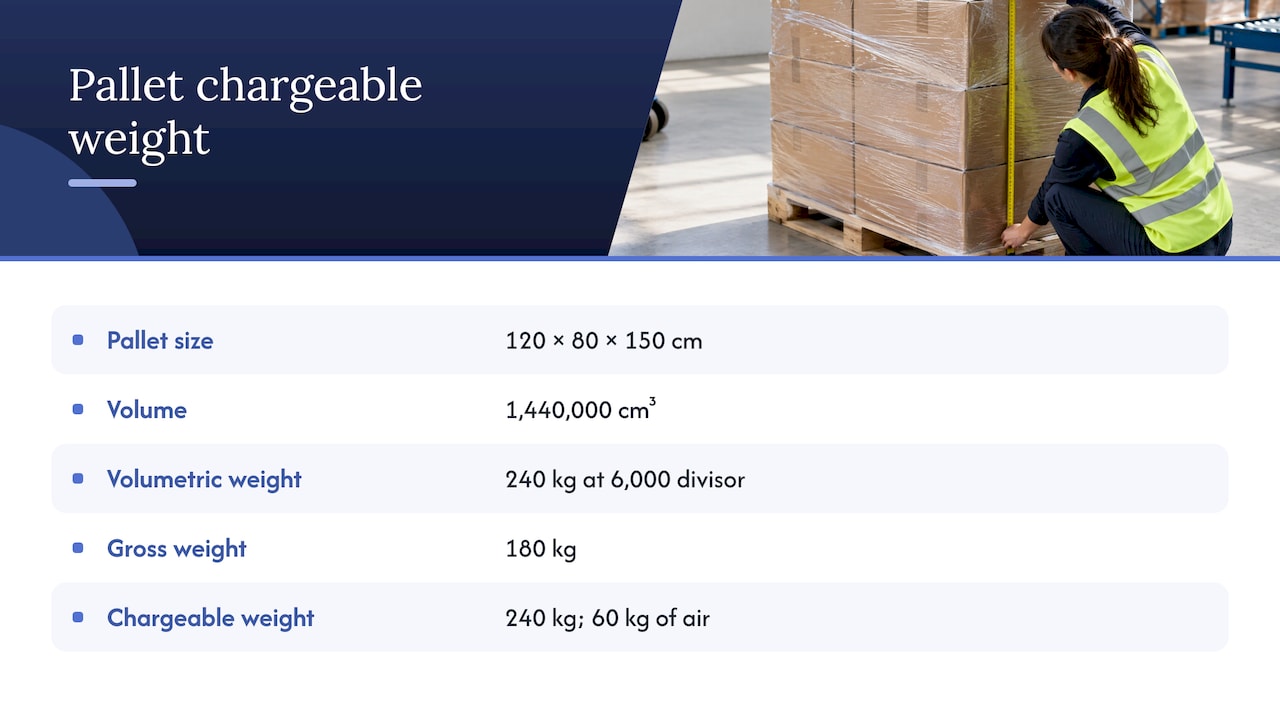
A pallet measures 120 × 80 × 150 cm and weighs 180 kg. Its volume is 1,440,000 cm³. Divided by 6,000, that is 240 kg. The gross weight is only 180 kg, so 240 kg is the chargeable weight, as this worked example shows. You pay for 60 kg of air.
Worked example 2: a pallet in inches and pounds
Most U.S. shippers measure in inches and pounds, so here is the same logic in those units. A pallet is 48 × 40 × 60 inches and weighs 400 lb.
- Volume: 48 × 40 × 60 = 115,200 cubic inches
- Volumetric weight: 115,200 ÷ 166 = 693.98 lb
- Gross weight: 400 lb
Volumetric is higher, so the chargeable weight is 694 lb. The shipper pays for almost 300 lb of space that carries no mass.
Worked example 3: when gross weight wins
A carton of metal fittings measures 20 × 16 × 12 inches (3,840 cubic inches) and weighs 60 lb. Volumetric weight is 3,840 ÷ 166 = 23.13 lb. The gross weight of 60 lb is far higher, so you are billed on 60 lb. Dense cargo is billed on the scale and the formula never comes into play.
Rounding rules that change the bill
Rounding is where small errors creep into quotes. According to the IATA rules in the same trainer:
- Volume weight is calculated to three decimal places before rounding.
- In kilograms, a fraction from 0.51 to 0.99 rounds up to the next full kilogram, exactly 0.5 is left as is, and a fraction from 0.1 to 0.4 rounds to the next half kilogram.
- For shipments from the USA, charges may be computed per kilogram or per pound, and any pound fraction is rounded up to the next full pound.
That is why the 693.98 lb pallet above becomes 694 lb, and why a 23.13 lb volumetric figure is billed as 24 lb. On a single carton the difference is trivial. Across a thousand cartons a month it is not.
5,000 or 6,000: which divisor applies?
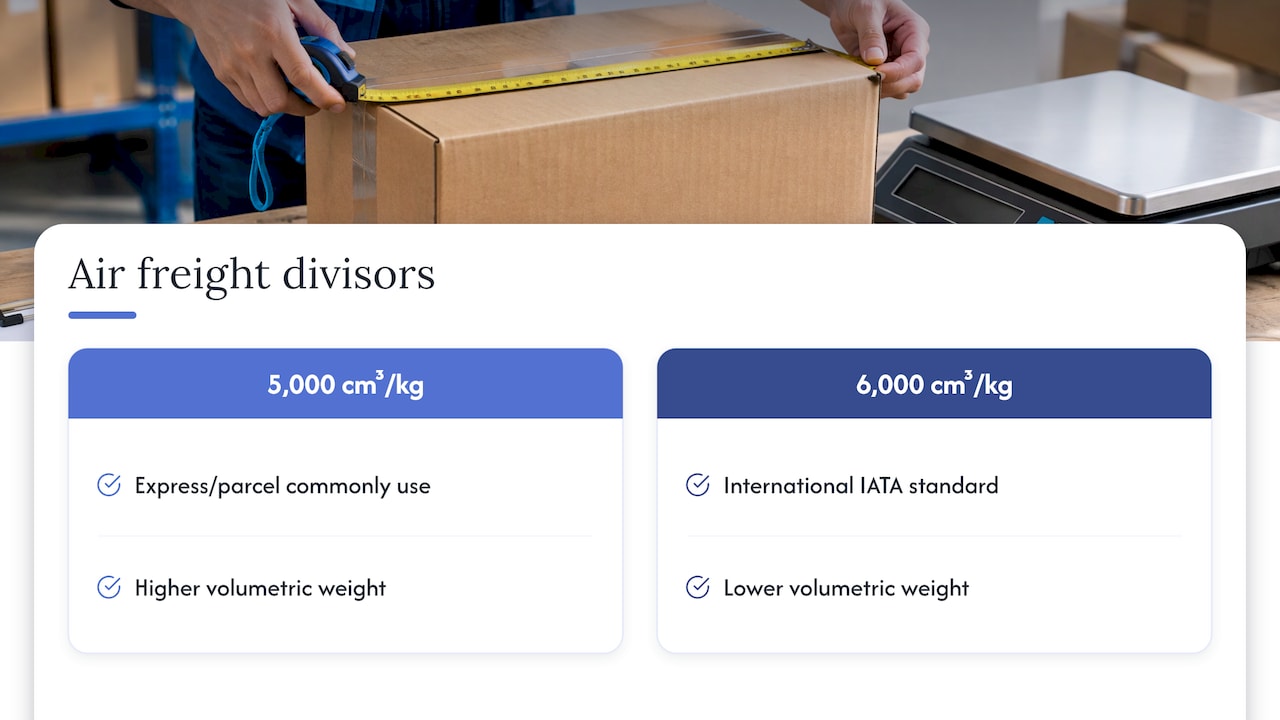
The international IATA standard is 6,000 cm³ per kg. Some carriers and some lanes use a different divisor, and a smaller divisor produces a higher volumetric weight. Express and parcel-style services commonly use 5,000, and U.S. domestic air cargo products can use their own inch-based figures. Whether 5,000 or 6,000 applies depends on the carrier and the service, so the quote should state the divisor. The divisor and the rounding rule come from your tariff or framework agreement.
For small-parcel carriers on the ground side, divisors have been moving too. Our guide to the 2026 USPS divisor change covers how that raises dimensional weight for small shippers. Air cargo has its own rules, so keep the two calculations separate.
How the invoice shows it
Air freight invoices separate billed weight from gross weight. In EDI invoice data, the billed and gross weights sit in separate segments, and carriers can send dimensions so the payer can recompute volumetric weight, as the EDI 110 air freight guide explains. Its sample shipment of 12 cartons, 186 kg gross and 1.42 cubic meters, bills at about 237 kg: 1.42 m³ is 1,420,000 cm³, and divided by 6,000 that is about 237 kg.
When your freight bill arrives, check three things:
- Did the carrier record the same piece count and dimensions as your packing list?
- Which divisor was used?
- Was the billed weight rounded in the way your agreement states?
A mismatch in dimensions is the most common reason a bill is higher than the quote.
How to lower your chargeable weight
Once you know which number is driving the bill, you can act on it.
- Right-size the carton. Air in a box is billed like cargo. Cutting 2 inches from each dimension of a 20 × 16 × 12 inch carton drops its volume from 3,840 to 2,592 cubic inches, a 32% reduction.
- Watch pallet height. Height multiplies the whole footprint. Taking a 48 × 40 pallet from 60 to 48 inches lowers its volumetric weight from 694 lb to 555 lb (92,160 ÷ 166).
- Avoid overhang. Measurements are taken at the extreme points, so a few inches of overhang on one side counts as if the whole pallet were that wide.
- Consolidate. Shipping several small cartons on one pallet or one air waybill reduces rounding losses.
- Compare modes by density. If your goods are very light for their size and the schedule allows, ocean freight is priced on a different basis, so the same cargo can cost far less than a volumetric air bill.
- Quote before you pack. Send dimensions and weights for your planned configuration and compare it with a tighter alternative before the cargo is boxed.
For planning, the break-even density is simple: at 6,000 cm³ per kg, cargo heavier than about 167 kg per cubic meter is billed on gross weight, lighter cargo on volume.
Mistakes that cause surprise charges
- Using product weight instead of gross weight. Packaging and pallets are part of the shipment.
- Measuring the product, not the packed piece.
- Mixing units, for instance dividing inches by 6,000. The divisor must match the unit.
- Forgetting the pallet itself when a forwarder builds a unit load device or you palletize for pickup.
- Rounding down. Fractions are rounded up in most billing.
- Assuming one divisor for every carrier and lane.
A habit that prevents most of these: keep a packing list with piece count, packed dimensions in both inches and centimeters, gross weight per piece and the calculated chargeable weight, and send it with every quote request. Our overview of how air freight clears customs shows the other documents that travel with it, and the freight forwarding process lays out the 12 steps from quote to delivery.
Our perspective
Most billing disputes in air freight start before the cargo leaves the dock. The shipper quoted on product weight, the carton was 3 inches larger than planned, or the pallet was stacked one layer too high. The formula is easy. Getting the measurements right at the moment of packing is the hard part.
Our approach is to keep transportation, warehousing and shipping on one platform, so the people who quote your air freight can work from the same packing data as the people who handle your inventory. We offer air freight, customs brokerage, warehousing, fulfillment and specialty freight packing, and we think packing decisions and freight decisions belong in one conversation. Our systems are designed around real-time tracking and transparent pricing, and our service runs around the clock.
If you ship regularly, treat chargeable weight as a design input, not a billing detail. Choose carton sizes, pallet heights and consolidation patterns with the divisor in mind, and the savings repeat on every shipment.
Akbar
Get a quote based on your real dimensions
If you import or export by air, our freight forwarding and air freight service covers air, ocean and land shipping along with customs brokerage. Send us your piece count, packed dimensions and gross weights and we will quote against the chargeable weight, not a guess. For goods that need to be repacked or crated first, our specialty freight packing services are listed on our services page, and our pricing page shows warehousing rates such as storage at 17-19 USD per month per pallet and 5-6 USD per month per bin.

If you store stock with us before shipping, you can also have it repacked to a tighter footprint before it flies.
FAQ
Is the volumetric divisor 5,000 or 6,000 for air freight?
The IATA standard for air cargo is 6,000 cm³ per kg. A divisor of 5,000 appears on some express and courier services, and it produces a higher volumetric weight. Confirm which one your carrier applies when you request a quote.
What is the formula for chargeable weight?
Calculate the volumetric weight (length × width × height ÷ 6,000 for centimeters and kilograms), compare it with the gross weight, and use the larger number. In inches and pounds, divide cubic inches by 166.
Does gross weight include packaging and pallets?
Yes. Gross weight is the product plus cartons, wrapping, crates and the pallet. A 50 lb product in a 10 lb package has a gross weight of 60 lb.
Do I measure each box or the whole pallet?
Measure each piece as it will be handed over. A palletized shipment is measured as one piece at its longest, widest and tallest points, including the pallet and any overhang. Loose cartons are measured individually and added together.
Sources
- Air Freight Calculation of Air Freight, IATA rules trainer (ASEAN, 2023)
- Volumetric weight calculator: formula and example
- EDI 110 Air Freight Details and Invoice Guide