U.S. Shippers: Choose a CFS Warehouse That Prevents Duty and Exam Delays
A CFS warehouse is the port-side facility that consolidates small shipments into export containers and deconsolidates inbound containers for distribution to multiple consignees. Use one whenever you’re moving less-than-container-load (LCL) freight and need to share container space with other shippers, or when an inbound container needs to be broken down and sorted before it reaches its final buyers. The payoff is straightforward: lower per-unit freight cost, faster port-side turnaround, and a physical point where customs, labeling, and inspection can happen before cargo moves inland.
TL;DR:
- Confirm the bonded status of a CFS facility in writing, as not all are bonded and duty deferral depends on active CBP bonds.
- Ensure the CFS explicitly has the necessary customs and security certifications, such as SOLAS weighing and CES, to prevent delays or compliance issues.
- Prioritize CFS proximity to the port, verified bonded authorization, and system visibility tools over just the advertised handling rates.
- Coordinate with your broker on customs documentation accuracy and denied-party screenings, and verify these services are integrated with the CFS.
- Consider a provider like Universal Shipping that combines warehousing, bonded storage advisory, and freight forwarding under one contract for streamlined logistics.
Table of Contents
- What a CFS Does: Core Functions and Typical Workflows
- CFS Services and Value-Added Capabilities Worth Budgeting For
- CFS vs Bonded Warehouse vs FTZ: Getting the Legal Differences Right
- How to Choose a CFS Partner: A Procurement Checklist
- How Universal Shipping Covers CFS and Bonded-Warehouse Needs
- Regulatory Compliance and Safety Standards CFS Operators Must Meet
- Documentation and the Customs Clearance Process at a CFS
- Cost Structure and Pricing Models for CFS Services
- Author Perspective: Practical Tips From an Operations Lead
- Let Universal Shipping Handle Your CFS and Bonded Storage Needs
- Sources
- FAQ
What a CFS Does: Core Functions and Typical Workflows
A container freight station exists to solve one problem: not every shipment fills a container, but ocean carriers price and move cargo by the container. CFS operators fix that mismatch through consolidation and deconsolidation, plus a handful of related handling steps that keep freight compliant and moving.
On the export side, a CFS receives LCL cargo from multiple shippers, sorts it by destination, and stuffs it into a single container bound for one port. On the import side, it reverses the process: a full container gets devanned, and its contents get split among several consignees, each getting only their portion. Transloading follows a similar logic. Ocean containers get devanned and their contents reloaded onto domestic trailers, which matters when a 40-foot ocean container needs to become two or three truckload shipments for inland delivery.
Many CFS facilities also function as Centralized Examination Stations, where U.S. Customs and Border Protection can pull cargo for inspection without disrupting the rest of the terminal.
A typical workflow runs in a predictable sequence:
- Receive the container or LCL cargo and log it against the manifest.
- Inspect for damage, count discrepancies, or CBP examination holds.
- Document the shipment, matching bills of lading and commercial invoices to physical cargo.
- Stuff or devan the container based on the shipment direction.
- Release the cargo to trucking, rail, or final delivery once documentation clears.
Any breakdown in that sequence, usually a documentation mismatch, tends to be where delays actually happen.
CFS Services and Value-Added Capabilities Worth Budgeting For
The base function of a CFS is consolidation and deconsolidation, but the services wrapped around that function are what actually determine your total cost and your risk exposure. Buyers who only ask about square footage and per-container rates usually get surprised later by accessorial fees or compliance gaps.
Ask any CFS operator about these before signing:
- Packing, crating, repacking, and relabeling for cargo that needs to meet a specific retailer or country requirement
- Kitting and palletizing, especially for freight headed to distribution centers with strict receiving specs
- Hazmat-certified handling for regulated commodities
- CCTV coverage and access-controlled security for high-value cargo
- SOLAS container weighing and certification, which carriers require before a container can be loaded on a vessel
- Bonded versus handling-only status, which changes whether duty gets deferred while cargo sits at the facility
- EDI and WMS integration so you can see cargo status without calling the warehouse floor
Facilities that advertise SOLAS weighing and CES capability as standard offerings tend to run tighter documentation processes overall, since both requirements force disciplined recordkeeping.
Pro Tip: Get the SOLAS weighing certificate in writing as part of your service agreement, not as a verbal assurance. A missing or late verified gross mass (VGM) submission can bump your container off its sailing entirely.
CFS vs Bonded Warehouse vs FTZ: Getting the Legal Differences Right
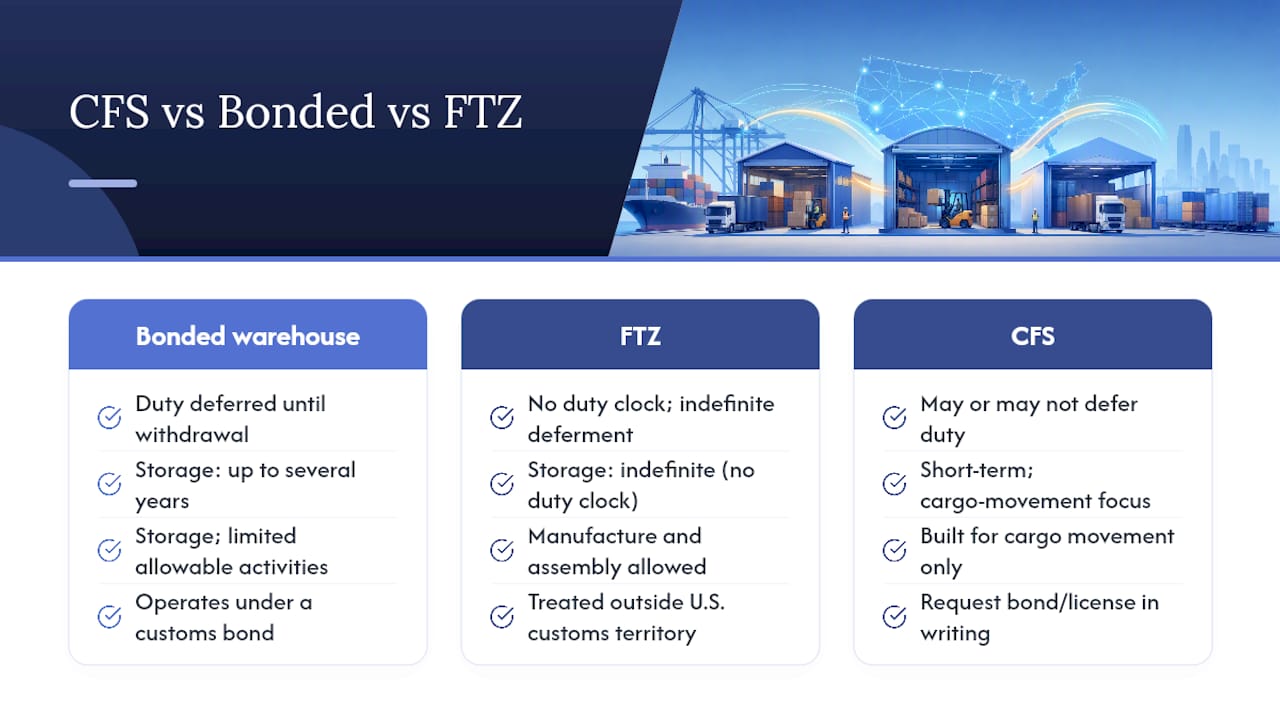
These three terms get used interchangeably in casual conversation, and that’s where import managers get into trouble. Each one carries distinct duty treatment, storage limits, and manipulation rights, and picking the wrong one can cost you cash flow or compliance headaches.
A Customs bonded warehouse lets you store dutiable imported merchandise without paying duty until you withdraw it for consumption. CBP caps that storage at a maximum period from the date of importation, typically up to several years, and the facility must operate under a bond with defined classes of allowable activity.
The maximum period a bonded warehouse can hold your dutiable merchandise before CBP requires withdrawal is up to several years, per federal bonded-warehouse rules.
A Foreign-Trade Zone (FTZ) operates on different footing entirely. FTZs are treated as outside U.S. customs territory, which means goods can sit there indefinitely without a duty clock running, and many zones allow actual manufacturing and assembly, not just storage. That’s a meaningful advantage if you’re importing components, not just finished goods.
A CFS is a different animal from both. It’s built for cargo movement, not long-term storage, and may or may not carry bonded status depending on the individual facility. Never assume a CFS defers duty just because it’s near the port. Request the bond number or bonded-warehouse license directly, in writing, before you route duty-sensitive cargo there. A bonded warehouse review before shipping is worth the time it takes to confirm licensing.
How to Choose a CFS Partner: A Procurement Checklist
Picking a CFS on price alone is how shippers end up with surprise drayage bills and blown delivery windows. Distance to the terminal, documented bonded status, and system visibility matter more than the quoted per-container handling rate.
Run through this before signing with any facility:
- Port proximity. A CFS closer to the terminal cuts drayage cost and time, though a facility slightly farther but inside a faster dray corridor can still beat a “closer” one on total landed cost.
- Capacity and equipment fit. Confirm the facility can handle your commodity type, whether that’s palletized freight, hanging garments, or oversized crates.
- Bonded authorization and CES capability, verified with documentation, not a sales rep’s word.
- Customs broker integration. Ask how the CFS coordinates with your broker on entry filing and denied-party screening.
- Visibility tools. EDI feeds, SOLAS weigh records, and WMS integration determine whether you see problems in real time or find out after the container misses its window.
- Insurance and security coverage appropriate to your cargo value.
Red flags worth walking away from: vague answers about bonded paperwork, no CES capability when you regularly ship regulated goods, or a facility that can’t produce real-time inventory status on request. Third-party 3PL selection criteria frameworks cover similar ground if you want a broader vendor-vetting template beyond CFS-specific questions.
Pro Tip: Ask for a sample SOLAS weigh certificate and a sample bonded-warehouse license during the RFP stage, not after the contract is signed. If the facility hesitates to produce either, treat that as your answer.
How Universal Shipping Covers CFS and Bonded-Warehouse Needs
Universal Shipping’s warehousing and fulfillment operations cover the same buyer jobs a CFS handles: consolidation, storage, and cargo prep ahead of final delivery. Pair that with in-house customs brokerage and freight forwarding, and you get bonded-status advisory and entry filing under one contract instead of coordinating three separate vendors.
Real-time tracking and optimized warehouse technology mean you see container status, inventory counts, and release timing without chasing a warehouse manager by phone. Coverage across all 50 states also means your CFS-adjacent needs, drayage, transloading, FBA prep, or last-mile delivery, don’t require a second logistics contract once cargo clears the port.
Regulatory Compliance and Safety Standards CFS Operators Must Meet
CFS facilities operate under a layered compliance framework, and the strongest operators treat that framework as baseline, not aspiration. CBP oversight governs any facility handling bonded or CES-designated cargo, including recordkeeping standards, bond compliance, and access controls for examination areas.
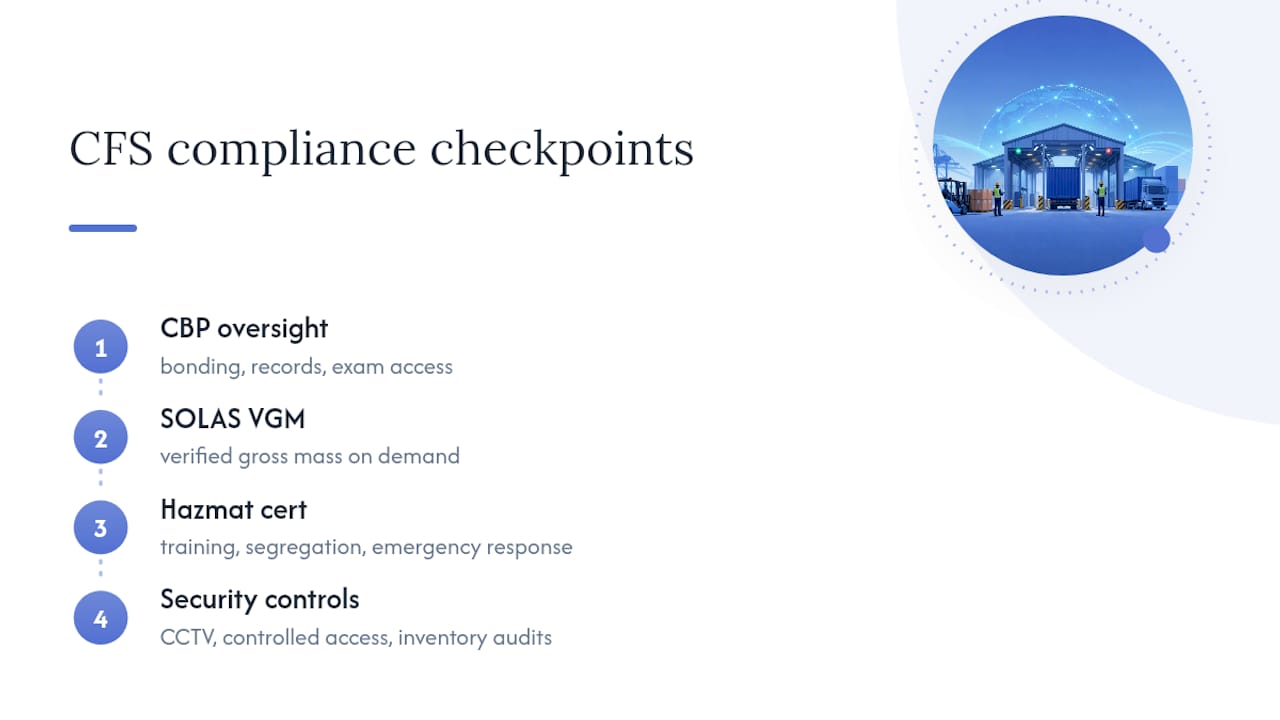
SOLAS weighing requirements, part of the International Maritime Organization’s container safety rules, apply to any export container regardless of which CFS handles it. A facility that can’t produce a verified gross mass on demand puts your sailing schedule at risk, not just your compliance file.
Hazmat handling adds another layer entirely. Facilities certified for regulated commodities need documented training, proper storage segregation, and emergency response protocols that go beyond general warehouse safety practices. If your cargo includes lithium batteries, aerosols, or other regulated materials, confirm hazmat certification before booking space, not after cargo arrives at the dock.
Security standards matter just as much as customs compliance. CCTV coverage, controlled access, and inventory audit trails protect against cargo theft and also support the documentation trail CBP expects during an examination. A facility with the Centralized Examination Station designation already meets a baseline set of federal security and access requirements, which is one reason CES status is worth confirming even if you don’t expect frequent exams.
None of this is optional paperwork. A gap in any one of these areas, hazmat certification, SOLAS compliance, or bonded documentation, tends to surface at the worst possible moment: when cargo is already on the water and a correction is no longer simple.
Documentation and the Customs Clearance Process at a CFS
Clearance at a CFS runs on paperwork accuracy as much as physical handling. Before cargo even arrives, your broker typically files an entry with CBP based on the commercial invoice, packing list, and bill of lading, and that entry has to match what’s physically inside the container down to weight and count.
Once cargo reaches the CFS, staff cross-check the manifest against the physical shipment. Any mismatch, wrong HS code, understated quantity, missing certificate of origin, can trigger a hold or route the shipment to a Centralized Examination Station for closer review. That’s why accurate HS code classification upfront saves real time at this stage; a misclassified item doesn’t just risk a duty recalculation, it risks a full exam.
Denied-party screening happens somewhere in this window too, usually run by the broker or freight forwarder, checking consignees and involved parties against restricted-party lists before release is authorized. Skipping this step, or trusting a CFS to run it for you without confirming that in writing, is a common gap.
Once CBP releases the entry, and assuming there’s no exam hold, the CFS can proceed with devanning or stuffing and prepare cargo for pickup. Release documentation, delivery order, release notice, and any bonded-withdrawal paperwork if duty deferral applies, needs to travel with the cargo to avoid a second hold at the trucking gate. The whole sequence moves fastest when the broker, the CFS, and the trucking provider are working off the same document set instead of three separate copies.
Cost Structure and Pricing Models for CFS Services
CFS pricing typically breaks into a handling fee per shipment or container, plus a separate line for storage once cargo sits past a free period, usually a handful of days before demurrage-style charges kick in. That base handling fee covers receiving, basic documentation, and standard stuffing or devanning. Everything beyond that, hazmat handling, repacking, palletizing, kitting, gets billed as an accessorial charge.
Storage pricing generally scales by unit type. Facilities that support both palletized and bin storage often price them separately, since a pallet occupies dramatically more footprint than a bin of small parts. Universal Shipping’s own storage rates run $5 to $6 per month per bin and $17 to $19 per month per pallet, which illustrates the kind of unit-based structure most facilities use even when the specific numbers vary by provider.
Additional labor, special handling requests, custom repacking jobs, expedited turnaround, typically bills hourly. That hourly accessorial rate is worth asking about upfront, since it’s the line item that turns a predictable quote into a surprise invoice. Facilities typically bill hourly for additional labor, special handling requests, custom repacking jobs, and expedited turnaround.
The real cost driver, though, isn’t the published rate card. It’s how much of your cargo needs services outside the base handling fee. A shipment that clears fast with no exam, no hazmat, no repacking, costs close to the quoted rate. A shipment that trips an exam hold or needs relabeling can cost multiples of that quote once accessorials and storage days stack up.
Author Perspective: Practical Tips From an Operations Lead
Coordinate your CFS booking around actual port dray windows, not the facility’s stated hours. A CFS that opens at 7 a.m. does you no good if the terminal’s earliest available pickup slot is 10. And never take bonded status on faith. Ask for the bond number, confirm it against CBP records, and get it in the contract. Verbal assurances don’t hold up when a duty bill arrives unexpectedly.
— Akbar
Let Universal Shipping Handle Your CFS and Bonded Storage Needs
If you’re evaluating CFS options because you need consolidation, bonded storage advisory, or customs clearance handled without juggling three separate vendors, Universal Shipping runs all three under one contract. That’s the practical advantage over piecing together a CFS, a separate customs broker, and a third warehousing provider: one point of contact, one tracking system, one invoice.
Our warehousing and fulfillment team pairs with in-house customs brokerage and freight forwarding, so bonded-status questions, entry filing, and container handling get resolved by people already looking at your shipment data instead of a chain of separate emails.
To get a quote, have your port of entry, commodity type, estimated weight, and HS code ready before you reach out. That’s the information that determines whether your cargo needs bonded handling, hazmat certification, or standard CFS processing, and having it upfront gets you an accurate number faster. Current pricing details for warehousing and storage services are available directly on our site.
Sources
For primary and industry sources behind the regulatory claims in this article, see CBP’s bonded warehouse guidance, Cushman & Wakefield’s comparison of bonded warehouses and FTZs, and the CFS glossary entry from Flexport for foundational definitions.
- U.S. Customs and Border Protection — Bonded warehouse guidance
- Cushman & Wakefield — Understanding bonded warehouses and foreign trade zones
- Benesch Law — Bonded warehouses and FTZs as tariff mitigation tools
FAQ
What Is a CFS Warehouse?
A CFS warehouse is a port-side facility that consolidates less-than-container-load shipments into export containers and deconsolidates inbound containers into individual shipments for delivery. It functions as the connecting point between ocean carriers, who move cargo by the container, and shippers whose freight doesn’t fill one.
What Does CFS Stand For in Logistics?
CFS stands for container freight station. It refers specifically to the warehouse function of consolidating and deconsolidating cargo near a port or terminal.
What Does CFS Stand For Outside of Shipping?
In logistics and freight, CFS refers exclusively to container freight station. Other industries use the acronym for unrelated terms, but within freight forwarding and customs contexts, container freight station is the standard meaning.
Is a CFS the Same as a Bonded Warehouse?
Not necessarily. A CFS may or may not carry bonded status, and duty deferral only applies if the facility holds an active CBP bond, so confirm bonded documentation in writing before assigning duty-sensitive cargo.
How Long Can Cargo Sit in a Bonded Warehouse Versus an FTZ?
Cargo in a Customs bonded warehouse can be stored for up to five years before CBP requires withdrawal, while cargo in a Foreign-Trade Zone can generally be stored indefinitely since FTZs are treated as outside U.S. customs territory.