
Cartonization Strategies for Fulfillment: Pick the Right Box
Cartonization is choosing the right number and size of shipping cartons for each order. The best strategy is a short, well-measured carton library, rules that reflect how your products actually pack, and weekly checks against carrier invoices. Those three things matter more than any single piece of software. If you ship from a warehouse you run yourself, they take real effort to maintain. If you ship through a fulfillment partner, such as our 3PL fulfillment services, the carton rules sit in the same operation as your receiving, storage and picking, so the data and the boxes stay in step.
TL;DR
- Cartonization picks the carton count and sizes for each order, based on item dimensions, weight, fragility and shipping cost, not on what box happens to be at the pack bench.
- The biggest dollar lever in the U.S. is dimensional weight: carriers bill the greater of actual weight and dimensional weight, so an oversized box is a surcharge on every label.
- Start with clean SKU data, a lean carton library and a few clear rules. Add automation when volume, SKU variety and DIM charges justify it.
- Track four numbers weekly: parcel cost per shipment, DIM waste, box utilization and repack rate.
- Two smaller boxes can sometimes cost less than one large one, so test cost, not just volume.
Table of Contents
- What cartonization means in fulfillment
- Why box size is a pricing decision
- Five cartonization strategies that work
- Data to prepare before you start
- How cartonization runs, step by step
- Manual rules or software?
- Measure whether it is working
- Common mistakes
- Where our warehouse fits
- Our view on cartonization
- FAQ
- Sources
What cartonization means in fulfillment
A fulfillment order is a list of items. Cartonization decides which boxes or mailers those items go into. In its formal definition, it determines the number and size of optimal cartons for a collection of items, taking into account carton configuration, item characteristics, shipping charges and incompatibilities between items.
That is different from general packaging optimization. Packaging optimization is a design project: materials, branding, cushioning, sustainability. Cartonization is an order-by-order decision made at pick or pack time. The question it answers is simple: for this order, which box, and how many?
To see why this matters, picture a pack bench with five box sizes and a packer in a hurry. The packer grabs the box that looks about right. Over a month, that habit produces void fill you did not need to buy, boxes that are one size too big, and parcels billed above what the contents weigh. Cartonization replaces the guess with a repeatable decision.
Why box size is a pricing decision
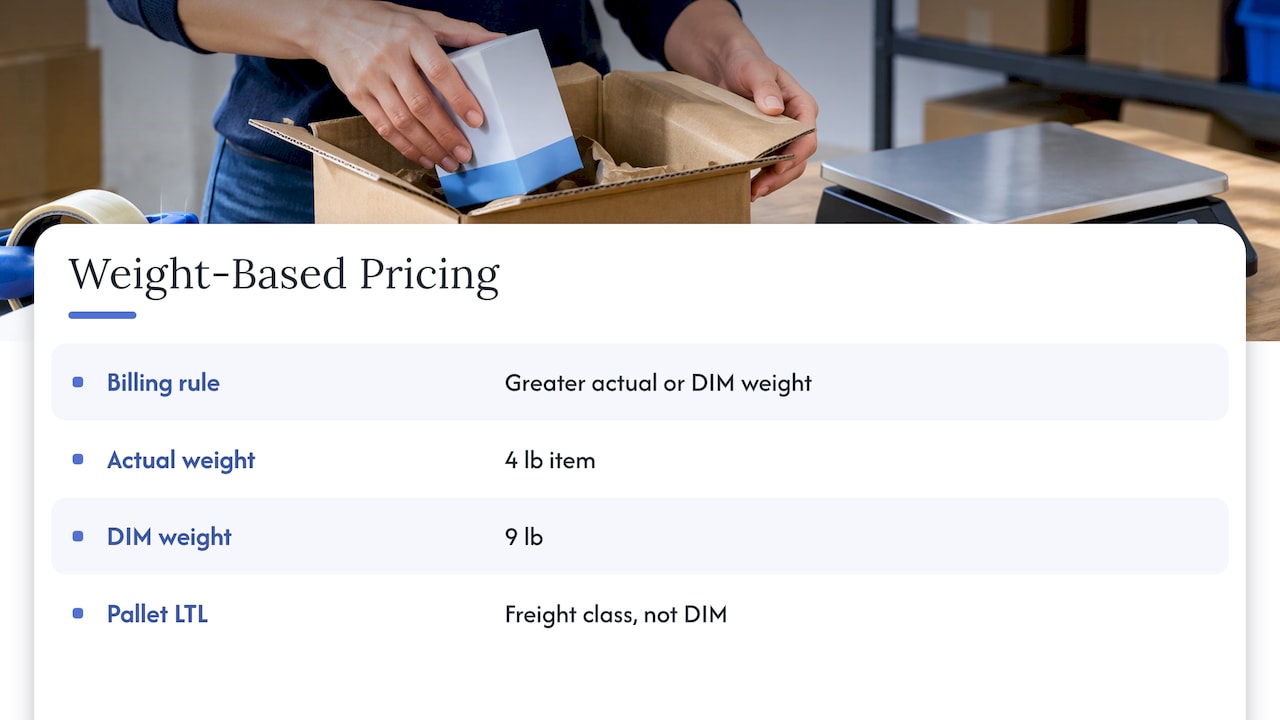
Major U.S. parcel carriers bill on the greater of two numbers: the package’s actual weight and its dimensional weight. Dimensional weight (DIM weight) is a weight the carrier calculates from the box’s length, width and height, using a divisor. A light, bulky package is billed as if it were heavier. Zonos documents the same logic in its cartonization rating: the charge uses the greater of the selected box’s dimensional weight or the items’ physical weight.
The consequence is plain. If a 4 lb item ships in a box that bills at 9 lb of dimensional weight, you pay for 9 lb on every shipment. Shave an inch off one dimension and the billed weight can drop a full pound-bracket or more. Carriers also revise divisors and thresholds, so check what applies to your accounts. We cover the 2026 change in USPS dimensional weight rules in a separate guide.
Heavy freight works differently. Pallets moving LTL are priced on freight class, not parcel DIM weight, and packing them well is its own discipline. See our steps to palletize freight so it passes LTL and our freight class guide if your mix includes both parcels and pallets.
Five cartonization strategies that work
1. Right-size to the product, not to a handful of generic boxes
Right-sizing means the carton fits the items with only the protection they need. It reduces corrugated, void fill and DIM weight together. The mistake is to chase the smallest possible box for every order. Fragile goods may need extra protection, and incompatible items, such as liquids next to paper goods, should not share a carton. A good rule set puts protection and compatibility ahead of volume.
2. Build a lean carton library
More box sizes is not better. Every added size costs storage space, purchasing attention and pack-station clutter. A practical approach is to measure your top-selling SKUs, find the order profiles that account for most of your volume, and choose a small set of carton sizes that covers them. Revisit the library a few times a year as your catalog changes.
Storage matters here because cartons take space. A pallet of flattened boxes sits in your warehouse the same way a pallet of product does. At our warehouse, storage is priced at $17-$19 per pallet per month and $5-$6 per bin per month, so every extra size you stock has a visible cost. Our warehouse storage fee benchmarks show how storage costs have moved in 2026.
3. Make the packing decision cost-aware
The smallest box is not always the cheapest shipment. Cost-aware packing compares options using carrier rates, DIM weight, shipping zone, material cost and pack labor. Sometimes two smaller boxes cost less than one large box, because the large one crosses a DIM or size threshold. Sometimes a slightly larger box that needs no void fill saves labor that outweighs the difference in postage.
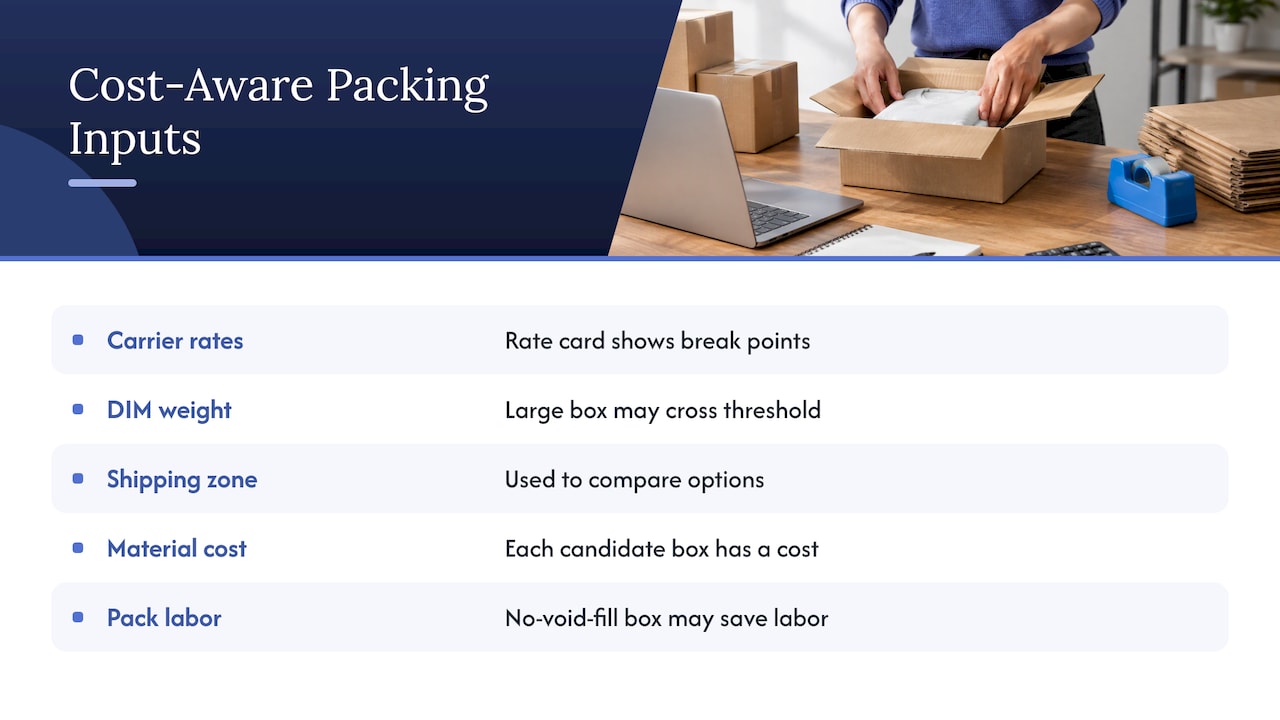
You can run this comparison by hand for a handful of high-volume SKUs. A spreadsheet with your carrier rate card, three candidate boxes, and each box’s material cost will show you where the break points are. For a whole catalog, the comparison needs to be automated.
4. Treat the pack rules as part of the strategy
Cartonization engines and manual rules both rely on item rules. Common ones include:
- Ship alone: items that must travel in their own carton, such as oversized goods or items with special handling.
- Do not combine: items that should never share a box, for example liquids and powders.
- Orientation: “this side up” goods that limit how an item can be rotated in the box.
- Maximum carton weight: the heaviest a packer can lift safely and a carrier will accept.
- Fragility: a minimum level of cushioning or a double-wall carton.
Write these down per SKU group before you pick a tool. A rule that lives only in an experienced packer’s head disappears when that person is on vacation.
5. Match the carton plan to your slotting and picking
Cartonization starts before packing. When you pick items that belong in one box from locations across a warehouse, the pack decision comes late and the packer sees only what arrived. When high-velocity items that ship together are stored near each other, you can pick to the carton plan. Our guides on warehouse slotting strategies and ABC inventory analysis show how to organize the floor so A-items, which drive most of your orders, are quick to pick and pack.
Data to prepare before you start
Cartonization works only as well as the data under it. An engine or a rulebook cannot choose a good box for an item whose size is a guess. SCT Software’s white paper puts it bluntly: reliable item and container master data is the foundation, and without accurate characteristics there is nothing reliable to optimize.
Prepare these records:
| Data | What to record | Why it matters |
|---|---|---|
| SKU dimensions | Length, width, height in one consistent unit | Needed for any three-dimensional fit |
| SKU weight | Actual weight in one consistent unit | Compared against DIM weight for billing |
| Item rules | Ship alone, do not combine, fragile, orientation | Prevents damage and bad combinations |
| Carton list | Inside dimensions, maximum weight, material cost, stock on hand | Lets you compare boxes on cost and availability |
| Carrier terms | Divisors, size and weight thresholds, surcharges, rate tables | Turns box choice into a dollar figure |
Two practical points. First, use inside dimensions for cartons and the true packed dimensions for products, including any retail packaging. Second, measure with one set of units. Mixing inches with centimeters or ounces with pounds is a common reason an engine produces nonsense.
You do not need to measure every SKU on day one. Start with your top 50 to 150 SKUs by order volume, which usually covers most shipments, then work down the catalog. If you track batches and inventory records in other systems, the same discipline applies: structured records are the foundation, as in this look at route cards, batches and inventory in MES.
How cartonization runs, step by step
Whether it runs in software or on a laminated rule card, the flow is the same.
- Receive the order. The order lists SKUs and quantities.
- Look up the item data. Each SKU brings its dimensions, weight and rules.
- Isolate special items. Anything marked to ship alone, or that is larger than any carton, is set aside. Zonos describes creating a dynamic carton when an item exceeds the available sizes.
- Test carton options. Items are fitted into candidate cartons, one carton or several.
- Choose the option. The choice is based on fit, rules and, in a cost-aware setup, the shipping cost.
- Instruct the packer. The pack station sees the box and, ideally, how to arrange the items.
- Ship and reconcile. The label’s billed weight is compared with the prediction.
The last step is the one most teams skip, and it is where the strategy gets better. If predicted and billed weights disagree for a SKU, the item data or the carton data is wrong.
In our own work, the receiving, storage, pick and pack steps sit under one roof, which is why this loop is practical to run. If you want to see how a pack process can be piloted and tuned, our two-week pick and pack pilot walks through it.
Manual rules or software?
Not every business needs an engine. A sensible way to decide is to look at four things:
- Volume: a few dozen parcels a day can run on a rule card. Thousands of orders a day cannot.
- SKU variety: a catalog of similar-size products fits a few rules. A catalog with hundreds of different shapes does not.
- DIM exposure: if many of your SKUs sit just over a carrier weight or size break point, small box changes are worth real money.
- Data quality: if your dimensions are thin, attribute-based rules such as “small, medium, fragile” will do better on day one than a three-dimensional engine. Populate the dimensions first, then migrate.
A sound path for most small and mid-sized businesses is this: begin with a measured SKU list and a lean carton library, apply written rules at the pack bench, review carrier invoices weekly, and automate when the manual process becomes the bottleneck. Automation also needs integration with your warehouse system, label printing and carrier rates, and a plan for training packers. Treat that as a project, not a switch.
Measure whether it is working
Set a baseline for four weeks before you change anything. Then track these figures weekly:
- Parcel cost per shipment: carrier spend divided by the number of shipments.
- DIM waste percentage: billed DIM weight minus actual item weight, divided by billed DIM weight.
- Box utilization: item volume divided by the selected carton’s volume.
- Repack rate: the share of orders where the packer overrode the chosen carton or had to switch.
Two more are worth watching. Damage claims per thousand orders tell you whether right-sizing has gone too tight. Pack time per order tells you whether the carton plan slows the bench.
When you pilot a change, run it on a slice of orders with a matched control group, so a seasonal swing in mix does not look like a win. Give the pilot enough weeks to see a full cycle of order types.
A worked example with made-up numbers: you ship 2,000 parcels a month from a rack of 80 SKUs. Your baseline average is $9.40 per parcel. After a pilot that moves your 15 highest-volume SKUs into better-fitting cartons, the pilot group averages $8.90. That is $0.50 per parcel. If the pilot represents 800 parcels a month, the saving is $400 a month. If extending it to all 2,000 parcels yields a similar result, that is $1,000 a month, which you compare against any labor, software or box-inventory cost the change adds. Those numbers are illustrative: your own invoices are the benchmark.
Common mistakes
- Optimizing for volume only. The smallest box may cross a surcharge threshold or leave the product exposed.
- Skipping weekly reconciliation. Without it, bad item data stays bad.
- Too many carton sizes. Each one adds storage and purchasing work.
- No rule for exceptions. Packers need a clear path for oversized, fragile or mixed orders.
- Ignoring returns. Right-sized boxes that cannot be reused for returns can raise reverse-logistics cost for some products.
Where our warehouse fits
If you run fulfillment in-house, the strategies above need space, staff and data discipline. If you would rather hand the work over, we receive, store, pick, pack and ship from a single operation, and we publish our storage and handling rates openly: bins at $5-$6 per month, pallets at $17-$19 per month, and additional services at $37 per hour. Receiving, order processing, additional picks, returns and packaging are priced on our pricing page.
For ecommerce brands, our omnichannel and ecommerce fulfillment service covers storing inventory and shipping orders across all 50 states, backed by real-time tracking. If you want to put your catalog and carton plan in front of us, start from our warehousing and fulfillment solutions.
Sellers who prep for Amazon can pair a carton plan with our FBA prep work. See our FBA prep cost guide for what to expect per unit.
Our view on cartonization
Most of the cartonization problems we see start long before the box. They start with a product record that says 12 x 8 x 4 when the product, in its retail packaging, is 12.5 x 8.5 x 4.5.
Our view is that cartonization belongs inside the fulfillment operation, not next to it. When transportation, warehousing and shipping are integrated on one platform, the dimensions captured at receiving, the bin the item is stored in, the carton chosen at pack and the weight the carrier bills can all be compared. That is how a carton plan improves week after week instead of being set once and forgotten.
We also think the plan should be simple to explain. A lean carton library, clear rules and a few weekly numbers will beat a complicated setup nobody on the floor trusts. Our systems are built around real-time tracking and visibility, so the numbers you review are the ones the operation actually produced.
If you ship parcels and pallets, ask that your partner treat them as one supply chain. A carton choice that saves a dollar on a parcel but breaks a pallet build costs more than it saves.
Akbar
FAQ
What is cartonization in fulfillment?
It is the process of deciding which cartons, and how many, an order should ship in. The decision uses each item’s size and weight, its handling rules and, in advanced setups, carrier rates. The aim is a box that protects the goods and keeps the billed shipping cost low.
Is cartonization only for large warehouses?
No. A small seller can apply it with a measured SKU list, a few carton sizes and a written rule card. Software becomes worthwhile when order volume, SKU variety and dimensional-weight charges make manual decisions slow or inconsistent.
How much can cartonization save?
It depends on your product mix, carriers and current box habits, so there is no fair universal figure. The savings come from lower DIM-weight billing, less corrugated and void fill, and fewer damage claims. Measure your own baseline and compare it with a pilot, using your carrier invoices.
Does the smallest box always cost the least?
Not always. Packing cost depends on carrier rate, DIM weight, zone, material cost and labor. Occasionally two small boxes ship cheaper than one large one, and a slightly larger box with no void fill can save labor. Compare actual costs for your top SKUs.
What data do I need first?
Start with length, width, height and weight for your best-selling SKUs, plus inside dimensions and maximum weights for your cartons. Add item rules such as fragile or ship alone, and your carrier terms. Accurate data matters more than the tool you choose.
Sources
- Thinking Inside of the Box: cartonization logic (SCT Software white paper)
- Shipping Cost Optimization with Cartonization (Zonos Docs)
- MES for Machine Shops: Route Cards, Batches, Inventory