
Cargo Insurance for Truckers and Freight Operators: 2026 Guide
Cargo insurance pays the declared value of goods lost or damaged in transit when carrier legal liability falls short of your actual commercial loss. That gap is wider than most operators expect. Under the Carmack Amendment, released-value rates as low as $0.50 per pound are common on domestic shipments. Under COGSA, ocean carriers cap liability at $500 per package or container. Neither figure comes close to the commercial value of a full truckload of electronics, pharmaceuticals, or finished goods.
Who needs to act now:
- Owner-operators and for-hire carriers moving goods for customers typically need motor truck cargo (MTC) coverage, and many shipper contracts require it.
- Freight brokers need contingent cargo coverage, though it is not a substitute for primary carrier coverage.
- Shippers and importers moving high-value or temperature-sensitive freight need their own cargo policy, especially under FOB or EXW Incoterms where the carrier’s liability is limited.
Three immediate next steps:
- Check your maximum per-load value against your current policy limit.
- Request a certificate of insurance (COI) from your insurer and verify the additional insured wording matches your customer’s contract.
- Match your policy’s coverage period and Incoterms clause to the bill of lading before the load moves.
The Institute Cargo Clauses (ICC) A, B, and C are the standard framework for marine cargo policies worldwide. For domestic trucking, the MTC form is the relevant product. Both are explained below.
Pro Tip: If a shipper hands you a contract requiring $250,000 in cargo coverage and your MTC policy tops out at $100,000, you are personally exposed for the difference. Read the limit line before you sign.
Key Takeaways
Cargo insurance fills the gap between what carrier liability statutes pay and what your goods are actually worth — and getting that gap right requires matching your policy form, limits, and Incoterms to your actual commercial exposure.
| Point | Details |
|---|---|
| Match limits to max load value | Your policy limit must cover the worst-case single shipment, not the average. |
| Choose all-risk for high-value goods | ICC A or an all-risk MTC endorsement covers perils that named-perils forms exclude. |
| Annual beats per-shipment at volume | Operators hauling consistently typically pay less per load on an annual open policy. |
| Document COIs and endorsements | Verify additional insured wording and sub-limits before every load, not after a loss. |
| Keep required logs current | Seal logs, temperature records, and GPS data are the difference between a paid claim and a denied one. |
Table of Contents
- What is cargo insurance and how does it actually work?
- Who actually needs cargo insurance — and which type?
- The main types of cargo coverage and who buys each
- What cargo insurance covers — and what it doesn’t
- How cargo insurance is priced — and what a $100K policy actually costs
- Cargo insurance vs. carrier liability: why the gap matters
- How to buy cargo insurance and what documents you’ll need
- Filing a claim: what to do in the first 24 hours
- Insurable interest, Incoterms, and who is contractually required to insure
- The gap nobody talks about clearly enough
- Work with a logistics partner who understands your exposure
- Sources
What is cargo insurance and how does it actually work?
Cargo insurance is a property insurance product that indemnifies the insured for physical loss or damage to goods while in transit, from origin warehouse to destination warehouse. Unlike carrier liability, which is a legal obligation imposed by statute, cargo insurance is a voluntary contract between the insured and an underwriter. The insured declares the value of the goods, pays a premium, and the insurer agrees to pay that declared value (or actual loss up to that value) if a covered peril causes damage or loss.
Most cargo policies are written as valued policies rather than pure indemnity policies. This matters because it removes the argument over market value at destination after a loss.
Insurable interest is the legal foundation of any valid claim. The claimant must have a financial stake in the goods at the moment of loss. Incoterms play a direct role here: under CIF or CIP terms, the seller is contractually obligated to arrange insurance for the buyer’s benefit during the main carriage leg. Under FOB, EXW, or DAP, insurance is a commercial decision, not a contractual requirement, so the buyer typically needs to arrange their own coverage. The IUMI Guide to Marine Cargo Insurance covers insurable interest and Incoterms alignment in detail.
All-risk vs. named perils at a glance:
- All-risk (ICC A / open perils): Covers all physical loss or damage except specifically excluded causes. The broadest form and the one most underwriters recommend for high-value or fragile goods.
- Named perils (ICC B / ICC C): Covers only the perils listed in the policy (fire, stranding, collision, general average, etc.). Lower premium, narrower protection.
Pro Tip: “All-risk” does not mean all losses are covered. It means all perils are covered unless excluded. Read the exclusions page before assuming a mysterious disappearance or temperature deviation is included.
Who actually needs cargo insurance — and which type?
The answer depends on your role in the transaction and what you stand to lose.
Owner-operators and asset-based carriers need motor truck cargo insurance. Most shipper contracts and broker agreements require it as a condition of dispatch. Without it, your only protection is your Carmack liability, which is often released-value rated and far below the load’s commercial value.

For-hire carriers running high-value lanes (electronics, pharmaceuticals, alcohol, tobacco) face the highest exposure. A single theft event on a $500,000 load can exceed annual revenue for a small fleet. MTC coverage with appropriate per-load limits is not optional in these lanes.
Freight brokers need contingent cargo coverage. But contingent cargo is exactly what the name implies: it only pays when the underlying carrier’s policy fails, whether through carrier insolvency, a denial for fraud or material misrepresentation, or exhausted limits. DAT’s cargo liability product illustrates how these products are positioned to cover legal liability while the carrier’s own cargo policy covers the goods. A broker who relies on contingent cargo as primary protection is one carrier insolvency away from an uncovered claim.
Shippers and importers moving goods on third-party carriers should carry their own cargo policy regardless of the carrier’s MTC limits. Carrier liability is capped by statute. Your cargo policy covers your commercial interest directly.
Common contractual triggers that force the issue:
- Shipper contracts specifying minimum cargo coverage limits and requiring COIs on file before dispatch.
- Broker agreements requiring carriers to name the broker as additional insured.
- Letters of credit and trade finance documents requiring evidence of insurance for CIF/CIP shipments.
- Warehouse agreements requiring bailees to carry warehouse legal liability coverage.
Pro Tip: A broker who books a load without verifying the carrier’s MTC limit against the load value is exposed if the carrier’s policy has a $100,000 limit and the load is worth $300,000. Contingent cargo will not fill that gap reliably.
The main types of cargo coverage and who buys each
Different operations need different policy forms. Here is how the primary product types map to buyer profiles.
| Coverage Form | Who Buys It | Coverage Scope | Typical Use Case |
|---|---|---|---|
| Motor Truck Cargo (MTC) | Asset carriers, owner-operators | Physical loss/damage to cargo in the carrier’s custody | Domestic trucking, required by shippers |
| Contingent Cargo | Freight brokers | Pays when carrier’s policy fails | Broker protection against carrier policy gaps |
| Inland Marine (Open Cargo) | Shippers, importers | All-risk or named perils, warehouse-to-warehouse | Domestic multimodal shipments |
| Ocean Marine Cargo | Importers, exporters | ICC A/B/C, port-to-port or warehouse-to-warehouse | International ocean and air freight |
| Warehouse Legal Liability | Warehouse operators, 3PLs | Legal liability for goods in bailee’s custody | Storage operations, 3PL providers |
| Stock Throughput | Large shippers, manufacturers | Single policy covering manufacturing, transit, and storage | High-volume supply chains |
Stock throughput vs. stacked policies: A stock throughput policy wraps manufacturing, storage, and transit under one form with one set of terms, one deductible, and one insurer. Stacked policies (separate marine, inland marine, and warehouse forms) give more flexibility but create coverage gaps at handoff points and require careful coordination. For most small and mid-size operators, stacked policies are the practical reality. Stock throughput becomes worth the complexity when annual shipment values are large enough to justify the underwriting relationship.
Key distinctions to keep in mind:
- MTC covers the carrier’s legal liability AND the cargo value up to the policy limit, depending on the form. Some MTC forms are legal liability only; others are broader.
- Ocean marine policies written on ICC A terms are the closest equivalent to all-risk for international shipments.
- Warehouse legal liability does not cover the full value of goods stored. It covers the warehouse operator’s legal liability for loss or damage, which is typically limited by the storage contract.
What cargo insurance covers — and what it doesn’t
Most cargo policies cover physical loss or damage to goods in transit caused by a covered peril, subject to the policy’s exclusions, sub-limits, and warranties. The perimeter of coverage sounds broad until you read the exclusions.
Commonly covered perils (all-risk form):
- Collision, overturning, or derailment of the carrying vehicle
- Fire, explosion, lightning
- Theft (with conditions — see below)
- Water damage from flooding or storm
- General average contributions (ocean)
- Loading and unloading accidents
Common exclusions that catch operators off guard:
- Mysterious disappearance: Shortage discovered at delivery with no evidence of theft or accident. Many MTC and inland marine policies exclude this entirely.
- Unattended vehicle: Theft from a truck left unattended (especially overnight) is often excluded or sub-limited unless the vehicle was locked in a secured facility.
- Temperature deviation: Reefer cargo losses from mechanical breakdown of the refrigeration unit may be excluded unless a specific reefer breakdown endorsement is added.
- Inherent vice: Damage caused by the nature of the goods themselves (fruit ripening, metal rusting) is almost universally excluded.
- Improper packing: Damage resulting from inadequate packing by the shipper is excluded under most forms.
- Delay: Loss of market, consequential loss, or loss caused purely by delay is excluded under virtually all cargo policies.
Sub-limits and warranties to check:
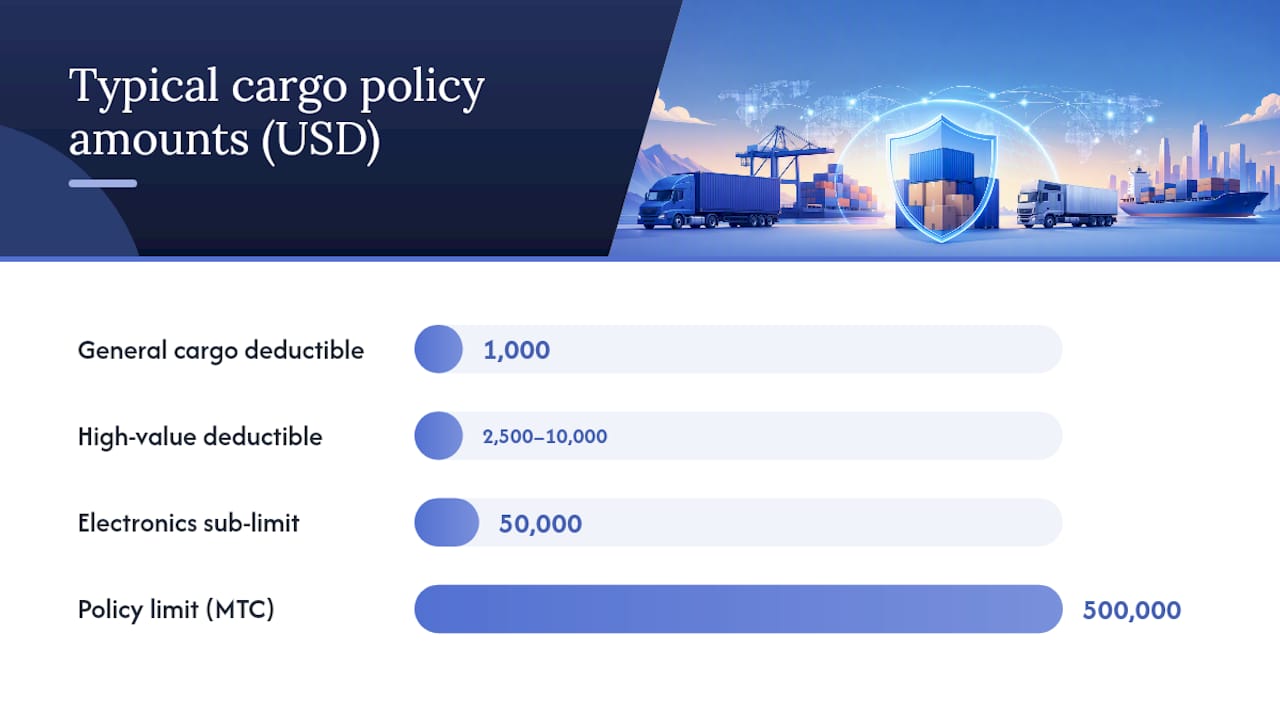
High-theft commodities (electronics, tobacco, alcohol, pharmaceuticals) often carry sub-limits well below the policy’s overall limit. A $500,000 MTC policy might have a $50,000 sub-limit for electronics. Reefer policies commonly require a temperature logger warranty: if you cannot produce continuous temperature records, the insurer can deny the claim. Parking warranties (requiring the vehicle to be parked in a secured, fenced, lit facility overnight) are standard on high-value cargo endorsements.
Statistic callout: Typical 2026 deductibles run $1,000 per shipment for general cargo and $2,500–$10,000 for high-value commodities. Stock-throughput policies carry higher minimums.
Pro Tip: Before binding coverage, ask your broker to walk through the theft exclusion wording line by line. “Theft” and “mysterious disappearance” are treated differently in almost every policy form, and the distinction determines whether a short-shipped load gets paid.
How cargo insurance is priced — and what a $100K policy actually costs
According to Logrock’s 2026 data, many owner-operators with $100,000 MTC limits pay roughly $500–$2,000 per truck per year. Higher-risk operations, including those hauling electronics, pharmaceuticals, or alcohol, can pay $2,000–$8,000 or more per truck annually.
Primary underwriting factors:
- Commodity: Electronics and pharmaceuticals rate higher than building materials or agricultural goods.
- Maximum per-load value: The single biggest driver of MTC premium.
- Lanes and radius: Long-haul interstate lanes and international routes carry more exposure than regional short-haul.
- Security controls: GPS tracking, geofencing, sealed trailers, and secured parking facilities all reduce premium.
- Loss runs: Three to five years of loss history is standard. A clean record earns credits; frequent small claims raise rates.
- Deductible: Raising the per-shipment deductible from $1,000 to $2,500 typically produces a meaningful premium reduction, though the exact savings vary by insurer and commodity.
Sample per-shipment calculation:
Run 50 such shipments per year and the annual cost is $12,000. An annual open cargo policy for the same volume might price lower per shipment once the underwriter sees consistent volume and a clean loss history.
Annual vs. per-shipment decision:
Per-shipment coverage is easy to budget and requires no annual commitment, but minimum premiums and per-transaction fees add up quickly. Annual policies tend to cost less per load when you haul consistently. The break-even point is roughly when your monthly shipment count times average declared value times the per-shipment rate exceeds the annual policy premium. Most operators hauling more than 10–15 loads per month cross that threshold.
Pro Tip: Tightening your commodity list, raising your deductible, and moving from a forwarder’s retail cover to a direct marine open policy are the three fastest ways to reduce premium without reducing coverage scope. A specialist cargo broker can run the comparison in an afternoon.
Cargo insurance vs. carrier liability: why the gap matters
Cargo insurance and carrier liability are not the same product and do not protect the same interest. Confusing them is the most expensive mistake shippers and operators make.
Cargo insurance indemnifies the insured’s declared value of the goods. It is a first-party property product. The insured files a claim with their own insurer and gets paid up to the declared value, subject to the deductible and exclusions.
Carrier liability is a legal obligation imposed by statute. The carrier is liable for loss or damage caused by its own negligence, but that liability is capped.
The practical consequence: a 40,000-pound truckload of consumer goods at a released value of $0.50 per pound gives the shipper a maximum Carmack recovery of $20,000. If the load is worth $400,000, the shipper absorbs a $380,000 loss without cargo insurance.
Released-value language on the bill of lading matters. When a carrier quotes a lower freight rate in exchange for a released-value limitation, that language in the BOL is legally binding. Shippers who sign without reading it have waived their right to full Carmack recovery. Carrier liability caps under COGSA and the Carmack Amendment are typically far below commercial cargo value, which is precisely why cargo insurance exists as a separate product.
Pro Tip: Never assume the carrier’s MTC policy covers your commercial loss. Ask for the policy limit, the per-load sub-limits, and the exclusions list before the load moves. Then decide whether to buy your own coverage on top.
How to buy cargo insurance and what documents you’ll need
Getting an accurate quote requires specific information. Underwriters cannot price a policy on vague descriptions. Insurers expect a commodity list, maximum value per load, lanes or radius, desired limits and deductible, security controls, and loss runs before they will issue terms.
Information to prepare before requesting a quote:
- Complete commodity list with descriptions (avoid “general freight” — underwriters will rate it at the worst commodity in the class).
- Maximum value per load (not average — the worst-case single shipment).
- Primary lanes or radius of operation (domestic, cross-border, international ports).
- Desired policy limit and per-shipment deductible.
- Security controls: GPS tracking, geofencing, sealed trailers, parking protocols.
- Three to five years of loss runs from your current insurer.
- Annual revenue or total annual shipment value (for open cargo / annual policies).
Certificate of insurance basics:
A COI is a one-page summary of your policy’s key terms. When a shipper or broker asks for a COI, check that it shows the correct policy period, the right coverage limits, and the additional insured wording the contract requires. An additional insured endorsement gives the named party direct rights under your policy. A certificate holder has no such rights — they only receive notice of cancellation. Many shipper contracts require additional insured status, not just certificate holder status. Know the difference before you sign.
Named insured vs. additional insured:
The named insured is the primary policyholder. Additional insureds are parties added by endorsement who have coverage rights under the policy. Brokers should require carriers to add them as additional insureds on the carrier’s MTC policy, not just list them as certificate holders.
Pro Tip: When presenting your operation to an underwriter, lead with your security controls and loss history, not just your commodity and value. A clean five-year loss run and documented GPS tracking on every truck can move you into a preferred pricing tier.
Filing a claim: what to do in the first 24 hours
The first three actions after a cargo loss determine whether the claim pays cleanly or drags into a dispute.
- Secure the scene. Do not move damaged cargo until it is photographed and documented. If the load was stolen, file a police report immediately.
- Document everything. Photograph the cargo, the trailer, the seals, and any damage to the vehicle. Note the seal numbers and whether they match the BOL.
- Notify your insurer and the carrier in writing. Most policies require prompt notice of loss. Late notice is one of the most common grounds for claim denial or reduction.
Documentation required for most cargo claims:
- Original bill of lading and any amendments
- Commercial invoice showing declared value
- Packing list
- Photographs of damage (cargo, packaging, vehicle, seals)
- Seal log showing seal numbers at origin and destination
- GPS or telematics records for the relevant time period
- Temperature logs for reefer shipments (continuous records, not spot checks)
- Police report (theft claims)
- Carrier’s inspection report or exception notation on delivery receipt
Common pitfalls that reduce or void claims:
- Signing a clean delivery receipt when damage is visible. Always note exceptions on the delivery receipt before signing.
- Altered or missing seal logs. Insurers treat missing seal records as evidence of potential fraud.
- Late notice. Most policies require notice “as soon as practicable” after discovery of loss. Waiting weeks is a problem.
- Disposing of damaged cargo before the insurer’s surveyor inspects it. Always get written authorization before disposing of damaged goods.
Timeline expectations: Small claims (under $25,000) with clean documentation typically resolve in 30–60 days. Large or complex losses involving surveyors, subrogation, or disputed liability can take six months or longer. Reefer claims with temperature disputes often fall in the middle range.
Pro Tip: For large losses, request an independent marine surveyor immediately. The surveyor’s report is the factual foundation of your claim. An insurer-appointed surveyor serves the insurer’s interest; an independent one serves yours.
Insurable interest, Incoterms, and who is contractually required to insure
Insurable interest is not a technicality. It is the legal requirement that determines whether a claim is valid. The IUMI Guide to Marine Cargo Insurance is clear: the claimant must have a financial interest in the goods at the time of loss. A seller who has already transferred title and risk to the buyer cannot claim under a cargo policy for a loss that occurred after that transfer.
Incoterms determine when risk transfers and, in two specific cases, who is contractually required to arrange insurance:
- CIF (Cost, Insurance, Freight): The seller must arrange and pay for marine cargo insurance for the buyer’s benefit during the main carriage leg. Minimum coverage under CIF is ICC C (named perils), though buyers should negotiate ICC A in the sales contract.
- CIP (Carriage and Insurance Paid To): Similar obligation, but the minimum required coverage under Incoterms 2020 is ICC A (all-risk), a meaningful upgrade from CIF.
- FOB, EXW, DAP, DDP: No contractual insurance obligation on either party. The buyer typically arranges coverage from the point of risk transfer, but nothing in the Incoterm requires it.
Practical contract clauses to include:
- Specify the coverage form required (ICC A, not just “marine cargo insurance”).
- State the minimum insured value (CIF + 10% is the market standard).
- Require the seller to provide a COI or insurance certificate before shipment.
- Include a clause requiring the insurer to be rated A- or better by AM Best.
Incoterms and risk transfer summary:
| Incoterm | Risk Transfers To Buyer | Seller Insurance Obligation |
|---|---|---|
| EXW | At seller’s premises | None |
| FOB | When goods cross ship’s rail | None |
| CIF | At port of shipment | Yes — minimum ICC C |
| CIP | At named place of destination | Yes — minimum ICC A |
| DAP / DDP | At named destination | None |
For long-distance moves or household goods shipments, the same principle applies: the party bearing risk at the time of loss is the one who needs coverage in place.
Pro Tip: If you are a U.S. importer buying on FOB terms, your cargo is uninsured from the moment it crosses the ship’s rail at the foreign port until you arrange your own policy. That is the most common coverage gap in international trade. Fix it by buying an open cargo policy that attaches at the point of risk transfer.
The gap nobody talks about clearly enough
Most articles about cargo insurance spend their energy explaining what it is. The more useful question is why so many operators still get burned despite knowing it exists.
The answer is almost always one of three things: a policy limit that was set years ago and never updated, a contingent cargo policy that a broker mistook for primary coverage, or a claim that got denied because the seal log was missing.
The Carmack Amendment and COGSA caps are not obscure legal footnotes. They are the operating reality of every load that moves in the U.S. and across its borders. A carrier’s MTC policy protects the carrier’s legal liability exposure. It does not automatically protect the shipper’s commercial interest. Those are two different financial interests, and they require two different policies.
The Incoterms piece is where international shippers consistently underestimate their exposure. Buying on FOB terms and assuming the seller’s insurance covers the ocean leg is a mistake that costs importers real money every year. The risk transfers at the ship’s rail. If you do not have a policy in place from that point forward, you are self-insuring whether you intended to or not.
One more thing worth saying plainly: contingent cargo is not a backup plan. It is a last resort that pays only when the carrier’s policy fails entirely. A broker who treats contingent cargo as their primary risk management tool is one bad carrier away from absorbing a six-figure loss out of pocket.
The practical fix is not complicated. Get an annual open cargo policy if you move consistent volume. Set the limit at your worst-case per-load value, not your average. Add the reefer breakdown endorsement if you haul temperature-sensitive goods. Keep your seal logs and temperature records current. And read the exclusions before you bind, not after you file.
Work with a logistics partner who understands your exposure
Cargo insurance is only part of the risk picture. How your freight is handled, documented, and tracked from origin to destination determines whether a claim pays cleanly or becomes a dispute. Usiship’s logistics and transportation services are built around real-time tracking, documented chain of custody, and the kind of operational discipline that underwriters reward with better rates.
Whether you need customs clearance support for international shipments or a domestic freight solution with full documentation, Usiship works with shippers and carriers across all 50 states to keep freight moving and claims rare.
Sources
These sources are worth bookmarking if you are buying, reviewing, or disputing a cargo policy.
- Warehousingcosts
- Guide to Marine Cargo Insurance — IUMI
- Cargo Insurance Cost (2026): Rates, % of Shipment Value, and How to Estimate Yours – Logrock
- Cargo Insurance Cost, Coverage & Pricing Guide
- Cargo Liability Insurance