
Cargo Damage Prevention: A Practical Guide for U.S. Shippers
You prevent cargo damage by controlling four things before the truck or container leaves: the carton, the pallet, the way the load is blocked and braced, and the paperwork that proves what condition the freight was in. Most damage is not caused by one dramatic accident. It builds up from ordinary braking, vibration, stacking and handling that weak packaging cannot absorb. This guide walks through each control in the order you would apply it, then covers what to do if a shipment still arrives damaged.
TL;DR
- Freight damage comes from stacked forces: top load, shock, vibration, sideways force and humidity acting together. Pack for the whole trip, not for the dock.
- Keep cartons inside the pallet edge, use new and well-constructed boxes, fill voids and cushion fragile items.
- Block and brace every load, with the most restraint toward the front of the trailer, and load heavy goods below light ones.
- Note any visible damage on the delivery receipt before signing, and photograph it.
- Fewer handoffs mean fewer chances for damage, so choose carriers and warehouse partners with that in mind.
Table of Contents
- Why freight gets damaged in the first place
- Start with the carton and the interior packaging
- Build the pallet so it survives LTL
- Block, brace and load for the forces on the road
- Protect against water, humidity and contamination
- Cut the number of handoffs
- Perspective: damage prevention is a systems job
- How Usiship helps prevent damage
- When damage happens anyway: document it
- FAQ
- Sources
Why freight gets damaged in the first place
It helps to know what a shipment actually lives through. The National Motor Freight Traffic Association (NMFTA) documents that in the LTL environment horizontal forces regularly exceed half the force of gravity. A 100-pound package takes about 50 pounds of lateral force on every turn and stop. Vibration also wears packaging down cumulatively, so a box can look fine and then fail under a load it would otherwise have survived.
The same NMFTA material makes the point that matters most: damage usually starts where several forces add up. A top load the box carries at the dock is multiplied by shock, cycled by vibration, pushed off center by sideways force, and borne by corrugated that humidity has already weakened. Shippers tend to test for one of these at a time. The freight experiences all of them at once.
How common is it?
One claims-focused source estimates that truckload shipments typically see 0.5% to 2% damage rates, while LTL shipments run 2% to 5% because freight passes through several touchpoints in hub-and-spoke networks. Industry estimates put annual freight damage and loss claims across U.S. logistics at $2 billion to $3 billion. In food, beverage and consumer products, shipping damage averages about half a percent of gross sales, roughly $1 billion a year according to figures from industry associations cited by Lantech.
The lesson for a small or mid-sized shipper is simple. Even a low percentage is real money once you add replacement product, reshipping, customer credits and the time spent on claims.
The main types of damage
For containerized freight, damage generally falls into physical, wet, contamination, reefer-related and infestation damage. Travelers reports that physical and wetting damage account for over 56% of its ocean cargo claims. Water gets in through holes, damaged gaskets or corrosion in containers, bad weather, poor ventilation, and condensation, sometimes called container rain. Contamination happens when cargo sits next to incompatible goods, the space was not cleaned, or goods were stored badly before shipping.
On the road, physical damage mostly traces back to poor stowage: too little dunnage or lashing, uneven weight distribution, or heavy crates piled on lighter pallets.
Start with the carton and the interior packaging
Packaging is a small share of supply chain spend, so it is easy to treat as an afterthought. It is the cheapest place to prevent damage.
Use new, well-constructed boxes. Chubb’s cargo guidance recommends new interior and exterior packaging, with cartons rated for a bursting strength of at least 200 pounds per square inch or an equivalent Edge Crush Test value. Reused boxes have already lost some of their compression strength.
Match the interior packaging to the job. The IOPP guide to packaging freight shipments lists the roles of interior materials: cushioning against shock and vibration, bracing contents in position, filling voids, protecting surfaces from abrasion, and guarding against corrosion, static and temperature extremes. A box with empty space inside is a box whose contents will move.

Separate fragile items. Use dividers or partitions so fragile pieces never touch each other.
Test what is fragile. Chubb suggests package-testing fragile products for compression, impact, drops, and shock and vibration under ISTA or ASTM standards. A test costs far less than a pattern of damaged orders.
Consider shock and tip indicators. For products vulnerable to rough handling, Chubb recommends indicators on both the inside and outside of the package, placed on a rigid surface near an upper corner, one vertical and one horizontal. For high-value equipment, triaxial accelerometers can record shock and vibration events from every direction. These do not stop damage by themselves. They tell you where in the chain it happened, which feeds the improvements below.
If your products are awkward, heavy or high value, our specialty freight packing services exist for those cases, where standard cartons and shrink wrap are not enough.
Build the pallet so it survives LTL
A good carton on a bad pallet still fails. NMFTA’s Packaging 101 guidance notes that boxes overhanging the pallet edge lose as much as one third of their strength, and that bottom-loaded freight pallets can weigh up to 5,000 pounds, so packaging has to withstand serious crush forces.
A short pallet checklist:
- Keep every carton inside the pallet footprint, with no overhang.
- Interlock layers where the carton shape allows, and keep corners aligned so load travels down the box walls.
- Put heavy items at the bottom and light items on top.
- Use pallets in good condition that can carry the weight. Broken boards and weak stringers fail under load.
- Stretch wrap or strap the unit so it moves as one block, and cap it so the top layer cannot slide.
- Label clearly, with consistent labels on more than one side.
LTL adds a further issue. Your pallet is loaded alongside freight you know nothing about. A packaging researcher quoted in a RIT Journal of Applied Packaging Research paper stresses that each package’s strength matters not only to protect its own product but also to allow loading with other freight in a mixed load, where carriers cannot control what else leaves the terminal. Build your pallet as if something heavy will be pushed against it.
For a step-by-step method, see our guide to palletizing freight for LTL. Warehouse teams should also review our pallet stacking checks, and make sure your declared freight class matches the pallet you actually ship, since a rebuilt or re-measured pallet affects both damage risk and billing.
Block, brace and load for the forces on the road
Stacking is not securing. Even in a full trailer, freight needs restraint so it cannot slide or tip in any direction.
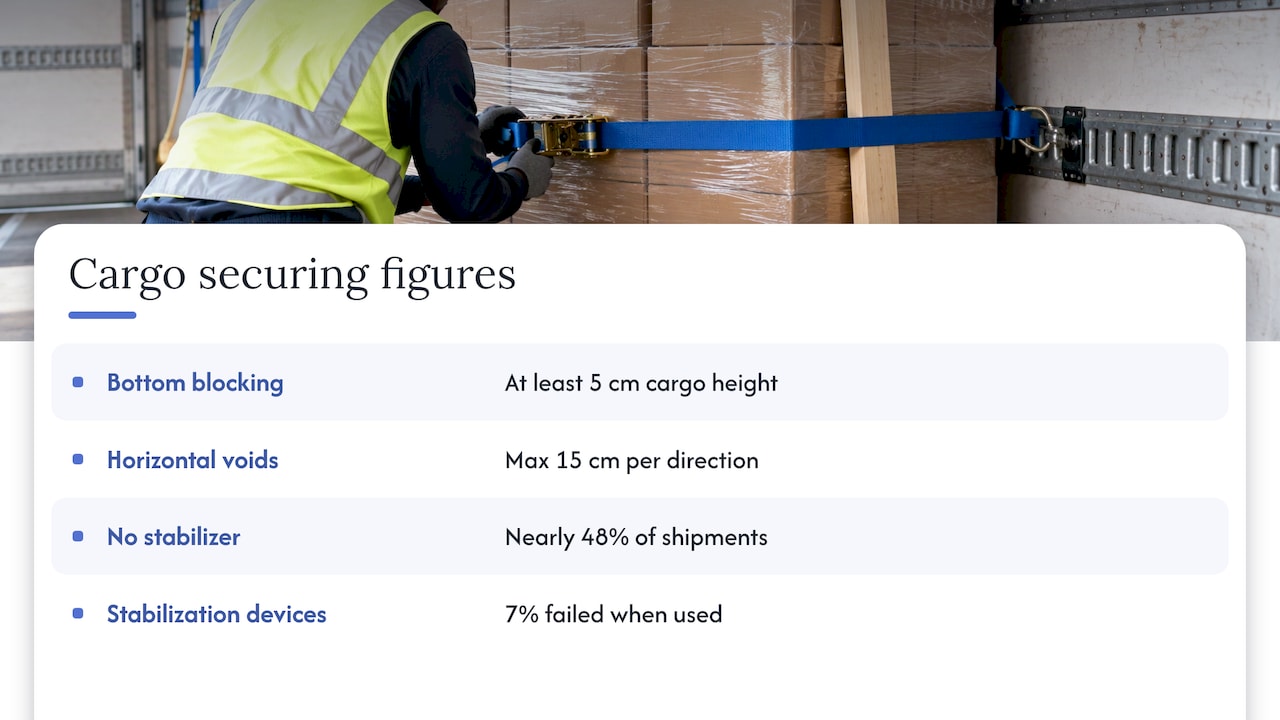
The Outokumpu Cargo Securing Handbook, a primary industrial source, states that cargo must be secured against sliding and tipping, that blocking is the primary method, that bottom blocking should cover at least 5 cm of cargo height, and that void spaces in any horizontal direction should not add up to more than 15 cm. It also explains that braking produces the greatest forces in road transport, so forward restraint matters most. Stow cargo tightly against the headboard, stanchions or other cargo. Note that this handbook comes from a European producer, so check which standards apply to your own domestic lanes.
The gap between knowing this and doing it is large. A 2006 study presented at the International Safe Transit Association conference found that nearly 48% of grocery and food distribution shipments had no stabilization device in the trailer, and another 7% of the devices failed when used.
Loading rules that prevent most shifting
The CPC Shipper’s Guide to Loading gives a set of practical rules:
- Stay within the unit’s load limits and meet both federal and local weight restrictions.
- Spread weight evenly across the container floor or over the vehicle’s axles.
- Load all cargo tightly so it cannot shift.
- Put lighter cargo on top of heavier cargo.
- Use strong dunnage, such as bulkheads across a container for rail movement.
For securing tools, shippers and carriers commonly use air bags, stretch wrap, tape, wooden blocks, straps, retaining bars and dunnage. Choose the method for the freight: air bags for voids between pallets, straps and bars for heavy, rigid items.
Who is responsible for the load?
The Federal Motor Carrier Safety Regulations require loads to be safely secured. Responsibility generally sits with the carrier, unless the shipper loads and seals the trailer before the carrier is authorized to move it. For ocean containers, Travelers says the shipper is responsible for ensuring cargo is secured against rolling, pitching, vibration and severe weather, and that doing so takes training and experience and generally has to follow international maritime requirements. If you load your own containers, that is where trained loaders or a partner who does the loading for you earn their keep.
Protect against water, humidity and contamination
Moisture damage is quiet. Humidity weakens corrugated before the trip even starts, and condensation can form inside a sealed container as temperatures swing.
- Store cartons and pallets in a dry, clean area before shipping, away from incompatible goods.
- Inspect the container or trailer before loading: floor, walls, roof, door gaskets and any holes or rust.
- Keep desiccants and moisture barriers in mind for goods that corrode or absorb water.
- For temperature-sensitive goods, confirm the correct settings on reefer equipment and keep records.
- Label hazardous cargo correctly. Incorrect hazard labeling is a recognized cause of container problems.
These steps cost little compared with a wet-damage claim. Our warehousing and fulfillment solutions include storage, which matters if goods wait before they ship.
Cut the number of handoffs
Every transfer is another chance for a forklift, a dropped carton or a compromised stack. Chubb’s advice is to choose reliable transportation partners with suitable equipment, avoid transfers when practical, and inspect conveyances and securing devices before loading.
Some practical ways to reduce touches:
- Ship full truckload when volume justifies it, since LTL involves more handling.
- Use direct lanes instead of multiple terminals where the cost works.
- When freight must move from one mode or container to another, do it in a controlled facility. Our guide to transloading explains how that handoff can be planned.
- Keep import paperwork clean. A held container sits longer and gets moved more. A correct packing list helps avoid holds.
Perspective: damage prevention is a systems job
We see cargo damage as a handoff problem more than a carton problem. A box can be perfectly good and still be crushed because the pallet was off center, the trailer was loaded without restraint, and the freight changed hands three times between origin and delivery.
That is why we built our service around keeping transportation, warehousing and shipping in one connected flow. When the same team that receives, stores, picks and packs your goods is also coordinating the freight movement, there are fewer gaps where responsibility is unclear and fewer places for packaging mistakes to hide.
Our advice to shippers is to decide on packaging and palletizing standards once, write them down, and apply them every time. Standards that live in someone’s head break the first time a busy shift changes. A consistent pallet build, a consistent label and a consistent loading method make damage rarer and make the cause obvious when it does happen.
Real-time tracking and one point of contact help here too, because you can see where a shipment is while it is moving and raise a problem while it can still be fixed.
Akbar
How Usiship helps prevent damage
We are a U.S. logistics provider covering freight forwarding by air, ocean and land, FTL and LTL, warehousing, fulfillment, cross-docking, transloading and specialty freight packing. For shippers who want fewer handoffs, that means one team can handle storage, preparation and movement.
Our published warehouse storage rates are $5-$6 per month per bin and $17-$19 per month per pallet, and additional services are $37 per hour. See the pricing page for the full list of fulfillment components. To talk through a freight lane or a packaging problem, start with our freight forwarding services.
If you are comparing options, our 3PL fulfillment services page explains how storage, picking and packing fit together for ecommerce and retail shippers.
When damage happens anyway: document it
No process removes every risk, and what you do at delivery decides whether you can recover the loss.
- Inspect right away. Chubb recommends an immediate inspection of all cargo to identify damage and mitigate the loss.
- Note it on the paperwork. Record visible damage on the bill of lading or delivery receipt before signing. One claims source reports that damage noted on the delivery receipt carries significantly higher approval rates, and that a missing damage notation is one of the top three denial triggers, at 15% to 18% of denials.
- Photograph everything. Capture the outer packaging, the interior, the pallet, the trailer or container and the labels.
- Keep the packaging. Do not discard cartons or dunnage until the claim is settled.
- Review the incident. Chubb advises looking at the nature, cause and extent of the damage and sending feedback on packaging, handling or transportation to everyone concerned so corrections follow.
Carrier liability in brief
Under the Carmack Amendment (49 U.S.C. § 14706), motor carriers are by default liable for actual loss or injury to property they cause. Liability can be limited to a value set by the shipper’s written or electronic declaration or by written agreement, if that value is reasonable, as the Fourth Circuit explained in a published opinion. The statute exists to protect shippers from carriers avoiding liability and to spare cargo owners from hunting for the one negligent carrier among many on an interstate move. Declared value therefore matters at booking, not after the loss. For deadlines and the filing process, read our freight claims playbook.
FAQ
How do you minimize cargo damage?
Use new, well-constructed packaging, test fragile products, build pallets without overhang, and block and brace every load. Choose carriers with suitable equipment, avoid unnecessary transfers and inspect equipment before loading. Then document any damage at delivery and review each incident to improve.
What is the most common cause of freight damage?
Poor packaging and poor stowage lead the lists: inadequate cartons, voids, uneven weight distribution and insufficient securing. In LTL, damage often comes from several forces combined, such as stacking weight, vibration, shock and humidity-weakened corrugated.
Who is responsible when freight is damaged in transit?
For motor carriers, the Carmack Amendment makes the carrier liable by default for damage it causes, though liability can be limited by a reasonable declared value or written agreement. If the shipper loads and seals the trailer, responsibility for securing the load can shift toward the shipper.
Do shock and tip indicators prevent damage?
They do not stop handling forces, but they show whether a package was tipped or hit hard, which helps you find where in the chain the problem occurred. Chubb recommends them on the inside and outside of packages vulnerable to rough handling.
What should I do first when a shipment arrives damaged?
Inspect it before the driver leaves, write the damage on the delivery receipt before signing, and take photographs. Keep all packaging. Then start the claim promptly using our freight claims guide.
Sources
- Normal Rigors of the LTL Environment (NMFTA)
- Packaging 101: How to Best Protect Freight in the LTL Shipping Environment (NMFTA)
- Freight Damage Claims
- Industry claims estimates (CXTMS)
- Shipping Damage: The Hidden Costs (Lantech)
- The Essential Guide to Cargo Damage
- Protecting Your Cargo in Transit (Travelers)
- Cargo Damage: 5 Common Risks and Types
- Cargo Tips: Mitigating Rough Handling Exposures (Chubb)
- Guide to Packaging Freight Shipments (IOPP)
- Load Securement and Packaging Methods to Reduce Risk of Damage (RIT)
- Cargo Securing Handbook (Outokumpu)
- Fourth Circuit published opinion No. 12-1674