
Capacity Planning in Logistics: A Practical Guide
Capacity planning in logistics means working out how much storage, labor, dock time, equipment and carrier space you need to move the volume you expect, then closing the gap before the volume arrives. Demand planning tells you how many orders are coming. Capacity planning tells you whether your warehouse, your people and your freight lanes can handle them. For most small and mid-sized shippers, the fastest way to close a gap is to add flexible capacity, such as pay-as-you-go pallet and bin storage, fulfillment labor and freight forwarding from a single provider like Usiship, instead of buying space and hiring for a peak that lasts a few weeks.
TL;DR
- Capacity planning converts a demand forecast into resource needs: pallet positions, pick hours, dock slots, pack stations and truck space.
- Build the plan in the same unit as demand, add a utilization buffer, and test at least three scenarios: expected, high growth and peak.
- The binding constraint is often not floor space. Check docks, pick labor and packing before you buy racking.
- Plan each layer on its own horizon: space takes months, labor weeks, carrier capacity days.
- Variable capacity (storage by the bin or pallet, hourly labor, contracted freight) lets you flex without carrying fixed cost all year.
Table of Contents
- Capacity planning versus demand planning
- The data you need before you start
- Convert demand into resource needs
- Build three scenarios, not one forecast
- Metrics that reveal gaps and bottlenecks
- Plan each capacity layer on its own horizon
- Securing carrier and freight capacity
- When to flex capacity instead of owning it
- Our perspective
- Put flexible capacity behind your plan
- FAQ
- Sources
Capacity planning versus demand planning
The two are often confused because they share a calendar. Demand planning is an unconstrained estimate of what customers will order, usually built from sales history with time-series and regression methods, as the University of Tennessee’s end-to-end planning framework describes. The same framework treats the supply plan as the best guess of what you will be able to supply, with uncertainty from raw material, labor availability and machine efficiency.
Capacity planning sits between the two. It asks what that forecast demands of your operation and where the operation will fall short. A forecast that shows November volume doubling is not a plan. The plan is the answer to whether your receiving dock, pack tables and trailers can absorb it, and what you will do if they cannot.
Sales forecasts for this purpose should look far enough ahead to matter. The LMA Consulting SIOP playbook recommends covering a minimum of 12 to 18 months, and gives the example of a hand tools manufacturer that turned its product forecast into cubic feet of storage, which decided whether a warehouse expansion was needed, and into forecast truckloads, which supported its freight agreements.
The data you need before you start
A capacity plan is only as good as the records behind it. Pull these together first:
- Order and shipment history by SKU, ideally two years, by week. Two years lets you see a seasonal pattern twice rather than once.
- Planned changes from sales, marketing and purchasing: promotions, launches, new retail accounts, inbound containers.
- Product dimensions and handling needs measured on the packaged product, not the bare item: case pack, pallet pattern, fragile or special packaging requirements.
- Current throughput and productivity: pallets received per hour, lines picked per hour, cartons packed per hour, orders shipped per day.
- Current utilization: occupied versus available pallet positions and bins, dock door hours used, labor hours worked.
- Inbound and outbound freight volumes by lane and mode.
When a number is missing, write down an assumption and mark it. Then test how wrong it could be: if a 10% error in carton size changes your pallet count by 3%, you can live with it. If it changes the answer by 30%, measure a sample.
Convert demand into resource needs
The core move is a conversion model: each forecast measure becomes an amount of a resource. Express capacity in the same unit as demand. Orders cannot be compared with pallets, and pallets cannot be compared with trailers, until each is converted.
Here is an illustrative example with round numbers. Substitute your own.
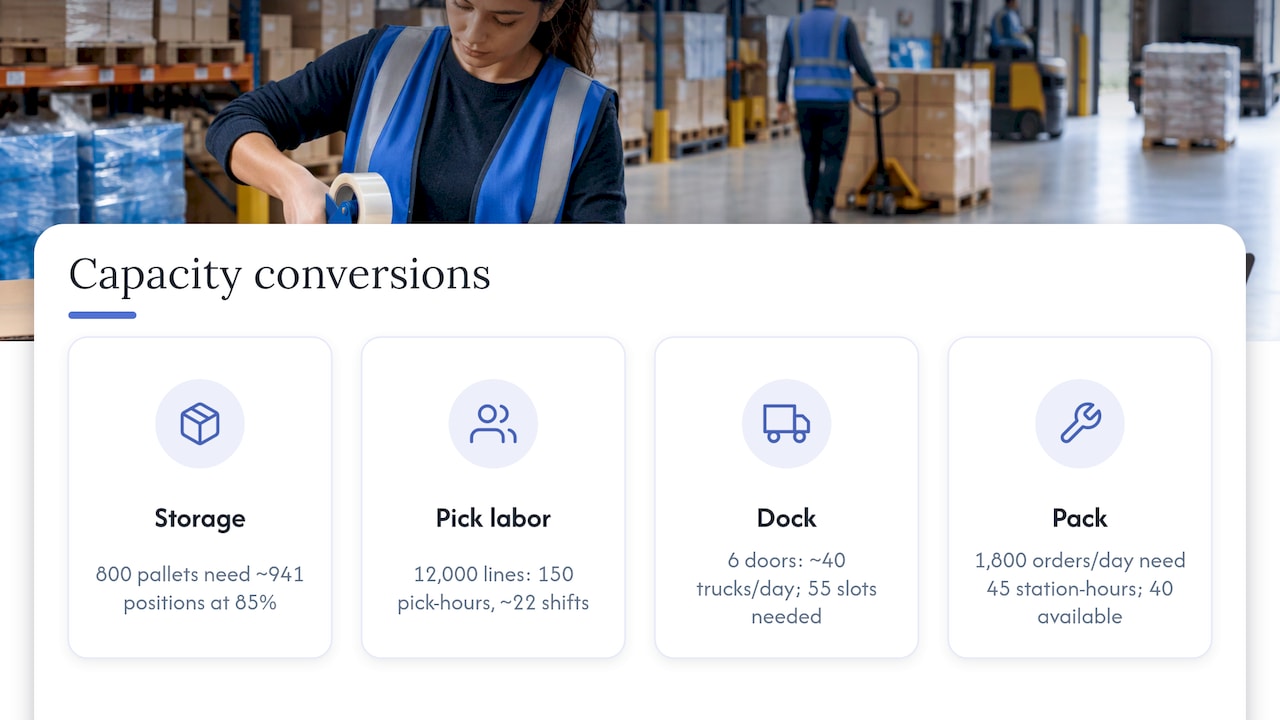
Storage. Your peak forecast is 800 pallets of stock on hand. You do not want to run a building at 100%, so you plan to an occupancy ceiling of 85%. You need 800 ÷ 0.85, about 941 usable positions. If you have 850, you are roughly 91 short.
Pick labor. You expect 12,000 order lines in the peak week and your team averages 80 lines per picker-hour. That is 150 pick hours. A picker contributes perhaps 7 productive hours per shift, so you need about 22 picker shifts that week. If your standard staffing is 18, you are four shifts short, and that is the number to fill with temporary labor or overtime.
Dock. Door capacity is doors times operating hours divided by average time per door. Six doors open 10 hours with an average 1.5-hour turn handle about 40 trucks a day. If inbound containers and outbound LTL pickups together need 55 door slots on your busiest day, the dock is your constraint, not your racking. Scheduling fixes some of that, and our guide to dock scheduling best practices covers how.
Pack stations. Peak 1,800 orders a day at 40 orders per station-hour is 45 station-hours. Five stations running 8 hours give you 40. You need one more station or a longer shift.
To get picker productivity right rather than guessing, calculate your warehouse pick rate from real data, and use it in the formula above.
Build three scenarios, not one forecast
A single forecast gives a false sense of precision. Build at least three:
- Expected demand: the baseline forecast.
- High growth: a strong quarter, a new retail account, a viral product.
- Peak or disruption: holiday volume, a launch spike, a late container, a wave of returns.
Run each through the same conversion model and mark where each resource crosses your threshold. Then decide in advance what you do at that point: overflow storage, extra shifts, revised slotting, a second carrier, or a phased expansion. The point is that the response is already chosen when the spike arrives, not invented during it.
Uncertainty is also a reason to review often. A University of Tennessee-style baseline updated annually will not survive a volatile quarter. During peak periods, refresh the forecast and the gap numbers weekly.
Metrics that reveal gaps and bottlenecks
Track a short list and watch the trend, not just the level:
- Space utilization. A University of Arkansas study of distribution center capacity builds a capacity utilization ratio from warehouse system data, where values approaching or exceeding 1.0 mean the facility is operating near or beyond practical capacity.
- Dock-to-stock time: how long received goods wait before they are available to pick. Rising times point to receiving or putaway constraints.
- Lines picked per labor hour and orders packed per station-hour.
- Cut-off misses: orders that miss the carrier pickup. A warehouse can have empty racking and still miss cut-offs because pickers, doors or packing run out first.
- Detention and demurrage: charges that show trucks and containers waiting on your dock.
How tight is typical? A 2020 benchmark survey of 273 third-party warehouse operators, more than 90% in the US, found 13% operating above 100% of capacity and 37% at 90 to 99%, above the 85 to 90% range the report recommends. Running hot is common, and it is the reason buffers matter.
Find the real constraint before you spend
It is tempting to add racking when occupancy passes a threshold. If the recurring stoppage is staging or packing, more racking only lets more stock pile up in front of the real constraint. Walk the flow from dock to truck and find the step where work waits longest. A two-week pick and pack pilot or a layout review that measures first and pilots one zone will tell you more than a pallet count alone. Better slotting can also free pick capacity without a single new square foot.
Channel mix matters too. If store replenishment shifts toward direct-to-consumer orders, labor per pallet rises even when total volume is flat. A plan built only on pallets will miss that.
Plan each capacity layer on its own horizon
Not every resource can be changed at the same speed, so plan them in layers:
| Layer | How fast it can change | Typical lever |
|---|---|---|
| Building and storage space | Months to years | Lease, expansion, additional location |
| Equipment and racking | Months | Purchase, lease |
| Core workforce | Weeks to months | Hiring, training |
| Flexible labor | Days to weeks | Temps, overtime, extra shifts |
| Transportation | Days | Carrier mix, spot freight, mode change |
The slowest layers need the earliest decisions. If your 18-month forecast says you will outgrow your space, you start now. If next week’s spike is a labor problem, you call the temp agency today.
Securing carrier and freight capacity
Transportation capacity is planned by lane and by week, not in total. A truckload carrier depends on full trailers, while LTL and parcel carriers build volume by consolidating orders going to the same ZIP zones, and CSCMP’s guide to warehousing notes that carriers may discount shippers who help fill trailers. That ties your inventory and shipping decisions together: larger, better-built shipments can lower freight cost, which you weigh against the cost of holding the inventory.
Practical steps:
- Convert forecast orders into loads per lane and week: pallets, weight, cube, and the equipment type each requires.
- Compare with confirmed capacity, meaning space you hold under contract or routing guide, not space you hope to find.
- Spread risk. A single carrier per lane is a single point of failure. Have a primary, a pre-qualified secondary and a backup.
- Set triggers. Decide in advance what a tender rejection spike or a 30% volume jump in two weeks makes you do.
- Palletize correctly. Freight that is palletized to pass LTL requirements avoids reclassification and rework that eat capacity.
- Book dock time. Delivery appointments are part of capacity at the receiving end.
Seasonal pressure also hits the supply of drivers. Understanding why seasonal hiring spikes in trucking happen helps explain why carrier availability tightens at peak and why lining up backup capacity early pays off.
Researchers modeling shipper capacity decisions, such as an EJOR study from Politecnico di Torino, frame three uncertainties: how much volume shows up, what spot capacity will cost, and how much contracted capacity is lost to no-shows or damage. Your plan should have an answer to each. Large manufacturers formalize this: Dow’s extended S&OP process gives its carriers and logistics providers monthly forecasts of requirements so they can prepare capacity in advance. You can do a lighter version by sharing your rolling forecast with your providers.
When to flex capacity instead of owning it
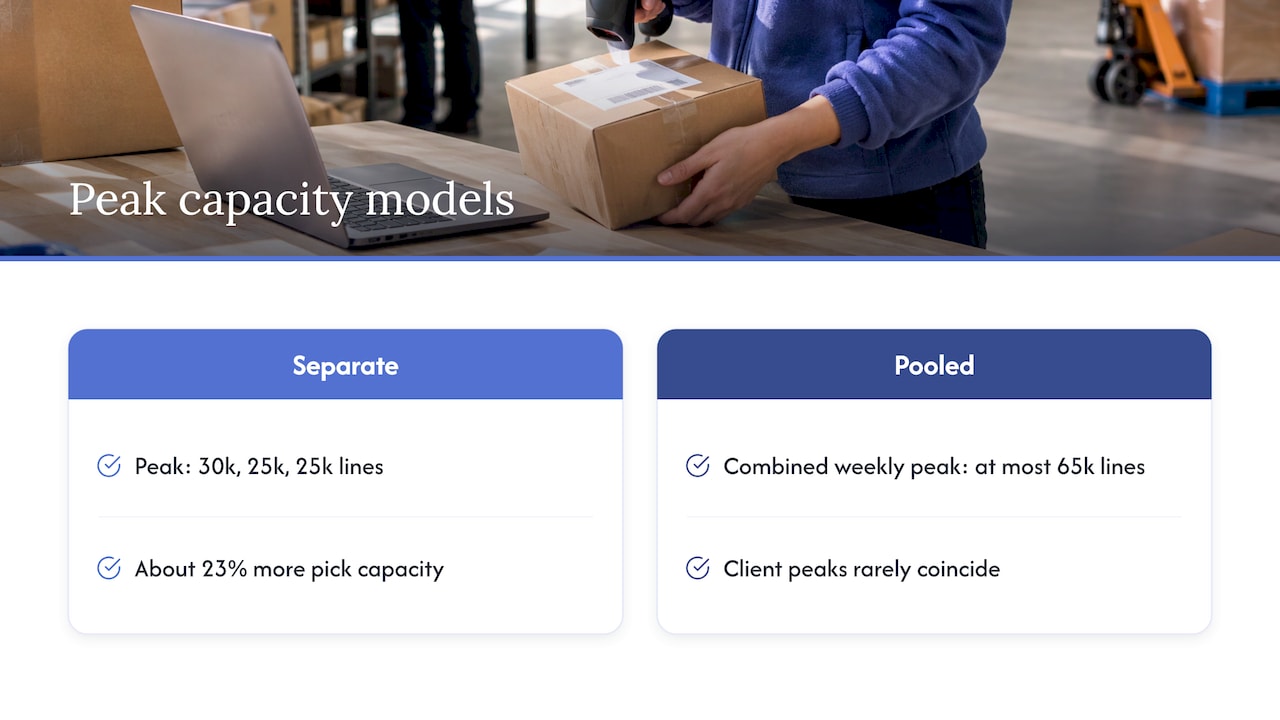
If your peak is three times your average, owning space and labor for the peak means paying for idle capacity most of the year. The alternative is to treat the variable part of your capacity as a service. In a shared warehouse, a provider can sum many clients’ demand week by week, and because clients rarely peak in the same week, the combined peak is lower than the sum of individual peaks. For example, three clients each with a peak week of 30,000, 25,000 and 25,000 lines might together never exceed 65,000 lines in any one week. Staffing each of them separately for its own peak would carry about 23% more pick capacity than the combined week needs. This is a simple illustration of pooling, using made-up numbers.
For ecommerce brands, retailers and importers, that is the practical case for a 3PL instead of in-house shipping. For inventory that must sit closer to customers, distributed warehousing adds capacity by region. When containers arrive faster than a dock can handle, transloading and cross docking move freight through without long storage.
Our perspective
Most capacity problems we see described are really visibility problems. The warehouse, the freight and the forecast live in three different spreadsheets, so nobody sees the gap until it is a backlog.
That is why we built our offer around integration: transportation, warehousing and fulfillment on one platform, with real-time tracking so you can see where inventory and shipments are. When freight forwarding, customs clearance, storage and fulfillment sit with one provider, a forecast can be turned into a plan across the whole chain instead of one link.
Our pricing is built to scale with you: storage is billed monthly by the bin or the pallet, and additional hands-on work is billed by the hour. Your peak costs what it uses, and you do not carry that capacity through the quiet months.
Our advice is simple. Model three scenarios, set your triggers, and decide ahead of time which capacity you will flex.
Akbar
Put flexible capacity behind your plan
Once your gap analysis shows where you are short, Usiship can cover it: warehousing and fulfillment, 3PL fulfillment and freight forwarding across all 50 states, including FTL and LTL, air, ocean, customs clearance, FBA prep and last-mile delivery. Published storage rates are 5 to 6 USD per bin per month and 17 to 19 USD per pallet per month, and additional services are 37 USD per hour. Other fulfillment fees are on the pricing page.
Send us your three scenarios and we will help match them to space, labor and freight.
FAQ
How do you do a capacity plan?
Start with a demand forecast, convert it into the units each resource uses (pallet positions, pick hours, dock slots, pack stations, truck space), and compare with what you have. Add a 10 to 20% buffer, run expected, high and peak scenarios, and write down the action you will take at each threshold.
What does 3PL capacity mean?
It is the amount of work a third-party logistics provider can handle in a period: pallets received, order lines picked, cartons packed, trailers loaded. It is planned in layers, from the building to flexible labor and subcontracted transport, each with its own lead time.
What does load planning mean in logistics?
Load planning is deciding how freight will be arranged in a trailer or container before loading starts: floor-loaded or palletized, weight distribution, and stop sequence for multi-stop deliveries. It links directly to transportation capacity, because better loads fill equipment more fully and reduce damage.
How often should I update a capacity plan?
Review the long-range plan at least quarterly alongside your forecast, and refresh gap numbers weekly in peak season. Revisit it any time a new account, product launch or supply delay changes your volume.
Sources
- University of Tennessee, end-to-end supply chain planning framework
- LMA Consulting, SIOP playbook
- University of Arkansas, distribution center capacity forecasting framework
- 2020 Third-Party Logistics Warehouse Benchmark Report
- CSCMP, The Definitive Guide to Warehousing
- Politecnico di Torino, capacity planning with uncertainty on contract fulfillment
- SupplyChainBrain, Dow applies S&OP to logistics planning
- Why seasonal hiring spikes in trucking