
Blank Sailings Meaning: What They Are and How to Plan Around Them
A blank sailing is a scheduled ocean voyage, or a scheduled port call within one, that the carrier cancels. The ship does not make the stop, so no cargo is loaded or discharged there. For a shipper, that means a booking you counted on may leave later than planned or not at all, and the effects show up in transit times, rates and storage bills.
The term covers two situations that are easy to mix up. In one, the carrier cancels a whole departure on a service string. In the other, the vessel sails but skips one port. Both are “blank” from the point of view of cargo waiting at the affected port. The rest of this guide explains the difference, why carriers do it, what it costs, and what you can do before and after you get the notice.
TL;DR
- A blank sailing is a carrier-cancelled voyage or a skipped port call on a scheduled liner service. Cargo booked on it has to move another way.
- Carriers mostly blank sailings to match vessel supply with cargo demand, and sometimes to recover from congestion delays.
- The costs are rolled cargo, longer lead times, less reliable schedules and, when enough capacity is pulled, upward pressure on rates.
- You cannot prevent a blank sailing. You can reduce the damage with earlier bookings, a second routing option, buffer stock and prompt cancellation of unused appointments.
- Watch demurrage and detention clocks closely when a vessel changes, because the free time you planned around may no longer fit.
Table of Contents
- What a blank sailing means in plain terms
- Why carriers blank sailings
- How blank sailings affect shippers
- Blank sailings, demurrage and detention
- What shippers can do about a blank sailing
- Perspective: what we see at Universal Shipping
- How Universal Shipping can help
- Frequently asked questions
- Sources
What a blank sailing means in plain terms
Ocean carriers run liner services on fixed rotations. A string of ships calls at the same ports in the same order, week after week, and shippers book space on a named departure. A blank sailing happens when the carrier removes one of those departures from the schedule, or removes a port from a particular rotation.
A simple example: a weekly service runs from several Asian ports to Los Angeles and Long Beach. In one week the carrier decides not to send a ship at all. Every container booked on that departure has to move to another sailing, and that week’s space on the trade lane disappears for everyone.
You will also hear “void sailing” and “cancelled sailing” used for the same thing. “Blanked” and “blanking” are the verb forms carriers and analysts use.
Blank sailing vs. port omission vs. rollover
These three terms describe different events with a similar result for the shipper: your box does not arrive when you expected.
| Term | What happens | Who decides |
|---|---|---|
| Blank sailing | A scheduled voyage is cancelled, or a scheduled port call on it is dropped | Carrier, in advance |
| Port omission or bypass | A vessel sails but skips a port, often because of delays or congestion | Carrier, sometimes close to arrival |
| Rollover | Your container is bumped to a later vessel, often because the ship is full or an earlier departure was cancelled | Carrier, at loading |
The three are connected. A blanked departure pushes its cargo onto the next ships, which can fill them and cause rollovers. A port omission can leave your container at a different terminal than the one you planned to pick it up from. The U.S. Federal Maritime Commission (FMC) treats notice periods for blanked sailings and bypassed ports separately: in its 2020 findings it recommended at least seven days’ notice to shippers and truckers for blanked sailings and 72 hours for port-bypass decisions.
Why carriers blank sailings
There is rarely one reason, and the reason matters because it tells you how long the disruption is likely to last.
Matching capacity to demand
This is the most common driver. When cargo volumes fall, running every ship at low utilization loses money. The FMC reported that carriers use blanked sailings to match vessel supply with cargo demand when volumes are low. Sea-Intelligence CEO Alan Murphy described blank sailings as carriers’ long-standing preferred tool for this, and separated planned “tactical” capacity cuts from blanks caused by congestion and schedule disruption.
The practical read: tactical blanks cluster around predictable slow periods, such as the weeks after a peak season or around major Asian holidays. Because they are planned, carriers often announce them weeks ahead.
Congestion and schedule recovery
When ships queue outside crowded ports, they cannot finish their return voyage or start the next one on time. FreightWaves reported that in this situation carriers may blank voyages to recover schedule integrity. These blanks are reactive. They tend to arrive with less notice and, because they follow a backlog, they often coincide with high demand and tight space.
Other triggers
Carriers also adjust rotations after alliance changes, route diversions, or when a port cannot handle a ship. Any of these can turn a scheduled call into a skipped one. The details differ every time, so ask your forwarder or carrier which type of blank you are dealing with before you decide how to respond.
How blank sailings affect shippers
The effect depends on how close your cargo is to the affected departure and how much slack your supply chain has.
Schedule and capacity
The FMC’s Fact Finding 29 summary says blank sailings, port bypasses and cancelled service strings increase uncertainty about space availability and can contribute to multiple bookings, unused appointments and operational inefficiency. When a departure is pulled, shippers often rebook on several lines at once to protect themselves, which makes the space picture look tighter than it is.
Scale of recent blanking
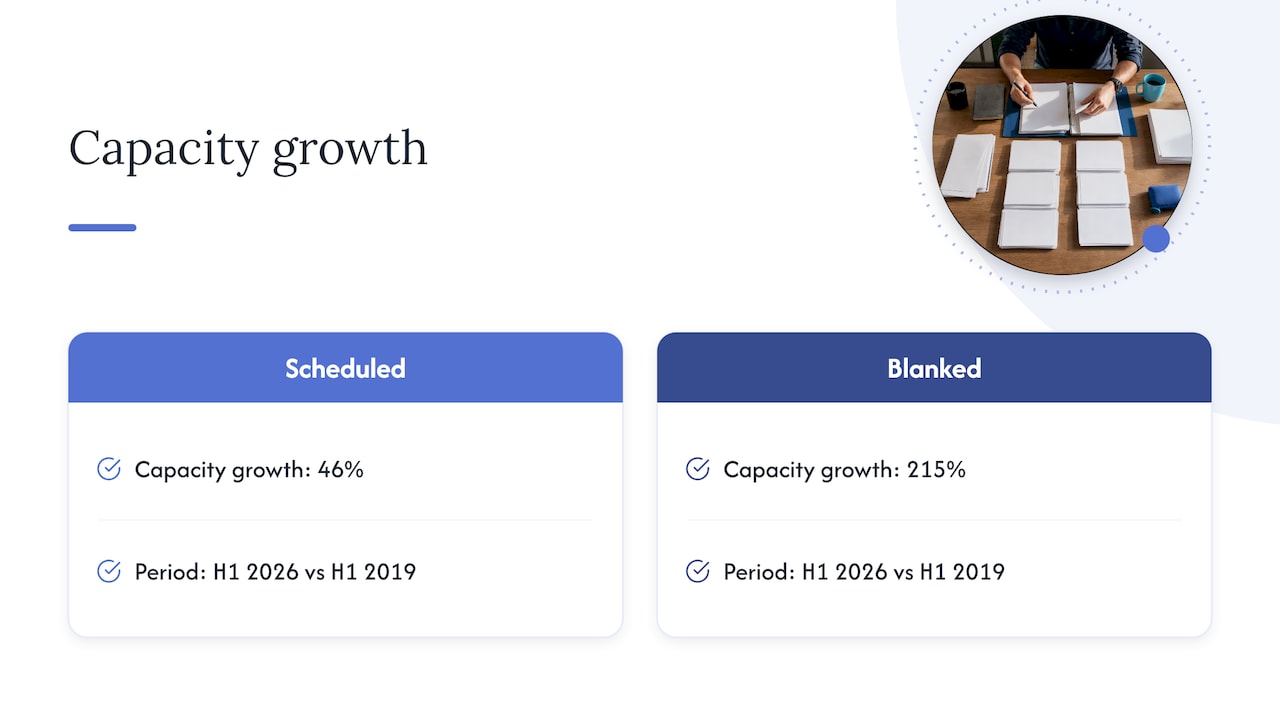
The numbers can be large. Supply Chain Dive reported in August 2026, citing Sea-Intelligence, that scheduled capacity on Asia to U.S. East Coast services grew 46% in the first half of 2026 versus the first half of 2019, while blanked capacity grew 215%. In other words, carriers scheduled more space but pulled a lot of it back.
Rates and lead times
Baker Tilly’s Pete Mento told Supply Chain Dive that when enough capacity is withdrawn, blank sailings can cause rolled cargo, longer lead times, lower schedule reliability and upward pressure on freight rates. The FMC’s stated position, as reported by FreightWaves, is that carriers may reduce capacity when demand is low, but the Commission monitors whether reductions are unreasonable or push shippers’ transportation costs up unreasonably.
Inventory and production
Marine Insight describes how blank sailings can disrupt just-in-time supply chains, drain safety stock and delay production. The same article points out the opposite problem later: held-up cargo can arrive at the same time as replacement inventory, leaving you overstocked. For perishables or goods meant for a specific event, it says delay can mean cargo is diverted, written off or unusable, and that alternative transport may be unavailable or more expensive.
Example: a three-week gap
Imagine an importer with a weekly container of consumer goods and about two weeks of safety stock. One departure is blanked and the next vessel is full, so the container rolls again. The gap is now closer to three weeks than one. The importer either air-ships part of the order, runs out of stock, or takes a late arrival that overlaps with the following week’s container. Each choice has a cost, and the cheapest one depends on decisions made before the notice arrived: how much buffer stock exists, whether an alternate port was pre-qualified, and whether a forwarder can move quickly.
Blank sailings, demurrage and detention
Blank sailings create charges indirectly. When your container arrives later or at a different time than planned, the free time on the other end may not line up with your trucking and warehouse plans.
The FMC’s 2015 report defines the terms: demurrage is a charge for use of terminal space, detention is a charge for use of container equipment, and free time is the period when neither applies. Trouble starts when a late vessel pushes your pickup into a period when a truck or warehouse slot is no longer available. The box sits, and the clock runs.
Two habits help. First, confirm the new discharge date and last free day in writing as soon as the carrier reschedules. Second, if a charge does land on you that you believe came from the carrier’s schedule change, know the rules for disputing it. Our guide to per diem charges and the FMC 30 day rule walks through the billing timelines. If cargo is damaged or lost during a rerouted move, the deadlines in our freight claims playbook apply.
What shippers can do about a blank sailing
No shipper controls the carrier’s schedule. You control how exposed you are to it.
Before it happens
- Book earlier on lanes you depend on. Space is easiest to find when a blank is not yet announced. Last-minute bookings are the ones that roll.
- Hold more than one carrier or service. If every container rides one weekly string, one blank means a full week gap. Splitting volume across services reduces that.
- Pre-qualify an alternate port or mode. Knowing in advance that a different gateway or an air freight option works for your product lets you act in a day, not a week. For inland legs, an intermodal plan can also give you flexibility once cargo is on U.S. soil.
- Set safety stock by lane, not by SKU alone. Lanes with frequent blanks need a bigger buffer than lanes with stable schedules.
- Ask your forwarder for blank-sailing alerts. Carriers publish advisories and your forwarder sees them first. Make sure they pass them on.
When you get the notice
- Find out which kind it is. A full cancellation, a port skip and a rollover each call for a different fix.
- Get the new vessel, ETA and last free day in writing.
- Tell your trucker, warehouse and customers right away. Pickup and delivery appointments built around the old date are now wrong. The FMC’s guidance is that shippers should promptly cancel bookings and appointments that will not be used, so other shippers can use them. Our guide to delivery appointment freight covers how to rebook without fees.
- Decide whether to wait or switch. Compare the cost of the delay (stockout, lost sales, storage) with the cost of a premium alternative. If only part of the shipment is urgent, splitting it is often cheaper than moving everything faster.
- Do not double-book and forget. Booking on several lines to protect yourself is understandable, but unused bookings and appointments waste space and can carry penalties.
After the dust settles
Look at what each blank actually cost you in days, dollars and customer impact. Patterns emerge: certain lanes, certain weeks of the year, certain carriers. Feed that into your next quarter’s booking calendar and safety stock.
Perspective: what we see at Universal Shipping
Most importers treat a blank sailing as a surprise. In our experience it is closer to a known risk that was never priced into the plan. The importers who handle it well did not find a magic carrier. They decided in advance how much delay they could absorb, which part of the shipment could go by air if needed, and who would make the call.
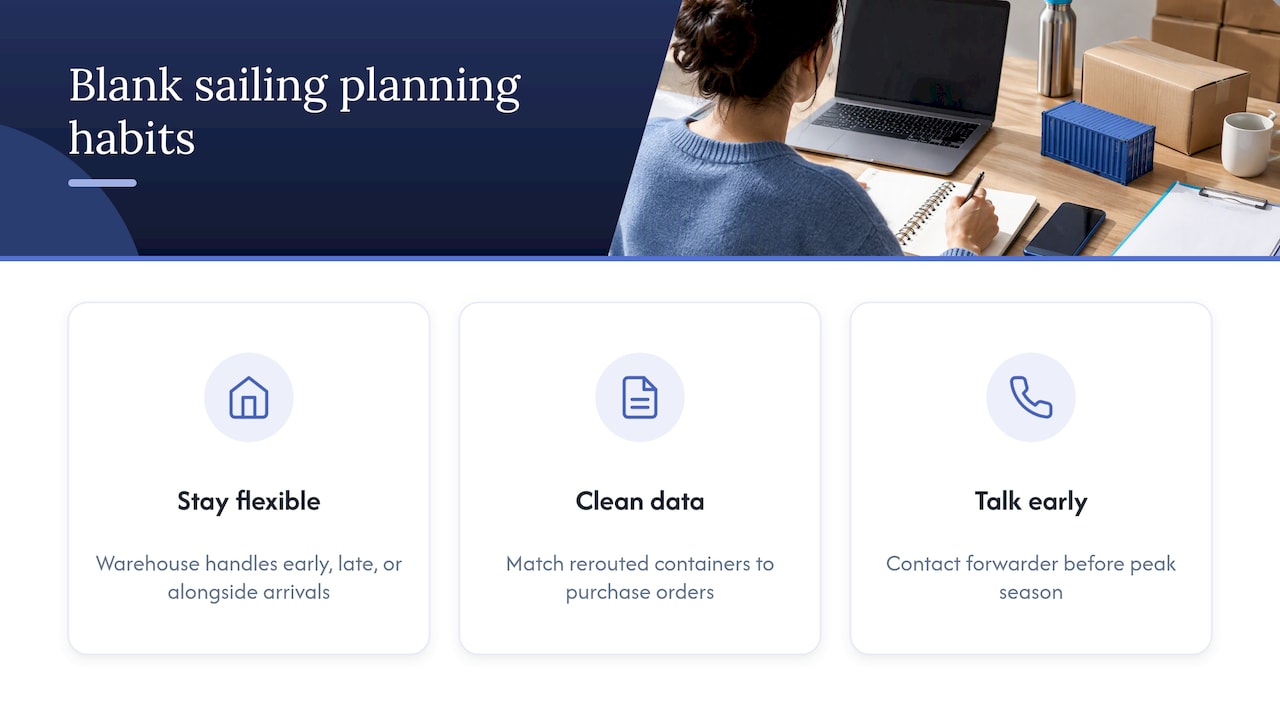
Three habits separate them from the rest. They keep the destination side flexible, with warehouse space and receiving capacity that can handle a container arriving early, late or alongside another one. They keep their data clean, so a rerouted container is matched to the right purchase order on arrival. And they talk to their forwarder before the peak, not during it.
That is why we build transportation, warehousing and fulfillment as one connected service. When a vessel changes, the same team sees the ocean leg, the customs entry, the trucking and the inventory landing, so one decision does not break another. If your volume is small, the same logic applies in a lighter form: consolidating shipments, as described in our freight consolidation pilot checklist, gives you fewer, fuller containers to track and more leverage when schedules shift.
— Akbar
How Universal Shipping can help
If a blank sailing has already hit your cargo, or you want a plan before the next one, our freight forwarding team handles ocean, air and land moves and customs brokerage across the United States, with real-time tracking so you see changes as they happen. If you need somewhere for delayed or early freight to land, our warehousing and fulfillment solutions cover storage, receiving and order processing. Published storage rates are on the pricing page: $5-$6 per month per bin, $17-$19 per month per pallet, and $37 per hour for additional services.
Frequently asked questions
What is a blank sailing?
A blank sailing is a cancelled departure or a skipped port call on a scheduled ocean liner service. The carrier removes it from the rotation, so cargo booked there must move on another vessel. It is sometimes called a void sailing.
Is a blank sailing the same as a delay?
No. A delay means the ship still comes, only late. A blank sailing means the planned call or departure does not happen at all. A blank often creates delays, because cargo moves to later ships, but the two events are different and the remedies differ.
How much notice do carriers have to give?
The FMC recommended at least seven days’ notice for blanked sailings and 72 hours for bypassed ports to shippers and truckers in its 2020 findings. That is a recommendation, not a guarantee, so check your booking terms and ask your forwarder what the carrier has actually committed to.
Do blank sailings raise freight rates?
They can. When enough capacity is withdrawn, there is upward pressure on rates, though the effect depends on demand at the time. In weak markets carriers blank sailings partly to hold rates up. In strong markets, blanks make tight space tighter.
Can I avoid blank sailings completely?
No, but you can limit the damage. Book early, spread volume across services, keep an alternate routing ready and keep appointments flexible. A forwarder who watches carrier advisories will usually warn you sooner than you would learn it alone.
Sources
- FMC: Commissioner Dye announces findings of San Pedro Bay discussions (June 17, 2020)
- FMC: Executive Summary of Fact Finding 29 (2021)
- FMC: Report on rules, rates and practices relating to detention, demurrage and free time (2015)
- FreightWaves: Trans-Pacific trade crashes into max-capacity ceiling
- FreightWaves: How the FMC monitors blank sailings and their competitive impacts
- Supply Chain Dive: Ocean carriers up blank sailings to brace for softening demand
- Supply Chain Dive: Blank sailings curb ocean capacity gains
- Marine Insight: What is blank sailing?