
Bill of Lading Explained: What It Is, Who Issues It, Types
A bill of lading (BOL, or B/L) is the document a carrier issues when it takes your freight. It does three jobs at once: it is a receipt for the goods, evidence of the contract of carriage, and, only in some forms, a document of title. Almost every freight dispute, customs hold and cargo claim comes back to what this one page says.
This guide explains what a BOL contains, who issues it, the types you will meet in U.S. shipping, and the mistakes that cost shippers time and money.
TL;DR
- A BOL is a receipt, a contract and, for some types, a document of title. It is not a shipping label and not cargo insurance.
- The carrier (or its agent, such as a freight forwarder) issues it, usually based on the shipping details you provide.
- A straight BOL is not negotiable. An order BOL can be endorsed and transferred. Master and house BOLs describe who issued the bill in a forwarder chain.
- For U.S. ocean imports, a wrong BOL number or bill level can cause customs data mismatches even when the cargo itself is fine.
- Note exceptions on the BOL at pickup and keep your delivery proof. Claim clocks start early.
Table of Contents
- What a bill of lading is, in simple words
- Who issues a bill of lading?
- What is on a bill of lading
- Bill of lading types
- Why the BOL number matters for U.S. imports
- Domestic shipping: where the BOL protects you
- Common BOL mistakes
- Our perspective
- Getting help with your bills of lading
- FAQ
- Sources
What a bill of lading is, in simple words
Think of the BOL as the carrier’s written statement: “We received these goods, in this apparent condition, and we will move them from here to there on these terms.” The Legal Information Institute at Cornell describes it as a legal instrument that lists the goods being shipped and the terms under which they will be delivered.
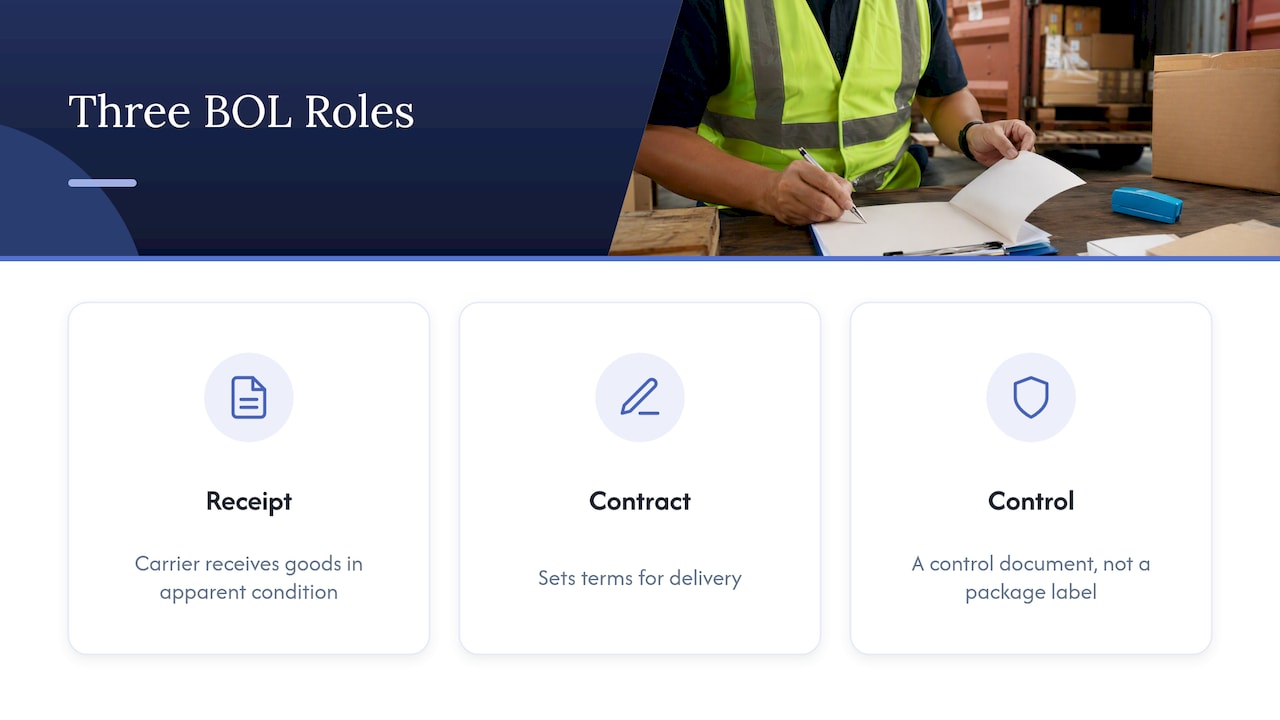
The most useful mental model is receipt, contract and control document. Not a package label.
The three purposes
- Receipt. It records what the carrier says it received, including quantity and apparent condition. If the freight arrives short or damaged, this is the baseline.
- Contract of carriage evidence. It points to the carrier’s obligations, limitations and terms. The International Trade Administration describes it as a contract between the owner of the goods and the carrier.
- Document of title. Only when the bill is in a negotiable form. A negotiable bill can be bought, sold or traded while the goods are in transit, according to the same ITA guide. A non-negotiable bill does not give title.
Who issues a bill of lading?
The carrier issues it, or an agent acting for the carrier. In practice that looks like this:
- Trucking (LTL and full truckload). The motor carrier or its driver signs the BOL at pickup. The shipper normally prepares the form, and the carrier signs for the freight. Under 49 U.S.C. §14706, a covered motor carrier or freight forwarder must issue a receipt or bill of lading for property it receives.
- Ocean freight. The shipping line issues a master bill. A freight forwarder that consolidates cargo may issue its own house bill to each shipper.
- Air freight. The equivalent is the air waybill, which is a different document with its own rules.
Whoever prepares the form, the shipper supplies the facts: who is shipping, who is receiving, what is in the load, how many pieces, how much it weighs. The carrier’s signature turns those facts into a receipt. If your description is vague, that vagueness becomes the record.
What is on a bill of lading
Layouts vary by carrier and mode, but most BOLs carry:
- Shipper, consignee and, where relevant, a “notify party”
- Carrier name and identifying numbers
- Pickup and delivery locations
- Description of goods, piece count, packaging type and weight
- Freight class and NMFC item number for LTL (see our guides to U.S. freight class and NMFC classes)
- Special instructions, hazardous material details, declared value where applicable
- BOL number, date and signatures
- Payment terms: prepaid, collect or third party
The piece count and description should match your commercial paperwork. If you are exporting or importing, your packing list and the BOL should tell the same story.
Bill of lading types
There is no single “BOL.” The type decides who can claim the cargo and how it moves through customs. Check which one you hold before assuming anything.
Straight vs. order bills
This is the classic split, and it controls transferability.
| Straight BOL | Order (negotiable) BOL | |
|---|---|---|
| Consignee | Named party only | “To order” of a named party |
| Transferable | No | Yes, by endorsement |
| Title to goods | Not conveyed by the document | Can be controlled by whoever holds the properly endorsed original |
| Typical use | Domestic trucking, trusted buyers | Trade finance, goods sold in transit |
The ITA export guide explains that a straight bill is not negotiable and does not give title, while a negotiable shipper’s-order bill may be bought, sold or traded while in transit. In U.S. regulated land transport, 49 CFR Part 1035 prescribes forms that distinguish uniform order and straight bills, and it recognizes both paper and electronic documentation in applicable contexts.
Master vs. house bills
When a freight forwarder consolidates several shippers’ cargo into one container, two layers of paperwork exist:
- Master BOL: issued by the ocean carrier, usually to the forwarder as the shipper of the consolidated container.
- House BOL: issued by the forwarder to each individual shipper for their portion.
U.S. Customs and Border Protection’s entry form, CBP Form 3461, lists BOL type options including master, house, in-bond and regular/simple. For a house bill, the form shows both master and house information but reports the house-bill quantity.
Other labels you will hear
- Regular/simple BOL: a single bill with no house layer, typical when one shipper fills a container directly with the carrier.
- In-bond BOL: cargo moving under customs bond to another port before entry. Our guide to customs bond types covers the bond side.
- Electronic BOL: the same legal function in digital form. Adoption works best with controls in place: who is authorized to sign, an amendment history, access permissions and a consistent master/house numbering process. Digital does not remove the need to check the governing terms.
Whether a bill is also “clean” or carries remarks is a separate question. A clean bill means the carrier noted no visible damage or shortage at receipt. Remarks on the bill reduce how much the document supports a later claim, so read what the driver or terminal wrote before you let the freight leave.
Why the BOL number matters for U.S. imports
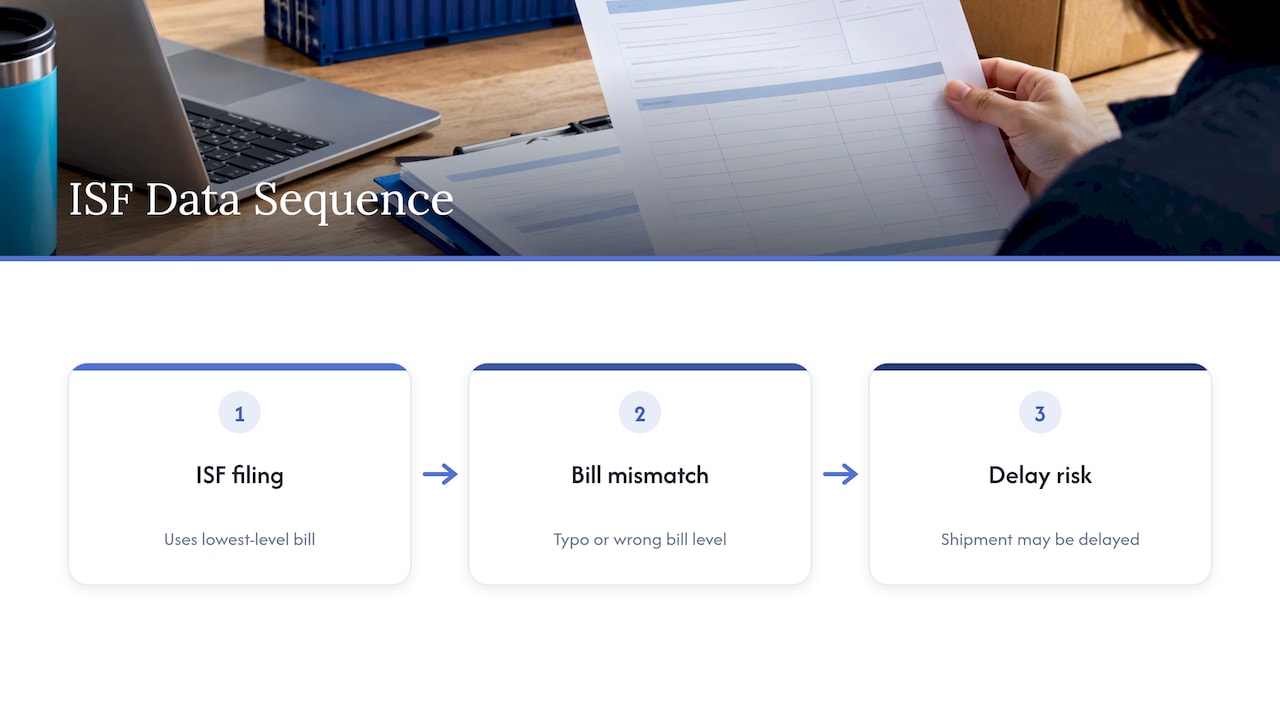
Customs professionals treat the BOL number as a data-integrity key. CBP’s Importer Security Filing FAQ confirms a bill of lading number is required at the time of an ISF filing, and that the filing must reference the lowest-level bill transmitted in AMS. That is normally the house or regular/simple bill, not automatically the master.
The practical risk: a typo or the wrong bill level can produce an accepted ISF followed by a “Bill Not on File” mismatch. The cargo is fine and the invoice is right, but the data does not line up, and the shipment can be delayed.
The BOL feeds the entry, but it does not replace the commercial invoice, the packing list, the entry itself or the security filing. If you import regularly, also review your customs power of attorney setup so the person filing for you has the right authority and the right documents.
Domestic shipping: where the BOL protects you
On a U.S. truck move, the BOL is your first line of evidence. It is not insurance. Liability depends on the statute, the carrier’s tariff, your contract, the declared value and the mode.
For covered interstate motor transportation, 49 U.S.C. §14706 sets a framework for carrier liability for actual loss or injury, subject to lawful limitations and written or electronic declared-value arrangements. It also sets floors: a carrier cannot shorten the claim-filing period below 9 months, or the period to bring suit below 2 years after written disallowance.
What that means at the dock:
- Count the pieces and look at the packaging before the driver leaves.
- Photograph the freight and the condition of pallets, wrap and cartons.
- Write exceptions on the BOL before signing, for example “2 cartons crushed” or “1 pallet short.”
- Keep the signed BOL and delivery proof.
- Read the carrier’s claim instructions and liability terms right away after any damage or shortage.
We lay out the full process in our freight claims playbook.
Common BOL mistakes
- Vague descriptions. “Misc. goods” invites reclassification and weakens a claim. Describe what is actually on the pallet.
- Wrong piece count or weight. The carrier’s record becomes the dispute baseline.
- Signing clean when it isn’t. If you or your receiver sign without noting visible damage, you lose leverage.
- Assuming every BOL has the same legal wording. Confirm which carrier tariff, service contract and mode-specific rules govern the move.
- Mismatched numbers. House and master numbers that differ between the ISF, manifest and entry cause delays.
- Treating the BOL as title when it is straight. A straight bill does not let a third party take the cargo by holding the paper.
Our perspective
Most BOL problems we see in logistics are not exotic. They are data problems: a description written in a hurry, a count that was never checked at pickup, a bill number keyed one digit off. The document is simple, but everything downstream relies on it, from customs filings to claims to warehouse receiving.
Our view is that the BOL should be treated as the first step of a connected process rather than a form to file away. When transportation, warehousing and customs sit on one platform, the same shipment data can be reused rather than retyped, and a mismatch is easier to catch before the truck leaves or the vessel arrives. That is the integrated approach we build around at Universal Shipping, along with real-time tracking and 24/7 support.
If you take one habit from this guide, make it this: reconcile the BOL against your invoice and packing list before it is signed, not after something goes wrong.
— Akbar
Getting help with your bills of lading
If you ship freight domestically or import into the U.S., our team handles freight forwarding and customs brokerage, so the documentation, filings and carrier handoffs are coordinated in one place. For warehousing and fulfillment rates, see our pricing page. Storage is listed there at 5-6 USD per month per bin and 17-19 USD per month per pallet.
FAQ
What is a BOL in shipping?
BOL stands for bill of lading. It is the carrier’s document confirming it received your goods, describing them and stating the terms of transport. It travels with the shipment and is the main reference if anything goes wrong.
Is a bill of lading the same as a shipping label or a packing list?
No. A label tells a handler where a package goes. A packing list details the contents for the buyer and customs. The BOL is the carrier’s receipt and contract evidence. For international moves you generally need all of them, and they should agree with one another.
Who issues the bill of lading, the shipper or the carrier?
The carrier or its agent issues and signs it. In trucking, the shipper often fills out the form and the driver signs at pickup. In ocean freight, the shipping line issues the master bill and a forwarder may issue a house bill.
Does a bill of lading prove who owns the cargo?
Only a negotiable (order) bill can work as a document of title, and only when properly endorsed. A straight bill names a consignee and does not convey title. Ownership between buyer and seller is also governed by their sales contract.
Does the BOL protect me if freight is damaged?
It records the facts that a claim depends on, but it does not guarantee payment. Liability depends on the applicable statute, tariff, contract and declared value. Note damage on the BOL at delivery and file the claim promptly. Federal law sets a minimum of 9 months to file a claim for covered motor carriage.
Sources
- Bill of Lading, International Trade Administration
- Bill of lading, Legal Information Institute (Cornell)
- 49 U.S.C. §14706, carrier liability and claims
- 49 CFR Part 1035, Bills of Lading (eCFR)
- CBP Form 3461
- Importer Security Filing 10+2 FAQ, CBP