
B2B Last-Mile Delivery: How It Works and What It Costs
B2B last-mile delivery is the final leg that moves business freight from a warehouse, cross-dock or distribution hub to a business recipient: a store, a plant, a job site or another warehouse. It differs from consumer delivery in almost every detail: fixed receiving windows, dock or liftgate handling, larger shipments, proof of delivery that carries contractual weight, and customers who now expect the visibility they get as shoppers. This guide covers how the leg works, what drives its cost, which numbers to track and how to pick a setup that fits your freight.
TL;DR
- B2B last mile means delivering to a business, usually at a dock or receiving desk within an appointment window, often with pallets, not single parcels.
- The last mile can account for 30% to 40% of total transportation cost, and U.S. cost per delivery rose a median 12% in 2026.
- Track on-time rate, first-attempt success, cost per delivery, damage claims and the share of “where is my order” contacts.
- Visibility, appointment discipline and clean handoffs between warehouse and carrier remove more cost than chasing a cheaper rate.
- We combine warehousing, fulfillment and last-mile delivery under one team, so the handoff that usually fails is a single process.
Table of Contents
- What B2B last-mile delivery actually means
- How a B2B shipment travels the last mile
- Delivery models used for B2B last mile
- Why last mile costs so much
- The challenges that trip up B2B deliveries
- Technology that makes the last mile predictable
- KPIs to track for B2B last-mile performance
- How to choose a B2B last-mile setup
- Our perspective on B2B last mile
- How Usiship supports business deliveries
- FAQ
- Sources
What B2B last-mile delivery actually means
In consumer delivery, a driver leaves a box at a front door. In B2B, the delivery is a scheduled event at a commercial location. The receiver has a dock with limited hours, a purchase order to match, and often a penalty if freight arrives outside its window or with the wrong paperwork.
The typical differences look like this:
| Factor | Consumer (B2C) last mile | B2B last mile |
|---|---|---|
| Recipient | Private individual | Store, plant, warehouse, job site |
| Destination | Home address | Loading dock, receiving desk, site |
| Timing | Carrier route, often unscheduled | Fixed window, often by appointment |
| Shipment | One or a few parcels | Multi-carton, pallets, oversized freight |
| Handling | Doorstep drop | Liftgate, pallet jack, inside delivery, sometimes unloading help |
| Proof of delivery | Photo or signature | Signed receipt matched to a PO or bill of lading |
The gap between the two is narrowing on expectations. APQC’s research finds that disruptions pushed many B2B customers to expect the same consistency and visibility they get in B2C, with less patience for delays. If you ship to retailers, distributors or manufacturers, your customer’s receiving manager is now comparing you to the best tracking experience they have had as a shopper.
How a B2B shipment travels the last mile
The details vary by freight type, but most B2B last-mile moves follow the same sequence.
- Inbound and staging. Freight arrives at a warehouse, cross-dock or transload facility, is received against an advance shipping notice and is put away or staged for the next outbound move. Clean receiving data here is what makes everything downstream accurate. Our guide to the advanced shipping notice explains the data levels that make single-scan receiving work.
- Order release and consolidation. Orders are picked, palletized or cartonized, labeled and consolidated by delivery area so one truck serves many stops.
- Appointment booking. Many commercial receivers require a booked slot. Missing it can mean refused freight or rebooking fees. See how to book delivery appointments and avoid fees.
- Routing and dispatch. Stops are sequenced against windows, vehicle capacity and equipment needs such as a liftgate.
- Delivery and proof. The driver unloads at the dock or other agreed point, the receiver signs, and exceptions such as shortages or damage are noted on the delivery receipt.
- Status and reconciliation. Tracking events and signed proof flow back to your systems so invoicing and claims can proceed.
Most delays and disputes start in steps 1 and 3, not on the road. A mislabeled pallet or a missed appointment costs more than an extra mile.
Delivery models used for B2B last mile
There is no single model. Shippers typically mix several, depending on shipment size, urgency and recipient type.
- Parcel and small-package carriers for cartons to offices, shops and clinics.
- LTL final delivery for palletized freight that travels on shared trucks and is delivered from a local terminal.
- Dedicated or scheduled routes for recurring deliveries to the same stores or sites, often on fixed weekdays.
- Pool distribution and cross-docking, where freight is consolidated at a regional point and broken out for local delivery. Cross-docking moves inbound freight straight to outbound vehicles with no storage in between, as one industry overview describes.
- Specialty and white-glove handling for furniture, fixtures and other bulky or fragile goods that need inside delivery, placement or unpacking. If you ship large items to homes as well as businesses, see our page on residential freight delivery.
- Same-day or expedited local delivery for urgent replenishment, such as parts or retail restocks.
The right mix usually comes down to three questions: how heavy and bulky is the freight, how tight are the receiving windows, and how much proof does the receiver need?
Why last mile costs so much
The last mile is short in distance and heavy in expense. According to Armstrong & Associates research, last-mile transportation can account for 30% to 40% of total transportation cost, with last-mile provider revenue averaging under $90 per shipment. The same research put the U.S. third-party big-and-bulky last-mile market at roughly $10.3 billion in 2023, a sign of how much freight now moves this way.
Costs are also climbing. FarEye’s 2026 survey of U.S. delivery operators found a median 12% year-over-year increase in cost per delivery, the same as in 2025. Sixty percent of respondents reported increases above 10%, and 45.8% said costs were growing faster than revenue.
What pushes the cost per stop up in B2B:
- Dwell and waiting time at docks with congested receiving schedules.
- Failed or refused deliveries caused by wrong appointments, missing PO numbers or closed docks.
- Special equipment, such as liftgates and pallet jacks, and extra labor for inside delivery.
- Low stop density, where trucks run partly full across long distances.
- Manual status work, where staff call carriers and receivers to find out where freight is.
Each of these is a process problem before it is a rate problem, which is why shaving a carrier’s per-mile price rarely fixes the bill.
The challenges that trip up B2B deliveries
Tight and inflexible receiving windows. Commercial docks are staffed for limited hours. Build appointments into the shipment plan, not as an afterthought, and confirm receiver requirements before the freight leaves the warehouse.
Handoff errors. Freight often changes hands between warehouse, linehaul carrier and delivery partner. Each handoff is a point where data and responsibility can be lost. Our piece on the first-mile handoff shows how a staged rollout reduces that friction, and the same logic applies on the delivery end.
Compliance deadlines. Retailers can impose must-arrive-by dates with chargebacks for lateness. Planning backward from the date, not the ship date, is the fix. Read more on MABD compliance.
Proof and traceability. APQC notes that traceability matters most for high-value B2B goods and for products that need proof of delivery for legal or regulatory reasons, such as pharmaceuticals. A dispute over receipt of a high-value pallet is far more disruptive than a missing consumer parcel.
Poor visibility. APQC found that only 41% of surveyed B2B organizations extend real-time order visibility into the last mile to a great or significant extent, compared with 55% of B2C organizations. B2B shippers have room to stand out here. For why location data goes missing in practice, see our guide to real-time shipment tracking.
Technology that makes the last mile predictable
Three capabilities do most of the work.
Real-time visibility. McKinsey describes visibility platforms that use API integrations, real-time tracking and predictive analytics to give visibility at every stage and optimize inefficient routes. The same analysis estimates that combining such platforms with workflow automation could cut waste from blind handoffs by up to 40%.
Dynamic routing. The USPS Office of Inspector General’s 2026 report notes that several regional carriers claim on-time rates of 98% or higher using AI-powered dynamic routing, and that multi-carrier shipping platforms have grown from label tools into hubs that orchestrate logistics.
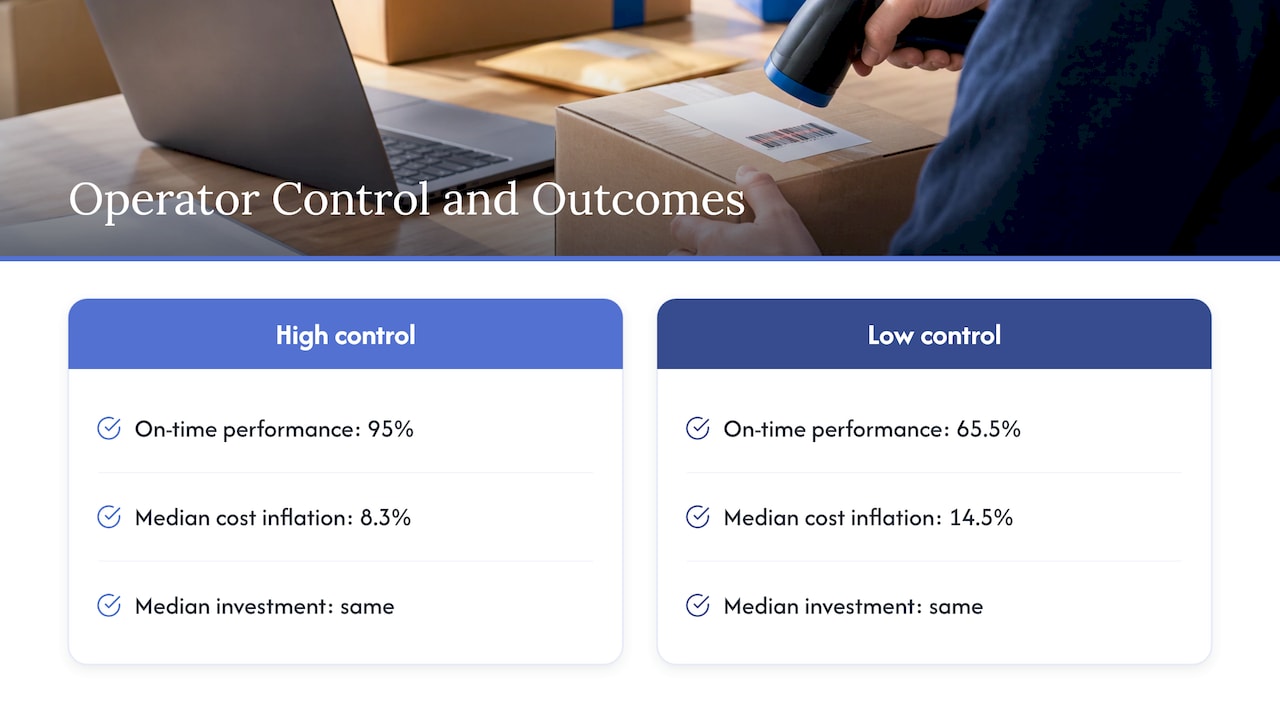
Control over the network. FarEye’s data points to control, not budget, as the difference. High-control operators reported 95% on-time performance and 8.3% median cost inflation, against 65.5% on-time and 14.5% inflation for low-control operators, at the same median investment level. A single view across warehouse, carrier and delivery is what control means in practice. Our article on control tower logistics covers how shippers build it.
KPIs to track for B2B last-mile performance
Pick a short list, review it weekly and tie each metric to an action. According to Locate2U’s guide, common starting targets are:
| KPI | Common starting target |
|---|---|
| On-time delivery rate | 95%+ for e-commerce, 98%+ for pharma |
| First-attempt success | 90%+, or 95%+ for mature operations |
| Order accuracy | 99%+ where it is critical |
| Service time per stop | 2 to 4 minutes residential, 5 to 8 minutes commercial |
Beyond those, track cost per delivery, claims and damage rate, failed delivery rate, tracking completeness and the share of customers contacting you to ask where their order is. For B2B, add one of your own: appointment hit rate, meaning the share of deliveries that arrive inside the booked window. If on-time performance is your weak spot, our plan to improve the on-time delivery KPI in 30 to 90 days is a practical start.
How to choose a B2B last-mile setup
Work through these criteria before you sign anything.
- Freight profile. Cartons, pallets, oversized or fragile? This decides parcel, LTL or specialty handling.
- Receiver requirements. Appointment rules, dock hours, liftgate needs, PO and labeling standards.
- Geography and density. Concentrated stops suit scheduled routes; scattered stops suit LTL or pooled networks.
- Visibility and data. Do you get tracking events, signed proof and exception alerts in a form your team and customers can use?
- Where the warehouse sits. Inventory placed closer to receivers shortens the last leg. See distributed warehousing for when this pays off.
- Single point of accountability. Fewer handoffs mean fewer places for a pallet to go missing. Compare options in our look at 3PL services versus in-house shipping.
Our perspective on B2B last mile
Most last-mile problems we see are not driving problems. They are warehouse problems that show up on a loading dock three days later: a label that does not match the PO, a pallet that was staged for the wrong route, an appointment nobody booked.
That is why we built our service around integration. Transportation, warehousing and fulfillment run on one platform with real-time tracking and personalized 24/7 service, so the team that picks the order also knows when the truck is due and what the receiver requires. Our approach is designed to give you one accountable partner instead of three vendors pointing at one another.
If you ship to retailers, distributors or job sites, start by fixing what happens before the truck leaves. Clean receiving, accurate labels, booked appointments and visible status do more for your on-time rate than any single rate negotiation.
Akbar
How Usiship supports business deliveries
We are a U.S. logistics provider that combines freight forwarding, warehousing, fulfillment and last-mile delivery for businesses across all 50 states. That includes full truckload and LTL, cross-docking, transloading, specialized furniture shipping and inventory management, so freight can be received, staged and delivered under one roof.
Our warehouse pricing is published: storage is $5 to $6 per bin per month and $17 to $19 per pallet per month, and additional services are billed at $37 per hour. Delivery and freight quotes depend on the shipment, so tell us what you move and where. See our last-mile delivery solutions or the full pricing page, or look at our warehousing and fulfillment solutions if you need stock positioned near your customers.
FAQ
What is the difference between B2B and B2C last-mile delivery?
B2C delivers small orders to homes, usually without a fixed appointment. B2B delivers to commercial locations such as docks and job sites, often within booked windows, with larger shipments and signed proof matched to a purchase order. Expectations for visibility are converging, though, as APQC’s research shows.
How much of shipping cost is the last mile?
Armstrong & Associates research puts it at 30% to 40% of total transportation cost. Other sources cite higher shares for parcels, so the figure depends on freight type and how it is measured.
How long does B2B last-mile delivery take?
It depends on service level, geography and where inventory sits. Local scheduled or expedited delivery can be same-day or next-day, while palletized freight and big-and-bulky items usually take longer. Placing stock closer to your receivers is the most reliable way to shorten the window.
Which metrics should I watch first?
Start with on-time delivery rate, first-attempt success and cost per delivery. Add claims rate and the share of customers asking where their order is. Locate2U’s targets give you a reasonable baseline to tighten over time.
Sources
- Last Mile Deliveries are Critical for 2024, APQC
- Big and Bulky Last-Mile Delivery in the United States, Armstrong & Associates
- U.S. last-mile cost inflation holds at 12%, Air Freight News on FarEye research
- Digitizing mid- and last-mile logistics handovers, McKinsey
- Evolving Last Mile Delivery in the United States, USPS Office of Inspector General
- Last Mile Delivery Metrics: The KPIs That Warn You Early, Locate2U
- What Is B2B Delivery? Models, JIT & Last Mile Explained