
File AMS 24 Hours Early: Reconcile With ISF and Monitor ACE
AMS filing is the electronic manifest submission that a carrier, NVOCC, or airline transmits to U.S. Customs and Border Protection before cargo reaches the border. It differs from ISF in one key way: AMS is the carrier’s job, while ISF is the importer’s responsibility. If you’re shipping into the U.S., confirm your filing pathway now, ACE, an AMS service center, or certified software, and lock in the correct mode-specific deadline before cargo departs.
TL;DR:
- Ensuring AMS is filed at least 24 hours before vessel loading or four hours before aircraft arrival prevents shipment delays and avoids last-minute errors.
- Filers must match bill of lading or airway bill numbers exactly between AMS and ISF to prevent holds or mismatches during cross-referencing.
- Delegating filing tasks to third parties does not eliminate liability; the primary filer remains responsible for data accuracy and timeliness.
- Using certified software or service centers with validated credentials streamlines AMS submission and reduces the risk of rejection or delays.
- Active monitoring, prompt amendments, and internal SLAs are essential for maintaining compliance and avoiding Do Not Load orders at ports.
Table of Contents
- What AMS Covers and How It Differs From ISF
- Who Files AMS and Who Carries the Risk
- AMS Filing Deadlines by Transport Mode
- Required Data Elements and Where Filings Go Wrong
- Filing Pathways: ACE, Service Centers, and Certified Software
- Reading CBP’s Status Messages: Bill on File, ISF Match, Do Not Load
- Your AMS Filing Checklist Before Cargo Moves
- How Universal Shipping Inc. Operationalizes AMS Filing
- AMS Filing Is an Operations Discipline, Not Paperwork
- Managed AMS Filing and Customs Clearance Support
- Sources
What AMS Covers and How It Differs From ISF
AMS exists to give CBP a look at what’s coming before it arrives. The carrier transmits manifest data, bill of lading numbers, cargo descriptions, port and voyage details, so CBP’s targeting systems can flag risk before a vessel or aircraft touches U.S. soil. That’s a different job from ISF, which importers file to disclose ten specific security-related data points about their own shipment.
The two filings have to line up, and that’s where things get tricky. CBP cross-references AMS against ISF using the bill of lading or master air waybill number, so any mismatch, even a formatting difference, can trigger a hold.
- AMS: carrier-filed, covers manifest and cargo data
- ISF (10+2): importer-filed, covers security and risk data
- The link point: bill of lading or master AWB number must match exactly across both filings
Who Files AMS and Who Carries the Risk
Vessel-operating common carriers, NVOCCs, and incoming air carriers are the primary filers of record. In practice, a lot of that work gets delegated. Deconsolidators handle house-level shipment data for air cargo and forward it through service centers, while freight forwarders and ABI-certified filers often submit on a carrier’s behalf under contract, a role CBP formally recognizes for AMS Air processing.
Delegation doesn’t erase liability. The named filer on record still answers to CBP if data is wrong or late.
- Vessel carriers and NVOCCs: file ocean AMS directly or through an agent
- Air carriers and deconsolidators: file air AMS, often splitting master and house-level data
- Required credentials: SCAC code, ACE/ABI filer code, and a continuous international carrier bond
AMS Filing Deadlines by Transport Mode
Timing rules shift by mode, and missing one by even an hour can stall a shipment at a foreign port. Here’s how the windows break down:
- Ocean: AMS must be submitted at least 24 hours before cargo is loaded onto the vessel at the foreign port, the well-known “24-hour rule.”
- Air: generally 4 hours before the aircraft’s arrival in the U.S., or at the time of departure for flights under 4 hours.
- Rail: 2 hours before the train arrives at the first U.S. port of arrival.
- Truck: 1 hour before arrival at the border, though FAST program participants get streamlined treatment.
These are legal minimums, not targets. Filing days or even hours earlier than the deadline buys room to fix typos, container swaps, or mismatched data before CBP’s systems flag anything, a habit industry guidance consistently recommends because corrections after the deadline get a lot harder.
Required Data Elements and Where Filings Go Wrong
CBP expects a defined set of fields on every AMS submission: bill of lading or air waybill number, shipper and consignee details, commodity description with HTS reference, container and seal numbers, cargo weight, voyage or flight identifiers, and port of loading and discharge. Miss one, or get one wrong, and the filing either bounces or sails through with bad data that surfaces later as an ISF mismatch.
The usual suspects behind mismatches:
- Bill of lading numbers formatted differently between the AMS and ISF filings
- Container numbers changed after the AMS filing was already submitted
- Typos in shipper or consignee names and addresses
- Vague or incomplete HS code descriptions that don’t match the actual commodity
Ship4wd’s analysis of common filing errors frames AMS and ISF as one filing with two authors, and that’s the right mental model. Treat any post-filing change, a swapped container, a corrected weight, as a trigger to reconcile both sides immediately.
Pro Tip: Build a two-person check into your process: one person files, a second person reconciles AMS against ISF before cutoff. Most mismatches are caught by a second set of eyes, not by software alone.
Filing Pathways: ACE, Service Centers, and Certified Software
You’ve got three real options for getting AMS data to CBP, and which one fits depends on your volume and technical capacity. Large carriers with high shipment counts often build direct EDI connections through the Automated Commercial Environment, using message formats like CAMIR and X12 transaction sets (309, 350, 355, 356) documented in CBP’s ACE import manifest guides. Mid-sized forwarders more often route through AMS-certified software or a service center, which handles the message formatting and acknowledgments without requiring an in-house EDI build.
CBP’s own Sea AMS Data Processing Services documentation lists approved software developers and service centers, a resource worth checking before you commit to a vendor.
Whichever path you choose, three credentials are non-negotiable:
- A valid SCAC code identifying your organization to CBP systems
- An ACE/ABI filer code authorizing electronic submission
- A continuous international carrier bond under 19 CFR 113.64
Platforms like FreightSuite illustrate where automated TMS tools fit into this picture, handling validation and transmission so filers don’t have to manage raw EDI formatting by hand. For most mid-sized operations, a certified platform or service center is the pragmatic call: it validates message structure before submission instead of after CBP rejects it.
Reading CBP’s Status Messages: Bill on File, ISF Match, Do Not Load
Once you submit, CBP talks back, and knowing what those messages mean is half the job. “Bill on File” confirms your AMS transmission was accepted and recorded. “ISF Match” confirms your ISF successfully linked to the corresponding AMS bill. Neither of those is a problem.
“Do Not Load” is the one that stops everything: it’s a blocking instruction issued to the ocean carrier that prevents cargo from being loaded at the foreign port until the issue is resolved.
- Rejections and Do Not Load orders need immediate amendment, not a wait-and-see approach
- Notify every stakeholder in the chain, shipper, consignee, broker, the moment a hold posts
- Set an internal SLA (same-business-day response is standard among experienced filers) for anyone monitoring ACE dashboards
Your AMS Filing Checklist Before Cargo Moves
Run through this sequence before every shipment, not just the complicated ones:
- Lock bill of lading, container, and seal numbers before transmission, not after.
- Cross-check AMS data against your ISF for exact matches on party names and reference numbers.
- File ahead of the mode-specific deadline, not at the wire.
- Automate validation where possible to catch format errors before CBP does.
- Log every amendment with a timestamp so you can trace what changed and when.
- Escalate to a licensed customs broker or your carrier’s operations team the moment a rejection or Do Not Load message appears.
Pro Tip: Keep a running amendment log per shipment. When CBP asks why a bill number changed three times, “we don’t know” is a much worse answer than a timestamped record.
How Universal Shipping Inc. Operationalizes AMS Filing
Usiship treats AMS as a workflow, not a form. That means verified SCAC and ABI credentials, a two-person validation pass on every filing, and active ACE monitoring so a Bill on File confirmation or a rejection gets caught the same day it posts.
The corrections that come up most often on Usiship’s desk look familiar: a container swapped after booking, a consignee address typo, an HS code that needed tightening before a customs officer questioned it. Each one gets reconciled against the linked ISF the moment it’s caught, not at month-end review.
AMS Filing Is an Operations Discipline, Not Paperwork
Too many shipping teams treat AMS as a box to check once and forget. That’s backward. The filings that cause the fewest delays are the ones treated as a living record, checked, amended, and reconciled against ISF continuously, not submitted and abandoned.
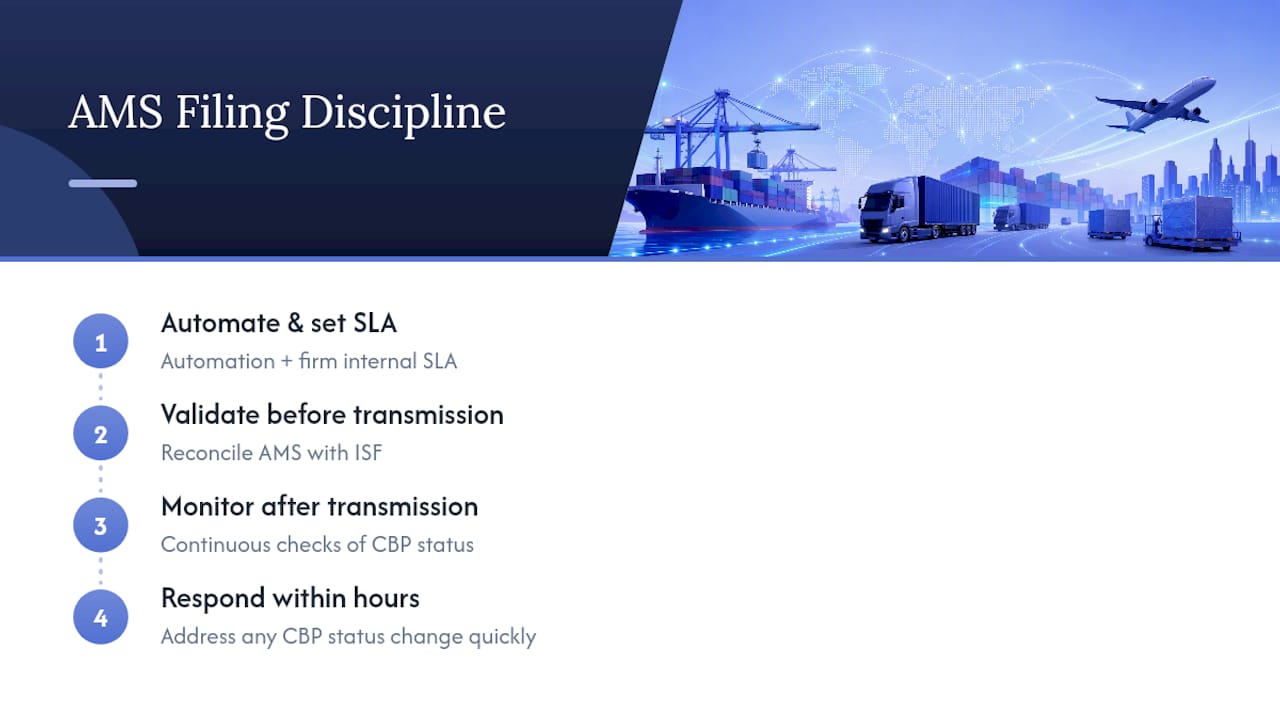
The fix isn’t more diligence from overworked staff. It’s automation paired with a firm internal SLA: validate before transmission, monitor after, and respond to any CBP status change within hours, not days. Teams that build that discipline in rarely see a Do Not Load order twice for the same root cause.
If you’d rather hand that discipline to a team that already runs it daily, that’s exactly what a managed customs and AMS filing service is built for.
— Akbar
Managed AMS Filing and Customs Clearance Support
Usiship runs AMS filing as a managed service, not a one-off task, so your team stops babysitting ACE dashboards and status codes. That includes licensed customs brokerage, direct ACE/ABI filing support, and active monitoring that catches a rejection or Do Not Load message the moment it posts instead of the next time someone checks.
The practical payoff is fewer surprises at the port: fewer fines tied to late or inaccurate transmissions, less time your operations team spends chasing amendments, and a filing record that’s already reconciled between AMS and ISF before CBP ever asks a question. Usiship’s customs clearance services cover the filing, the monitoring, and the amendment handling as one package across all 50 states. If your current process depends on one person remembering to check ACE every morning, get a quote through Usiship’s customs clearance page and put that job on a team that does it as a daily discipline instead.