
Avoid Customs Holds: Air Freight Shipping for Logistics Managers
Air freight shipping is the fastest commercial way to move time-sensitive or high-value cargo across long distances. Choose it when urgent restocks, high-value goods, or perishables and medical supplies need to arrive in days rather than weeks, and when the cost premium over ocean or ground transport is worth the speed and reliability you get in return.
TL;DR:
- Air freight costs are primarily calculated based on chargeable weight, which is the larger of actual weight and volumetric weight, with additional surcharges for fuel, security, handling, and customs.
- Small shipments in consolidation cost more per kilogram due to fixed handling fees, making group shipping or dense packaging strategies financially advantageous.
- Choosing the appropriate service level depends on shipment urgency, size, and contents, with express for urgent items and consolidation for non-urgent, small parcels.
- Precise and early paperwork, including accurate weight, proper declarations, and compliance filings, significantly reduces delays and holds in customs.
- Full-service forwarders streamline booking, clearance, and tracking, minimizing operational errors and ensuring legal and regulatory requirements are met efficiently.
Table of Contents
- Service types and how domestic and international lanes differ
- How air freight cost is calculated and what drives the price
- Picking a service level and setting transit-time expectations
- Getting the paperwork and compliance filings right
- Which add-on services actually reduce delay and risk
- How a full-service forwarder puts this into practice
- What logistics managers get wrong about air freight
- Get your air shipment moving with Universal Shipping
- Sources
- FAQ
Service types and how domestic and international lanes differ
Not every air shipment moves the same way, and picking the wrong service level wastes money or misses a deadline. Express or next-flight-out service books the soonest available flight and typically clears fastest, at the highest price per kilogram. Scheduled cargo service rides a set flight rotation, usually a few days slower but considerably cheaper for planned shipments. Charter service reserves an entire aircraft, used for oversized freight, event-driven demand spikes, or when no scheduled capacity exists on a route. Consolidation groups multiple shippers’ cargo into one master shipment, cutting cost for smaller loads that do not need a dedicated flight.
Two documents define the shipment legally: the Master Air Waybill (MAWB), issued by the airline to the forwarder, and the House Air Waybill (HAWB), issued by the forwarder to the individual shipper. A consolidated shipment carries one MAWB and several HAWBs, which matters when tracing a delay or filing a claim.
Domestic and North American lanes skip most customs formalities, so transit is mostly about airport-to-airport scheduling. International lanes add customs clearance, denied party screening, and country-specific import rules, which is why routing and paperwork deserve careful attention before booking.
Before booking, confirm:
- The acceptance point and cutoff time at the origin airport.
- Whether the rate quoted is airport-to-airport or includes pickup and delivery.
- Which party is named as importer of record on international moves.
How air freight cost is calculated and what drives the price
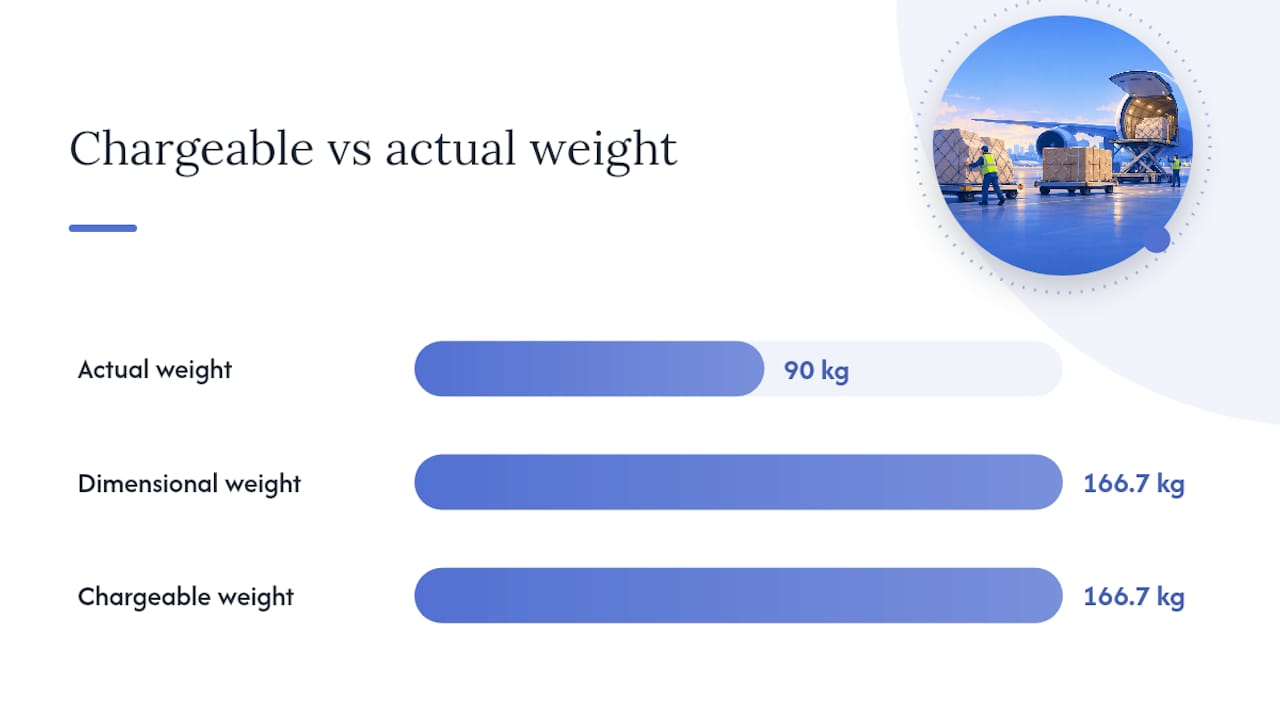
Air freight is billed on chargeable weight, which is the greater of actual weight and dimensional (volumetric) weight. Carriers calculate dimensional weight by dividing a shipment’s length times width times height in centimeters by a standard divisor, commonly 6,000. A pallet measuring 100 by 100 by 100 centimeters works out to 166.7 kilograms of dimensional weight. If that same pallet weighs only 90 kilograms on the scale, you pay for 166.7 kilograms because it is the larger figure.
On top of the base rate per kilogram, expect several add-ons:
- Fuel and security surcharges, which move with oil prices and airport security requirements.
- Terminal handling charges at both origin and destination airports.
- Customs brokerage and duty payments on international shipments.
- Documentation and screening fees tied to compliance filings.
Small shipments booked through consolidation generally cost more per kilogram than pallet or unit load device (ULD) volumes, because fixed handling fees are spread across less weight. IATA’s overview of cargo types moved by air notes that shippers weigh urgency and value density against these cost structures when deciding whether air makes sense for a given load.
Three tactics reliably lower the bill: consolidate smaller shipments with other freight headed to the same destination, stay flexible on routing so your forwarder can use the cheapest available capacity, and repackage goods in dense, uniform boxes to shrink dimensional weight rather than actual weight.
Picking a service level and setting transit-time expectations
Match the service to the shipment, not the other way around. Weigh urgency, value density, weight and volume, whether the cargo is regulated as dangerous goods, budget, and how developed the destination airport’s handling infrastructure is.
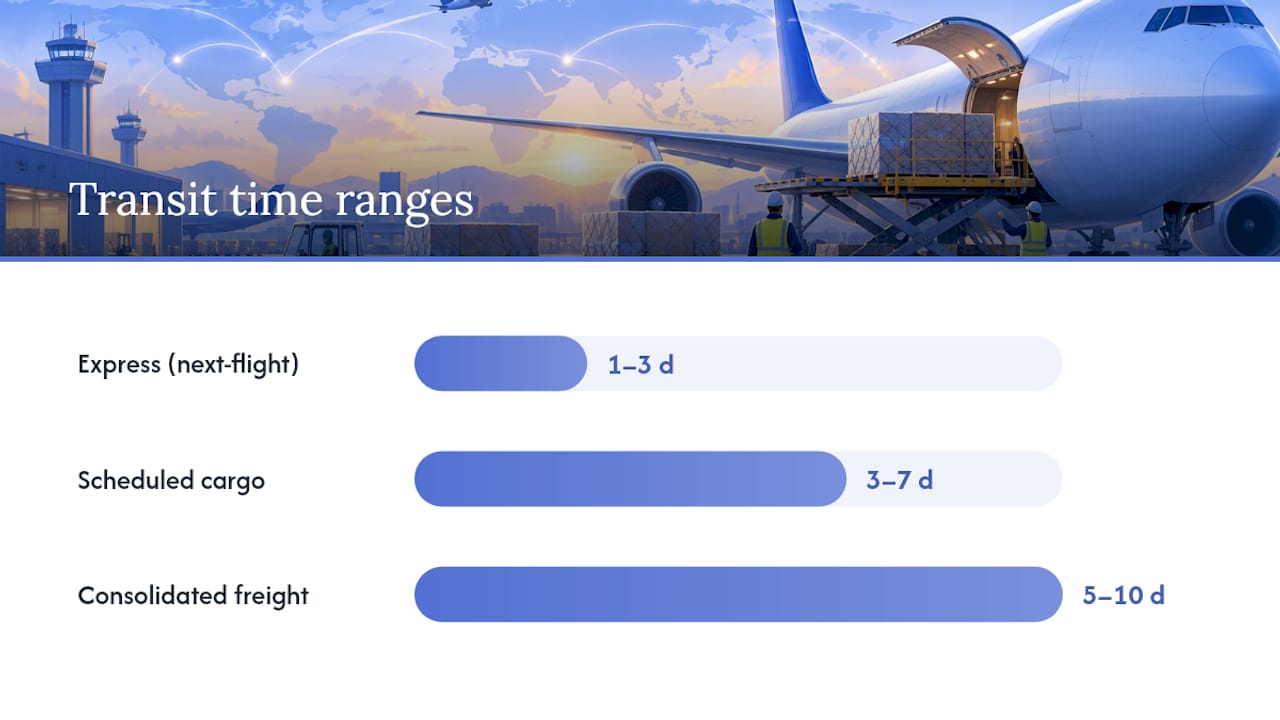
Typical ranges, door-to-door: express or next-flight-out often runs one to three days, scheduled cargo three to seven days, consolidated freight five to ten days depending on the consolidation cycle, and charter timing depends entirely on aircraft availability and routing.
A rough decision matrix helps:
- Medical supplies, live product launches, or contractual penalty clauses: express.
- Routine restocks with a known reorder cycle: scheduled or consolidated.
- Oversized equipment or a demand spike with no scheduled capacity: charter.
- Small, non-urgent parcels: consolidation to control cost.
Escalate immediately on weight or dimension discrepancies between the booking and the scale, a missing Dangerous Goods Declaration on a battery-containing shipment, or an AWB with incomplete consignee or commodity information. A forwarder’s expedited freight decision matrix can help formalize these calls for a logistics team handling multiple lanes at once.
Pro Tip: Book your service level before you finalize packaging: dimensional weight, not actual weight, often decides whether express or consolidation is the cheaper option.
Getting the paperwork and compliance filings right
Four documents anchor every compliant air shipment: the Air Waybill, which serves as the contract of carriage and primary manifest record; the commercial invoice, which declares value and supports customs duty calculation; the packing list, which itemizes contents and weights per package; and, for regulated goods, the Shipper’s Declaration for Dangerous Goods.
For shipments bound for the United States, the Air Cargo Advance Screening (ACAS) program requires advance electronic filing of specific shipment data elements before cargo is loaded. CBP’s ACAS implementation guidance describes these mandatory message elements and notes that filing early, with master and house bills correctly linked, reduces the risk of Do-Not-Load or selectee holds. Separately, CBP’s Air AMS and ACE guidance requires accurate AWB-level manifest data on arrival, and vague commodity descriptions or mismatched weights can trigger penalties or a secondary exam.
Lithium battery shipments carry their own rules. ICAO’s Technical Instructions addenda confirm that batteries shipped above certain state-of-charge limits may require operator or State approval, and IATA’s 2026 Dangerous Goods Regulations call for many lithium ion batteries to be offered at no more than 30% state of charge, correctly classified under UN 3480 or UN 3481, and in some cases marked “cargo aircraft only.” Classification responsibility sits with the shipper, not the carrier.
Treat the Air Waybill and Dangerous Goods Declaration as legal documents, not administrative paperwork. Most holds trace back to a mismatch between what was declared and what was packed.
Checks that prevent holds:
- Confirm battery watt-hour rating and state of charge match the packing list before drop-off.
- Verify HS classification and commodity description are specific, not generic.
- Run denied party screening on all parties named on the AWB before booking, a step covered in more detail in guidance on denied party screening.
Which add-on services actually reduce delay and risk
A handful of value-added services consistently pay for themselves. Customs brokerage handles tariff classification, duty calculation, and formal release, which matters most on lanes with complex duty exposure, including shipments where a change in origin can shift duty rates significantly, as covered in guidance on China-to-U.S. shipping. Temperature-controlled handling protects pharmaceuticals, fresh produce, and other perishable cargo through cold-chain packaging and monitored transit.
Declared-value insurance is worth the premium whenever the cargo’s replacement cost exceeds what the carrier’s standard liability would cover, which for most airlines is a modest per-kilogram limit. Real-time visibility platforms and proactive delay notifications remove the guesswork around estimated arrival, letting a logistics manager reroute downstream trucking or notify a customer before a problem becomes a missed deadline.
- Brokerage prevents duty miscalculations and clearance delays at the border.
- Cold-chain handling protects perishable and pharmaceutical cargo in transit.
- Declared-value insurance covers cargo worth more than standard carrier liability.
How a full-service forwarder puts this into practice
Universal Shipping’s freight forwarding services combine air freight booking, licensed customs brokerage, and shipment tracking under one workflow, so ACAS filing, AWB accuracy, and manifest data are handled as one process rather than separate handoffs. Dangerous goods paperwork, including battery watt-hour and state-of-charge documentation, gets checked before booking to cut hold risk.
Before requesting a quote, prepare accurate actual and dimensional weights, itemized commodity descriptions with HS codes, and full battery specifications if the shipment includes lithium cells.
What logistics managers get wrong about air freight
The biggest operational risk is not the flight schedule, it is the paperwork behind it. Accurate weight and dimension reporting, early ACAS and manifest filing, and precise dangerous goods declarations prevent more delays than any choice of express versus scheduled service ever will.
My one insider tip: treat the AWB as a legal manifest, not a shipping label, and always confirm battery watt-hours and state of charge before the box is sealed. That single check catches most of the holds I see repeated across shippers.
— Akbar
Get your air shipment moving with Universal Shipping
Some logistics providers handle air freight forwarding, customs brokerage, and shipment tracking as one connected service, so customers avoid chasing separate vendors for booking, clearance, and status updates. 
Check current service tiers and pricing or go straight to the freight forwarding and customs brokerage page to request a quote for your next air shipment.
Sources
- ICAO Technical Instructions for the Safe Transport of Dangerous Goods by Air — Addendum
- ACAS Implementation Guide Version 2.3.1
FAQ
How much does it cost to ship air freight?
Cost depends on chargeable weight, which is the greater of actual weight and dimensional weight, plus fuel, security, and terminal handling surcharges. Small shipments moved through consolidation typically cost more per kilogram than pallet or ULD volumes because fixed handling fees spread across less weight, as IATA’s cargo overview notes when comparing shipment types.
What is air freight in shipping?
Air freight is cargo transport by commercial or chartered aircraft, used when speed matters more than the higher cost compared to ocean or ground transport. It suits urgent restocks, high-value goods, and perishable or medical shipments that cannot tolerate a multi-week transit.
Is air freight cheaper than ocean freight?
Air freight generally costs more per kilogram than ocean freight, but it moves in days rather than weeks, so the choice depends on how urgency and inventory holding costs weigh against the price difference. For non-urgent, high-volume cargo, ocean freight usually remains the lower-cost option.
What items cannot be shipped by air?
Certain dangerous goods are restricted or forbidden on passenger aircraft, and some, including lithium batteries above specified state-of-charge limits, may need to move as “cargo aircraft only” or require operator approval under IATA’s Dangerous Goods Regulations. Shippers are responsible for correctly classifying and declaring these items before booking.