
Accessorial Charges: A Practical Guide for Freight Shippers
Accessorial charges are the additional fees carriers bill when a shipment requires services, equipment, or conditions beyond the standard pickup-to-delivery rate. By default, the shipper pays them unless the contract explicitly shifts liability. Check your rate confirmation for listed accessorials and caps right now. Capture delivery evidence at every stop: proof of delivery (POD), timestamps, and photos. Add recurring destinations to a destination-classification database or flag them in your TMS so limited-access and residential fees surface at quoting time, not on the invoice.
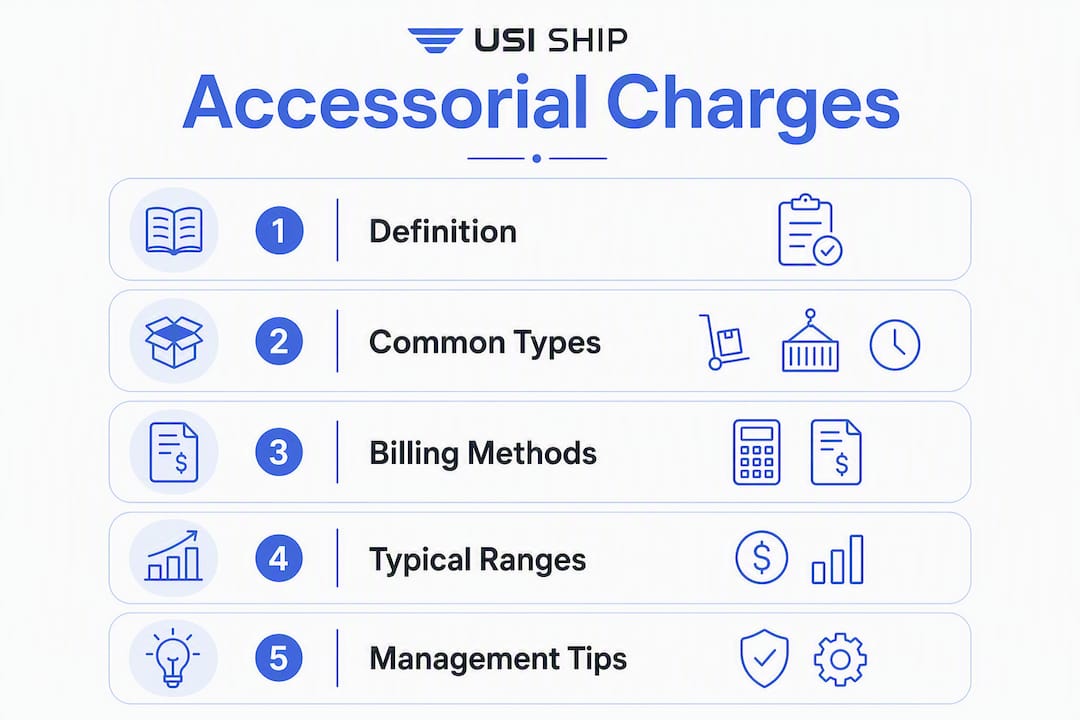
The rest of this guide covers how each fee is calculated, what typical U.S. ranges look like, how to prevent the most common triggers, and how to dispute charges that do not belong on your invoice.
Table of Contents
- What accessorial charges are and why carriers use them
- The most common accessorial charges you will see on U.S. freight invoices
- How carriers calculate and bill accessorial charges
- Typical U.S. fee ranges and what they look like on an invoice
- How to avoid or reduce accessorial fees before they happen
- How to audit and dispute accessorial charges
- Contract language that limits your accessorial exposure
- Technology tools that help you manage accessorial spend
- Operational checklists and a sample dispute email
- Key Takeaways
- The part of accessorial management most shippers get wrong
- How Usiship helps you control accessorial costs before they hit your invoice
- Useful sources for further reading
What accessorial charges are and why carriers use them
Accessorial charges cover any service, time, equipment use, or condition that falls outside the carrier’s standard line-haul scope. A driver waiting two hours at a dock, a liftgate deployed at a residential address, a hazmat placard requirement, a shipment that turns out to weigh more than the BOL stated: each of these creates real cost for the carrier, and accessorials are how that cost gets recovered.
Carriers use them for three reasons:
- Cost recovery. Base rates are priced for a clean pickup and delivery. Detention, lumper fees, and inside delivery all consume driver time or third-party labor that was never priced into the line-haul.
- Regulatory compliance. DOT hazmat regulations require specific placarding, handling, and documentation, which carriers pass through as hazmat surcharges.
- Risk pricing. Residential and limited-access locations take longer and carry higher liability. The surcharge reflects that reality.
Some accessorials are quoted upfront when the shipper provides complete shipment details. Others appear post-delivery after the carrier audits what actually happened: an address reclassified as residential, a package that triggered a dimensional weight adjustment, a pallet count that changed at the dock. Fuel surcharges follow their own index (typically tied to the DOE weekly diesel price) and are usually treated as a separate line item rather than a true accessorial.
The strategic objective is not to eliminate every accessorial. Many are legitimate. The real goal is billing accuracy: every charge on your invoice should be authorized, documented, and aligned with what your contract actually says.
The most common accessorial charges you will see on U.S. freight invoices
The list below covers LTL and truckload freight. Where the fee behaves differently across modes, that distinction is noted.
1. Detention
Trigger: Driver waits beyond the free-time window at pickup or delivery.
Billing basis: Per hour after free time expires. Most carrier agreements allow two free hours; after that, rates typically run $50–$85/hour, with industry medians around $100 per load.
LTL vs. FTL: Both modes charge detention, but FTL detention is more common because a single driver is committed to one load for the full day.

2. Layover
Trigger: A driver cannot complete delivery on the scheduled day and must hold the load overnight.
Billing basis: Per day. Rates commonly run $200–$500/day depending on the carrier.
Note: Layover and detention can stack on the same shipment if the driver waited and then could not deliver.
3. Truck Ordered Not Used (TONU)
Trigger: A carrier dispatches a truck and the shipper cancels or fails to tender the load.
Billing basis: Flat fee per occurrence, typically $150–$300.
FTL note: TONU is almost exclusively a truckload charge; LTL carriers rarely apply it because the truck carries multiple shippers.
4. Liftgate service
Trigger: No loading dock at origin or destination; a hydraulic liftgate is required to raise or lower freight.
Billing basis: Flat fee per occurrence, typically $30–$150.
LTL note: Liftgate is one of the most frequently missed fees in LTL quoting, especially for furniture and appliance shipments. Specialized freight like furniture almost always requires liftgate at residential stops.
5. Lumper fees
Trigger: A third-party labor crew unloads the trailer at the receiver’s warehouse.
Billing basis: Per job. Standard unloads typically run $75–$300; complex pallet breakdowns or re-palletization can go higher.
Documentation requirement: Always get a signed lumper receipt. Without it, you cannot dispute the charge or verify the amount.
6. Inside delivery
Trigger: Freight must be moved beyond the threshold of the delivery location, not just dropped at the dock or curb.
Billing basis: Flat fee or per-piece rate, depending on the carrier.
Stacking risk: Inside delivery often stacks with liftgate on residential shipments.
7. Residential delivery surcharge
Trigger: Delivery to a home or home-based business rather than a commercial address.
Billing basis: Flat fee per shipment. Parcel carriers charge roughly $6–$7 for ground residential in current rate schedules; LTL residential surcharges run higher, often $50–$100+.
Common mistake: Shippers list a business address that carriers classify as residential (a home office, for example), triggering the surcharge post-delivery.
8. Limited access delivery
Trigger: Delivery to a location that requires extra time or effort to navigate: construction sites, military bases, schools, churches, fairs, mines, or anywhere a standard commercial truck cannot pull up and unload normally.
Billing basis: Flat fee, typically $75–$250, though some carriers charge $100–$400 depending on location complexity.
Critical caveat: Carrier definitions of “limited access” are not standardized. A site one carrier treats as commercial may trigger a limited-access fee from another. Maintain a destination database and verify classification before tendering.
9. Reclass and reweigh
Trigger: The carrier’s audit finds the freight class or weight on the BOL does not match what was actually shipped.
Billing basis: Adjusted freight charges based on the corrected class or weight, plus an inspection fee in some cases.
LTL note: Reclass is almost exclusively an LTL issue because LTL rates are class-based under the NMFC system. A shipment quoted at class 50 that audits to class 85 can double the freight charge.
10. Redelivery
Trigger: The carrier attempts delivery and cannot complete it (no one available to receive, access denied, address incorrect).
Billing basis: Flat fee per attempt, which can reach roughly $400 in some carrier tariffs.
Prevention: Appointment scheduling and accurate contact information at the consignee eliminate most redelivery triggers.
11. Storage
Trigger: Freight sits at a carrier terminal or warehouse beyond the free-time window because the consignee cannot accept it.
Billing basis: Per day, typically $25–$250/day depending on carrier and shipment size.
Stacking risk: Storage often follows a failed redelivery attempt, so two charges can appear on the same invoice.
12. Stop-off and additional stops
Trigger: A truckload shipment requires more than one pickup or delivery location.
Billing basis: Flat fee per additional stop, typically $50–$150.
FTL note: This is primarily a truckload charge. LTL carriers price multi-stop differently because each stop is a separate BOL.
13. Tarp and flatbed extras
Trigger: Open-deck freight requires tarping for weather protection, or specialized blocking and bracing.
Billing basis: Flat fee per tarp used, or per load.
Note: Flatbed accessorials also include coil racks, chains, and straps, each of which may carry its own line item.
14. Oversized and overlength charges
Trigger: Freight exceeds standard length, width, or height thresholds defined in the carrier’s tariff.
Billing basis: Flat fee or per-foot surcharge beyond the threshold.
LTL note: LTL carriers apply overlength fees when a single piece exceeds 8–12 feet depending on the carrier.
15. Hazmat surcharge
Trigger: Shipment contains materials regulated under DOT 49 CFR hazmat rules, requiring placarding, special handling, or documentation.
Billing basis: Flat fee per shipment or per piece, depending on hazard class.
Documentation: Customs and regulatory paperwork must be complete before tender; missing documentation can trigger both a hazmat fee and a delay charge.
Pro Tip: Multiple accessorials can stack on a single shipment. A residential delivery requiring a liftgate, inside delivery, and a redelivery attempt can add $300–$600 to a single invoice before any line-haul adjustment.
How carriers calculate and bill accessorial charges
Understanding the billing mechanics is what separates a shipper who budgets accurately from one who gets surprised every month.
Pricing models by fee type:
- Flat fee per occurrence: Liftgate, TONU, redelivery, residential, limited access, hazmat. The amount is fixed regardless of shipment size or time spent.
- Per hour: Detention and layover. The clock starts after free time expires, and carriers use driver logs, gate timestamps, and appointment records as evidence.
- Per day: Storage and layover. Free time (often 24–48 hours at a terminal) applies before daily charges begin.
- Per piece or per hundredweight: Lumper fees at some carriers, sort-and-segregate charges, and certain inside-delivery rates.
- Per event: TONU and stop-off charges apply once per trigger event.
Timing: quoted vs. post-delivery:
This is where most invoice surprises originate. Carriers frequently apply fees after delivery based on what actually happened rather than what was quoted. Common post-delivery adjustments include:
- Address corrections (residential reclassification)
- Dimensional weight recalculation
- Freight reclass after a carrier inspection
- Detention confirmed from driver logs submitted days later
Billing timeline: Most carrier invoices for LTL arrive within 7–14 days of delivery. Post-delivery adjustments can appear on a separate invoice 30–60 days later. Set an internal SLA to review all freight invoices within 21 days of receipt so dispute windows stay open.
Typical U.S. fee ranges and what they look like on an invoice
Accessorials can represent 20–30% of total parcel spend for a typical shipper, climbing toward 40% during peak season. In LTL and truckload, the impact varies by lane and shipment profile, but a single complex delivery can add several hundred dollars to a base rate.
| Accessorial | Typical U.S. Range | Billing Basis |
|---|---|---|
| Detention | $50–$100/hour (after 2 free hours) | Per hour |
| Liftgate | $30–$150 | Flat per occurrence |
| Lumper | $75–$300 (standard); higher for complex unloads | Per job |
| TONU | $150–$300 | Flat per occurrence |
| Layover | $200–$500/day | Per day |
| Redelivery | Up to ~$400 | Flat per attempt |
| Storage | $25–$250/day | Per day |
| Limited access | $75–$250 (some carriers up to $400) | Flat per occurrence |
| Residential (LTL) | $50–$100+ | Flat per shipment |
| Residential (parcel) | ~$6–$7 (ground) | Flat per shipment |
Example 1: Detention on a truckload pickup. A driver arrives at 8:00 AM for a scheduled pickup. The dock is not ready until 10:30 AM. Free time is two hours, so detention begins at 10:00 AM. At $75/hour, the shipper owes $37.50 for the 30-minute overage. If the dock runs until noon, that is $150 in detention on a single pickup.
Example 2: LTL reclass from class 50 to class 85. A shipper quotes a pallet of plastic parts at class 50 (base rate: $200). The carrier inspects and reclassifies to class 85. The same pallet now bills at roughly $340 in freight charges, plus a $25 inspection fee. A $200 shipment becomes a $365 invoice.

Caveat: Every range above reflects industry norms, not guarantees. Regional carriers, specialized carriers, and peak-season surcharges can push figures outside these bands. Always verify against the carrier’s published tariff for the specific lane.
How to avoid or reduce accessorial fees before they happen
Prevention is cheaper than dispute resolution. Most accessorial charges trace back to incomplete or inaccurate information at the time of booking.
- Capture accurate dimensions and weight at order entry. Weigh and measure every pallet before tendering. Dimensional weight recalculations and reweigh fees disappear when your numbers match the carrier’s scale.
- Verify address type before booking. Confirm whether the delivery location is commercial or residential. Check whether it meets any carrier’s definition of limited access. A quick call to the consignee prevents a $150 surprise.
- Use the correct NMFC class. For LTL, look up the freight class in the NMFC directory before booking. Misclassification is the single largest source of post-delivery invoice adjustments in LTL.
- Book appointments where required. Redelivery fees almost always follow a failed delivery attempt. If the consignee needs an appointment, book it before tendering the load.
- Confirm dock equipment at origin and destination. Does the location have a loading dock? If not, liftgate is required. Ask the question at booking, not at delivery.
- Insist on lumper receipts and driver signatures. At delivery, the driver or receiver should sign a lumper receipt showing the amount paid. Without this, you cannot verify the charge or dispute an inflated one.
- Capture timestamps and photos at every stop. Gate-in and gate-out times, dock assignment records, and photos of freight condition are the primary evidence in detention and damage disputes.
- Negotiate longer free time for high-volume lanes. If you ship regularly to a slow-unloading facility, negotiate three or four hours of free time in your carrier contract instead of the standard two.
- Build and maintain a destination-classification database. Sophisticated shippers tag known limited-access locations and factor those fees into quotes automatically. A spreadsheet works; a TMS rule works better.
Pro Tip: Include expected accessorials and caps directly in the rate confirmation. A rate confirmation that lists “liftgate: $75 flat, detention: $65/hour after 2 hours” eliminates ambiguity and gives you a contractual baseline for every dispute.
How to audit and dispute accessorial charges
Billing accuracy, not fee elimination, is the real goal. A repeatable audit process catches errors before they compound.
Step-by-step dispute workflow:
- Step 1: Identify the suspect charge. Flag any line item that was not quoted, exceeds the contracted rate, or lacks a documented trigger.
- Step 2: Gather evidence. Pull the rate confirmation, BOL, driver logs, timestamps, photos, lumper receipts, appointment confirmations, and signed POD.
- Step 3: Match to the rate confirmation and tariff. Compare the billed amount and trigger to what the contract says. If the charge is not in the tariff or exceeds the cap, you have grounds for dispute.
- Step 4: Submit the dispute in writing. Email the carrier’s billing department with the invoice number, the specific charge, your evidence, and the requested remedy (credit or corrected invoice). Most carriers require disputes within 180 days of invoice date, but submit within 21 days of receipt to stay well inside that window.
- Step 5: Track and follow up. Log every dispute with submission date, carrier contact, and expected resolution date. Follow up at 14 days if no response.
- Step 6: Escalate if unresolved. Escalate to your carrier account manager, then to contract/legal review if the amount is material. For high-volume dispute programs, a third-party freight-audit service can handle submission and tracking at scale.
Required documentation checklist:
- Rate confirmation (signed, showing accessorial rates and caps)
- Bill of Lading (BOL) with accurate shipment details
- Driver logs and gate timestamps
- Appointment confirmation (email or carrier portal record)
- Photos of freight and delivery conditions
- Lumper receipt (signed, showing amount)
- Signed POD showing receiver name, time, and condition
Suggested internal SLA: Submit disputes within 21 days of invoice receipt. Review dispute outcomes quarterly and use patterns (same carrier, same lane, same fee type) to drive contract renegotiation.
Contract language that limits your accessorial exposure
The best time to control accessorial costs is before the first shipment moves, not after the invoice arrives.
Sample clause ideas:
- Free-time definition: “Free time at origin and destination shall be [X] hours from scheduled appointment time. Detention shall not accrue before the scheduled appointment time.”
- Limited-access definition: “Limited access locations shall be defined as [specific list]. Carrier shall notify shipper within 24 hours of tender if a destination is classified as limited access. Shipper pre-approval is required before a limited-access surcharge is applied.”
- Lumper pre-approval: “Carrier shall obtain written pre-approval from shipper before engaging third-party unloading services. Lumper charges shall not exceed $[X] per occurrence without prior written authorization.”
- Dispute timeline: “Shipper retains the right to dispute any invoice line item within 180 days of invoice date. Carrier shall respond to disputes within 30 days.”
- Audit rights: “Shipper or its designated agent may audit carrier invoices and supporting documentation for any shipment within the preceding 12 months.”
Negotiation checklist:
- Cap detention at a flat maximum per load for high-volume lanes.
- Require line-item invoices with trigger documentation for every accessorial.
- Insist on pre-approval clauses for lumper and inside delivery.
- Define “residential” and “limited access” explicitly in the contract, not by reference to the carrier’s tariff alone.
- Use volume commitments and lane guarantees as leverage to win concessions on recurring fees.
- Request monthly invoice summaries with accessorial spend broken out by fee type so you can track trends.
The carriers most willing to negotiate are the ones who want your volume. Come to renewal with 12 months of accessorial spend data broken out by fee type. That data tells the carrier exactly where you want relief and shows you have done the work.
Technology tools that help you manage accessorial spend
No single tool eliminates accessorials, but the right stack reduces surprises and speeds dispute resolution significantly.
Transportation Management Systems (TMS): A TMS like MercuryGate, Oracle TMS, or Blue Yonder can apply rules at tender: flag shipments to known limited-access ZIP codes, block bookings without required paperwork, and auto-populate accessorial fields based on address type. The upfront implementation effort is real, but the payoff is fewer post-delivery surprises.
Freight audit and payment platforms: Tools in this category (such as Cass Information Systems or nVision Global) match carrier invoices against rate confirmations automatically, flag discrepancies, and manage dispute submission. For shippers processing hundreds of invoices monthly, automation here pays for itself quickly.
Carrier portals and EDI integrations: Most major LTL carriers offer portal access where you can check shipment status, pull PODs, and see accessorial charges before the invoice arrives. EDI 210 (freight invoice) and EDI 214 (shipment status) integrations push that data directly into your ERP or TMS.
Destination-classification databases: A structured database (even a well-maintained spreadsheet) that tags known limited-access, residential, and appointment-required locations is one of the highest-ROI tools available. Build it once, maintain it continuously, and every future quote for those locations will include the right fees.
Mobile driver capture apps: Apps that capture gate timestamps, photos, and electronic signatures at pickup and delivery create an automatic evidence trail. When a detention dispute arrives 45 days later, the timestamps are already in the system.
Human review still matters. Automated invoice matching catches rate mismatches, but it cannot evaluate whether a lumper charge was legitimate or whether a limited-access classification was applied correctly. Build a human review step for any flagged charge above a defined threshold.
Operational checklists and a sample dispute email
Pre-shipment checklist
- Confirm actual weight (scale ticket or certified scale).
- Confirm actual dimensions (L × W × H for each piece).
- Look up NMFC class for LTL shipments.
- Verify address type: commercial, residential, or limited access.
- Confirm dock equipment at origin and destination (dock door, liftgate needed?).
- Book appointment if required by consignee.
- Complete all required paperwork (BOL, hazmat docs if applicable).
- Record expected accessorials and caps on the rate confirmation.
Delivery capture checklist
- Record gate-in and gate-out timestamps.
- Photograph freight condition at pickup and delivery.
- Obtain driver name and ID number.
- Obtain signed lumper receipt if third-party unloading occurs.
- Obtain signed POD with receiver name, time, and condition noted.
- Note any delays, access issues, or equipment problems.
Post-invoice audit checklist
- Record invoice receipt date and start the 21-day dispute clock.
- Match each line item to the rate confirmation.
- Identify any charge not listed in the rate confirmation or exceeding the cap.
- Pull supporting documentation for each suspect charge.
- Prepare dispute packet: invoice copy, rate confirmation, BOL, evidence.
- Submit dispute in writing and log the submission.
Sample dispute email
Subject: Invoice Dispute — Invoice #[XXXX], Shipment PRO #[XXXX]
Dear [Carrier Billing Contact],
We are disputing the [fee name] charge of $[amount] on Invoice #[XXXX] dated [date].
Reason for dispute: This charge was not included in our rate confirmation dated [date] / exceeds the contracted cap of $[amount] / was applied without the required pre-approval.
Attached documentation:
- Rate confirmation (signed, dated [date])
- Bill of Lading #[XXXX]
- [Timestamps / photos / lumper receipt / POD as applicable]
Requested remedy: Credit of $[amount] to our account or issuance of a corrected invoice.
Please confirm receipt of this dispute and provide a resolution timeline. Per our contract, disputes must be resolved within 30 days.
[Your name, title, company, contact information]
Key Takeaways
Accessorial charges are predictable and manageable when every fee is documented in the rate confirmation, evidence is captured at delivery, and invoices are audited within 21 days of receipt.
| Point | Details |
|---|---|
| Capture evidence at every stop | Gate timestamps, photos, and signed PODs are your primary dispute tools. |
| Flag limited-access destinations early | Maintain a destination database so fees surface at quoting time, not on the invoice. |
| Negotiate caps in the contract | Secure written caps on detention, lumper, and limited-access fees before the first load moves. |
| Audit invoices within 21 days | Submit disputes well inside the carrier’s window; track outcomes to drive renegotiation. |
| Usiship manages accessorial exposure end-to-end | Pre-tender validation, destination flags, invoice audit, and dispute support reduce surprise spend. |
The part of accessorial management most shippers get wrong
The conventional advice is to dispute everything and negotiate everything down. That framing misses the point. Carriers apply most accessorials because something genuinely happened: the dock was not ready, the address was wrong, the freight needed a liftgate. Disputing a legitimate charge wastes your credibility with the carrier and your team’s time.
The shippers who actually reduce accessorial spend do something different. They treat every charge as a data point. A detention charge is not just a billing error to dispute; it is evidence that a dock process needs fixing. A pattern of residential surcharges on what should be commercial deliveries means your address verification at order entry is broken. A string of reclass adjustments means your NMFC lookup process is unreliable.
The best-run freight programs I have seen share one habit: they review accessorial spend by fee type every month, not just when an invoice looks wrong. That monthly review turns a reactive dispute process into a proactive cost-reduction program. The goal is not a zero-accessorial invoice. The goal is an invoice where every line item was expected, authorized, and documented before the truck left the yard.
How Usiship helps you control accessorial costs before they hit your invoice
Freight shippers who manage accessorials reactively spend more time disputing than shipping. Usiship’s logistics transportation services are built around the opposite approach: surface every potential fee before the load tenders, not after it delivers.
Usiship handles pre-tender validation, destination classification, and invoice audit as part of its end-to-end freight forwarding and supply chain management. For ecommerce and fulfillment operations, omnichannel fulfillment support includes dimensional controls and packaging standards that prevent the most common parcel accessorials before a shipment leaves the warehouse. For specialized freight, the team flags liftgate, inside delivery, and limited-access requirements at quoting time so the rate confirmation already reflects the full cost.
When a dispute does arise, Usiship’s team manages documentation, submission, and carrier follow-up so your operations team stays focused on moving freight. Get a quote or speak with a logistics specialist at usiship.com to see how proactive accessorial management fits into your freight program.
Useful sources for further reading
The sources below were used in building this guide. For exact fee triggers and amounts, always verify against the specific carrier’s published tariff for your lane.
- DAT: Understanding Freight Accessorial Charges — Industry overview of supplemental fees beyond base freight rates, with context on how accessorials affect supply chain costs.
- Truckstop: Accessorial Charges Brokers Need to Know — Practical breakdown of detention, lumper, TONU, and layover fees with typical rate ranges for brokers and shippers.
- Shippo: What Are Accessorial Charges? A Guide for Shippers — Covers parcel accessorials in depth, including residential surcharges, dimensional weight, and peak-season surcharge patterns.
- ITS Traffic: Accessorial Charges Explained — Expert framing on billing accuracy vs. fee elimination, with guidance on documentation and contract alignment.
- Owlery: What Is Limited Access Delivery? — Explains how carrier definitions of limited access vary and why a destination database is the best operational control.
- Heavy Haulers: What Is Limited Access Delivery and How Do Truckers Get Around It? — Covers limited-access fee ranges and practical workarounds for specialized and oversize freight.
- ArcBest: Accessorial Charges in Truckload and LTL Freight — Carrier-side perspective on how accessorials are applied in both LTL and truckload modes, useful for understanding tariff language.