
Ecommerce Ops: 90 Day Pilot for Distributed Order Management
Distributed order management is the software layer that decides where an order should be sourced and fulfilled when a business has more than one warehouse, store, or fulfillment node feeding customer orders. You need it once you’re running multi-channel selling across several locations and your current system can’t answer, in real time, which node should ship a given order. Done right, it lifts fill rates, cuts fulfillment costs, and shortens delivery windows.
TL;DR:
- Dedicated DOM is essential when managing three or more fulfillment nodes or offering real-time inventory sharing and split shipments, as basic OMS cannot handle these complex routing needs effectively.
- Effective DOM relies on comprehensive inventory visibility, configurable routing rules, and real-time available-to-promise calculations to optimize fulfillment from multiple locations for faster delivery and lower costs.
- Integration between DOM and surrounding systems must support event-driven, low-latency APIs and include audit logs and correlation IDs to prevent order errors and enable quick troubleshooting.
- Implementing DOM should follow a staged approach, starting with pilot projects over 90 days, rather than a full rollout, to manage risks and validate performance at each phase.
- Using a third-party fulfillment partner can provide multi-node execution capabilities immediately, especially when routing optimization is less critical than order accuracy and speed.
Table of Contents
- What distributed order management is and how it fits into the commerce stack
- DOM vs OMS: the practical differences operations teams must know
- Key DOM features and capabilities operations teams should evaluate
- How DOM routing and optimization actually work
- Integration and architecture: systems, APIs, and data you must connect
- Implementation approach, typical timeline, and staging plan
- Common use cases and who benefits most from DOM
- Metrics, ROI, and what operational gains to expect
- Security and compliance considerations in distributed order management
- Practical traps we’ve seen in DOM projects
- An adjacent path: reducing DOM complexity with a fulfillment partner
- Sources
- FAQ
What distributed order management is and how it fits into the commerce stack
Distributed order management, often shortened to DOM, is the layer responsible for one job: deciding which location, warehouse, store, or supplier should fulfill each unit of an order the moment it’s placed. Gartner defines DOM as software that orchestrates and optimizes fulfillment across multiple channels and inventory locations, using configurable business rules and network-wide inventory visibility to calculate available-to-promise and available-to-ship.
That definition matters because DOM isn’t the same thing as your order management system, your warehouse management system, or your ERP. It sits between them, reading inventory and capacity signals and pushing routing decisions downstream. In a typical stack:
- The OMS owns the order record: status, payment, customer communication, and returns history.
- The WMS executes picking, packing, and shipping instructions inside a single facility.
- The ERP holds financial and procurement data, often including the master inventory ledger.
- The TMS and carriers handle rate shopping, label generation, and last-mile execution once a routing decision is made.
DOM either lives as an embedded module inside a larger OMS suite, or as a dedicated orchestration engine that plugs into an existing OMS, WMS, and ERP without replacing any of them. The embedded route is simpler to procure but harder to swap out later. The dedicated engine costs more integration effort upfront but keeps your system of record intact while the routing logic stays flexible, a distinction worth weighing before you sign a contract.
DOM vs OMS: the practical differences operations teams must know
A general OMS can track and process orders across channels, but it typically applies static rules, such as “ship from the nearest warehouse,” rather than evaluating real-time inventory, capacity, and cost across a network. Framing from Increff puts it plainly: the OMS is the ledger and system of record, while DOM is the dispatch brain that decides sourcing across a distributed network.
You likely need dedicated DOM capability, not just a better OMS, when:
- You operate three or more fulfillment nodes (warehouses, stores, or 3PL sites) that could each service the same order.
- You sell across multiple channels where inventory needs to be shared and reserved dynamically, rather than siloed per channel.
- You offer BOPIS, ship-from-store, or split shipments, which require real-time available-to-promise logic your OMS alone probably can’t calculate fast enough.
If your answer to all three is no, a well-configured OMS with basic routing rules may be enough for now.
Key DOM features and capabilities operations teams should evaluate
Specifying DOM well means looking past the sales deck and checking for a specific set of capabilities. Start with inventory visibility: a usable DOM engine needs to see in-transit stock, reserved units, store-level counts, and supplier-held inventory, not just warehouse totals. Without all four, routing decisions get made on incomplete information and the system quietly ships from the wrong node.
The policy engine is where most of the operational value lives. Look for:
- Configurable routing rules that let you prioritize cost, speed, or margin by SKU, channel, or customer tier.
- Blackout period controls so nodes under maintenance, audit, or peak load can be excluded automatically.
- Split shipment logic that decides when to fulfill from multiple nodes rather than delaying for a single complete shipment.
- Returns routing that sends items back to the facility best positioned to restock or liquidate them, not just the nearest one.
- Store fulfillment workflows covering pick, pack, and carrier handoff at retail locations, which behave differently from warehouse operations.
Available-to-promise and promise-date calculation should run in real time, not batch, since a promise date calculated on last night’s inventory snapshot is a promise you might not keep.
Pro Tip: Ask any DOM vendor to show you their observability dashboard live, not in a screenshot, before you evaluate anything else.
Performance and observability matter as much as the routing logic itself. You want visibility into decision latency, override frequency, and exception queues, because a system that routes perfectly in testing but times out under Black Friday load isn’t solving your problem.
How DOM routing and optimization actually work
Every routing decision draws on a similar set of inputs: node proximity to the delivery address, real-time inventory at each candidate node, current pick and pack capacity, shipping cost by carrier and zone, service-level commitments, and handling constraints like hazardous materials or oversized items. What differs between vendors is how those inputs get weighed.
- Rules-based engines apply fixed if-then logic, fast and explainable but brittle when conditions change.
- Heuristics approximate a good answer quickly without exhaustively evaluating every combination, a practical middle ground for high-volume networks.
- Mixed-integer linear programming (MILP) finds a mathematically optimal routing plan but can be too slow for real-time decisions at scale.
- Decision-support heuristics embedded in a live system trade a small amount of optimality for speed and explainability.
- Agentic AI approaches let autonomous agents handle procurement, transfer, and distribution decisions with less manual configuration, but they require governance before they touch production traffic.
A real-world case using a real-time scalable heuristic in a decision support system improved the weighted ship-to-order ratio from 54.1% to 67.8% and lifted same-day coverage from 24.3% to 37.8% after go-live, across a retail network processing 212,278 orders. That’s the kind of gain a well-tuned heuristic can deliver without the latency cost of full optimization.
Whichever family you choose, build in guardrails: audit logs on every routing decision, correlation IDs that tie an order through every system it touches, and a clear escalation path when the engine can’t confidently resolve a routing conflict. An academic simulation of agentic AI paired with SAP found that idempotent APIs and correlation IDs on agent-originated transactions prevent double-booked orders during retries, a simple safeguard whose absence causes real production incidents.

Integration and architecture: systems, APIs, and data you must connect
DOM only works if it can talk to everything around it in near real time. Before you scope a project, map every touchpoint it needs:
- Storefront and marketplace feeds, so new orders and inventory changes reach the engine instantly.
- OMS, for order status updates and lifecycle events.
- WMS, for pick, pack, and ship confirmations at each node.
- ERP, for financial reconciliation and master inventory data.
- Carrier and TMS systems, for rate shopping and label generation once routing is decided.
- Supplier feeds, when drop-ship or vendor-managed inventory is part of the network.
API expectations matter as much as the endpoints themselves. You want event-driven streams rather than nightly batch syncs, low-latency available-to-promise calls that return in milliseconds, idempotent write operations so retries don’t create duplicate orders, and correlation IDs threaded through every call so a support agent can trace one order across five systems in seconds instead of an afternoon.
There’s a real tradeoff between composable, API-first platforms and full suites. Guidance on orchestration architecture recommends keeping the OMS as the durable system of record, the WMS as the execution layer, and orchestration strictly focused on policy decisions, which avoids vendor lock-in but demands more integration discipline from your team. A control tower approach to monitoring these connections gives operations leads a single view into where a shipment or decision is stuck, which becomes essential once you have five or six systems talking to each other.
Implementation approach, typical timeline, and staging plan
Rolling out DOM in one shot, across every channel and node at once, is how most projects stall. A staged approach manages risk and gives you early proof points to justify the next phase.
- Pilot on a narrow slice: pick one product category or region, connect it to two or three nodes, and validate routing logic against real orders.
- Run in parallel: let the new engine make recommendations alongside your existing process before it takes over live routing.
- Expand to store fulfillment and returns: these workflows behave differently from warehouse operations and deserve their own testing window.
- Scale across the full network: once fill rate and latency metrics hold steady, extend to remaining channels and nodes.
Timelines vary sharply by approach. Buyer research on order management puts augment-style pilots at roughly 90 days to initial capability, specialist DOM deployments at 2 to 6 months, and full enterprise suite rollouts at 6 to 18 months.
Pro Tip: Set your gating KPI before the pilot starts, not after you see the results, or you’ll be tempted to move the goalposts.
Budget for change management alongside the software cost. Store associates, warehouse pickers, and customer service teams all need retraining when routing logic changes, and that line item gets underestimated more often than the integration work itself.
Common use cases and who benefits most from DOM
DOM earns its cost fastest in networks where a single order could plausibly ship from more than one place. That describes several common scenarios:
- Omnichannel retail with store-as-fulfillment-node, where BOPIS and ship-from-store depend on knowing real-time store inventory.
- Direct-to-consumer brands running multiple warehouses that need to split orders without delaying the whole shipment.
- Grocery and perishables, where node selection also has to account for temperature control and shelf life, not just proximity.
- B2B distributors juggling supplier drop-ship alongside owned inventory across regional hubs.
- 3PL-supported operations where fulfillment is split between an owned facility and a partner network.
DOM is overkill for a single-warehouse operation selling through one or two channels. If every order can only come from one place anyway, there’s no routing decision to optimize, and the cost of the software outweighs the benefit.
Metrics, ROI, and what operational gains to expect
The gains DOM delivers show up in a handful of metrics worth tracking before and after go-live: fill rate, cost per order, average time-to-fulfill, split-shipment rate, and routing decision latency.
Research gives a sense of realistic magnitude, with important caveats about how the figures were produced. A retail case study using a real-time heuristic decision support system saw its weighted ship-to-order ratio climb from 54.1% to 67.8% and same-day coverage rise from 24.3% to 37.8% after go-live. Separately, a simulation combining agentic AI with SAP reported notable reductions in carrying costs, stockouts, and order-to-delivery time according to simulations, though these results require governance and testing before production use.
Track these before and after any rollout phase:
- Fill rate by channel and node.
- Cost per order, broken out by shipping and handling.
- Time-to-fulfill, from order placement to carrier handoff.
- Split-shipment frequency, which should trend down as routing improves.
- Exception and override rate, a proxy for how much manual work the engine is still generating.
Build your ROI case conservatively: use the low end of any research range, model against your actual order volume, and treat the simulation-based figures as a ceiling rather than a baseline.
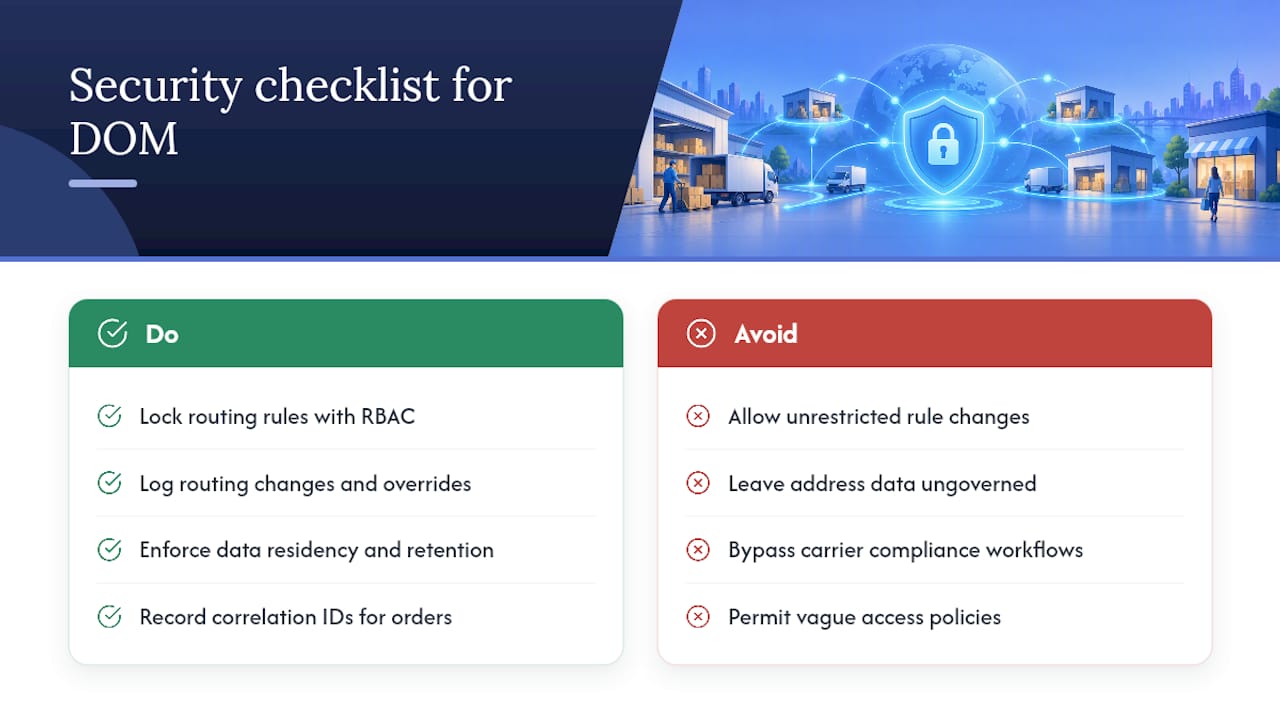
Security and compliance considerations in distributed order management
DOM touches customer addresses, payment status, and inventory data across every system it connects to, which makes it a meaningful part of your security surface, not a peripheral one. Every integration point, storefront, OMS, WMS, ERP, and carrier API, is a place where data can leak or where a bad actor could inject a fraudulent order.
Access control matters at the policy level as much as the data level. Routing rules that determine which node fulfills high-value orders, or that exclude certain regions, should be locked down with role-based permissions and change logs, since a single unauthorized rule change can silently reroute a large share of order volume.
Data residency and retention rules apply here the same way they do to any system holding customer information: know where order and address data is stored, how long it’s retained, and whether any node in your network operates under a different regulatory regime than the rest.
Audit trails are your best defense when something goes wrong. Every routing decision, override, and exception should be logged with a correlation ID so you can reconstruct exactly why an order went where it did, which matters both for internal troubleshooting and for responding to a customer dispute or a compliance inquiry. Transport-side compliance, including carrier eligibility and documentation, follows established transport compliance workflows that DOM routing decisions need to respect rather than override.
Practical traps we’ve seen in DOM projects
Most DOM rollouts stumble on the same handful of things: dirty inventory data that makes routing decisions look wrong when the software is actually right, integration gaps between store systems and the orchestration layer, and store staff who were never trained on the new pick workflow.
Governance deserves more attention than it usually gets. Every routing rule should be explainable to a store manager or customer service rep, not just to the engineer who wrote it. And before committing to a full DOM build, a competent 3PL partnership can absorb multi-node complexity while you validate demand for the investment.
— Akbar
An adjacent path: reducing DOM complexity with a fulfillment partner
Not every team needs to buy and configure a DOM platform to solve a multi-node fulfillment problem. If your bottleneck is execution, getting orders picked, packed, and shipped accurately across locations, rather than routing intelligence itself, a fulfillment partner can absorb that complexity faster than a software rollout can.
Universal Shipping Inc. offers warehousing and fulfillment solutions alongside omnichannel and ecommerce fulfillment support, FBA prep, and last-mile delivery, built around real-time tracking and a single integrated platform rather than a patchwork of point solutions. For teams still deciding whether a full DOM build is worth the timeline, working with a 3PL fulfillment service can deliver multi-node execution now, while the routing software decision gets made properly.
Before choosing a 3PL for this role, check for:
- Clear SLAs on pick accuracy, ship time, and exception handling.
- Integration support for your existing OMS and storefront, not a rip-and-replace requirement.
- Real-time visibility into inventory and order status across every facility.
- A defined onboarding timeline with named milestones, not an open-ended ramp.
If your fulfillment needs include marketplace prep work, our send-to-Amazon workflow guidance covers the dock and pallet details that often trip up FBA-bound shipments. Check current pricing and service tiers to see where a fulfillment partnership fits your budget.
Sources
- Real-time scalable heuristic and DSS framework for store replenishment and allocation — arXiv (2026)
- Order Management Systems | Supply Chain Research — Buyers guide (2026)
FAQ
What are the four types of WMS?
Warehouse management systems are commonly grouped into standalone WMS, supply chain module WMS built into a larger ERP suite, cloud-based WMS, and integrated systems combined with transportation or labor management. Definitions vary by vendor, so check how a specific platform categorizes its own offering before comparing features.
How does an OMS work?
An order management system captures an order at the point of sale, tracks its status through payment, fulfillment, and delivery, and serves as the system of record for customer and order history. In a distributed network, it typically hands sourcing decisions off to a DOM engine rather than calculating optimal routing itself.
Can you give me an example of distribution management?
A retailer with stores and warehouses across a region using ship-from-store to fulfill an online order from the nearest location with available stock is a practical example of distribution management in action. The decision draws on real-time inventory, proximity, and capacity data rather than a fixed shipping rule.
What are the top order management systems?
Rankings shift often and depend on company size, channel mix, and integration needs, so there’s no single definitive list. Gartner’s DOM category page is a reasonable starting point for comparing vendors against your own operating profile rather than relying on a generic top-ten list.