
Freight Teams: Stop Sort Window Bottlenecks in Hub and Spoke Logistics
Hub-and-spoke logistics centralizes sorting and consolidation at strategic hub facilities instead of routing shipments directly between every origin and destination. It cuts the number of lanes a network needs, fills more trailers before they move, and lowers per-unit transport cost as volume grows. The model earns its keep once a network has a moderate to large number of nodes generating steady freight; below that, direct point-to-point routes usually beat the overhead of a hub.
TL;DR:
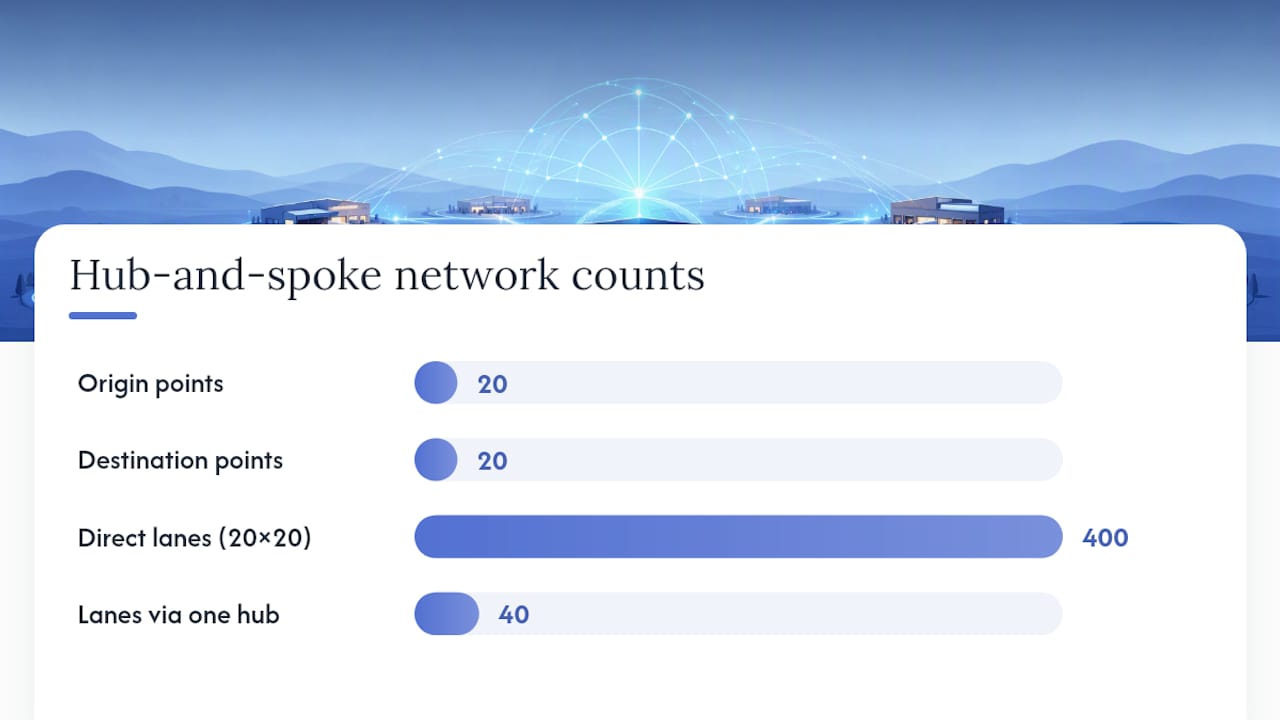
- Hub-and-spoke logistics reduces the number of lane relationships needed, cutting from roughly 400 to 40 in a 20-by-20 network, improving efficiency at scale.
- The model is most effective for networks with 10 to 15 or more nodes that generate steady freight, while smaller or high-volume lanes may perform better with direct point-to-point routes.
- Proper hub siting involves proximity to demand centers, access to intermodal connections, and alignment with natural freight corridors, often spaced about 300 miles apart for truckload networks.
- The success of hub-and-spoke depends heavily on managing the overnight sorting window, with peak inbound volumes guiding staffing and equipment to prevent bottlenecks.
- Using a staged pilot and measuring cost per parcel or ton-mile against a point-to-point baseline helps determine if a hub network’s overhead offsets its consolidation savings.
Table of Contents
- What Is Hub-and-Spoke Logistics, and How Does Freight Actually Move?
- What Does Hub-and-Spoke Actually Save, and What Does It Cost You?
- When Should You Choose Hub-and-Spoke Over Point-to-Point or Mesh?
- How Do You Run the Sorting Window Without It Becoming a Bottleneck?
- What Should a Hub-and-Spoke Rollout Checklist Include?
- How Does Usiship Apply Hub-and-Spoke Principles in Practice?
- When Does Hub-and-Spoke Stop Being the Right Answer?
- Where Usiship Fits Into Your Hub-and-Spoke Strategy
- Sources
- FAQ
What Is Hub-and-Spoke Logistics, and How Does Freight Actually Move?
The mechanics are simpler than the diagrams make them look. Freight gets picked up from shippers, funneled into a central facility, sorted and combined with other loads headed the same direction, then pushed back out toward final destinations. This routing logic, formally called the spoke and hub distribution paradigm, has organized airline networks and parcel carriers for decades because it solves the same math problem regardless of industry: connecting every point directly to every other point scales terribly, while routing through a shared hub does not.
Here’s the flow in the order it actually happens:
- Collection. Drivers pick up freight from shippers, retail locations, or manufacturing sites within a local service area.
- Inbound to hub. Trucks bring that freight into the hub, usually arriving in a concentrated evening window.
- Sort and consolidate. Workers and automated sortation systems break down inbound loads and rebuild outbound loads by destination.
- Outbound transfer. Consolidated freight departs the hub on line-haul trailers headed to other hubs or regional spokes.
- Final distribution. Local drivers deliver freight from the receiving spoke to its final address.
Three distinct roles keep this moving. Line-haul carriers handle the long trailer runs between hubs. Middle-mile operations manage the leg from hub to regional spoke, which is often where the real cost optimization happens because it determines trailer density. Last-mile drivers handle the final, most expensive leg per mile.
The nightly cycle exists for a reason: freight arrives in the evening, gets sorted in a tight overnight window, and departs at dawn so it reaches the next hub or destination before business hours. That overnight sort is the busiest, least forgiving part of the whole system.
What Does Hub-and-Spoke Actually Save, and What Does It Cost You?
The economics are straightforward once a network hits scale. Routing freight through a shared hub needs far fewer lanes than direct point-to-point connections, and fewer lanes means fewer half-empty trailers. A carrier managing 20 origin points and 20 destinations directly would need to maintain roughly 400 lane relationships; through one hub, that drops to 40.
What you gain:
- Fewer lanes to plan, price, and staff
- Higher trailer fill rates, since freight consolidates before the long haul
- Lower administrative overhead from fewer direct carrier relationships
- Easier volume forecasting at the hub level than across dozens of scattered routes
What it costs you:
- Some shipments travel extra miles to reach a hub before heading toward their actual destination
- A hub outage, whether from weather, equipment failure, or a labor shortage, can stall an entire region’s freight at once
- Point-to-point transit times can beat hub-routed transit for high-volume lanes that justify a dedicated truck
Large parcel networks illustrate the scale where this math pays off best. National operators run sorting hubs that process millions of parcels overnight, and that volume is exactly what makes the extra handling step worth it. Below that scale, the calculation changes.
Pro Tip: Run the math on your five busiest lanes before committing to a hub model. If those lanes alone could fill dedicated trailers without a hub, keep them direct and hub-route everything else.
Facility costs matter too. A hub adds a real estate and staffing line that point-to-point routing avoids, and the extra transportation miles some shipments travel carry a fuel and emissions cost worth weighing against the fewer, fuller trucks the model produces overall.
When Should You Choose Hub-and-Spoke Over Point-to-Point or Mesh?
Node count is the first filter. Networks with a handful of high-volume, stable lanes often do better with direct point-to-point service or a mesh structure, since very small, latency-sensitive networks tend to favor mesh while larger, higher-churn networks favor a hub structure. Once a network crosses somewhere around 10 to 15 active nodes with irregular, fragmented demand, the lane math tips firmly in the hub’s favor.
Where you put the hub matters as much as whether you build one. Solid siting criteria include:
- Proximity to your largest demand clusters, not just geographic center
- Access to intermodal connections (rail ramps, ports, major interstate corridors)
- Alignment with existing freight corridors rather than fighting against natural traffic flow
- Drive-time bands that keep spoke deliveries within a reasonable same-day radius
For truckload networks specifically, a workable starting distance guideline is spacing hubs roughly 300 miles apart, close enough to support trailer exchanges and driver schedules that keep drivers home more often.
Multi-hub planning becomes necessary once a single hub’s drive-time radius no longer covers your service area without blowing past delivery commitments. Adding a second or third regional hub changes your routing logic entirely, since spokes now need rules for which hub they feed, and it builds in redundancy if one facility goes down.

Pro Tip: Before adding a second hub, model what happens if your primary hub is unavailable for 24 hours. If you have no fallback capacity, that single point of failure is a bigger risk than the extra miles a second hub might save you.
Resilience planning should include backup hub capacity, staffing buffers for peak season, and service-level agreements that account honestly for the delay a hub disruption would cause, rather than assuming everything runs at full capacity all the time.
How Do You Run the Sorting Window Without It Becoming a Bottleneck?
The sorting window is where hub-and-spoke networks succeed or fail. Mis-sizing that window relative to inbound volume is the single most common reason a hub rollout underperforms, because everything downstream, dispatch times, driver schedules, next-day delivery promises, depends on freight clearing the sort floor on time.
Sizing the window starts with knowing your peak inbound volume, not your average. Your staffing and sortation equipment need to handle that peak, not a flattened daily average that looks fine on paper and fails every night in practice.
A few operational rules keep dock throughput moving:
- Set fixed inbound and outbound dock windows, and hold carriers to appointment times rather than first-come, first-served arrivals.
- Stagger shift start times so peak sortation hours have full staffing without paying overtime through slower stretches.
- Rotate trailers through middle-mile lanes based on route density, filling the fullest, most efficient combinations first.
- Track load-building in real time so outbound trailers depart at planned capacity rather than partially full on a fixed schedule.
Technology closes the gap between plan and execution. A warehouse management system paired with a transportation management system gives dispatchers visibility into what’s arriving, what’s sorted, and what’s ready to load, while a control tower layer adds real-time tracking across the whole network rather than facility by facility. Usiship’s control tower logistics approach reflects this same principle: centralized visibility catches a slipping sort window before it turns into a missed dispatch.
What Should a Hub-and-Spoke Rollout Checklist Include?
Before freight touches a new hub, a handful of pre-launch checks separate a smooth rollout from a chaotic one:
- Confirm sortation and dock capacity against realistic peak volume, not projected averages.
- Walk the cross-dock layout physically to catch bottlenecks a floor plan won’t reveal.
- Lock carrier commitments and appointment windows in writing before go-live.
- Test EDI and system integrations between your WMS, TMS, and carrier partners end to end.
- Vet line-haul carrier partners through FMCSA SAFER carrier snapshots to confirm safety records and operating authority before granting access to your network.
A staged, region-by-region pilot beats a full national launch. Test one hub with a handful of spokes under real inbound conditions, set acceptance criteria in advance, and define rollback triggers if throughput or on-time dispatch falls short before you scale further.
Compare cost per parcel or cost per ton-mile against your point-to-point baseline throughout the pilot. That single comparison tells you faster than any other metric whether the hub is actually earning its overhead.
| KPI | What It Tells You |
|---|---|
| Sort throughput (units/hour) | Whether staffing and equipment match peak inbound volume |
| Dock-to-departure cycle time | How long freight sits before an outbound trailer leaves |
| Dwell time | Idle time that signals a scheduling or capacity mismatch |
| Trailer utilization | How full outbound trailers run relative to capacity |
| On-time dispatch rate | Whether the sort window is producing reliable departures |
How Does Usiship Apply Hub-and-Spoke Principles in Practice?
Usiship structures several of its services around the same consolidation logic that makes hub-and-spoke work at scale. Receiving hubs accept inbound freight, whether from overseas suppliers or domestic manufacturers, and consolidate it before redistributing to fulfillment centers or final destinations. Cross-docking moves freight through with minimal storage time, which mirrors the overnight sort cycle that defines hub operations generally.
A common use case looks like this: import freight lands at a receiving hub, gets consolidated with other inbound shipments, then redistributes to regional omnichannel fulfillment centers that act as spokes. Amazon FBA prep flows through a similar pattern, with inbound goods sorted, prepped, and routed to meet marketplace delivery requirements. Control tower visibility ties these steps together so a shipper can see where freight sits in that flow at any point, rather than waiting on a status update from a single facility.
When Does Hub-and-Spoke Stop Being the Right Answer?
Hub-and-spoke will keep dominating high-volume, fragmented networks because the lane math doesn’t change. What does change is when a network’s node count or geography stops matching the model, and that’s when teams should evaluate a hybrid pattern instead of forcing everything through a single hub structure. Revisit topology every time volume shifts meaningfully. Measure cost per parcel against baseline, not what the org chart assumed three years ago.
— Akbar
Where Usiship Fits Into Your Hub-and-Spoke Strategy
Usiship is the practical alternative to piecing together your own hub network from scratch, freight forwarding, warehousing, cross-docking, and last-mile delivery run as one connected system instead of separate vendor contracts you have to coordinate yourself.
If you’re weighing whether a receiving hub and regional fulfillment spokes make sense for your volume, that’s exactly the kind of assessment Usiship’s team runs before recommending a pilot. Services like freight consolidation and omnichannel fulfillment map directly onto the hub-and-spoke roles covered above: receiving hubs for consolidation, control tower visibility for tracking every leg, and fulfillment spokes for final distribution. Bonded warehousing and customs clearance round out the picture for anyone importing goods into a receiving hub before redistribution.
Start with an honest assessment of your current node count and lane volume, then pilot one region before scaling. Reach out to Usiship to walk through what a hub-fed network would look like for your specific freight profile.
Sources
For deeper background on the model’s origins and terminology, the spoke and hub distribution paradigm entry covers its airline and parcel-industry roots. For hub spacing and driver-scheduling specifics, see Penske’s logistics glossary. For broader transport planning context, this partner analysis on efficient transport planning is worth a read.
- Spoke–hub distribution paradigm – Wikipedia
- Hub-and-Spoke Distribution: How Freight Networks Move | Peak Transport Blog
- What is Hub and Spoke? Distribution Model? Full Guide (+ Tips) – ShipBob
- What is Hub and Spoke? Logistics Glossary – Penske
FAQ
What Is Hub-and-Spoke Logistics in Simple Terms?
It’s a distribution model where freight routes through a central hub for sorting and consolidation before continuing to its final destination, rather than moving directly between every origin and destination pair.
How Is Hub-and-Spoke Different From Point-to-Point Shipping?
Point-to-point sends freight directly from origin to destination on dedicated lanes, while hub-and-spoke consolidates freight at a central point first, trading some extra mileage for far fewer total lanes to manage.
How Many Nodes Justify a Hub-and-Spoke Network?
Networks with roughly 10 to 15 or more active nodes generating steady freight volume typically see enough consolidation savings to justify a hub, while smaller networks often do better with direct routing.
How Far Apart Should Hubs Be Placed?
For truckload operations, a common starting guideline spaces hubs roughly 300 miles apart, close enough to support trailer exchanges and manageable driver schedules.
Does Usiship Offer Hub-and-Spoke Logistics Services?
Usiship provides services such as receiving hubs, cross-docking, control tower visibility, and omnichannel fulfillment that support hub-and-spoke style consolidation and redistribution.