
Amazon FBA Packaging Rules Every Seller Must Know in 2026
f you’re using Fulfilment by Amazon to run your eCommerce business, your packaging decisions are either quietly protecting your margins or slowly draining them. Amazon’s inbound compliance standards have tightened significantly in 2026, and the consequences of getting things wrong are no longer minor inconveniences. Shipments get refused. Fees get charged automatically. And in repeat cases, your account health takes a real hit. Understanding what Amazon actually requires, unit by unit, box by box, is the first step toward a smoother, more profitable operation.
For amazon sellers, staying ahead of these rules is a competitive advantage, not just a checklist exercise.
The 2026 Amazon FBA Policy Shift That Changes Everything
Starting January 1, 2026, Amazon eliminated its prep and item labelling services for U.S. FBA shipments entirely. This means Amazon will no longer fix your barcodes, poly bag your products, or bubble wrap your fragile items on your behalf. Inbound defect fees have risen by up to 80x, and a 500 unit shipment with barcode errors can now cost $870 in defect fees alone. Every unit must arrive at the fulfilment centre fully prepped and fully labelled, with no exceptions and no safety net.
Unit Level Packaging, Getting the Basics Right
Before anything else, each individual sellable unit needs to be packaged to survive standard warehouse handling. Amazon’s receiving teams process millions of units. Fragile, improperly packaged, or loosely assembled products do not get special treatment. They get rejected or disposed of.
Sets and Multi Piece Products
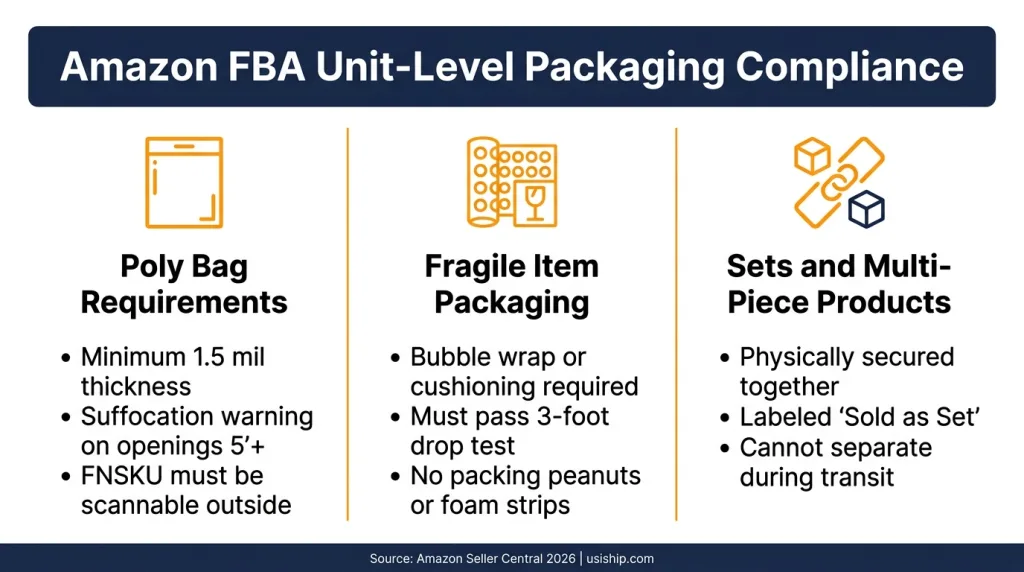
Items sold as a set must be physically secured together and clearly marked “Sold as Set” or “Do Not Separate.” If the components can come apart during transit, the shipment fails at receiving.
Fragile Items
Products that can break under pressure, such as glassware, ceramics, and electronics, must be wrapped in bubble wrap or cushioning material that passes a standard 3 foot drop test. Packing peanuts, foam strips, and shredded paper are not approved materials.
Poly Bag Rules
Any product susceptible to dust, moisture, or handling damage must be poly bagged. The requirements are specific:
- Bags must be a minimum of 1.5 mil thick
- Any bag with an opening of 5 inches or larger requires a suffocation warning, printed on the bag or applied as a sticker
- The FNSKU barcode must be scannable through the bag or placed on the outside
Barcoding, FNSKU Labels, and Where Most Sellers Go Wrong
Labelling errors are one of the most common causes of FBA inbound issues. Every unit must have a correctly scannable barcode label to avoid delays and processing issues. Amazon Seller Central – FBA Product Labeling Requirements
FNSKU vs. Manufacturer Barcode
You have two labelling options when enrolling products in FBA. Using the manufacturer barcode allows commingling with other sellers’ identical inventory, which creates risk if another seller’s batch has quality issues. Using Amazon’s FNSKU label ties inventory specifically to your seller account and keeps it fully separated. For most sellers, FNSKU is the safer path.
Placement Rules That Matter
Labels must sit on a flat surface, not over a seam, curve, or box edge. Any previous barcodes on repackaged or returned items must be completely covered with opaque labels. A barcode placed on a curved surface or partially obscured by tape will fail the scan and hold up your entire shipment.
If you work with a provider that offers fba prep services for shopify sellers, these placement details are handled systematically rather than relying on individual prep staff to remember every rule for every SKU.
Expiration Dates and Consumable Products
For consumables, health products, or anything perishable, expiration date labelling has its own specific requirements.
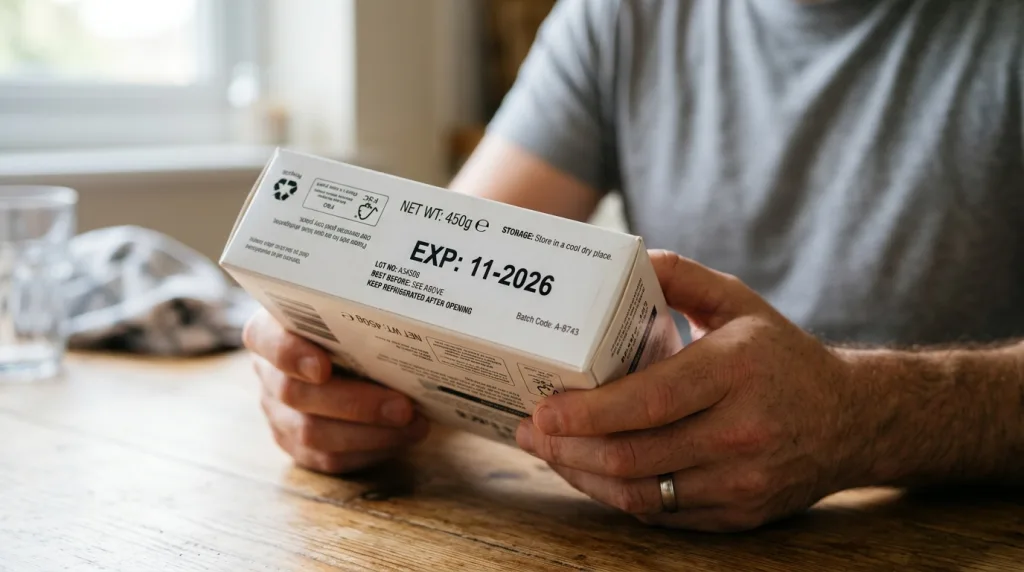
- Format must be MM-YYYY or MM-DD-YYYY
- The date must be visible on the outside of the unit without opening it
- Products must meet Amazon’s minimum remaining shelf life, typically 90 to 150 days from the date of receipt depending on the category
Sellers managing multiple SKUs with varying shelf lives benefit significantly from structured warehouse shipping services, making it easier to track expiry dates across the catalog.
Products that arrive with expired dates, illegible dates, or dates in non-compliant formats are rejected at the receiving dock.
What Happens When a Shipment Is Non-Compliant
Amazon’s response to non-compliant inventory is fast and unforgiving. Depending on the severity:
- The shipment may be refused entirely at the fulfilment centre
- Automatic unplanned prep or relabelling fees are charged per unit
- Repeated violations restrict your ability to send inventory to certain FC locations
- Ongoing non-compliance affects your overall seller health score and account standing
Fines for packaging violations can range from $2 to $25 per unit, and that is before accounting for the cost of reshipping or the opportunity cost of inventory sitting in limbo during peak selling periods.

The Practical Case for Outsourcing Your Prep
Keeping pace with every spec update, category rule, and labelling requirement across a growing product catalogue is genuinely difficult. It demands either a dedicated in house prep team with documented SOPs, or a reliable external partner who works within these requirements daily.
Universal Shipping Inc. handles FBA prep, inbound labelling, and shipment compliance for sellers across the US, built around Amazon’s exact 2026 standards. And for sellers who need their products to move efficiently after reaching customers, their last mile shipping services are designed to keep the entire fulfilment chain running smoothly.
Scaling Beyond Prep With 3PL Fulfilment
As order volumes grow, many sellers move beyond basic prep support and adopt a more complete logistics setup. A dedicated 3rd party fulfilment centre allows storage, picking, packing, and distribution to be managed in one system, reducing pressure on in-house teams and improving consistency across higher order volumes.
Conclusion
Amazon’s FBA packaging rules are not arbitrary bureaucracy. They exist because fulfilment centres operate at a scale where one non compliant unit creates downstream problems across an automated system built for precision. The 2026 changes, particularly the end of Amazon’s own prep services, have shifted full compliance responsibility onto sellers permanently. Treat inbound packaging standards as a core operational discipline, review your Seller Central guidelines regularly as Amazon updates them throughout the year, and build a supply chain that puts compliance at the front of the process rather than the end.